Marketing & Acquisition

Experian shares five trends and twists coming over the next 12 months, that could push new boundaries and in many cases improve the customer experience as it pertains to the world of credit and finance.

Will 2017 finally be the year that lenders embrace digital credit marketing? Here are three reasons they should, if they haven't taken the plunge.
During Thanksgiving 2015, 736 million pounds of turkey were consumed in the United States.
personalized subject lines have a 27% higher unique click rate, an 11% higher CTO and more than double the transaction of other promotional mailings

Reduce your TCPA compliance risk; Follow these steps when creating your dialing strategy

Businesses believe that 23% of their customer or prospect data is inaccurate.

Will they still aspire to achieve the “American Dream” of education, homeownership and raising a family? Are Millennials ready for a mortgage?

For lenders to capitalize and identify the right consumers for their respective portfolios, they need insights. Trade level fields can bridge the gap.

Bank executives don’t realize is they’re facing fraud because they’re literally inviting the fraudsters in bank branches.

Time heals countless things, including credit scores. Many of the seven million people who saw their VantageScore® credit scores drop to sub-prime levels after suffering a foreclosure or short sale during the Great Recession have recovered and are back in the housing market. These Boomerang Buyers — people who foreclosed or short sold between 2007 and 2014 and have opened a new mortgage — will be an important segment of the real estate market in the coming years. According to Experian data, through June 2016 roughly 800,000 people had boomeranged, with Los Angeles, Phoenix, and Sacramento housing the most buyers. Some analysts believe more than three million Americans will become eligible for a home over the next three years. Are potential Boomerang Buyers a great opportunity to boost market share or a high risk for a portfolio? Early trends are positive. The majority of Boomerang Buyers who opened mortgages between 2011 and June 2016 are current on their debts. An Experian study revealed more than 29 percent of those who short sold have boomeranged, and just 1.5 percent are delinquent on their mortgage —falling below the national average of 2.8 percent. This group is also ahead of or even with the national average for delinquency on auto loans (1.2 percent vs. the national average of 2.2 percent), bankcards (3 percent vs. 4.3 percent) and retail (even at 2.7 percent). For those Boomerang Buyers who had foreclosed, the numbers are also strong. More than 12 percent have boomeranged, with just 3 percent delinquent on their mortgage. They also match or are below national average delinquency rates on auto loans (1.9 percent) and bankcards (4.1 percent), and have a slightly higher delinquency rate for retail (3.5 percent). Due to their positive credit behaviors, Boomerang Buyers also have higher VantageScore® credit scores than before. On average, the overall non-boomerang group’s credit score sunk during a foreclosure but went up 10 percent higher than before the foreclosure, and Boomerang Buyers rose by nearly 14 percent. For people who previously had a prime credit score, their number dropped by nearly 5 percent, while those who boomeranged returned to the score they had prior to the foreclosure. By comparison, the overall non-boomerang and boomerang group saw their credit score drop during a short sale and increase more than 11 percent from before the short sale. For people who previously had prime credit, they dropped 2 percent while those who boomeranged were almost flat to where they were before the short sale. Another part of the equation is the stabilized housing market and relatively low loan-to-value (LTV) limits that lenders have maintained. In the past, borrowers most often strategically defaulted on their mortgages when their LTV ratios were well over 100 percent. So as long as lenders maintain relatively low LTV limits and the housing market remains strong, strategic default is unlikely to re-emerge as a risk.
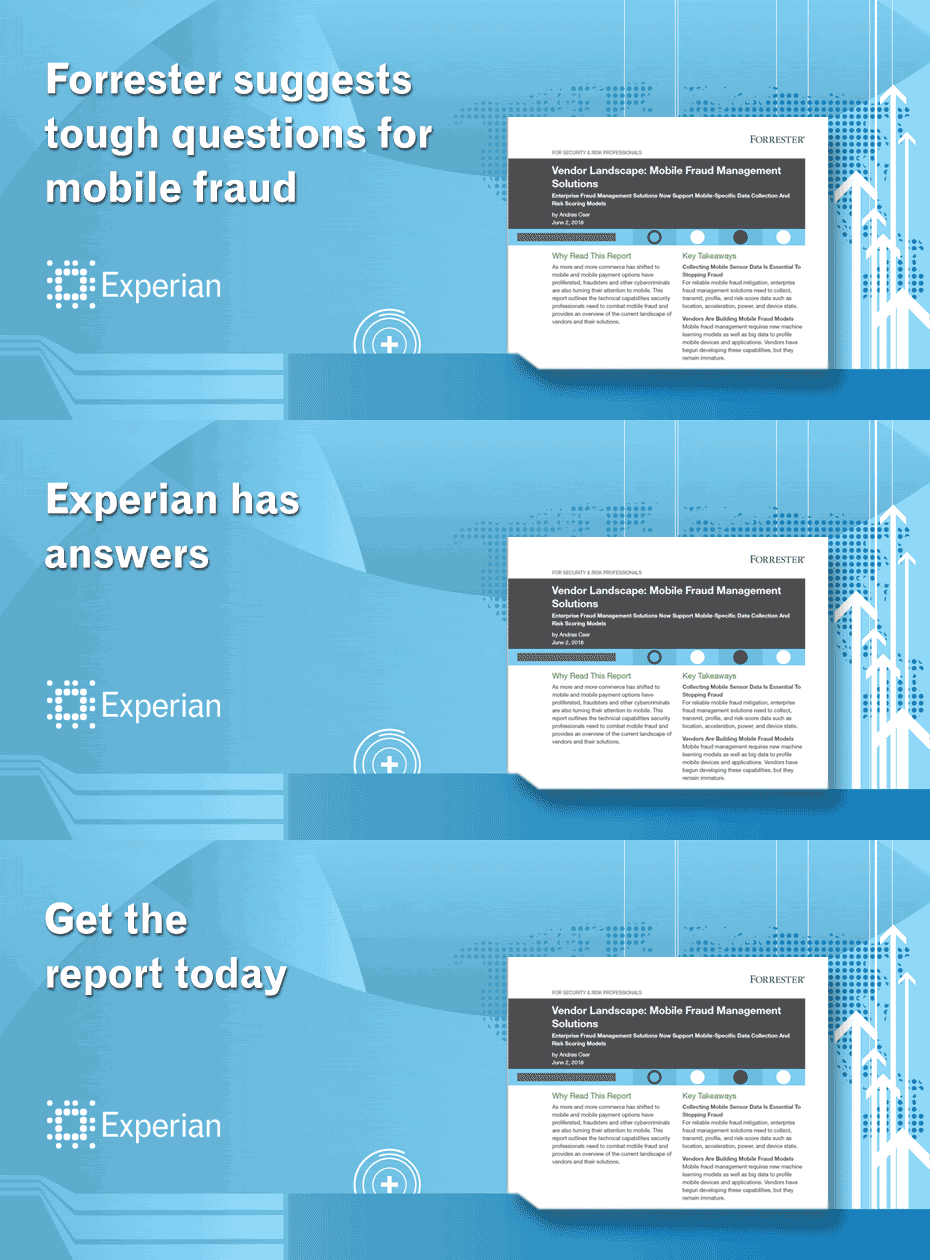
Many fraud and compliance teams are struggling to keep pace with new business dynamics.

Financial health open doors for people, creating opportunities for credit, cars, homes and stability. So how can you get "healthy?"

Conditions for small-business credit remained relatively unchanged in Q1 2016

False declines are often unwarranted and occur due to lack of customer information Have you ever been shopping online, excited to get your hands on the latest tech gadget, only to be hit with the all-too-common disappointment of a credit card decline? Whom did you blame? The merchant? The issuer? The card associations? The answer is probably all of the above. False declines like the situation described above provoke an onslaught of consumer emotions ranging from shock and dismay to frustration and anger. Of course, consumers aren’t the only ones negatively impacted by false declines. Many times card issuers lose their coveted “top of wallet” position and/or retailers lose revenue when customers abandon the purchase altogether. False declines are unpleasant for everyone, yet consumers struggle with this problem every day — and fraud controls are only getting tighter. How does the industry mutually resolve this growing issue? The first step is to understand why it occurs. Most false declines happen when the merchant or issuer mistakenly declines a legitimate transaction due to perceived high risk. This misperception is usually the result of the merchant or issuer not having enough information to verify the authenticity of the cardholder confidently. For example, the consumer may be a first-time customer or the purchase may be a departure from the card holder’s normal pattern of transaction activity. Research shows that lack of a holistic view and no cross-industry transaction visibility result in approximately $40 billion of e-commerce declines annually. Think about this for a minute — $40 billion in preventable lost revenue due to lack of information. Merchants’ customer information is often limited to their first-hand information and experience with consumers. To solve this growing problem, Experian® developed TrustInsight™, a real-time engine to establish trusted online relationships over time among consumers, merchants and issuers. It works by anonymously leveraging transactional information that merchants and financial institutions already have about consumers to create a crowd-sourced TrustScore™. This score allows first-time online customers to get a VIP experience rather than a brand-damaging decline. Another common challenge for merchants is measuring the scope of the false declines problem. Proactively contacting consumers, directly capturing feedback and quickly verifying transaction details to recoup potential lost sales are best practices, but merchants are often in the dark as to how many good customers are being turned away. The solution — often involving substantial operational expense — is to hold higher-risk orders for manual review rather than outright declining them. With average industry review rates nearing 30 percent of all online orders (according to the latest CyberSource Annual Fraud Benchmark Report: A Balancing Act), this growing level of review is not sustainable. This is where industry collaboration via TrustInsight™ offers such compelling value. TrustInsight can reduce the review population significantly by leveraging consumers’ transactions across the network to establish trust between individuals and their devices to automate more approvals. Thankfully, the industry is taking note. There is a groundswell of focus on the issue of false declines and their impact on good customers. Traditional, operations-heavy approaches are no longer sufficient. A trust-based industry-consortium approach is essential to enhance visibility, recognize consumers and their devices holistically, and ensure that consumers are impacted only when a real threat is present.

It’s impossible to capture all of the insights and learnings of 36 breakout sessions and several keynote addresses in one post, but let’s summarize a few of the highlights from the first day of Vision 2016. 1. Who better to speak about the state of our country, specifically some of the threats we are facing than Leon Panetta, former Secretary of Defense and Director of the CIA. While we are at a critical crossroads in the United States, there is room for optimism and his hope that we can be an America in Renaissance. 2. Alex Lintner, Experian President of Consumer Information Services, conveyed how the consumer world has evolved, in large part due to technology: 67 percent of consumers made purchases across multiple channels in the last six months. More than 88M U.S. consumers use their smartphone to do some form of banking. 68 percent of Millennials believe within five years the way we access money will be totally different. 3. Peter Renton of Lend Academy spoke on the future of Online Marketplace Lending, revealing: Banks are recognizing that this industry provides them with a great opportunity and many are partnering with Online Marketplace Lenders to enter the space. Millennials are not the largest consumers in this space today, but they will be in the future. Sustained growth will be key for this industry. The largest platforms have everything they need in place to endure – even through an economic downturn.In other words, Online Marketplace Lenders are here to stay. 4. Tom King, Experian’s Chief Information Security Officer, addressed the crowds on how the world of information security is growing increasingly complex. There are 1.9 million records compromised every day, and sadly that number is expected to rise. What can businesses do? “We need to make it easier to make the bad guys go somewhere else,” says King. 5. Look at how the housing market has changed from just a few years ago: Inventory continues to be extraordinarily lean. Why? New home building continues to run at recession levels. And, 8.5 percent of homeowners are still underwater on their mortgage, preventing them from placing it on the market. In the world of single-family home originations, 2016 projections show that there will be more purchases, less refinancing and less volume. We may see further growth in HELOC’s. With a dwindling number of mortgages benefiting from refinancing, and with rising interest rates, a HELOC may potentially be the cheapest and easiest way to tap equity. 6. As organizations balance business needs with increasing fraud threats, the important thing to remember is that the customer experience will trump everything else. Top fraud threats in 2015 included: Card Not Present (CNP) First Party Fraud/Synthetic ID Application Fraud Mobile Payment/Deposit Fraud Cross-Channel FraudSo what do the experts believe is essential to fraud prevention in the future? Big Data with smart analytics. 7. The need for Identity Relationship Management can be seen by the dichotomy of “99 percent of companies think having a clear picture of their customers is important for their business; yet only 24 percent actually think they achieve this ideal.” Connecting identities throughout the customer lifecycle is critical to bridging this gap. 8. New technologies continue to bring new challenges to fraud prevention. We’ve seen that post-EMV fraud is moving “upstream” as fraudsters: Apply for new credit cards using stolen ID’s. Provision stolen cards into mobile wallet. Gain access to accounts to make purchases.Then, fraudsters are open to use these new cards everywhere. 9. Several speakers addressed the ever-changing regulatory environment. The Telephone Consumer Protection Act (TCPA) litigation is up 30 percent since the last year. Regulators are increasingly taking notice of Online Marketplace Lenders. It’s critical to consider regulatory requirements when building risk models and implementing business policies. 10. Hispanics and Millennials are a force to be reckoned with, so pay attention: Millennials will be 81 million strong by 2036, and Hispanics are projected to be 133 million strong by 2050. Significant factors for home purchase likelihood for both groups include VantageScore® credit score, age, student debt, credit card debt, auto loans, income, marital status and housing prices. More great insights from Vision coming your way tomorrow!