Tag: loans

Quick Summary: Leasing continues to increase in the electric vehicle (EV) market. EVs accounted for nearly 20% of all new vehicle leases in Q4 2024, up from only 2.11% of new vehicle leases four years ago in Q4 2020. With consumers looking for flexibility—both in monthly payment and model availability—we’re seeing leasing continue to surge in the electric vehicle (EV) market. According to Experian’s State of the Automotive Finance Market Report: Q4 2024, EVs accounted for 19.5% of all new vehicle leases this quarter, up from 11.7% last year and a substantial increase from 2.1% in Q4 2020. Diving a bit deeper, data found EVs accounted for 9.3% of all new purchases in Q4 2024. Of those EVs, 50.1% were leased, while 38.9% were financed through loans. With lease payments for EVs ultimately being more affordable compared to loans and the excitement of driving the latest models packed with advanced technology, it’s no surprise we’re seeing leasing grow in popularity. Top leased EVs: How do lease and loan payments compare? As more consumers transition to EVs and manufacturers introduce new options to their lineup, certain models have become top choices for those opting to lease. Tesla accounted for the top two leased EVs in Q4 2024, with Tesla Model 3 coming in at 12.2% and Tesla Model Y at 9.1%. However, the Honda Prologue followed closely at 8.8% this quarter. Rounding out the top five were Hyundai IONIQ 5 (6.9%) and Chevrolet Equinox EV (5.9%). It’s notable that leasing has traditionally been a value-driven option for consumers, and the same holds true in the EV market. Leasing continues to offer lower monthly payments, making the finance option stand out for those looking to test an EV before purchasing or simply wanting the latest model on the lot. In Q4 2024, the average payment difference between a loan and a lease was $175. Though, the average monthly payment to lease a non-luxury EV was $504 this quarter, noting a $205 difference compared to the $709 loan payment. By comparison, the average monthly payment between a loan and leased luxury EV was $98—coming in at $842 for a lease and $940 for a loan. As more consumers choose to lease EVs, automotive professionals in both new and used markets have a chance to capitalize on this trend. By leveraging this data, those in the new retail market can effectively reach the right audience, while those in the used market can stay ahead of the curve and prepare for the influx of off-lease models in the coming years. To learn more about automotive finance trends, view the full State of the Automotive Finance Market: Q4 2024 presentation on demand.

Learn how Washington State Employees Credit Union increased their revenue and member satisfaction by implementing a digital prequalification process.

Reporting positive rental payments provides residents with a powerful incentive to pay their rent on time and in full. Read more!

Here's a brief FCRA-related compliance overview to refresh your memory on various FCRA requirements when requesting and using consumer credit reports.

Historically, economic hardships have directly impacted loan performance. Are you prepared to navigate and successfully respond to the current environment?

We are excited to announce that Experian has been selected as a Fintech Breakthrough Awards winner in the Consumer Lending Innovation category.
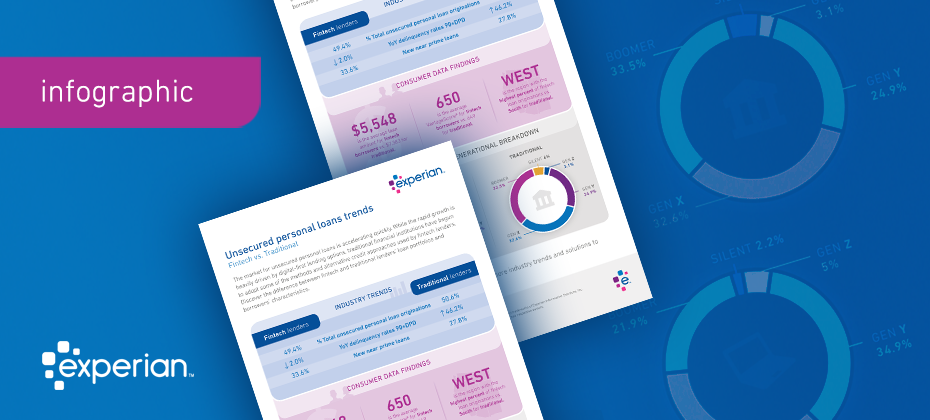
How are fintechs faring against traditional FIs? Our latest infographic uncovers industry trends and key metrics in unsecured personal installment loans.

What is CECL? CECL (Current Expected Credit Loss) is a new credit loss model, to be leveraged by financial institutions, that estimates the expected loss over the life of a loan by using historical information, current conditions and reasonable forecasts. According to AccountingToday, CECL is considered one of the most significant accounting changes in decades to affect entities that borrow and lend money. To comply with CECL by the assigned deadline, financial institutions will need to access much more data than they’re currently using to calculate their reserves under the incurred loss model, Allowance for Loan and Lease Losses (ALLL). How does it impact your business? CECL introduces uncertainty into accounting and growth calculations, as it represents a significant change in the way credit losses are currently estimated. The new standard allows financial institutions to calculate allowances in a variety of ways, including discounted cash flow, loss rates, roll-rates and probability of default analyses. “Large banks with historically good loss performance are projecting increased reserve requirements in the billions of dollars,” says Experian Advisory Services Senior Business Consultant, Gavin Harding. Here are a few changes that you should expect: Larger allowances will be required for most products As allowances will increase, pricing of the products will change to reflect higher capital cost Losses modeling will change, impacting both data collection and modeling methodology There will be a lower return on equity, especially in products with a longer life expectancy How can you prepare? “CECL compliance is a journey, rather than a destination,” says Gavin. “The key is to develop a thoughtful, data-driven approach that is tested and refined over time.” Financial institutions who start preparing for CECL now will ultimately set their organizations up for success. Here are a few ways to begin to assess your readiness: Create a roadmap and initiative prioritization plan Calculate the impact of CECL on your bottom line Run altered scenarios based on new lending policy and credit decision rules Understand the impact CECL will have on your profitability Evaluate current portfolios based on CECL methodology Run different loss methods and compare results Additionally, there is required data to capture, including quarterly or monthly loan-level account performance metrics, multiple year data based on loan product type and historical data for the life of the loan. How much time do you have? Like most accounting standards, CECL has different effective dates based on the type of reporting entity. Public business entities that file financial statements with the Security and Exchange Commission will have to comply by 2020, non-public entity banks must comply by 2022 and non-SEC registered companies have until 2023 to adopt the new standard. How can we help: Complying with CECL may require you to gather, store and calculate more data than before. Experian can help you comply with CECL guidelines including data needs, consulting and loan loss calculation. Experian industry experts will help update your current strategies and establish an appropriate timeline to meet compliance dates. Leveraging our best-in-class industry data, we will help you gain CECL compliance quickly and effectively, understand the impacts to your business and use these findings to improve overall profitability. Learn more

Not only are personal loans are increasing, but so is the share of those loans originated by FinTechs is also growing quickly across all generations.

A recent survey focusing on the credit behavior of Millennials (age group 18 to 30) shows that 90 percent are familiar with cosigning and two-thirds have used a cosigner in the past.
Findings from the most recent Experian State of the Automotive Finance Market report show outstanding automotive loan balances increased 11 percent from Q4 2012, reaching $798.5 billion in Q4 2013 — the highest level since 2007.
VantageScore Solutions’ analysts recently examined how many accounts consumers with prime credit scores typically have in their credit file. Consumers who generally qualify for loans have an average of 13 loans in their credit files, and typically the oldest loan is more than 15 years old.