Latest Posts

For companies that regularly engage in financial transactions, having a customer identification program (CIP) is mandatory to comply with the regulations around identity verification requirements across the customer lifecycle. In this blog post, we will delve into the essentials of a customer identification program, what it entails, and why it is important for businesses to implement one. What is a customer identification program? A CIP is a set of procedures implemented by financial institutions to verify the identity of their customers. The purpose of a CIP is to be a part of a financial institution’s fraud management solutions, with similar goals as to detect and prevent fraud like money laundering, identity theft, and other fraudulent activities. The program enables financial institutions to assess the risk level associated with a particular customer and determine whether their business dealings are legitimate. An effective CIP program should check the following boxes: Confidently verify customer identities Seamless authentication Understand and anticipate customer activities Where does Know Your Customer (KYC) fit in? KYC policies must include a robust CIP across the customer lifecycle from initial onboarding through portfolio management. KYC solutions encompass the financial institution’s customer identification program, customer due diligence and ongoing monitoring. What are the requirements for a CIP? Customer identification program requirements vary depending on the type of financial institution, the type of account opened, and other factors. However, the essential components of a CIP include verifying the customer's identity using government-issued identification, obtaining and verifying the customer's address, and checking the customer against a list of known criminals, terrorists, or suspicious individuals. These measures help detect and prevent financial crimes. Why is a CIP important for businesses? CIP helps businesses mitigate risk by ensuring they have accurate and up-to-date information about their customers. This also helps financial institutions comply with laws and regulations that require them to monitor financial transactions for any suspicious activities. By having a robust CIP in place, businesses can establish trust and rapport with their customers. According to Experian’s 2024 U.S. Identity and Fraud Report, 63% of consumers say it's extremely or very important for businesses to recognize them online. Having an effective CIP in place is part of financial institutions showing their consumers that they have their best interests top of mind. Finding the right partner It’s important to find a partner you trust when working to establish processes and procedures for verifying customer identity, address, and other relevant information. Companies can also utilize specialized software that can help streamline the CIP process and ensure that it is being carried out accurately and consistently. Experian’s proprietary and partner data sources and flexible monitoring and segmentation tools allow you to resolve CIP discrepancies and fraud risk in a single step, all while keeping pace with emerging fraud threats with effective customer identification software. Putting consumers first is paramount. The security of their identity is priority one, but financial institutions must pay equal attention to their consumers’ preferences and experiences. It is not just enough to verify customer identities. Leading financial institutions will automate customer identification to reduce manual intervention and verify with a reasonable belief that the identity is valid and eligible to use the services you provide. Seamless experiences with the right amount of friction (I.e., multi-factor authentication) should also be pursued to preserve the quality of the customer experience. Putting it all together As cybersecurity threats are becoming more sophisticated, it is essential for financial institutions to protect their customerinformation and level up their fraud prevention solutions. Implementing a customer identification program is an essential component in achieving that objective. A robust CIP helps organizations detect, prevent, and deter fraudulent activities while ensuring compliance with regulatory requirements. While implementing a CIP can be complex, having a solid plan and establishing clear guidelines is the best way for companies to safeguard customer information and maintain their reputation. CIPs are an integral part of financial institutions security infrastructures and must be a business priority. By ensuring that they have accurate and up-to-date data on their customers, they can mitigate risk, establish trust, and comply with regulatory requirements. A sound CIP program can help financial institutions detect and prevent financial crimes and cyber threats while ensuring that legitimate business transactions are not disrupted, therefore safeguarding their customers' information and protecting their own reputation. Learn more

Fraud analytics can help your business keep up with sophisticated fraud attempts and provide expert security.

Using financial management services to drive user engagement can be an effective strategy to win the race for consumer attention.
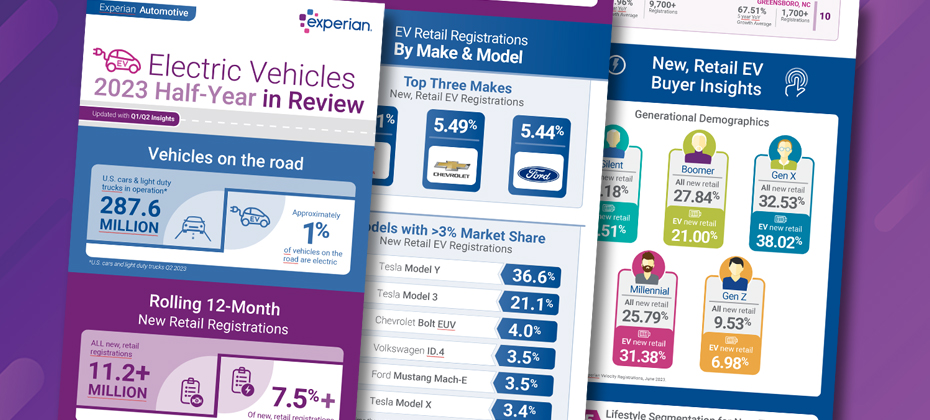
Experian Automotive has updated our Electric Vehicles 2022 Year-in-Review Infographic Report with new 2023 Half-Year insights. In the previous report, we shared that over 6% of new, retail registrations were for electric vehicles. As we evaluated the current state of the Electric Vehicle Market for the first half of 2023 (January-June registrations), the percentage of new, retail registrations for electric vehicles has increased to over 7.5%. There are several factors driving consumer adoption of electric vehicles in the United States, including: Environmental concerns: Consumers are increasingly concerned about the environmental impact of transportation, and EVs produce zero emissions at the tailpipe. Government incentives: Many state and federal governments offer incentives for the purchase of electric vehicles, such as tax credits and rebates. Falling battery costs: The cost of lithium-ion batteries, the key component of EVs, has fallen in recent years, making EVs more affordable for consumers. Increasing availability of EV models: Automakers are releasing a growing number of EV models, giving consumers more choices to fit their needs and budgets. Despite the progress that has been made, there are still some challenges that need to be addressed to accelerate EV adoption in the United States. These challenges include: Lack of charging infrastructure: There is a need for more public charging stations, especially in rural areas and along major highways. High upfront cost: EVs can still be more expensive to purchase than gasoline-powered vehicles, even after factoring in government incentives. Range anxiety: Some consumers are concerned about the range of EVs, which can be limited compared to gasoline-powered vehicles. Despite the challenges, the future of electric vehicles in the United States is bright. Automakers are investing heavily in EV development, and the number of EV models available to consumers is expected to continue to grow. Additionally, state and federal governments are taking steps to support EV adoption, such as investing in charging infrastructure and offering incentives for consumers and businesses to purchase If you’d like to learn more about the current state of the Electric Vehicle market and buyer and how that market is growing and changing, check out our Updated Electric Vehicles Year in Review Infographic.

First-party fraud can be detected and prevented by using robust fraud risk management strategies and solutions. Learn more!

Providing identity protection services alongside your existing offerings can help your business attract more new customers.

With the rise of digital services, the telecom industry faces the need to mitigate fraud while streamlining the onboarding process.

Authorized push payment fraud is a growing threat. Learn how to detect and prevent it in our latest blog article. Read more!

Model governance is growing increasingly important as more companies implement machine learning model deployment and AI analytics solutions into their decision-making processes. Models are used by institutions to influence business decisions and identify risks based on data analysis and forecasting. While models do increase business efficiency, they also bring their own set of unique risks. Robust model governance can help mitigate these concerns, while still maintaining efficiency and a competitive edge. What is model governance? Model governance refers to the framework your organization has in place for overseeing how you manage your development, model deployment, validation and usage.1 This can involve policies like who has access to your models, how they are tested, how new versions are rolled out or how they are monitored for accuracy and bias.2 Because models analyze data and hypotheses to make predictions, there's inherent uncertainty in their forecasts.3 This uncertainty can sometimes make them vulnerable to errors, which makes robust governance so important. Machine learning model governance in banks, for example, might include internal controls, audits, a thorough inventory of models, proper documentation, oversight and ensuring transparent policies and procedures. One significant part of model governance is ensuring your business complies with federal regulations. The Federal Reserve Board and the Office of the Comptroller of the Currency (OCC) have published guidance protocols for how models are developed, implemented and used. Financial institutions that utilize models must ensure their internal policies are consistent with these regulations. The OCC requirements for financial institutions include: Model validations at least once a year Critical review by an independent party Proper model documentation Risk assessment of models' conceptual soundness, intended performance and comparisons to actual outcomes Vigorous validation procedures that mitigate risk Why is model governance important — especially now? More and more organizations are implementing AI, machine learning and analytics into their models. This means that in order to keep up with the competition's efficiency and accuracy, your business may need complex models as well. But as these models become more sophisticated, so does the need for robust governance.3 Undetected model errors can lead to financial loss, reputation damage and a host of other serious issues. These errors can be introduced at any point from design to implementation or even after deployment via inappropriate usage of the model, drift or other issues. With model governance, your organization can understand the intricacies of all the variables that can affect your models' results, controlling production closely with even greater efficiency and accuracy. Some common issues that model governance monitors for include:2 Testing for drift to ensure that accuracy is maintained over time. Ensuring models maintain accuracy if deployed in new locations or new demographics. Providing systems to continuously audit models for speed and accuracy. Identifying biases that may unintentionally creep into the model as it analyzes and learns from data. Ensuring transparency that meets federal regulations, rather than operating within a black box. Good model governance includes documentation that explains data sources and how decisions are reached. Model governance use cases Below are just three examples of use cases for model governance that can aid in advanced analytics solutions. Credit scoring A credit risk score can be used to help banks determine the risks of loans (and whether certain loans are approved at all). Governance can catch biases early, such as unintentionally only accepting lower credit scores from certain demographics. Audits can also catch biases for the bank that might result in a qualified applicant not getting a loan they should. Interest rate risk Governance can catch if a model is making interest rate errors, such as determining that a high-risk account is actually low-risk or vice versa. Sometimes changing market conditions, like a pandemic or recession, can unintentionally introduce errors into interest rate data analysis that governance will catch. Security challenges One department in a company might be utilizing a model specifically for their demographic to increase revenue, but if another department used the same model, they might be violating regulatory compliance.4 Governance can monitor model security and usage, ensuring compliance is maintained. Why Experian? Experian® provides risk mitigation tools and objective and comprehensive model risk management expertise that can help your company implement custom models, achieve robust governance and comply with any relevant federal regulations. In addition, Experian can provide customized modeling services that provide unique analytical insights to ensure your models are tailored to your specific needs. Experian's model risk governance services utilize business consultants with tenured experience who can provide expert independent, third-party reviews of your model risk management practices. Key services include: Back-testing and benchmarking: Experian validates performance and accuracy, including utilizing statistical metrics that compare your model's performance to previous years and industry benchmarks. Sensitivity analysis: While all models have some degree of uncertainty, Experian helps ensure your models still fall within the expected ranges of stability. Stress testing: Experian's experts will perform a series of characteristic-level stress tests to determine sensitivity to small changes and extreme changes. Gap analysis and action plan: Experts will provide a comprehensive gap analysis report with best-practice recommendations, including identifying discrepancies with regulatory requirements. Traditionally, model governance can be time-consuming and challenging, with numerous internal hurdles to overcome. Utilizing Experian's business intelligence and analytics solutions, alongside its model risk management expertise, allows clients to seamlessly pass requirements and experience accelerated implementation and deployment. Experian can optimize your model governance Experian is committed to helping you optimize your model governance and risk management. Learn more here. References 1Model Governance," Open Risk Manual, accessed September 29, 2023. https://www.openriskmanual.org/wiki/Model_Governance2Lorica, Ben, Doddi, Harish, and Talby, David. "What Are Model Governance and Model Operations?" O'Reilly, June 19, 2019. https://www.oreilly.com/radar/what-are-model-governance-and-model-operations/3"Comptroller's Handbook: Model Risk Management," Office of the Comptroller of the Currency. August 2021. https://www.occ.treas.gov/publications-and-resources/publications/comptrollers-handbook/files/model-risk-management/pub-ch-model-risk.pdf4Doddi, Harish. "What is AI Model Governance?" Forbes. August 2, 2021. https://www.forbes.com/sites/forbestechcouncil/2021/08/02/what-is-ai-model-governance/?sh=5f85335f15cd

Ghost student fraud is a serious and alarming issue in the educational sector. Learn how to spot it and safeguard your institution.

The 2023 hurricane season is upon us. This year, over 21 named storms were predicted for this year, and we have already seen storms make landfall. One of the biggest dangers that hurricanes pose to the automobile industry is vehicle water and/or flood damage. In 2022, FEMA paid out over $1 billion for flood damage to automobiles in the United States. This damage can have a significant impact on businesses in the automobile industry, including: New car dealerships: Flood damage can destroy new cars and trucks, forcing dealerships to replace them. This can be a costly proposition, especially in a time when supply chains are already disrupted. Used car dealerships: Flood damage can also damage used cars, making them less valuable or even unsalable. This can lead to lost revenue for used car dealerships. Auto repair shops: Auto repair shops may be called upon to repair flood-damaged vehicles. However, some flood-damaged vehicles may be beyond repair. This can lead to lost revenue for auto repair shops. Auto parts suppliers: Auto parts suppliers may also be impacted by flood damage. If factories that produce auto parts are flooded, it can disrupt the supply of auto parts to dealerships and repair shops. In addition, it is important to note that flooded cars may still be on the road. And these vehicles may not be in operation in the geography where the reported water and/or flood damage occurred. To help you stay up to date on the latest insights into flood damaged vehicles we’ve put together a complimentary Vehicle Insights: Water and Flood Reported Events Infographic. You’ll learn: • What percentage of owners repurchase a different vehicle after water or flood damage for their current vehicle • Where was the damage originally reported? • Where are vehicles with water or flood damage currently located? Download the Vehicle Insights: Water and Flood Reported Events Infographic Now! Here is another resource you may find useful to help mitigate the risk of purchasing flood damaged vehicles. Check out our Free AutoCheck Flood Risk Check.

Data-driven machine learning model development is a critical strategy for financial institutions to stay ahead of their competition, and according to IDC, remains a strategic priority for technology buyers. Improved operational efficiency, increased innovation, enhanced customer experiences and employee productivity are among the primary business objectives for organizations that choose to invest in artificial intelligence (AI) and machine learning (ML), according to IDC’s 2022 CEO survey. While models have been around for some time, the volume of models and scale at which they are utilized has proliferated in recent years. Models are also now appearing in more regulated aspects of the business, which demand increased scrutiny and transparency. Implementing an effective model development process is key to achieving business goals and complying with regulatory requirements. While ModelOps, the governance and life cycle management of a wide range of operationalized AI models, is becoming more popular, most organizations are still at relatively low levels of maturity. It's important for key stakeholders to implement best practices and accelerate the model development and deployment lifecycle. Read the IDC Spotlight Challenges impeding machine learning model development Model development involves many processes, from wrangling data, analysis, to building a model that is ready for deployment, that all need to be executed in a timely manner to ensure proper outcomes. However, it is challenging to manage all these processes in today’s complex environment. Modeling challenges include: Infrastructure: Necessary factors like storage and compute resources incur significant costs, which can keep organizations from evolving their machine learning capabilities. Organizational: Implementing machine learning applications requires talent, like data scientists and data and machine learning engineers. Operational: Piece meal approaches to ML tools and technologies can be cumbersome, especially on top of data being housed in different places across an organization, which can make pulling everything together challenging. Opportunities for improvement are many While there are many places where individuals can focus on improving model development and deployment, there are a few key places where we see individuals experiencing some of the most time-consuming hang-ups. Data wrangling and preparation Respondents to IDC's 2022 AI StrategiesView Survey indicated that they spend nearly 22% of their time collecting and preparing data. Pinpointing the right data for the right purpose can be a big challenge. It is important for organizations to understand the entire data universe and effectively link external data sources with their own primary first party data. This way, stakeholders can have enough data that they trust to effectively train and build models. Model building While many tools have been developed in recent years to accelerate the actual building of models, the volume of models that often need to be built can be difficult given the many conflicting priorities for data teams within given institutions. Where possible, it is important for organizations to use templates or sophisticated platforms to ease the time to build a model and be able to repurpose elements that may already be working for other models within the business. Improving Model Velocity Experian’s Ascend ML BuilderTM is an on-demand advanced model development environment optimized to support a specific project. Features include a dedicated environment, innovative compute optimization, pre-built code called ‘Accelerators’ that simply, guide, and speed data wrangling, common analyses and advanced modeling methods with the ability to add integrated deployment. To learn more about Experian’s Ascend ML Builder, click here. To read the full Technology Spotlight, download “Accelerating Model Velocity with a Flexible Machine Learning Model Development Environment for Financial Institutions” here. Download spotlight *This article includes content created by an AI language model and is intended to provide general information.

Here's why you should implement automated income and employment verification to meet renters where they are. Read more!

Electric vehicles (EVs) are sustaining prominence throughout the automotive industry, and data from the second quarter of 2023 shows registrations are still on the rise. According to Experian’s Automotive Consumer Trends Report: Q2 2023, 7.50% of new vehicle registrations were EVs, resulting in more than 2.7 million EVs in operation in the US, an increase from the approximate 1.7 million this time last year. Though, despite the continued growth in EV popularity, data found that 85% of EV owners also have a gas-powered vehicle in their household garage and 11% have a hybrid vehicle. It’s possible that majority of consumers prefer to have a secondary vehicle for comfortability, considering charging stations aren’t as accessible in some states and gas operated vehicles offer more miles. That said, it’s important for automotive professionals to have additional insight when helping consumers find a vehicle that fits their lifestyle, such as if they have plans to keep another vehicle in addition to their EV and the type of vehicle they’re interested in. Luxury EVs dominate market share When looking at new EV registrations by vehicle class in the last 12 months, luxury EVs accounted for 77.73%, while non-luxury made up the remaining 22.67%. It’s notable that Tesla led the luxury EV registration market share in Q2 2023 at 81.61%, followed by BMW at 4.42%, Rivian at 3.76%, Mercedes-Benz at 3.27%, and Audi coming in at 2.52%. For non-luxury EVs, Chevrolet accounted for 24.21% of new registration market share this quarter and Ford was not far behind at 24.00%, followed by Volkswagen at 15.77%, Hyundai at 15.22%, and Kia at 9.17%. Breaking the data down further, Tesla made up four of the top five models for luxury EVs in Q2 2023, which explains the dominance in overall luxury EV market share. This quarter, the Model Y came in at 47.36%, followed by the Model 3 at 27.30%, the Model X (4.42%), the BMW i4 (2.82%), and the Model S (2.53%). Meanwhile, the Chevrolet Bolt EUV accounted for 17.67% of the non-luxury EV market share in Q2 2023 and the Volkswagen ID.4 came in second at 15.77%, followed closely by the Ford Mustang Mach-E at 15.74%, and the Hyundai IONIQ 5 at 11.13%. Despite Tesla comprising the majority of luxury EV market share, something professionals should keep in mind is other OEMs making their way into the market, which will give consumers more models to choose from as the gas alternative vehicles continue to grow in popularity. This will be important data to leverage in years to come when helping a consumer find a vehicle. To learn more about EV insights, view the full Automotive Consumer Trends Report: Q2 2023 presentation.

The deprecation of third-party cookies is one of the biggest changes to the automotive digital marketing landscape in recent years. Third-party cookies have long been used to track users across the web, which allows advertisers to target them with relevant ads. However, privacy concerns have led to the deprecation of third-party cookies in major browsers, such as Google Chrome and Safari. This change will have a significant impact on automotive marketers, as it will make it more difficult to track users and target them with ads. However, there are several things that auto marketers can do to prepare for the cookieless future. Here are some marketing tips when the cookie deprecates: Focus on first-party data. First-party data is data that you collect directly from your customers, such as email addresses, contact information, and purchase history. This data is more valuable than third-party data, as it is more accurate and reliable. You can use first-party data to create targeted ad campaigns and personalize your marketing messages. Work with a third-party aggregator. Automotive marketers can tackle a cookie-less world by using other sources of consumer data insights. For instance, a third-party data aggregator, like Experian, has access to numerous sources, platforms, and websites. Beyond that, we have access to a vast range of specific consumer data insights, including vehicle ownership, registrations, vehicle history data, and lending data. We take all that information and help marketers segment audiences and predict what consumers will do next. Leverage Universal Identifiers. Universal Identifiers provide a shared identity to identity across the supply chain without syncing cookies. First-party data (such as CRM data) and offline data can be used to create Universal Identifiers. Use contextual targeting and audience modeling. Contextual targeting involves targeting ads based on the content that a user is viewing. Contextual targeting is a privacy-friendly way to target ads and it can be effective in reaching relevant audiences. Utilize Identity Graphs. An identity graph combines Personally Identifiable Information (PII) with non-PIIs like first-party cookies and publisher IDS. Identity graphs will allow cross-channel and cross-platform tracking and targeting. Experian’s Graph precisely connects digital identifiers such as MAIDS, IPs, cookies, universal IDs, and hashed emails to households providing marketers with a consolidated view of consumers’ digital IDs. The deprecation of third-party cookies will be a challenge for auto marketers, but it's also an opportunity to rethink marketing strategies and focus on building stronger relationships with customers. Here are some additional cookieless marketing tips: Start preparing now. Don't wait until the last minute to start preparing for the cookieless future. Start collecting first-party data from your customers now. Be transparent with your customers. Let your customers know what data you are collecting and how you are using it. Make sure that you have their consent to collect and use their data. Be creative with your marketing campaigns. There are several ways to reach your target audience without relying on cookies. Be creative with your marketing campaigns and experiment with different strategies. Sample audience segments include: Consumers in market Loan status In positive equity Driving a specific year/make/model 1000+ lifestyle events such as new baby, marriage, new home Geography, demographics, psychographics To take it to the next level, we can use predictive analytics to go beyond what cookie data could provide by predicting who is ready to purchase a vehicle. For example, an auto marketer may have used cookie data to find buyers who had shown interest in a hybrid sedan, but that’s where it ended. When combining audience segmentation with a predictive model, marketers can target and identify consumers in-market and most likely ready to purchase a specific model. In this way, the data-driven insights from a third-party data provider specializing in automotive insights can replace the cookie-driven approach and take it a significant step beyond. The cookieless future is coming, but marketers who are prepared will be able to succeed. By focusing on first-party data, contextual targeting, and partnerships, auto marketers can reach their target audiences and achieve marketing goals.