
Loading...

The Housing Market Year in Review – 2024, the Recession That Wasn’t

by David Fay 6 min read December 30, 2024

In 2024, the housing market defied recession fears, with mortgage and home equity growth driven by briefly lower interest rates, strong equity positions, generally positive economic indicators, and stock market appreciation. This performance is notable because, in 2023, economists’ favorite hobby was predicting a recession in 2024. Following a period of elevated inflation, driven largely by loose monetary policy, expansionary fiscal policy, and supply chain disruptions brought on by COVID, economists were certain that the US economy would shrink. However, the economy continued outperforming expectations, even as unemployment rose modestly (Figure 2) and inflation cooled (Figure 3).
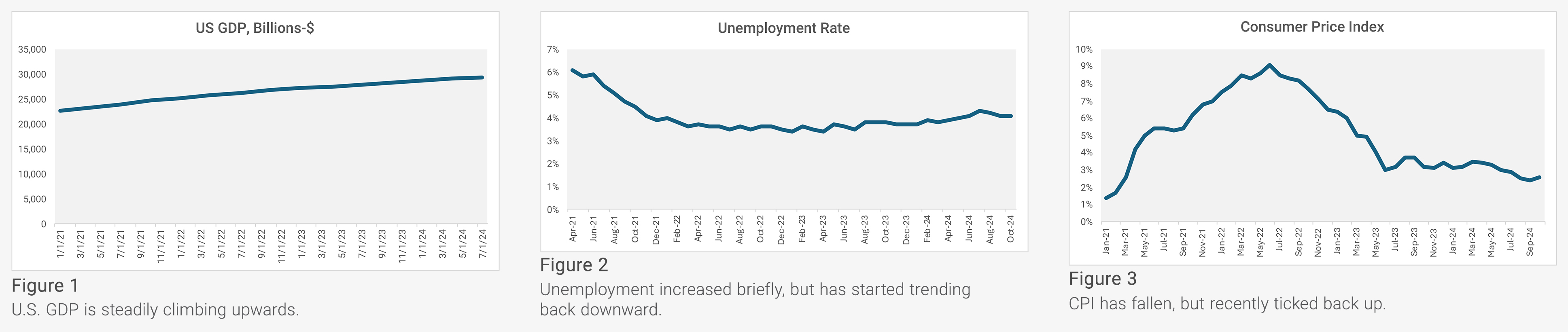
Source: FRED (Figure 1, Figure 2, Figure 3).

So, a good economy is good for the mortgage and home equity markets, right? Generally speaking, this statement was true. As monitored by Experian’s credit database, mortgage originations increased by approximately thirty percent year over year as of November 2024 (Figure 4), and Q3 ’24 pre-tax profit for Independent Mortgage Banks (IMBs) averaged $701 per loan.1 So, business in home lending is good — certainly better than it was during the period when the Fed was raising rates, origination volumes shrank as opposed to grew, and IMB profit per loan turned negative.
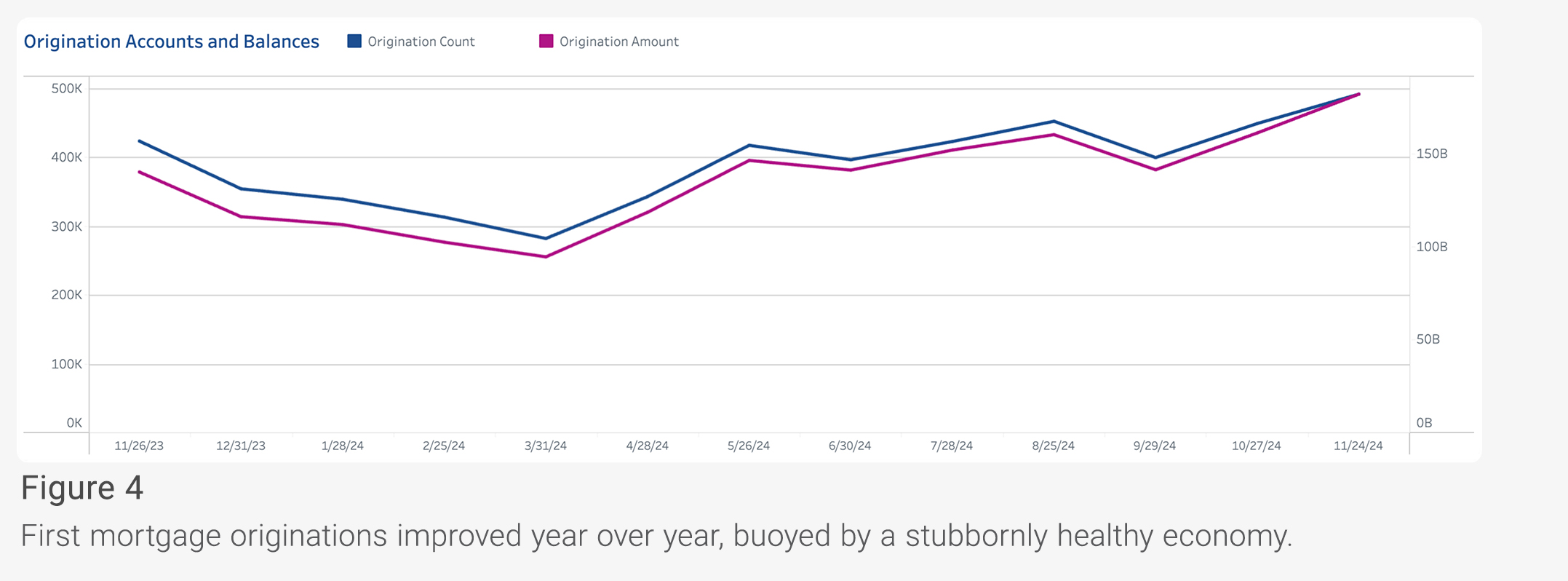
Source: Experian Ascend Insights Dashboard.

What constituted this growth in mortgage lending? As we all know, the Fed has lowered interest rates by 100bps since they started reducing rates in September. The market had priced in the September cut weeks prior to the actual announcement (Figure 5), and the market enjoyed a spike in refinance volume as a result (Figure 6). However, in the lead-up to and following the US presidential election, interest rates spiked back up due to the market’s expectations around future economic activity, which will dampen pressure on refinance volumes even after the recent additional rate drop. The impact of further rate drops on mortgage rates is unclear, and refinance volume still constitutes only around three percent of overall origination volume.
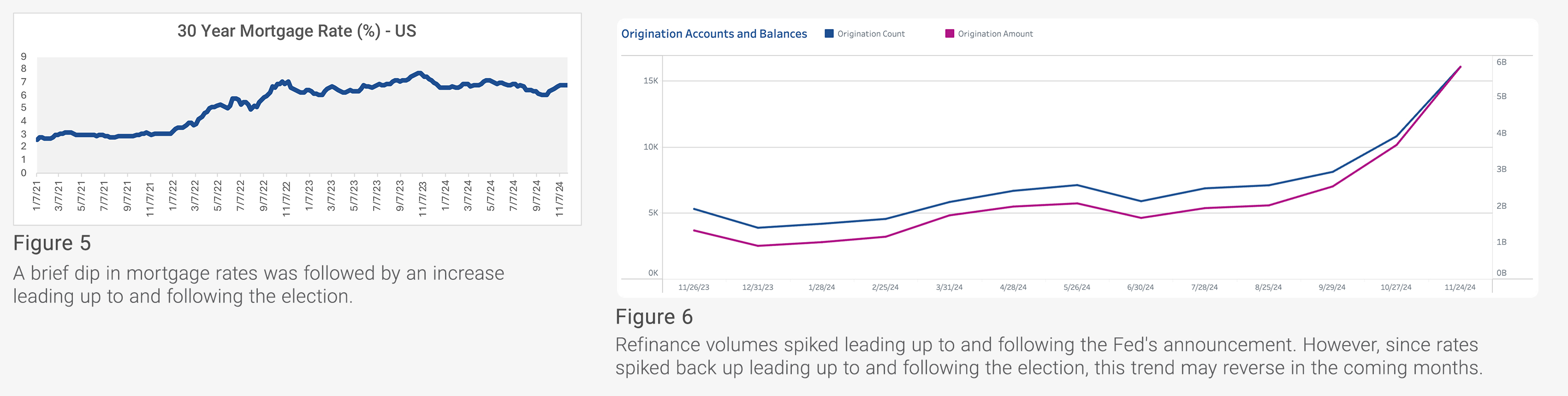
Source: Figure 5, Figure 6 (Experian Ascend Insights Dashboard).

The shift to a purchase-driven housing market

What does this all mean? Our view is that pockets of refinance volume (rate and term, VA, FHA, cashout) are available to those lenders with a sophisticated targeting strategy. However, the data also very clearly indicates that this market is still very much a purchase market in terms of opportunity for originations growth. This position should not surprise long-time mortgage lenders, given that purchase volume has always constituted a significant majority of origination volume. However, this market is a different purchase market than lenders may be used to.

This purchase market is different because of unprecedented statistics about the housing market itself. The average age of a first-time homebuyer recently reached a record high of 38. The average age of overall homebuyers in November of this year similarly jumped to a new record high of 56, with homes being “wildly unaffordable for young people.” Twenty-six percent of home purchases are all-cash, another record high, and homeowners have an aggregate net equity position of $17.6 trillion, fueling those all-cash purchases. The market is expensive both from an interest rate perspective and a housing price-level perspective, and those trends are driving who is buying homes and how they are buying them.2

Opportunities for lenders in 2025

What do these housing market dynamics mean for lenders? To begin with, lenders should not spend money marketing mortgages to consumers in their 50s and 60s with large equity positions. These consumers are likely to be in the 26 percent all-cash buyer cohort, and that money will be wasted since mortgages are no longer so cheap that even cash-rich buyers would take them. Further, this equity-rich generation has children, and nearly 40% of those children borrow from the bank of mom and dad to purchase their first home. Since roughly a quarter (albeit a shrinking quarter) of homebuyers are first-time homebuyers, and since 40% of those rely on help from parents to facilitate that purchase, it may make sense for lenders to identify those consumers with 1) children and 2) significant equity positions and to offer products like cash-out refinances or home equity loans/lines to help facilitate those first-time purchases.

Data is critical to executing these kinds of novel marketing strategies. It is one thing to develop these marketing and growth strategies in principle and another entirely to efficiently find the consumers that meet the criteria and give them a compelling offer. Consider home equity originations. As Figure 7 illustrates, HELOC originations are strong but have completely stalled from a growth rate perspective. As Figure 8 illustrates, this is despite the market’s continued growth in direct mail marketing investment. Although HELOC origination volumes are a fraction of mortgage—around $27b per month for HELOC versus $182b per month for mortgage—there are significantly more home equity direct mail offers being sent per month (39 million) for home equity products as there are for mortgage (31 million) as of October ’24.3 This all means that although many lenders have wised up to the home equity opportunity to the point of saturating the market with offers, few have successfully leveraged targeting data and analytics to craft sufficiently compelling offers to those consumers to convert those marketing leads into booked loans.
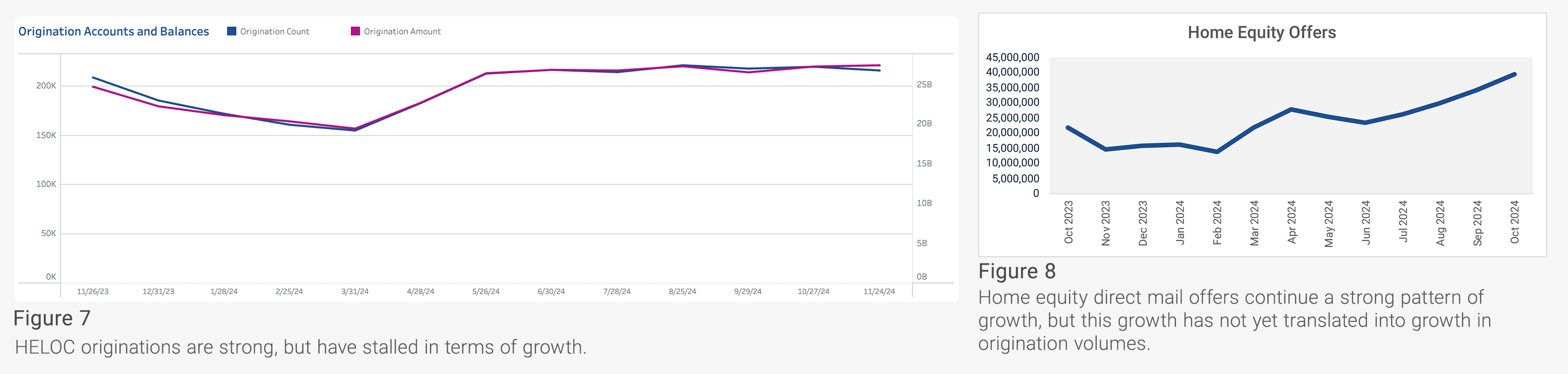
Source: Figure 7 (Experian Ascend Insights Dashboard), Figure 8 (Mintel).

Adapting to a resilient housing market

In summary, the housing market, comprised of mortgage and home equity products, has experienced persistent growth over the past year. Many who are reading this note will have benefitted from that growth. However, as we have identified, in many respects housing market growth has 1) been concentrated to some key borrower demographics and 2) many lenders are investing in marketing campaigns that are not efficiently reaching or convincing that key housing demographic to book loans, whether it be a home equity or mortgage product. As such, as we move into 2025, Experian advises our clients to focus on the following three themes to ensure they benefit from this trend of growth into the new year:

  1. Ensure you effectively differentiate your marketing targeting, collateral, and offers for the various demographics in the market.
  2. Ensure your origination experiences for mortgage and home equity products are modern and efficient. Lenders who force all borrowers through a painful, manual legacy process will waste marketing dollars and experience pipeline fallout.
  3. Although the market is growing, other lenders are coming for your current customers. They could be coming for purchase activity, refinance opportunities, or they may be using home equity products to encroach on your existing mortgage relationship. As such, capitalizing on growth in 2025 is not merely about gaining new customers; it is also about retaining your existing book of business using high-quality data and analytics.

Learn more

1 Although December numbers are available for year-over-year comparison, we excluded them due to the holiday period’s strong seasonality patterns.

2 The Case-Shiller index recently topped out at record levels.

3 Mintel/Comperemedia data.

Related Posts

  Experian Verify is redefining how lenders streamline income and employment verification; a value clearly reflected in Marcus Bondraeger’s experience at Freedom Mortgage. With access to the second-largest instant payroll network in the U.S., Experian Verify  connects lenders to millions of unique employer records, including those sourced through Experian Employer Services clients, delivering instant results at scale. This reach enables lenders to reduce manual processes, accelerate loan decisions and enhance the borrower experience from the very first touchpoint. Unlike traditional verification providers, Experian Verify offers transparent, value-driven pricing: it charges only when a consumer is successfully verified, not simply when an employer record is found. As lenders navigate increasing compliance requirements and secondary market expectations, they can also rely on Experian Verify’s FCRA-compliant framework, fully supporting both Fannie Mae and Freddie Mac. Combined with Experian’s industry-leading data governance and quality standards, lenders gain a verification partner they can trust for accuracy, security, and long-term operational efficiency. Perhaps most importantly, Experian Verify delivers 100% U.S. workforce coverage through its flexible, automated waterfall: instant verification, consumer-permissioned verification, and research verification. This multilayered approach ensures lenders meet every borrower where they are, whether they’re connected to a large payroll provider, a smaller employer, or require additional document-based validation. As Marcus highlights in the video, this comprehensive and configurable design empowers lenders to build verification workflows that truly fit their business needs while enhancing speed, completeness, and borrower satisfaction. Explore Experian Verify

by Ted Wentzel 6 min read February 20, 2026

Lenders who want to outperform peers in today’s housing market should embrace a data-driven playbook. These four strategic pillars—borrower insights, efficiency, geography, and refinance readiness—define the path forward. 

by Ivan Ahmed 6 min read February 18, 2026

As the U.S. housing market enters a new phase, the 2026 State of the U.S. Housing Market Report from Experian provides a data-driven overview for lenders, servicers, and property managers. This article synthesizes findings related to mortgage originations, affordability pressures, home equity utilization, credit risk, and generational sentiment, with implications for lender strategy in 2026 (Experian, 2026).  Mortgage market in flux: Opportunity amid transition  The mortgage market presents mixed signals. Rate moderation in late 2025 contributed to renewed demand, while the product mix continued to evolve. Conventional loans remained dominant at approximately 72% of originations, yet Veterans Affairs (VA) loans experienced the highest growth between 2023 and 2025, reaching 10.8% market share (Experian, 2026).  At the same time, second mortgages and home equity lines of credit (HELOCs) gained momentum as homeowners sought liquidity without refinancing out of historically low interest rates. This trend reflects growing demand for equity-based solutions that preserve favorable first-mortgage terms (Experian, 2026).   Pull-through challenges: Only 34% of inquiries become loans  Conversion efficiency remains a key challenge. Only 34% of first-mortgage hard credit inquiries resulted in a completed mortgage origination, highlighting friction between borrower interest and loan fulfillment (Experian, 2026).  Consumer research reinforces this gap. In an Experian survey, 50% of respondents reported that understanding what they could qualify for would be the most helpful step in their homeownership journey, suggesting that improved prequalification tools could materially increase pull-through rates (Experian, 2026).   Affordability pressure goes beyond the mortgage  Between 2021 and 2025, property taxes increased by 15.2%, while non-tax escrow costs—primarily homeowners' insurance—rose by 67.4% nationwide (Experian, 2026).  State-level variation further complicates affordability assessments. Florida recorded the highest average non-tax escrow expenses at $430 per month largely due to sharp increase in home insurance costs. California, by contrast, exhibited the highest average property tax burden at $626, largely driven by elevated home values despite lower statutory tax rates (Experian, 2026). These dynamics underscore the importance of holistic cost modeling, particularly for first-time buyers.   Home equity: A lender’s growth frontier  Home equity remains a significant growth opportunity. An estimated 96.2 million consumers reside in owner-occupied homes, with substantial portions owning their homes outright or holding more than 20% equity (Experian, 2026). HELOC usage is increasing, particularly among younger borrowers, 50% of whom utilize more than 60% of their available HELOC credit, compared with 36% of older borrowers (Experian, 2026).  Market share shifts are also notable. Fintech lenders experienced a 140.2% increase in HELOC originations from 2023 to 2025, significantly outpacing banks and credit unions. These gains suggest that digital-first experiences and streamlined workflows are increasingly decisive factors for borrowers (Experian, 2026).   Risk and resilience: What credit and property data reveal  Overall delinquency rates eased slightly; however, near-prime and prime borrowers demonstrated early signs of stress, particularly within first-mortgage portfolios (Experian, 2026).  Property-level risk is also intensifying. Flood exposure increased by 3.7% nationally, with 26.4% of Florida homes identified as at risk. Rising exposure has contributed to escalating insurance costs, further affecting affordability and credit performance (Experian, 2026).  From a credit hierarchy perspective, secured debt—especially mortgages and auto loans—continued to show the lowest delinquency rates. In contrast, student loans and credit cards exhibited higher delinquency risk, particularly among financially constrained renters and homeowners (Experian, 2026).   Generational optimism versus macroeconomic constraints  Despite affordability headwinds, consumer optimism persists. Approximately 47% of renters believe they will be ready to purchase a home within four years, increasing to 67% within eight years (Experian, 2026).  Structural constraints remain significant. Roughly 70% of homeowners hold mortgage rates below 6%, contributing to limited housing inventory as current owners remain rate-locked. With 30-year mortgage rates still above that level and a softening labor market, even modest increases in unemployment could further pressure affordability (Experian, 2026).   Implications for lenders  Experian’s analysis highlights several strategic priorities for housing industry stakeholders:  Expand access to credit. Incorporate alternative data sources, such as cash-flow analytics and rental payment history, to responsibly extend credit to underserved but qualified borrowers (Experian, 2026).  Capitalize on equity demand. Develop HELOC offerings that are fast, flexible, and digitally enabled to meet the needs of equity-rich, rate-locked homeowners (Experian, 2026).  Enhance risk precision. Integrate credit, property, and behavioral data to identify emerging risk early, particularly among near-prime segments, and to support more accurate pricing and portfolio management (Experian, 2026).   Conclusion  The 2026 housing market reflects a complex interplay of macroeconomic pressure, shifting borrower behavior, and growing reliance on home equity solutions. Agility and data-driven decision-making will be essential for lenders navigating this environment. The 2026 State of the U.S. Housing Market Report offers critical insight to support growth while managing risk in an evolving landscape (Experian, 2026).  📘 Access the full report here: Experian 2026 State of the U.S. Housing Market Report  References  Experian. (2026). 2026 state of the U.S. housing market report. Experian.     

by Upavan Gupta 6 min read February 9, 2026

Subscribe to our blog

Enter your name and email for the latest updates.

This site is protected by reCAPTCHA and the Google Privacy Policy and Terms of Service apply.

Subscribe to our Experian Insights blog

Don't miss out on the latest industry trends and insights!
Subscribe