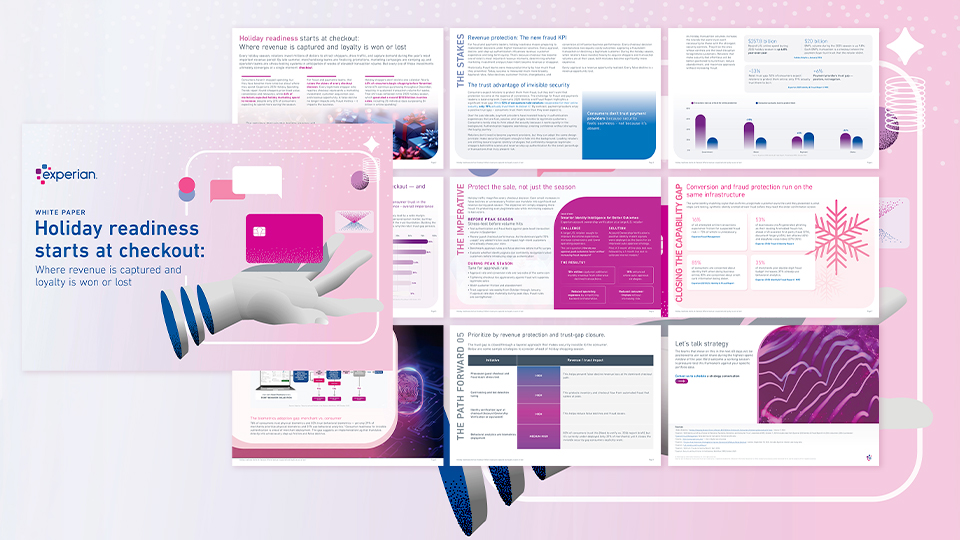
Every retailer invests heavily to drive shoppers to its website during the holidays. But after months of planning and thousands to millions of dollars spent on marketing, every customer journey comes down to one critical moment: Checkout. Today, fraud prevention means protecting revenue by ensuring legitimate customers complete their purchase, not just stopping bad actors. That’s becoming increasingly important as holiday shopping evolves. In 2025, U.S. online holiday spending reached a record $257.8 billion,1 with shoppers spreading their purchases across months rather than just Black Friday and Cyber Monday. Every approval and every false decline has a bigger business impact than ever. Trust is becoming a conversion strategy Consumers expect retailers to protect them from fraud, but they don’t want that protection to slow them down. That’s where a significant opportunity exists. Experian research found that 52% of consumers expect retailers to protect them online, yet only 19% trust them to do so.2 Meanwhile, payment providers enjoy a positive trust gap because security happens quietly in the background with minimal friction. The takeaway? Customers don’t equate more authentication with more trust. Instead, they equate less friction with better experiences. Learn how retailers can improve approvals, reduce false declines and build customer trust through layered identity intelligence. Download the white paper Invisible security is the future of checkout Modern identity verification, behavioral analytics and account intelligence allow retailers to recognize trusted customers behind the scenes – reserving step-up authentication only for higher-risk transactions. Why does that matter? Because friction is measurable. Research from Experian and cited in our white paper, shows that 16% of online transactions encounter suspected fraud friction, and 70% of that friction is unnecessary.3 Meanwhile, 25% of consumers abandon the purchase after experiencing onboarding friction, choosing a competitor instead. Reducing unnecessary friction isn’t just good customer experience; it’s good business. One retailer that used Experian’s account ownership verification and identity intelligence captured more than $8 million in additional monthly revenue by improving auto-approval strategies and reducing customer friction. Learn how to protect revenue, not just prevent fraud As holiday traffic ramps up, retailers have an opportunity to rethink checkout as more than a fraud control. It’s a revenue engine. Our latest white paper explores how layered identity strategies can help retailers improve approvals, reduce false declines and deliver the frictionless experiences customers increasingly expect. Download the full white paper to learn how invisible security can help strengthen customer trust while maximizing holiday conversion. Download now
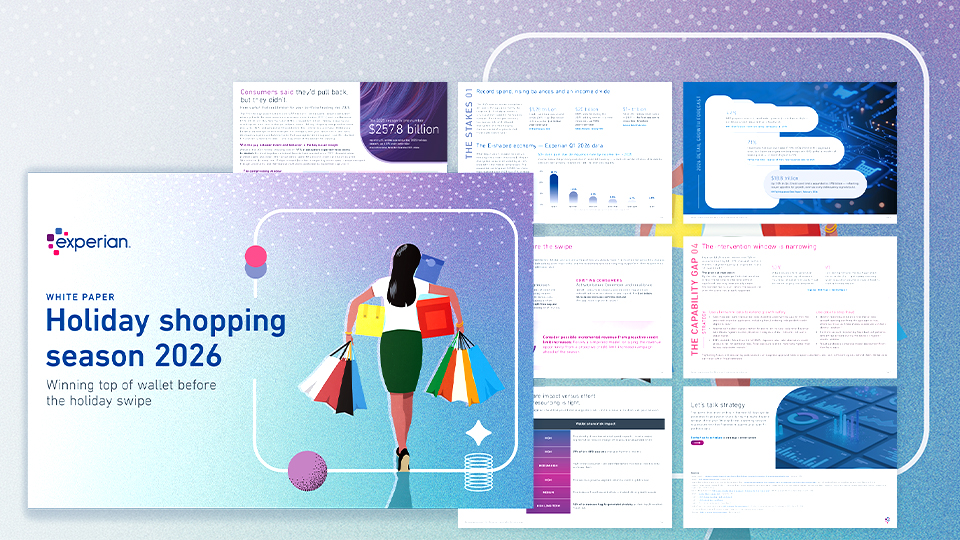
Every year, consumers say they’ll spend less during the holidays. Every year, many do the opposite. Ahead of the 2025 holiday shopping season, 57% of consumers told Deloitte they expected the economy to weaken, the most pessimistic outlook recorded in the survey’s history. Planned holiday spending was down 10%. Yet by the end of the season, online holiday sales reached a record $257.8 billion, up 6.8% year over year. Credit card balances climbed to $1.28 trillion, and Buy Now, Pay Later (BNPL) financing surpassed $20 billion during the holiday period. For lenders, the takeaway is to identify and engage the right consumers before the holidays were best equipped to capture that spending while effectively managing risk. As the 2026 holiday season approaches, Experian’s latest market insights suggest that while credit performance appears relatively stable at the portfolio level, important shifts beneath the surface are changing how lenders should evaluate both opportunity and risk. Holiday shopping season 2026 Winning top of wallet before the holiday swipe Download the white paper now Holiday lending decisions happen long before the holidays It’s been observed that the holiday shopping season has expanded – beginning before Black Friday – over recent years. While Cyber Week continues to generate headlines, holiday spending is becoming more distributed throughout the quarter. For lenders, that means strategies must be in place before peak shopping begins. Credit line increases, portfolio reviews, acquisition strategies and risk segmentation completed in late summer often determine how much holiday spending an institution can safely capture. At the same time, early signs of credit deterioration are emerging faster than traditional portfolio metrics suggest reinforcing the importance of identifying emerging portfolio risk early rather than relying solely on broad portfolio performance indicators. Income is becoming a stronger predictor of credit performance One of the most notable shifts in today’s lending environment is the growing relationship between income and future credit performance. Experian’s data suggests the market is becoming increasingly polarized. The population earning more than $250,000 annually has more than doubled since 2023, but more than one-quarter of those consumers have since moved into lower income brackets, often following retirement or job loss. Meanwhile, consumers earning less than $50,000 annually show relatively little income mobility, with approximately 85% remaining in the same income band year-over-year. These trends highlight an important reality: a credit score alone may no longer provide a complete picture of borrower risk. Four priorities before peak holiday spending With only a short window before holiday borrowing accelerates, lenders have an opportunity to strengthen both growth and risk strategies. Key areas of focus include: Refine acquisition strategies Move beyond score-only targeting by incorporating verified income, cash flow and existing credit relationships to identify qualified borrowers. Optimize existing portfolios Identify customers demonstrating positive credit migration and proactively evaluate opportunities to increase credit lines before peak spending begins. Monitor emerging credit risks Use early-stage delinquency indicators and behavioral signals to identify potential performance issues before losses accelerate. Strengthen fraud management and prevention Seasonal account openings and increased transaction volumes create greater fraud exposure. Identity verification, synthetic identity detection and dormant account monitoring remain critical during high-volume acquisition periods. Preparing for the holiday shopping season ahead The 2025 holiday season demonstrated that consumer spending decisions don’t always align with consumer sentiment. How does that translate for the 2026 shopping season? For lenders, success will depend less on reacting to spending trends in November and more on making informed credit decisions months earlier. As consumer financial behavior continues to evolve, combining traditional credit data with income, cash flow and alternative data can provide a more complete understanding of both opportunity and risk. Institutions that incorporate these broader insights into acquisition, portfolio management and fraud strategies will be better positioned to grow responsibly during one of the year’s most active lending periods. Ready to learn more? Access the full white paper

Verification has become an increasingly important area of focus in mortgage lending, but success is about more than just coverage. In the latest episode of the Chrisman Commentary Podcast, Experian’s Jamie Norris, Senior Manager of Strategic Alliances, shares why distribution and integration are increasingly the keys to driving adoption, automation, and better borrower experiences. Why Distribution Matters in Verification As lenders continue to pursue faster, more efficient mortgage processes, verification solutions must fit seamlessly into the systems they already use. Norris explains how Experian’s strategy is focused on helping lenders access trusted income and employment data while minimizing workflow disruption by making Experian Verify accessible across loan origination systems (LOS), point-of-sale platforms, underwriting technologies, and reseller networks. Building a Smarter Verification Strategy The conversation explores why lenders benefit from having access to multiple verification providers, how they can optimize verification strategies to maximize automation while minimizing costs and borrower friction, and why an “instant-first” approach is gaining momentum across the industry. Looking Ahead: AI, Automation, and the Future of Mortgage Lending Norris also discusses how AI-driven underwriting and decisioning are reshaping mortgage technology. As lending platforms become increasingly automated, real-time verification data is expected to support faster decisioning and more streamlined borrower experiences. She shares Experian’s vision for expanding its verification ecosystem and delivering a broader suite of solutions that meet lenders wherever they work. Listen to the full episode above to hear Jamie’s insights on verification strategy, partner integrations, AI-enabled lending, and what’s next for mortgage automation.