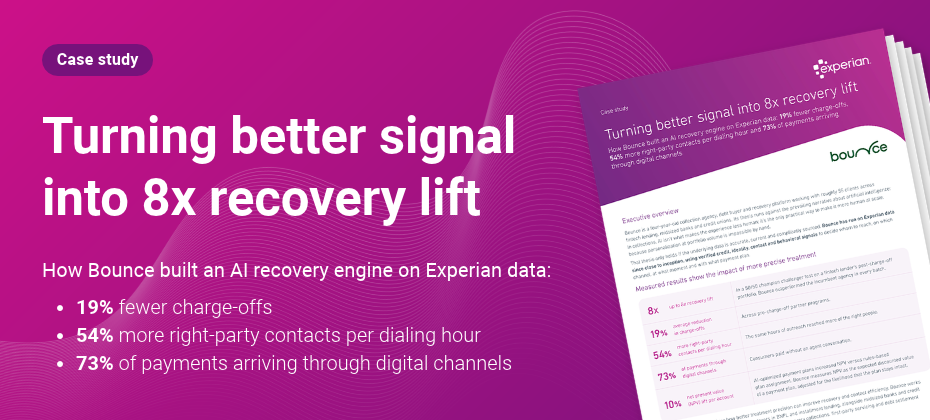
Artificial Intelligence (AI) can help collections teams personalize debt recovery at scale, but only when it has accurate, current data to work with. Bounce, a collection agency, debt buyer and recovery platform shares how they combine consumer data, affordability models and compliance rules to decide when and how to reach people. A more tailored, data-driven approach to recovery Many traditional collections strategies rely on broad treatment paths. Accounts may enter a queue and receive a set sequence of letters and calls, regardless of a consumer’s circumstances or preferred channel. Bounce is taking a more tailored collections strategy, using data to guide prioritization, outreach and treatment. How data supports five stages of debt recovery Bounce assesses affordability so offers are sized to what a consumer may realistically sustain emphasizing human agents handling conversations where a person can make a difference, including disputes, hardship, complex negotiation and high-balance accounts. Bounce integrates Experian data at five points in the recovery lifecycle: Portfolio hygiene Identifying bankrupt and deceased consumers so those accounts can receive special handling. Segmentation and prioritization Ranking consumers by likelihood of repayment in the near term. Contact and channel strategy Pinpointing best-known phone and address data at the point of outreach. Timing Alerts notifying teams of relevant changes in a consumer’s credit file. Model enrichment Building a custom model to apply Premier and Trended 3D attributes to it. Results With the reimagined recovery approach, Bounce found: Up to 8x recovery lift 19% average reduction in charge-offs 54% more right-party contacts per dialing hour Why Bounce’s approach depends on Experian data Bounce’s view is that documented data lineage helps support approval of automated treatment decisions. Data quality and freshness can limit how precisely a model treats consumers: a model can only act on the information available to it. The case study also describes compliance rules set by legal and compliance teams and enforced as constraints the model can’t override. Explore the Bounce case study Download the case study to learn how Bounce uses data across recovery, assigns work between models and human agents, and reports its results. Download case study

Today’s AI-powered fraud bots are exceptionally good at mimicking human behavior. Learn why a modern defense strategy is key.

Learn what incident response is, the key steps in the process and how to build and test an incident response plan for a data breach.