Market Trends

Bankcard origination volumes reached $97.5 billion in Q4 2015, the highest level on record since Q3 2008 and an increase of 22% over the same quarter in 2014. The 60–89-days-past-due bankcard delinquency rate came in at .53% for Q4 2015 — significantly lower than the 1.22% delinquency rate back in Q3 2008. The increase in bankcard originations combined with lower delinquencies points to a positive credit environment. Lenders should stay abreast of the latest bankcard trends in order to adjust lending strategies and capitalize on areas of opportunity. >> Key steps to designing a profitable bankcard campaign
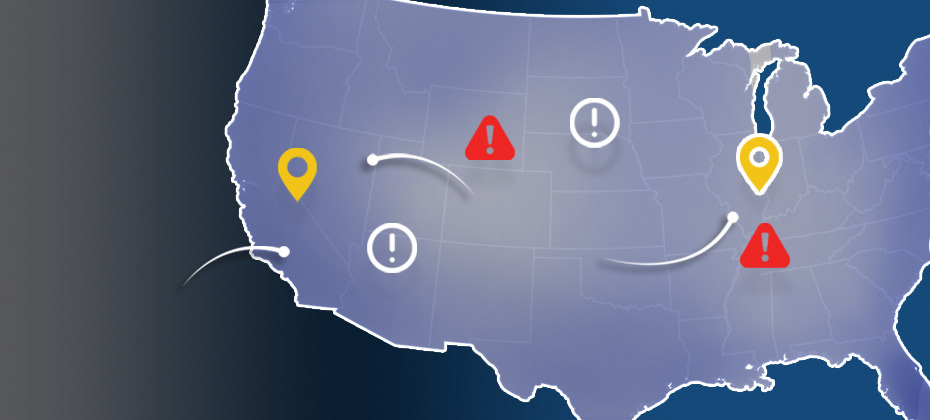
2015 data shows where billing and shipping e-commerce fraud attacks occur in the United States Experian e-commerce fraud attacks and rankings now available Does knowing where fraud takes place matter? With more than 13 million fraud victims in 2015,[1] assessing where fraud occurs is an important layer of verification when performing real-time risk assessments for e-commerce. Experian® analyzed millions of e-commerce transactions from 2015 data to identify fraud-attack rates across the United States for both shipping and billing locations. View the Experian map to see 2015 e-commerce attack rates for all states and download the top 100 ZIP CodeTMrankings. “Fraud follows the path of least resistance. With more shipping and billing options available to create a better customer experience, criminals attempt to exploit any added convenience,” said Adam Fingersh, Experian general manager and senior vice president of Fraud & Identity Solutions. “E-commerce fraud is not confined to larger cities since fraudsters can ship items anywhere. With the switch to chip enabled credit card transactions, and possible growth of card-not-present fraud, our fraud solutions help online businesses monitor their riskiest locations to prevent losses both in dollars and reputation in the near term.” For ease of interpretation, billing states are associated with fraud victims (the address of the purchaser) and shipping states are associated with fraudsters (the address where purchased goods are sent). According to the 2015 e-commerce attack rate data: Florida is the overall riskiest state for billing fraud, followed by Delaware; Washington, D.C.; Oregon and California. Delaware is the overall riskiest state for shipping fraud, followed by Oregon, Florida, California and Nevada. Eudora, Kan., has the overall riskiest billing ZIP Code (66025). The next two riskiest ZIPTM codes are located in Miami, Fla. (33178) and Boston, Mass. (02210). South El Monte, Calif., has the overall riskiest shipping ZIP Code (91733). The next four riskiest shipping ZIP codes are all located in Miami. Overall, five of the top 10 riskiest shipping ZIP codes are located in Miami. Defiance, Ohio, has the least risky shipping ZIP Code (43512). The majority of U.S. states are at or below the average attack rate threshold for both shipping and billing fraud, with only seven states — Florida, Oregon, Delaware, California, New York, Georgia and Nevada — and Puerto Rico ranking higher than average. This indicates that attackers are targeting consumers equally in the higher-risk states while leveraging addresses from both higher- and lower-risk states to ship and receive fraudulent merchandise. Many of the higher-risk states are located near a large port-of-entry city, including Miami; Portland, Ore.; and Washington, D.C., perhaps allowing criminals to move stolen goods more effectively. All three cities are ranked among the riskiest cities for both measures of fraud attacks. Neighboring proximity to higher-risk states does not appear to correlate to any additional risk — Pennsylvania and Rhode Island are ranked as two of the lower-risk states for both shipping and billing fraud. Other lower-risk states include Wyoming, South Dakota and West Virginia. Experian analyzed millions of e-commerce transactions to calculate the e-commerce attack rates using “bad transactions” in relation to the total number of transactions for the 2015 calendar year. View the Experian map to see 2015 e-commerce attack rates for all states and download the top 100 ZIP Code rankings. [1]According to the February 2016 Javelin study 2016 Identity Fraud: Fraud Hits an Inflection Point.

Over the next several years, the large number of home equity lines of credit (also known as HELOCs) originated during the boom period of 2005 to 2008, will begin approaching their end of draw periods. Upon entering the repayment period, these 10-year interest-only loans will become amortized to cover both principal and interest, resulting in payment shock for many borrowers. HELOCs representing $265 billion will reach their end of draw between 2015 and 2018. Now is the time for lenders to be proactive and manage this risk effectively. Lenders with HELOC portfolios aren’t the only ones affected by HELOC end of draw. Non-HELOC lenders also are at risk when consumers are faced with payment shock. Experian analysis shows that it is an issue of consumer liquidity — consumers who reach HELOC end of draw are more likely to become delinquent not only on their HELOC, but on other types of debt as well. If consumers were 90 days past due on their HELOC at end of draw, there was a 112 percent, 48.5 percent and 24 percent increase in delinquency on their mortgage, auto and bankcard trade, respectively. With advanced data and analytics, lenders can be proactive in managing the risk associated with HELOC end of draw. Whether your customer has a HELOC with you or with another lender or is a new prospect, having the key data elements to obtain a full view of that consumer’s risk is vital in mitigating HELOC end-of-draw risk. Lenders should consider partnering with companies that can help them develop and deploy HELOC risk strategies in the near future. It is essential that lenders proactively plan and are well-positioned to protect their businesses from HELOC end-of-draw risk. Experian HELOC end of draw study

Ensure you’re protecting consumer data privacy Data Privacy Day is a good reminder for consumers to take steps to protect their privacy online — and an ideal time for organizations to ensure that they are remaining vigilant in their fight against fraud. According to a new study from Experian Consumer Services, 93 percent of survey respondents feel identity theft is a growing problem, while 91 percent believe that people should be more concerned about the issue. Online activities that generate the most concern include making an online purchase (73 percent), using public Wi-Fi (69 percent) and accessing online accounts (69 percent). Consumers are vigilant while online Most respondents are concerned they will fall victim to identity theft in the future (71 percent), resulting in a generally proactive approach to protecting personal information. In fact, almost 50 percent of respondents say they are taking more precautions compared with last year. Ninety-one percent take steps to secure physical information, such as shredding documents, while also securing digital information (using passwords and antivirus software). Many consumers also make sure to check their credit report (33 percent) and bank account statements (76 percent) at least once per month. There’s still room for consumers to be safer Though many consumers are practicing good security habits, some aren’t: More than 50 percent do not check to see if a Website is secure Fifty percent do not have all their Web-enabled devices password-protected because it is a hassle to enter a password (30 percent) or they do not feel it is necessary (25 percent) Fifty-five percent do not close the Web browser when they are finished using an online account Additionally, 15 percent keep a written record of passwords and PINs in their purse or wallet or on a mobile device or computer Businesses need to be responsible when it comes data privacy Customer-facing businesses must continue efforts to educate consumers about their role in breach and fraud prevention. They also need to be responsible and apply comprehensive, data-driven intelligence that helps thwart both breaches and the malicious use of breached information and protect all parties’ interests. Nearly 70 percent of those polled in a 2015 Experian–Ponemon Institute study said that the increased visibility and media reporting of breaches, including payment-related incidents, have caused their organizations to step up data security efforts. Experian Fraud & ID is uniquely positioned to provide true customer intelligence by combining identity authentication with device assessment and monitoring from a single integrated provider. This combination provides the only true holistic view of the customer and allows organizations to both know and recognize customers and to provide them with the best possible experience. By associating the identities and the devices used to access services, the true identity can be seen across the customer journey. This unique and integrated view of identity and device delivers proven superior performance in authentication, fraud risk segmentation and decisioning. For more insights into how businesses are responding to breach activities, download our recent white paper, Data confidence realized: Leveraging customer intelligence in the age of mass data compromise. For more findings from the study, view the results here.

As millennials continue to experience challenges in obtaining credit, Experian’s latest research finds that this population is very receptive to nonbank lenders for the ease, speed and accessibility they provide.

The world of online marketplace lending has grown tremendously over the past several years. Still, for as much hype as it has received, it’s important to note the sector represents only 1.1 percent of unsecured loans and 2.5 percent of small business loans in the United States. While the industry is still in its infancy, it's expected to grow at an annual rate of 47 percent in the U.S by 2020, according to Morgan Stanley. And as it transitions from its “start-up” phase into “adolescence,” many expect it will become a high-growth, mature and stable market, bringing great benefit to consumers of financial services. So what does the future hold for online marketplace lenders? Who better to weigh in than those in the space, going through the evolution, seeing challenges first-hand and keeping a pulse on where they need to invest in order to survive. This video features a diverse group of leaders in the online marketplace lending industry. // Peter Renton, Founder, Lend Academy Scott Sanborn, COO, Lending Club Sam Hodges, Co-founder, Funding Circle USA Andrew Smith, Partner, Covington & Burling Joseph DePaulo, CEO, College Ave. Kathryn Ebner, VP, Credibly Without stealing all of their thunder, a few key themes emerged for 2016. Online marketplace lenders will look to expand their product offerings into all credit verticals – personal loans, auto, student, small business and beyond. Expect competition to continue to heat up. Large institutional investors will increasingly back and test the space. Some players will partner with large banks. Many will explore scoring with the use of alternative data. Innovations to come in customer service and product expansion. Bottom line, alternative finance doesn’t seem so “alternative” anymore. As such, competition will heat up, and regulators will continue to keep an eye on business practices, processes and what it all means for consumers. To learn more about online marketplace lending, visit https://www.experian.com/business-services/landing/marketplace-lending.html

Payments and the Internet of things has been colliding for a while now – and it surfaced again recently with Mastercard announcing that it is working with an array of partners including Capital One to launch payments in connected devices. The thinking here seems to be that payments is a function in the Marlow’s pyramid of needs for any new consumer device. I am conflicted on this point – not that I don’t believe the Internet of Things isn’t important, but that we may be overthinking in how payments is important to be shoved inside everything that has a radio baked in. And not everything will have a radio in the future, and the role of a smartphone as the center of the connected device commerce universe isn’t going away. It is important to keep perspective here – as this announcement is less about coat sleeves hiding NFC chips with tokenized credit cards – rather it’s the commerce enablement of devices that we may carry on our person so that they can be armed for payment. Though I may disagree on whether a coat sleeve or jewelry are essential end-points in commerce, a platform of capabilities to challenge, authenticate and verify, and ultimately trust and provision a tokenized representation of something, whether its a card or a fragment of a consumer's identity, to a device that itself represents a collection of radios and sensors is very exciting. It is exciting because as device counts and assortments grow, they each have their own residual identity as a combination of things and behaviors that are either deterministic or probabilistic. The biggest shift we will see is that the collective device identities can be a far better and complete representation of customer identity that the latter will be replaced by the former. Name-centric identities will give away to algorithmically arrived ones. As Dan Geer puts it, no longer will I need to announce that I am Cherian, but my collection of devices will indeed do so on my behalf, perhaps in consultation with each other. More over, none of these devices need to replicate my identity in order to be trusted and tethered, either. Coming back to Payments, today my Fitbit’s claim to make a successful payment is validated way before the transaction, when I authorized provisioning by authenticating through a bank app or wallet. What would be interesting is when the reverse becomes true – when these class of devices that I own can together or separately vouch for my identity. We may forget usernames and passwords, fingerprints may prove to be irrevocable and rigid, but we will always be surrounded by a fog of devices that each carry a cryptographically unique and verifiable signature. And it will be up to the smartphone, its ecosystem and the devices that operate in its periphery to individually negotiate and establish trust among each of them. So this is why I believe the MasterCard effort in tokenizing devices is important when you view it in conjunction with the recent launch of SwiftID from CapitalOne. Payments getting shoved in to everyday things like wearables, disguises the more important effort of becoming a beachhead in establishing trust between devices, by using tokenization as the method of delivery. As you may have gathered by now, I am less excited of pushing cards in to devices (least of all – cars!) and more about how a trusted framework to carve out a tamper proof and secure cache within an untrusted device, along with the process to securely provision a token or a signed hash representing something of value, can serve as the foundation for future device – and by extension – user identity. On a side note, here’s a bit about pushing cards in to cars, and mistaking them for connected cars. To me there are only two connected car classes today. One is Tesla where each car on the road is part of the whole, each learning separately and together as they examine, encounter and learn the world around them to maneuver safely. The other is a button in an app that I hit to have a car magically appear in front of me. Other than Tesla and Uber, there are no other commercial instances of a connected car that appeals (Google has no cars you can buy, yet).

Millennials, now the largest generation in the United States, are taking longer to establish credit than earlier generations of young people.

The numbers are staggering: more than $1.2 trillion in outstanding student loan debt, 40 million borrowers, and an average balance of $29,000. With Millennials exiting college and buried in debt, it’s no surprise they are postponing marriage, having babies, home purchases and other major life events. While the student loan issue has been looming for years, the magnitude is now taking center stage. All of the 2016 presidential contenders have an opinion, and many are starting to propose solutions – some going as far as to call for “debt-free college.” The issue has also caught the eye of the Consumer Financial Protection Bureau (CFPB). In its 2014 report, the CFPB stated one in four recent college graduates is either unemployed or underemployed. They also stated when faced with the inability to repay their debt, students lack payment options and are unclear as to how to resolve their debt. There is a bright spot. Experian reported new findings stating that among adults 18 to 34 years of age, the average credit score of those who had at least one open student loan account was 640, 20 points higher than others in their age group. So, if paid in a timely manner, student loans can help younger people establish a decent credit history before they go on to buy things like homes and cars. Still, education is key. Today, only 24 U.S. states require some form of financial literacy to be included in their high school course work, with only four states (Utah, Montana, Tennessee and Virginia) devoting a full semester to a personal finance course. Education is needed before students start diving into the student loan scene, and also after they graduate, to ensure they understand their repayment options and obligations. The CFPB is calling on all parties (universities, colleges, private lenders, advocates, policy makers and even family members) to get involved. Providing financial education, financial literacy, repayment options, deferral methods and income calculators are all needed to tackle this growing problem. The Great Recession and slow recovery brought home the importance of a college degree in today’s economy for many Americans. Bachelor’s degree recipients fared much better than their counterparts who only finished high school. The question becomes how to fund it, and make sure students who rely on loans understand the finances attached to this milestone investment. Learn more about Experian’s student debt trends and credit education in The Increasing Need for Consumer Credit Education: A Review of Student Debt.

Last December, American Banker named online marketplace lending its innovation of the year as a result of the “industry’s rapid growth and evolution.” Meanwhile, in 2015, millennials scored headlines in nearly every publication imaginable – industries, politicians and academics all trying to understand and articulate how the now largest-living generation will influence how we work, live and lead. So perhaps it’s no surprise the two hot topics have collided this year. Gen Y is tech-dependent and Internet-enabled. They have increasingly grown to expect the tools and services they use to be available online, including anything and everything in the financial services space. Marketplace lenders are ever-so eager to sweep in and serve. Online and mobile solutions are certainly one thing, but Experian’s latest research reveals this generation is also very receptive to “non-bank” lenders for the ease, speed and accessibility they provide. 47 percent of millennials said they are likely to use alternative finance sources in the near future 57 percent reported they are willing to use alternative companies and services that innovate to meet their needs 13 percent said they’ve already taken out a loan from an alternate or non-bank lender As they come of age, hitting those big milestones – college graduations, marriage, starting families, making home purchases – Gen Y is wading through its financial options. Research and logic suggest millennials will without a doubt have a greater openness toward nontraditional banking, representing a huge market for online marketplace lenders. For the millennial entrepreneurs especially, marketplace lending is proving to be a good fit. “They are on the earlier curve of their small business ownership and entrepreneurial paths,” David Solis, sales performance manager at Bank of America, told CNN Money. “It makes sense they’re going to be pursuing alternative forms of lending.” Affluent millennials are another segment open to alternative financial services. A 2015 LinkedIn study on this specific target stated affluent millennials are particularly likely to envision a cashless, sharing-based economy in the future, where banks no longer serve as their primary financial institutions. Nearly seven out of 10 affluent millennials are likely to consider such offerings outside of the traditional financial services space, compared to just 47 percent of affluent Gen X’ers. The millennial generation may not fully understand all products traditional banks offer, since they rarely set foot in “brick-and-mortar” establishments, but they are a prime market for online investing and lending services. They’re more experimental, more digital, less loyal. In short, they are looking for financial services that are as tech-savvy as they are; those who don’t keep up may get left behind, and online marketplace lenders are certainly positioning themselves to win over this generation. To be most successful in capturing this highly sought-after generation, online marketplace lenders will need to continue to innovate both in terms of differentiating their product offerings and getting more sophisticated in their targeted marketing approach. As the online marketplace continues to expand with more players, heating up with increased competition, segmentation strategies will be key in finding the right borrowers and matching them with the right offer. As we head into 2016, there is no doubt many will continue to monitor the financial services trends emerging. Chances are online marketplace lenders and millennials will likely be attached to many of the headlines. For more information, visit www.experian.com/marketplacelending.

It’s official. Millennials have surpassed Baby Boomers in population size, according to the US Census. And while they are quick to adopt the “selfie” and all things social, they have been slow to embrace the world of credit. Sure, there’s been increased regulation over the past decade, and coming into adulthood in the midst of the Great Recession hasn’t helped. But don’t count Millennials out of the credit game just yet. A deeper, more segmented view of this digital-dependent generation shows a very diverse population with plenty of opportunity for lenders. Plus, their sheer size in numbers and $200 billion in annual buying power demand financial institutions evolve to accommodate this massive market. As Gen Y comes of age, there is growing evidence they are open to building and growing their personal credit history. But if financial institutions wish to capture the attention and business of this demographic, they must adapt, leveraging deeper segmentation insights with more effective prospecting strategies to reach them. Experian's data reveals key trends in terms of how this generation is utilizing credit, tips and tools to find the most credit-ready individuals, and strategies to grow the thin-file Millennials as they come of age. “Given the significance millennials play in financial services and the credit marketplace, it is crucial to understand this influential consumer segment and how they use credit as a tool,” said Michele Raneri, vice president of analytics and business development. “While this generation may not look like they are on the right track financially, it’s important to keep in mind that credit scores are built on credit experiences, and while this generation has been slower to use credit, they have plenty of opportunities to build a positive credit history.” To learn more about Millennials and credit, visit Experian.com/millennials.
The Responsible Business Lending Coalition, a group of nonbank small-business lenders, recently announced a regulatory program designed to bring greater clarity to the industry’s pricing and consumer protections, including: The right to transparent pricing and terms The right to non-abusive products The right to responsible underwriting The right to fair treatment from brokers The right to inclusive credit access The right to fair collection practices Industry self-regulation is a good way for market leaders to demonstrate self-discipline and is preferable to legislative or regulatory changes because of its flexibility and ability to accommodate evolving market trends. >> Webinar: Online Marketplace Lending

According to the latest Experian-Oliver Wyman Market Intelligence Report, mortgage originations for Q2 2015 increased 56% over Q2 2014 — $547 billion versus $350 billion.
According to a recent Experian analysis, millennials (ages 19–34) are now the largest segment of the U.S. population and are also the least credit savvy group.
According to the latest Experian-Oliver Wyman Market Intelligence Report, mortgage originations increased 25% year over year in Q1 2015 to $316 billion.