Fraud & Identity

With an ever-present need for efficiency, security, and seamless citizen services, many agencies are looking at the benefits of a data-driven government. Last year, the federal government kicked off a unified effort to enable data-driven decision making. The goal at that level – and across all agencies – is to serve citizens more efficiently and effectively. By embracing the power of data and analytics, agencies of all sizes can set themselves up to better serve their citizens. What is a data-driven government? Agencies collect citizen data from a variety of service-based sources, including the Postal Service, Census Bureau, social welfare departments, and agencies that issue government IDs. When properly leveraged, this data holds many possibilities. However, many agencies face challenges when it comes to efficient collection, sharing, usage, integrity, and accessibility. Due to the amount of data collected and the potential lack of consistency in the collection and storage techniques, the data may not be usable. Without proper management and analysis, there’s little government agencies can do with their data to improve their processes. A data-driven government has well-managed data and uses that data to drive their decisions as they relate to citizen requests for benefits, tax collection, elections, and more. What are the benefits of data-driven decision making? Data management and government data analytics enable agencies to react quickly to citizen demands and concerns and proactively anticipate an issue before it becomes a crisis. With the right tools, agencies can gain a holistic view of their citizens, communicate effectively internally, provide digitally-driven services and improve overall efficiency through government-wide data integration and management. These changes have a wide range of benefits, including reduction of cost, fraud, waste and abuse, the automation of manual processes, and better service delivery. Why is a data-driven strategy required? In addition to the benefits listed above, a data-driven strategy also helps agencies align with published NIST guidelines and the need to monitor, evaluate, and maintain digital identity systems. Proper use of data-driven digital identity strategies will enhance equity and the usability of the solutions agencies provide to their citizens. Building an effective data-driven strategy The right strategy starts with ensuring that all departments about the need for proper data management and analytics and the guidelines that will govern it, such as maintaining up-to-date data, removing silos, and leveraging the right tools. The next step is finding the right partner. An effective partner can help agencies develop and maintain data management systems and implement the right tools and analytics – things like machine learning in government – to help each agency function efficiently and safeguard the data of its citizens. To learn how Experian can help your agency improve its use of data, visit us or request a call. Visit us

CrossCore named Overall Leader, Product Leader in Fraud Reduction Intelligence Platforms, Innovation Leader and Market Leader in Fraud Reduction..

Jennifer Schulz, CEO of Experian, North America kicked off Experian’s annual Vision conference Tuesday morning pointing to data, analytics, technology and collective curiosity as the drivers for change and a more impactful tomorrow to more than 700 attendees. Keynote speaker: Jennifer Bailey Jennifer Bailey, Vice President of Apple Pay and Apple Wallet, spoke about the customer experience “ethos.” She explained how Apple takes a long-term view and values the single most important performance metric as customer experience. She said creating a seamless customer experience comes down to making things simple and understandable, and asking, “Are we solving a customer problem?” and “How are we making it easier for customers to enjoy and liver their lives. Bailey, who said of all apps she uses the weather app the most, also talked about innovation, and that both intent and making mistakes are important parts of the process. Apple’s products are known for their user-friendliness, and design is part of that. She encouraged the audience to give design teams room to create without bottom line pressures and not to be afraid to take well-considered risks. Keynote Speaker: Gary Cohn Gary Cohn, Vice Chairman of IBM, talked about the current economic climate, and while it’s a natural viewpoint to look to the past for guidance, the current environment is unlike any before. Cohn discussed regulatory compliance in the banking industry and prioritizing safety and soundness. While AI is topical and in numerous headlines recently, Cohn reminded the conference goers that AI isn’t new. He said what is new and important is that you can now teach models to find the information needed rather than having to feed all the information yourself. He believes AI is not the end of employment, but rather helps boost productivity, efficiency, and job satisfaction and provides organizations more data. As for advice for the audience, Cohn shared opportunities are in the uncomfortable zones and you have to be willing to fail in order to succeed. Session highlights – Day 1 The conference hall was buzzing with conversations, discussions and thought leadership. Overall themes that were frequently part of the conversation included seamless customer experiences, agility in face of economic changes and leveraging AI/ML into strategies. Fraud automation and preventing commercial fraud More businesses are opening than ever before and lenders and service providers need a way to determine risk from businesses who are less than a year old. There is no one-size-fits-all approach to fraud. A layered solution assesses risk and applies the correct friction to resolve the risk and pass or refer the applicant. Identity Today’s consumer wants a personalized experience and is privacy conscious. Additionally, regulators are also pushing for greater privacy. Clean rooms allow you and a partner to add data to a safe space and learn more about consumers without exposing data. The right data improves acquisition rates, identity verification and allows you to anticipate customer needs. Advanced scoring Data, models and strategy are the levers institutions are using to leverage responsible analytics to meet their objectives like safely growing existing portfolios, managing the “right” level of risk, and providing a seamless digital experience. However, the total value of a decisioning system is almost always constrained by its most rudimentary component. The panel of experts discussed their uses and goals for leveraging models and customer experience was at the top of their priorities. Recession preparedness Delinquency is on the rise and lending offers made continue to drop. Changes in the economic climate require frequent monitoring of portfolio and decisions, benchmarking against peers, updating credit models and decision strategies, and stress testing portfolio and models. Trends in credit risk management While AI at the hands of everyone is topical today, it ranked lowest on the list of trends attendees believed were impacting their business. At the top of the list? The growing demand for simpler, faster and seamless experiences. More insights from Vision to come. Follow @ExperianVision and @ExperianInsights to see more of the action.

During their redeterminations process stats should look for efficiency and a risk-based approach to ensure compliance during the unwinding process.

As organizations look for ways to keep themselves and the consumers they serve safe in the digital era, many turn to fraud risk mitigation.

There’s an undeniable link between economic and fraud trends. During times of economic stress, fraudsters engage in activities specifically designed to target strained consumers and businesses. By layering risk management and fraud prevention tools, your organization can manage focus on growing safely. Download infographic Review your fraud strategy

What Is Identity Proofing? Identity proofing, authentication and management are becoming increasingly complex and essential aspects of running a successful enterprise. Organizations need to get identity right if they want to comply with regulatory requirements and combat fraud. It's also becoming table stakes for making your customers feel safe and recognized. 63 percent of consumers expect businesses to recognize them online, and 48 percent say they're more trusting of businesses when they demonstrate signs of security. Identify proofing is the process organizations use to collect, validate and verify information about someone. There are two goals — to confirm that the identity is real (i.e., it's not a synthetic identity) and to confirm that the person presenting the identity is its true owner. The identity proofing process also relates to and may overlap with other aspects of identity management. Identity proofing vs identity authentication Identity proofing generally takes place during the acquisition or origination stages of the customer lifecycle — before someone creates an account or signs up for a service. Identity authentication is the ongoing process of re-checking someone's identity or verifying that they have the authorization to make a request, such as when they're logging into an account or trying to make a large transaction. How does identity proofing work? Identity proofing typically involves three steps: resolution, validation, and verification. Resolution: The goal of the first step is to accurately identify the single, unique individual that the identity represents. Resolution is relatively easy when detailed identity information is provided. In the real world, collecting detailed data conflicts with the need to provide a good customer experience. Resolution still has to occur, but organizations have to resolve identities with the minimum amount of information. Validation: The validation step involves verifying that the person's information and documentation are legitimate, accurate and up to date. It potentially involves requesting additional evidence based on the level of assurance you need. Verification: The final step confirms that the claimed identity actually belongs to the person submitting the information. It may involve comparing physical documents or biometric data and liveness tests, such as a comparison of the driver's license to a selfie that the person uploads. Different levels of identity proofing may require various combinations of these steps, with higher-risk scenarios calling for additional checks such as biometric or address verification. Service providers can implement a range of methods based on their specific needs, including document verification, database validation, or knowledge-based authentication. Building an effective identity proofing strategy By requiring identity proofing before account opening, organizations can help detect and deter identity fraud and other crimes. You can use different online identity verification methods to implement an effective digital identity proofing and management system. These may include: Document verification plus biometric data: The consumer uploads a copy of an identification document, such as a driver's license, and takes a selfie or records a live video of their face. Database validations: The proofing solution verifies the shared identifying information, such as a name, date of birth, address and Social Security number against trusted databases, including credit bureau and government agency data. Knowledge-based authentication (KBA): The consumer answers knowledge-based questions, such as account information, to confirm their identity. It can be a helpful additional step, but they offer a low level of assurance, partially because data breaches have exposed many people's personal information. In part, the processes you'll use may depend on business policies, associated risks and industry regulations, such as know your customer (KYC) and anti-money laundering (AML) requirements. But organizations also have to balance security and ease of use. Each additional check or requirement you add to the identity proofing flow can help detect and prevent fraud, but the added friction they bring to your onboarding process can also leave customers frustrated — and even lead to customers abandoning the process altogether. Finding the right amount of friction can require a layered, risk-based approach. And running different checks during identity proofing can help you gauge the risk involved. For example, comparing information about a device, such as its location and IP address, to the information on an application. Or sending a one-time password (OTP) to a mobile device and checking whether the phone number is registered to the applicant's name. With the proper systems in place, you can use high-risk signals to dynamically adjust the proofing flow and require additional identity documents and checks. At the same time, if you already have a high level of assurance about the person's identity, you can allow them to quickly move through a low-friction flow. Experian goes beyond identity proofing Experian builds on its decades of experience with identity management and access to multidimensional data sources to help organizations onboard, authenticate and manage customer identities. Our identity proofing solutions are compliant with National Institute of Standards and Technology (NIST) and enable agencies to confidently verify user identities prior to or during account opening, biometric enrollment or while signing up for services. Learn more This article includes content created by an AI language model and is intended to provide general information.

Experian's 2023 Future of Fraud Forecast examines rising threats impacting businesses and consumers and how best to combat them.

Businesses must be aware of the risks associated with card not present fraud and take steps to protect themselves and their customers.

Read our 2023 Data Breach Industry Forecast to learn more about reflections, new predictions, and what to expect by 2033.
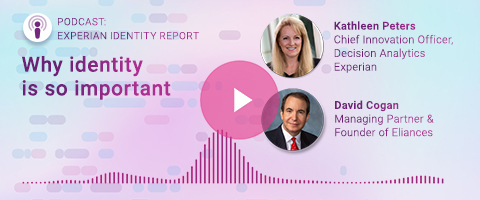
Kathleen Peters, Chief Innovation Officer, Decision Analytics for Experian, was recently featured on the Eliances Heroes podcast as part of the new weekly segment, the “Experian Identity Report.” In the introductory show, podcast host David Cogan, spoke with Kathleen about why identity is so important to our society. Listen to the podcast for the full discussion and see the transcript below. Learn more about Experian Identity David Cogan: How critical is it? Well, I’ll tell you. Payment fraud will exceed $206 billion in the next five years and let’s face it. Managing one’s personal identity is very complicated on its own and if the business enterprise managing customer identities in a strategic and secure way and scale across countless interaction is extremely complicated. And it’s only going to get more complex with the future from what I understand and all the technology that’s coming out if not by the day, by the hour. And that’s why we’re bringing this to you. Interviews with the world’s leading experts on the game changing impact of identity and the need to use reliable data to make confident decisions that securely accelerate customer engagement and that’s why we’re honored here today to have with us Kathleen Peters, Chief Innovation Officer, Experian Decision Analytics North America. Kathleen Peters: Thanks so much David, it’s great to be here with you. DC: $206 billion of payment fraud in the next five years? I mean who’s going to want to turn on their computer after this. That is a serious number. What do we do? KP: It’s really important that we get our arms around this both as consumers as well as businesses because we want to engage online. So much of what we’re doing is digital. It especially started in COVID when we were having our groceries delivered and everything else and even our grandparents are having to do their banking transactions online. The world is changing, and fraudsters take notice of that as well. Fraudsters are opportunistic and when they see a bunch of folks doing stuff online that they’ve never done before, they’re seeing that as an opportunity too. DC: You know the days of people horseback riding and overtaking trains are long gone and now it’s all digital. KP: It’s a lot easier these days. DC: Why is identity so important to our daily digital lives and in business? KP: It’s a great question, David. And as a consumer myself, you, and I when we transact online whether that’s to have food delivered, or I’m buying something for my kids or I’m even paying a bill, I want to be able to trust that my information will be safe, that my privacy will be protected and that my experience will be as smooth as possible. I think that’s what we all want. So as consumers and as businesses, how do we enable all the opportunities this new digital world is presenting to us in a way that we are safe and also businesses can transact with us securely and have confidence on who’s engaging with them online. DC: Let’s talk about identity. What really makes identity so challenging to manage at a business enterprise level especially with how complex the business portion is? KP: Absolutely. It really comes down to there are so many elements that comprise our identity. It’s multidimensional. So historically, when we think about identity, we probably think about the things that were on our DL or passport the kind of information that’s pretty static – name, address, SSN, date of birth – those kinds of things. Once we get online, that identity becomes a little more challenging. We’re not necessarily physically in front of the business that we’re engaging with so the business needs to determine if the person is who we say we are. There’s a famous Far Side comic from years ago where a dog is sitting in front of the computer and he says “On the internet, no one knows you’re a dog.” And that still rings true in that you need to be able to ensure that the customer that’s coming to your business online is a real person and not a bot, is a person with good intent and not a fraudster. You need to look no farther than some of the recent controversies around Twitter and Elon Musk’s on-again, off-again, on-again intent to buy the company. A few months ago he had pulled back because he wanted to know definitively how many users on Twitter are humans versus bots and sometimes determining that can be really hard. And that comes down to managing all these new definitions of identity. DC: That’s very important. The thing is businesses and consumers want to know really what to be able to do. So, what kinds of things is Experian able to offer to help with all of that? KP: We’re in a great position as Experian because we have such a depth and breadth of identity data. We have the analytics horsepower and really touchpoints that are really unique when it comes to thinking about identity. So we’ve been talking about these traditional identity elements and digital, online identity. When you think about it, Experian also really understands your financial identity. So when you bring those things together and a consumer is looking to maybe understand what their financial identity means, their credit score or even how to improve their credit score, Experian’s there. We’ve got a robust direct to consumer business, we’ve got offerings like Boost and Go that help people establish and build their credit. We’ve got marketplaces for cards, insurance, etc. And then when consumers want to open a new account at a financial institution, or a fintech, or a retailer, or even maybe buy some crypto or log into a business, Experian can bring that wealth of capability to help our clients, help businesses, separate those good consumers with good intent from the fraudsters and do that very quickly and efficiently so that consumers can have a great experience and build that trust with who they’re engaging with. DC: Kathleen, that’s really amazing. Alright, now with all of that going on, what is Experian doing now with innovating for the identity space? KP: This is a real passion of mine David and this is where I spend a lot of my time. We’re always looking ahead to see what is the new data, new capabilities that can help us improve that consumer experience and engagement, help clients find the right consumers online to engage and target, and really allow our clients to grow their businesses safely. So, we’re building some products in house, where we’re connecting new pieces that might be new to Experian like linking some of that traditional identity data with particular payment instruments. Is this Kathleen’s credit card? Is this my bank account? When I come and try to do transactions online. But we’re also partnering with new companies. There are a number of startups that are being formed that have been in business looking at new ways to stop fraud and new ways to help identify and authenticate users online. So, as we innovate, we’re building some things in house, we’re partnering, we’re investing in young companies, and sometimes we’re even acquiring. So, bringing together that breadth of data, analytics, really trying to think about what will be the next way that we’ll think about identifying ourselves online is some of the ways we’re innovating. DC: Well, we’re very fortunate to have you and your company here to be able to do that because it’s growing by leaps and bounds. I’m amazed by the number $206 billion which is probably going to go higher, so we’re very fortunate that Experian is around and really identifying this issue and trying to do something now. What do you think our audience will learn about these weekly, critical chats about identity with Experian experts? KP: These are going to be great conversations that we’re going to be able to share and talk about how rapidly things are changing and evolving and how this really relates to our daily lives and the things that are going on in this very dynamic economic climate, digital climate, the way things are changing the way we’re engaging. I think people are also going to learn a lot about Experian’s mission around financial inclusion and opportunity creation. We’re a very mission driven company and we’re the consumer’s bureau, so we want to do this journey in partnership with consumers so that you can take an active part in protecting yourself, understanding what’s going on, helping us fight fraud, but also just really be able to take advantage of all of these new opportunities in a safe way.

Data breaches are difficult to predict. Take proactive steps to ensure that your business can respond quickly and drive faster resolution.

As there is talk about the global economy potentially heading into a recession, it's important to be on the lookout for six fraud trends.

Fraud mitigation is an ongoing process to identify suspected fraud quickly and manage any fallout without increasing risk.

Financial elder abuse fraud occurs when someone illegally uses a senior’s money or other property. Previngting it requires a robust fraud solution.