
Loading...

How to Build Lifetime Loyalty with Gen Z

by Theresa Nguyen 4 min read October 18, 2021

Generation Z has money on their minds, and as their appetite for personal finance grows, financial institutions better be ready.

Accounting for 40% of all U.S. consumers, Gen Z is comprised of digital natives with little to no memory of the world as it existed before smartphones, social media and the internet. Aside from growing up in a tech-saturated world, Gen Zers are also socially conscious and determined to take control of their financial futures. According to Credit Union Times, Gen Zers wield a purchasing power of more than $143 billion, which is projected to increase by more than 70% in the next five years.

What do these insights mean for financial institutions? As the newest and soon-to-be largest cohort of consumers, Gen Zers represent an enormous opportunity for growth. While establishing a relationship with Gen Z now is key to creating lifelong customers, the same approaches used to capture previous generations may not be as effective with this younger cohort.

To successfully reach and acquire Gen Z consumers, financial institutions must recognize their unique needs, preferences and experiences. Here are some key trends and preferences to consider:

  1. They live and breathe social media.

According to Mintel, 99% of Gen Z adults and teens are active social media users. Despite this percentage of Gen Zers on social media, credit card issuers spent 94% of their media budget on direct mail from January 2019 to May 2021. This highlights the need for financial institutions to recognize social media as a powerful and necessary marketing vehicle. As a fast-growing consumer group with massive spending power, Gen Z makes for valuable customers, but are being missed by current marketing strategies. While direct mail is popular among millennials, financial institutions must recognize Gen Z’s preference for social media and pivot themselves to effectively reach them. By leveraging both social media and direct mail, financial institutions can dramatically increase their reach and acquire a wider pool of consumers.

  1. They want to be financially literate.

Concepts like budgeting, investing and credit building can seem daunting to Gen Zers, especially if they lack the proper guidance and resources to get started. According to a NerdWallet survey, 41% of Gen Zers feel anxious about their personal finances, while 40% feel nervous and confused. To add onto their worries, older Gen Z members may have witnessed their parents struggle financially during the Great Recession or have seen millennials burdened with student loan debt. For fear of facing the same challenges as their predecessors, Gen Zers have shown great interest in taking control of their financial lives and becoming financially literate.

In response to this desire for financial education, many banks and credit card issuers have taken an educational approach in their marketing by using infographics and ‘how-to’ guides to teach Gen Z about the basics of personal finance. Offering educational resources not only gives Gen Zers the confidence to make financial decisions, but it gives financial institutions the opportunity to build an early connection with this consumer group.

Many banks and credit card issuers are also positioning themselves as companies Gen Zers can “grow with.” By not limiting their products to a specific life stage, these financial institutions seek to grow alongside the consumer so that they remain loyal customers even when their needs and lifestyles change.

  1. They care about what brands stand for.

According to Mintel Trend Buydeology, Gen Z consumers are passionate about the causes close to their hearts and are more likely than other generation to pay a higher price for brands that support the causes they care about. With this in mind, financial institutions must prove they are authentic, socially responsible and committed to serving their communities. To resonate with Gen Z consumers and align with their preferences, financial institutions should educate themselves about social issues, take part in meaningful discussions both on and offline, and develop innovative strategies to drive real impact and change.

Ready to win over Gen Z?

Financial institutions have a massive opportunity to build lasting relationships with Gen Z consumers and having a pulse on what this fast-growing segment wants is a must. To learn more, check out our efforts to help marginalized and underserved communities or join our upcoming webinar on November 3, 2021.

Learn more  Register for webinar

Related Posts

Financial services leaders are dealing with numerous pressures at the same time. These growing challenges for financial services organizations include sophisticated fraud, rapid Artificial Intelligence (AI) adoption without clear regulatory direction, rising customer expectations and the need for compliant, sustainable growth. Businesses are rethinking how they manage risk, growth and customer trust. These financial industry challenges are no longer confined to internal risk teams. They directly impact long-term customer loyalty. How organizations navigate these challenges will determine how effectively they deliver value to their customers. We’ve outlined the six challenges for financial services oranizations that consistently rank highest among industry leaders today. Challenge 1: Fraud is becoming harder to detect and eroding customer trust 72% of business leaders expect AI-generated fraud and deepfakes to be major challenges by 20261 As fraud tactics evolve quickly, driven in part by AI, customers are being targeted through identity-based attacks from account takeovers to synthetic identities and misuse of personal information. When these threats go undetected, or when legitimate activity is incorrectly flagged, the result isn’t just financial loss. It’s a breakdown of trust. Organizations that want to stay ahead must move beyond isolated fraud controls. By embedding identity management and monitoring into the customer experience, organizations can move from reactive fraud response to proactive identity protection. Identity theft protection and monitoring help organizations turn fraud prevention into a visible, trust-building experience for customers — offering early alerts, guidance, and peace of mind when identity risks arise. Challenge 2: AI decisions must be trusted by customers, not just regulators 76% of businesses say implementing responsible AI is one of their biggest challenges2 As AI becomes more embedded in financial services, it shapes the experiences customers see every day. From credit decisions to eligibility outcomes and personalized offers. While AI can drive faster and more inclusive decisions, it also introduces a new expectation: customers want to understand why a decision was made. Responsible AI is no longer just about regulatory compliance. It’s about delivering outcomes that feel fair, consistent and easy to understand. When decisions appear unclear, confidence erodes. When organizations can clearly explain outcomes, not just internally, they build confidence across regulators, partners and customers. This allows AI to scale responsibly while reinforcing trust in every interaction. Financial wellness tools such as credit scores, reports and education help make AI-driven decisions more transparent, giving customers clarity into outcomes and confidence in how their financial health is assessed. Challenge 3: Digital experiences are failing to deliver clarity and confidence 57% of U.S. consumers remain concerned about conducting activities online3 Customer confidence is affected by day-to-day interactions such as onboarding, payments and issue resolution. Inconsistent decisions, unclear outcomes and friction in digital journeys can quickly erode confidence and increase confusion, disengagement and abandonment. Financial services leaders will need to rebuild and strengthen confidence. Improving key decision points with better data and analytics helps ensure customers receive timely insights, understandable outcomes and meaningful guidance, turning everyday interactions into opportunities to build stronger relationships. By delivering ongoing financial wellness insights and education, organizations can replace confusion with clarity — helping consumers better understand their financial standing and stay engaged over time. Challenge 4: Gen Z continues to raise the bar It's no secret that Gen Z stands out for its strong preference for digital financial services and digital interactions, but Gen Z is also pushing the envelope on financial wellness. 48% of Gen Z report that they do not feel financially secure, indicating strong demand for financial support and tools4 Their expectations for instant decisions, seamless digital experiences, transparency and tools that help them manage their financial lives are quickly becoming the baseline. To meet and exceed these expectations, financial institutions will need to support real-time, data-driven decisioning that adapt to individual needs. Delivering modern, app-like financial experiences, without compromising risk management. Increasingly, organizations are meeting Gen Z expectations by offering financial wellness and protection tools through employee benefits, supporting everyday financial confidence beyond traditional compensation. Challenge 5: Limited data limits meaningful consumer engagement 62 million U.S. consumers are thin-file or credit invisible under traditional credit scoring.5 Growth will always be a priority, but it must be responsible and inclusive. Traditional credit data alone often provides an incomplete picture of consumer financial behavior, limiting visibility and making it harder to confidently expand access. By incorporating alternative and expanded data, organizations can gain a more holistic view of consumers. This broader perspective supports smarter decisions, personalized insights and more inclusive engagement, which enables growth while maintaining compliance and managing risk responsibly. Expanded data supports more personalized financial wellness experiences, enabling organizations to provide relevant insights, responsible access and guidance tailored to individual consumer needs. Challenge 6: Disconnected decisions create inconsistent customer experiences Increasingly, fintech leaders are moving toward unified risk and decisioning strategies to deliver more personalized experiences6 While customers interact with a single institution, decisions are often made across disconnected data sources, systems and teams. These silos create inconsistent experiences, slow responses and operational complexities that customers feel directly through conflicting messages and uneven outcomes. Experian helps organizations break down these silos by unifying data, analytics and decisioning across the enterprise. When data incidents occur, integrated experiences enable faster data breach resolution, helping consumers understand what happened, take action, and recover with confidence. Looking ahead These challenges for financial services organizations are not emerging; they’re already here and reshaping how financial institutions engage with consumers. Leaders who proactively address financial industry challenges by connecting data, analytics, and responsible AI are better positioned to deliver trusted, transparent and meaningful experiences. Learn More References:1. https://www.experian.com/blogs/insights/2025-identity-fraud-report2. https://www.techradar.com/pro/businesses-are-struggling-to-implement-responsible-ai-but-it-could-make-all-the-difference3. https://www.experian.com/blogs/insights/2025-identity-fraud-report4. https://www.deloitte.com/global/en/issues/work/genz-millennial-survey.html5. https://www.experian.com/thought-leadership/business/the-roi-of-alternative-data6. https://us-go.experian.com/2025-state-of-fintech-report?cmpid=IM-2025-state-of-fintech-report-livesocial-share

by Zohreen Ismail 4 min read February 9, 2026

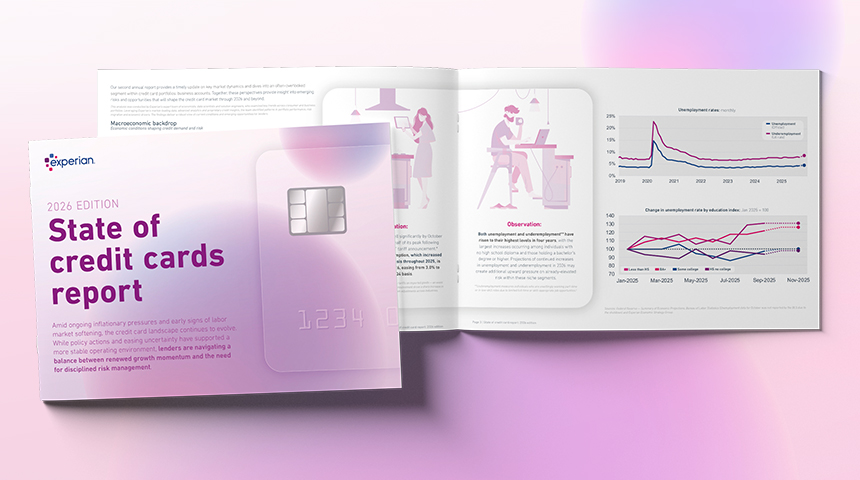
Growth, risk and the rise of "hidden" business accounts As inflation remains elevated and early signs of labor market cooling emerge, the credit card landscape is entering its next phase. Over the past few weeks, policy actions and discussions around potential interest-rate caps have driven increased uncertainty across the credit card industry and broader global markets. Lenders face a careful balancing act: capturing growth opportunities while maintaining disciplined risk oversight. Our second annual State of Credit Cards Report explores the macroeconomic forces influencing the market, key shifts in originations and delinquency trends, and lender mix. New this year, the report also digs into an often‑overlooked segment: business accounts hidden inside consumer credit card portfolios. Additionally, the report offers actionable strategies to help lenders segment risk and drive disciplined growth more effectively. Key insights include: 30+ DPD delinquency rates remained above pre-pandemic levels in 2025, underscoring the need for disciplined asset‑quality monitoring. Fintechs continue to gain ground, posting a 71% YOY increase in account originations.  Business accounts masked in the consumer credit card universe represent roughly 14% of balances and are more than 50% larger than the business card universe — a material segment with distinct risk and profitability dynamics that many lenders are not explicitly managing today. The report also outlines practical strategies to: Identify and segment business behavior within consumer portfolios. Align underwriting and account management with actual usage patterns. Capture targeted growth while protecting long‑term portfolio performance. Ready to dive deeper? Download the full 2026 State of Credit Cards Report to uncover insights that can help your organization manage risk more precisely and grow with confidence. Download report

by Theresa Nguyen 4 min read February 2, 2026

While Experian is known as a trusted source for credit insights, we have built a reputation for helping car shoppers, dealers, and lenders make informed decisions with confidence in the automotive space. Leveraging the value of data is key for identifying the latest trends in markets, behaviors, and industry changes. In fact, Experian’s Automotive Market Trends Report: Q1 2025 revealed the latest shifts in alternative fuel type registrations. Through the first quarter of this year, data found that growth in retail registrations for electric vehicles (EVs) is slowing compared to previous years, reaching 7.8%, down from 7.9% last year and 7.1% the year prior. Meanwhile, hybrids increased to 13.6% of new retail registrations through Q1 2025, from 11.3% through Q1 2024 and 8.8% through Q1 2023. Some of the uptick in hybrids may be attributed to consumers’ concerns with EV charging infrastructure and range anxiety. Hybrids are known to offer practical middle grounds—with the convenience of refueling and not having to plan longer trips around charging availability, this fuel type is becoming a more ideal choice for some. Vehicle preferences continue to vary by age group Through Q1 2025, Gen Z accounted for 14.8% of new retail hybrid registrations and 8.4% of EV registrations, while Millennials made up 15.9% for hybrid and 11.4% for EVs. On the other hand, Baby Boomers were at 16.3% for hybrids and 5.9% for EVs this quarter. Younger generations have naturally gravitated towards the gas-alternative fuel types as it aligns with their current lifestyle, including everyday commuting and the tech-forward features that these vehicles offer. As the automotive industry continues to evolve, staying attuned to the shifting landscape is essential. We’re committed to delivering insights that will help professionals make forward-looking decisions and stay ahead of the curve. To learn more about vehicle market trends, view the full Automotive Market Trends Report: Q1 2025 presentation on demand.

by John Howard 4 min read July 7, 2025