Loading...

The Data You Need for a Win-Win Strategy

Published: January 28, 2019 by Stefani Wendel

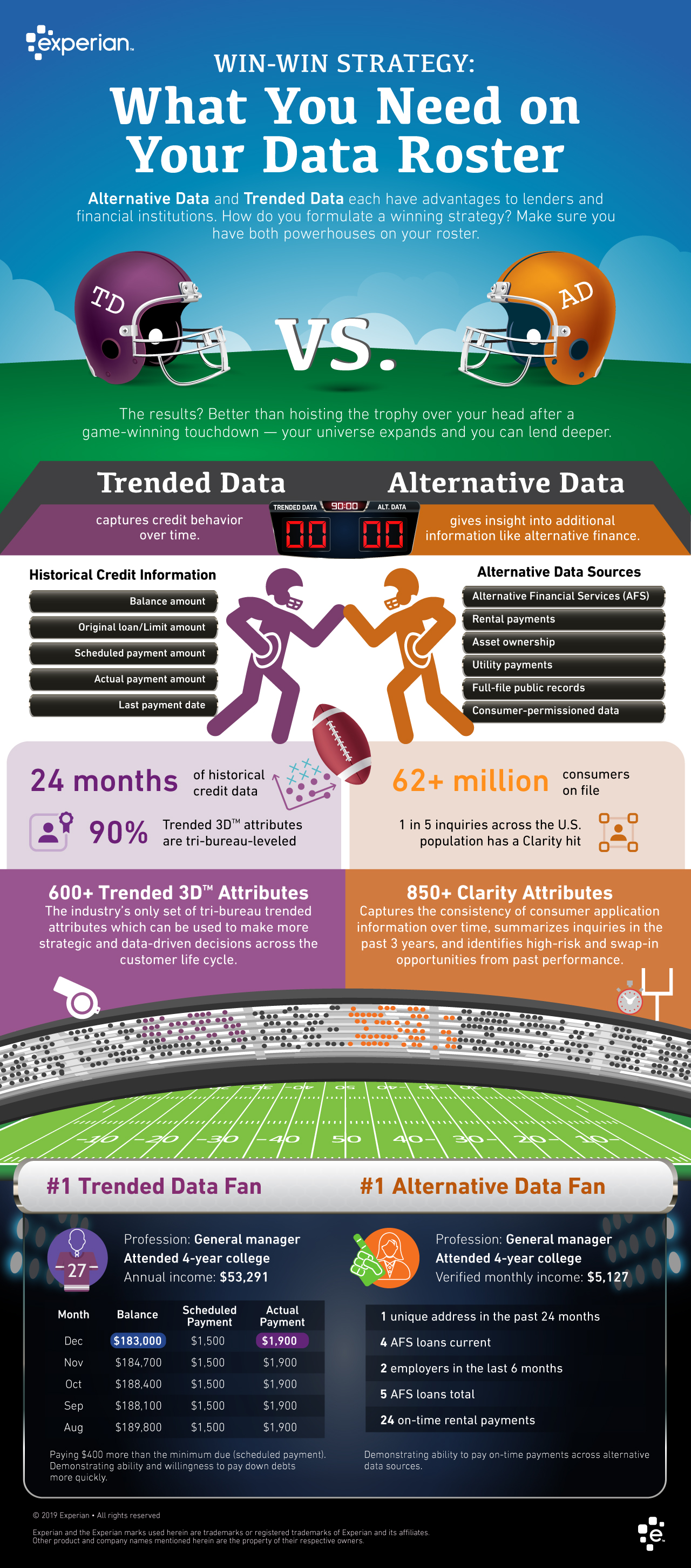
Alternative credit data and trended data each have advantages to lenders and financial institutions. Is there such a thing as the MVD (Most Valuable Data)?
Get Started Today

Alternative Credit Data vs. Trended Data

When it comes to the big game, we can all agree the score is the last thing standing; however, how the two teams arrived at that score is arguably the more important part of the story. The same goes for consumers’ credit scores.

The teams’ past records and highlight reels give insight into their actual past performance, while game day factors beyond the stat sheets – think weather, injury rehab and personal lives – also play a part.

Similarly, consumers’ credit scores according to the traditional credit file may be the dependable source for determining credit worthiness. But, while the traditional credit file is extensive, there is a playbook of other, additional information you can arm yourself with for easier, faster and better lending decisions.

We’ve outlined what you need to create a win-win data strategy:

Alternative credit data and trended data each have unique advantages over traditional credit data for both lenders and consumers alike. How do you formulate a winning strategy? By making sure you have both powerhouses on your roster.

The results?

Better than that game-winning touchdown and hoisting the trophy above your head – universe expansion and the ability to lend deeper.


Get Started Today

Related Posts

Since 1996, The Internal Revenue Service (IRS) has issued more than 27 million individual taxpayer identification numbers (ITINs) –⁠ a 9-digit number used by individuals who are required to file or report taxes in the United States but are not eligible to obtain a Social Security number (SSN). Across the country, ITIN holders are actively contributing to their communities and the U.S. financial system. They pay bills, build businesses, contribute billions in taxes and manage their finances responsibly. Yet despite their clear engagement, many remain underrepresented within traditional lending models.  Lenders have a meaningful opportunity to bridge the gap between intention and impact. By rethinking how ITIN consumers are evaluated and supported, financial institutions can: Reduce barriers that have historically held capable borrowers back Build products that reflect real borrower needs Foster trust and strengthen community relationships Drive sustainable, responsible growth Our latest white paper takes a more holistic look at ITIN consumers, highlighting their credit behaviors, performance patterns and long-term growth potential. The findings reveal a population that is not only financially engaged, but also demonstrating signs of ongoing stability and mobility. A few takeaways include: ITIN holders maintain a lower debt-to-income ratio than SSN consumers. ITIN holders exhibit fewer derogatory accounts (180–⁠400 days past due). After 12 months, 76.9% of ITIN holders remained current on trades, a rate 15% higher than SSN consumers. With deeper insight into this segment, lenders can make more informed, inclusive decisions. Read the full white paper to uncover the trends and opportunities shaping the future of ITIN lending. Download white paper

Published: February 2, 2026 by Theresa Nguyen

Unlock the future of fintech by exploring how alternative data is reshaping decision-making and growth strategies.

Published: January 12, 2026 by Laura Burrows

Learn how Experian's Credit + Cashflow Score leads to a 40% improvement in predictive accuracy compared with conventional credit models. 

Published: November 25, 2025 by Zohreen Ismali