
SUVs Continue to Dominate the Automotive Finance Market in Q1 2022

by Melinda Zabritski 3 min read June 29, 2022

business woman in auto salon. concept of female driver

We witnessed many changes in the automotive industry since the beginning of the pandemic, but one thing that has stayed consistent is consumers’ desire for larger vehicles, such as SUVs and crossover utility vehicles (CUVs). In fact, they have sustained dominance in the automotive finance market for some time now—partly due to the advancements among newer models, such as increased fuel efficiency and additional cargo space.

According to Experian’s State of the Automotive Finance Market Report: Q1 2022, SUVs and CUVs made up 60.38% of total vehicle financing, an increase from 58.95% in Q1 2021.

Since consumer preferences for larger vehicles have become more prominent, we’ve seen the average loan amounts rising for a while—but this has been exacerbated by the pandemic, with inventory shortages and high consumer demand becoming a core challenge in the automotive industry.

In Q1 2022, the average monthly loan payment for a new vehicle was $648, compared to the average monthly lease, which increased to $522. And the average monthly payment for a used vehicle surpassed $500 this quarter, coming in at $503.

Larger vehicles dominate top leased models

While consumers often lean towards used vehicles as they search for the most budget-friendly option, another option to consider is leasing, as they tend to have a lower monthly payment than a loan. In Q1 2022, there was a $126 difference between average monthly payments of a lease and a new loan.

This is why it’s important for professionals to understand the most prevalent leased vehicles on the market and their price points. This enables them to assist consumers when searching for a vehicle that fits their needs and budget.

With consumers opting for larger, more expensive vehicles such as SUVs, CUVs and full-size pickup trucks, it’s no surprise they made up majority of the top 10 leased models in Q1 2022.
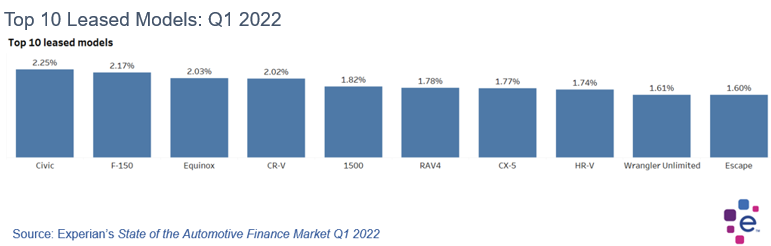
Top 10 leased models Q1 2022

While the Honda Civic made up the highest percentage, it is important to note that it was the only sedan among the top leased vehicles in Q1 2022, accounting for 2.25% of leasing.

It’s really in the new CUVs and SUVs where you can see the difference in monthly payments between a loan and a lease. For instance, the Mazda CX-5 had an average monthly loan payment of $460 this quarter and the average monthly lease payment was $365. While the Chevrolet Equinox was not too far behind, with an average monthly loan payment of $444 and an average monthly lease payment of $319 in Q1 2022.

Consumers have also opted for new CUVs, such as the Honda CR-V, which had an average monthly loan payment of $474 and an average monthly lease payment of $371. Similarly, the Ford Escape had an average monthly loan payment of $436 and the average monthly lease payment was $349.

As we continue to witness automotive financing trends evolve, analyzing the ongoing insights will enable dealers and lenders to help consumers find the most budget-appropriate options in their search for a vehicle that best fits their needs.

To learn more about leasing and other automotive finance trends, watch the entire State of the Automotive Finance Market: Q1 2022 presentation on demand.


Related Posts

How ChexSystems Strengthened Consumer Fraud Monitoring with Experian

Learn how ChexSystems and Experian help financial institutions strengthen consumer fraud monitoring and build customer trust.

August 4, 2026 by Scarlet Nickel
The New Competitive Advantage in Fintech Is a Unified View of the Consumer

Fintech growth is returning, but growth alone is no longer enough to separate market leaders from the rest. The next stage of fintech will be shaped by how well organizations understand the consumers they serve, how accurately they assess risk and how consistently they make decisions across the customer lifecycle. That requires more than speed, more data or a single new model. It requires a unified view of the consumer that brings together identity, credit and behavioral signals into one decisioning strategy. Experian’s 2026 State of Fintech Report identifies partnerships, data and fraud as three forces shaping the next phase of fintech growth. The report also makes a clear point: institutions that integrate these forces into cohesive strategies will be better positioned to grow with confidence. For many fintechs, the challenge is not a lack of innovation. It is the increasing complexity of turning innovation into scalable, explainable and profitable growth. Fintech organizations span a wide range of maturity, from early-stage startups to scaled lenders, and many are experimenting with new products, technologies and customer engagement models at the same time. That creates opportunity, but it also creates pressure to make more disciplined decisions. The market is rewarding institutions that connect product strategy, risk management and customer experience in a more coordinated way. This is why the unified consumer view is becoming so important. It helps fintechs turn fragmented signals into consistent decisions that support both growth and resilience. Why a unified consumer view matters now A unified consumer view means bringing together the signals that define a customer’s identity, credit behavior, financial capacity and risk profile. It moves fintechs away from isolated decision points and toward a more connected picture of the customer across origination, account management and servicing. This matters because consumer behavior is becoming more fluid, fraud is becoming more sophisticated and product strategies are becoming more specialized. A customer may appear strong through one lens and risky through another. An application may pass an onboarding check, but later show behavior that suggests emerging fraud or repayment stress. Without a connected view, those signals may stay trapped in different systems or teams. The 2026 State of Fintech Report highlights this shift across several areas. Fintechs are managing credit cards and unsecured personal loans with greater precision, recognizing that each product requires different strategies and risk controls. Credit cards require ongoing account management because exposure continues after origination. Unsecured personal loans follow a fixed repayment structure, which makes underwriting precision especially important at the point of origination. These differences show why a one-size-fits-all strategy cannot support modern fintech growth. A unified consumer view helps lenders apply the right data, risk framework and customer strategy to the right product at the right time. Siloed decisions create blind spots Many fintechs already use multiple sources of data. They may rely on traditional credit data, alternative data, fraud tools, cash flow information, identity verification and internal account performance data. If those signals are managed separately, the organization may still lack a clear view of the customer. Data can become fragmented. Risk teams can reach different conclusions than fraud teams. Product teams can pursue growth without a full understanding of emerging portfolio pressure. The State of Fintech Report points out that fintech competition is increasingly defined by the ability to align data strategies with decision frameworks. That means data is not just a support function. It is becoming central to growth, risk management and customer experience. Organizations are investing in richer datasets and more advanced analytics, but the differentiator is how effectively those inputs are operationalized. This is where many fintechs still have work to do. The value comes not from any single dataset, but from how signals are layered, interpreted and applied together. For example, a lender may understand a consumer’s credit score, but that does not always reveal broader financial behavior. Cash flow data may add insight into income and expenses, but it needs to be categorized and normalized to support reliable decisions. Identity signals may help detect fraud, but they become more powerful when combined with credit and behavioral data. A unified view brings these inputs together so fintechs can better determine whether a customer represents a growth opportunity, a fraud risk, an emerging credit risk or a borrower who needs a different product experience. Product complexity requires better decisioning The need for a unified consumer view becomes even clearer when looking at how fintechs manage different credit products. Fintech lenders continue to originate approximately 1.5 unsecured personal loans for every one credit card, which reinforces the importance of both products within portfolio strategy. Credit card originations continue to grow moderately while unsecured personal loan originations have slowed after tighter lending standards. These patterns suggest that fintechs are not simply shifting from one product to another. They are becoming more mature in how they manage each product based on its structure, risk profile and consumer use case. Credit cards and installment loans behave differently. Credit cards introduce ongoing exposure and require active account management, line management and monitoring of utilization behavior. Unsecured personal loans carry fixed terms and structured repayment schedules, which makes origination quality especially important. For fintechs, this means product strategy and risk strategy must be tightly connected. The same consumer may need to be evaluated differently depending on the product, loan amount, repayment expectations and observed behavior. A unified consumer view gives lenders the context needed to make those differences actionable. This is also where segmentation becomes more sophisticated. The State of Fintech Report’s loan segmentation framework connects strategy, risk and data advantage across small-dollar, mid-tier and large-ticket loans. Small-dollar lending can support thin-file acquisition, but may require alternative data and stronger identity visibility. Mid-tier lending may involve debt consolidation and cash flow pressure, where transaction insights and trended data can be particularly useful. Large-ticket lending can support higher-value growth, but it also creates greater exposure and may require a fuller combination of credit, fraud and identity signals. This kind of framework helps fintechs align product strategy with risk and data strategy in a more deliberate way. Fraud is making the unified view even more urgent Fraud is another reason fintechs need to move beyond siloed decisioning. Fraud is becoming more complex across the customer lifecycle. Synthetic identities, first-party misuse and AI-driven threats are reshaping the risk landscape. Traditional controls that focus primarily on onboarding are no longer enough. Effective strategies now require continuous monitoring across account access, transactions and servicing. That shift changes how fintechs should think about customer intelligence. Fraud is no longer something that only happens at the point of application. It can emerge later through account behavior, suspicious activity or patterns that look normal when viewed in isolation. Advanced identity signals, including email intelligence, are becoming more central to fraud prevention because they add context that traditional data may not capture. The report also highlights Experian’s acquisition of AtData as part of a broader recognition that email-based identity signals represent a critical layer in digital identity and fraud detection.   The takeaway for fintech leaders is clear. Identity, fraud and credit risk cannot be treated as separate problems. A customer who appears creditworthy may still present identity risk. A fraud signal may also influence credit exposure. A repayment pattern may reflect financial stress, misuse or both. A unified view helps lenders evaluate these signals together so they can make decisions with more confidence and less friction for legitimate customers. Trust is becoming a growth strategy Trust has always mattered in financial services, but fintechs now need to think about trust as a measurable part of decisioning. Customers expect fast applications, seamless experiences and fair outcomes. Regulators and internal governance teams expect transparency, explainability and consistency. Business leaders expect growth without unnecessary exposure. These expectations are difficult to meet when data and decisions are fragmented. The State of Fintech Report’s 2026 action playbook identifies trust as a function of decision accuracy, identity confidence and customer transparency. That framing is important because it moves the conversation beyond speed alone. A fast decision is not valuable if it approves the wrong customer, declines a good customer or creates unnecessary friction in the wrong place. Fintechs should evaluate where friction improves outcomes, such as preventing fraud or identifying risk, and where it creates unnecessary loss of good customers. For many lenders, the path forward is not removing friction everywhere. It is applying the right level of friction at the right moment based on a clearer view of the consumer. This is where unified decisioning becomes a competitive advantage. It allows fintechs to create experiences that feel faster and more relevant while still protecting the portfolio. It supports better segmentation, more informed offers and more consistent risk treatment. It also gives teams a shared understanding of why decisions are made, which is essential as AI and automation become more embedded in lending workflows. What should fintech leaders do next? A unified view of the consumer is not built by adding one more tool or one more dataset. It requires a decisioning strategy that connects data, analytics, fraud, identity and product objectives. Fintech leaders should start by evaluating where their current decisioning frameworks fall short. Are credit and fraud signals looked at together? Are cash flow insights being used consistently? Are identity signals monitored after account opening? Are decisions explainable across teams and channels? The 2026 State of Fintech Report recommends prioritizing experimentation tied to measurable decision lift and model performance. This means testing combinations of credit, alternative, cash flow and identity signals to determine where incremental data improves response rates, approval rates, early-loss reduction and fraud mitigation. It also means treating data and decisioning as connected priorities, with a focus on signal quality, integration and measurable impact. The goal is not to collect more inputs for the sake of volume. The goal is to understand which signals improve outcomes and how those signals should be applied at scale. For fintechs, this is the next competitive frontier. Growth will continue to depend on product innovation, customer acquisition and speed to market. But the lenders that separate themselves will be the ones that can connect those growth priorities to a stronger decisioning foundation. That requires a consumer view that is broader than a credit profile, deeper than a fraud check and more actionable than a data warehouse. It requires a unified framework that helps lenders understand who the customer is, how the customer behaves and how risk may change over time. Download the 2026 State of Fintech Report The next phase of fintech will not be defined by a single innovation. It will be defined by the ability to connect identity, credit and behavioral data into more confident decisions across the full customer lifecycle. Fintechs that build this unified view will be better positioned to grow, manage risk and strengthen customer trust in a more complex market. To explore the trends shaping fintech growth and decisioning in 2026, download Experian’s 2026 State of Fintech Report. Read now To learn more about how Experian partners with fintechs, visit www.experian.com/fintech. Learn more

August 4, 2026 by Laura Davis
The Conversion Problem: Why Only 1 in 3 Mortgage Shoppers Close (and How to Fix It) 

Discover why only 1 in 3 mortgage shoppers close and how lenders can improve conversion using borrower readiness signals, alternative data and AI-driven insights.

August 3, 2026 by Royce Chang

Subscribe to our Newsletter

Enter your name and email for the latest updates.

This site is protected by reCAPTCHA and the Google Privacy Policy and Terms of Service apply.

Subscribe to our Newsletter

Don't miss out on the latest industry trends and insights!
Subscribe
