Financial Services

Customers rarely announce their departure. Instead, they quietly reduce engagement, move deposits and explore competing offers. By the time attrition shows up in reporting, competitors may have already captured meaningful wallet share. For lenders, the risk isn’t just lost accounts, it’s silent revenue erosion within relationships that still appear intact. The hidden risk in your portfolio Today’s consumers often hold less than half of their deposits or loans with a single provider. At the same time: Competition for prime borrowers continues to intensify. Cross-sell remains one of the most effective and efficient growth strategies available. Even small improvements in retention can drive outsized profitability gains. The opportunity is real, but only if you can see momentum early and act before competitors do. From static reviews to strategic signals Traditional monthly and quarterly reviews confirm what has already happened, but they rarely surface early indicators like emerging behavioral shifts or improving credit capacity. Modern portfolio management requires continuous visibility into behavioral signals, trended credit data and event-based triggers that highlight change as it happens. When you can see momentum forming, you can act with precision, intervene before balances leave, engage customers as capacity strengthens, and activate compliant prescreen cross-sell campaigns at the right moment. Our new interactive strategic snapshot outlines the modern approach to portfolio management, one that connects ongoing account review with timely, event-based signals, helping you protect, retain and grow high-value customers. Download it now to see how to turn early signals into stronger customer lifetime value. Read the snapshot

Smaller creditors often struggle to access reliable credit‑reporting solutions, as many available options frequently require technical integration, such as full Application Programming Interface (API) implementation or enterprise‑level approvals, creating barriers that small lenders cannot easily overcome. Minimum volume requirements further intensify the challenge, forcing smaller creditors to pay disproportionately high costs for the limited number of reports they need. As a result, the financial burden and operational complexity restrict their ability to compete, hindering growth and preventing them from adopting the same efficient, data‑driven processes available to larger institutions. Experian fully recognizes the need to empower smaller creditors and is proud to introduce a new capability, Experian Express, designed with these creditors in mind. Experian Express is a digital onboarding portal that fast-tracks the credentialing process for smaller creditors to gain access to Experian’s Credit Profile Report for the purpose of extending credit. Via a fully digital online process, users can choose from two plans tailored to the needs of community banks and credit unions. A new opportunity to build high-value relationships With Experian Express, credit unions and community banks can offer benefits to both consumer and business customers seeking access to credit. Consumers and businesses want more digital convenience, and a primary institution that can meet their needs in one place, as more than half of consumers who switch their primary bank hold over four checking relationships¹ and 55% of U.S. consumers say mobile apps are their most‑used method for managing bank accounts,² while customers across all age groups are curating financial services from multiple providers due to digital gaps at their primary institutions.³ Community banks and credit unions that offer integrated digital credit products, faster onboarding, and personalized advice can convert today’s rising credit demand into long-term, primary relationships rather than one-off loan transactions. What is the value of the opportunity for capturing more consumer and business relationships? Both consumers and businesses are showing strong signals of growth in their demand for credit. Consumer demand for credit in 2026 represents $52.6B annualized,4 when converting the Federal Reserve’s latest growth pace into a reachable opportunity for community banks and credit unions in today’s market. Elevated new business formation presents an opportunity to build more relationships, as a growing majority of small businesses have been in operation for less than 2 years and have little credit history. New small businesses often use the business owner’s personal credit to access capital for growth. Younger businesses are accounting for a growing portion of newly opened commercial accounts. In 2025, businesses under 2 years old accounted for 36% of new commercial accounts.5 It is important to recognize that customer composition is changing as new business formation rises, with solopreneurs and gig workers making up a growing majority of new small businesses. Smaller lenders like credit unions and community banks, which serve as the backbone of Main Street, should prioritize this demographic as the divide between consumer and business customers in their portfolios continues to blur. Taking advantage of the new wave of customers while mitigating fraud More customers demand digital experiences; however, Experian’s 2026 Global Future of Fraud Forecast shows that artificial intelligence (AI) is simultaneously enabling an unprecedented escalation in fraud. Fraud losses are rising sharply: nearly 60% of companies reported increased fraud from 2024 to 2025, and consumers lost more than $12.5 billion to fraud in 2024 alone.⁶ Experian warns that fraudsters are rapidly weaponizing agentic AI to launch autonomous, harder‑to‑detect digital attacks, creating “machine‑to‑machine mayhem” as transactions occur without clear ownership or liability.⁷ Generative‑AI–enabled deepfakes are also accelerating, allowing fraudsters to impersonate job candidates, bypass identity checks, and infiltrate sensitive systems at scale.⁷ In addition, as most small businesses are newly formed with little credit history, up to 46% of small business loan applications show signs of first-party fraud, commonly known as first payment default, such as misrepresented revenue or business details. 7 The misrepresentation of financial information by new business customers creates a unique issue for creditors as they face a wave of first-payment defaults. As digital adoption grows, businesses and consumers face an environment where fraud is not only faster and more scalable but increasingly woven into everyday digital interactions. How can firms take advantage of the new wave of business customers while protecting their portfolios? In a world where fragmented data and siloed systems hinder accurate decision-making, a unified approach to scoring for both creditworthiness and fraud signals offers a solution. Whether dealing with a consumer or a small business looking for access to credit, relationships with customers represent a new form of digital currency that provides long-term value. Need to find a way to grow your business and consumer accounts? Start by using the right data to better understand their needs and easily upsell your existing customers. Seeing the whole picture of your customers is the key to outperforming competitors. To stay competitive, community banks and credit unions must act with laser precision to block fraudsters and unlock credit for underserved, yet high-potential, consumer and small business customers. Now it is easier than ever to gain an edge with Experian’s vast datasets, which provide depth and accuracy to deliver unmatched insights for confident decision-making through Credit Profile Reports. Community banks and credit unions can use Experian Express’ tailored annual plans, which include fraud prevention tools, to gain access to Experian’s Credit Profile Reports and better understand the creditworthiness of a consumer applying for credit or a small business owner’s personal credit to enhance their ability to get access to credit. Lenders can use Experian Express as a bridge to access Experian’s credit solutions online to perform credit checks. Ready to start a conversation? Learn more about Experian Express

For many banks, first-party fraud has become a silent drain on profitability. On paper, it often looks like classic credit risk: an account books, goes delinquent, and ultimately charges off. But a growing share of those early charge-offs is driven by something else entirely: customers who never intended to pay you back. That distinction matters. When first-party fraud is misclassified as credit risk, banks risk overstating credit loss, understating fraud exposure, and missing opportunities to intervene earlier. In our recent Consumer Banker Association (CBA) partner webinar, “Fraud or Financial Distress? How to Differentiate Fraud and Credit Risk Early,” Experian shared new data and analytics to help fraud, risk and collections leaders see this problem more clearly. This post summarizes key themes from the webinar and points you to the full report and on-demand webinar for deeper insight. Why first-party fraud is a growing issue for banks Banks are seeing rising early losses, especially in digital channels. But those losses do not always behave like traditional credit deterioration. Several trends are contributing: More accounts opened and funded digitally Increased use of synthetic or manipulated identities Economic pressure on consumers and small businesses More sophisticated misuse of legitimate credentials When these patterns are lumped into credit risk, banks can experience: Inflation of credit loss estimates and reserves Underinvestment in fraud controls and analytics Blurred visibility into what is truly driving performance Treating first-party fraud as a distinct problem is the first step toward solving it. First-payment default: a clearer view of intent Traditional credit models are designed to answer, “Can this customer pay?” and “How likely are they to roll into delinquency over time?” They are not designed to answer, “Did this customer ever intend to pay?” To help banks get closer to that question, Experian uses first-payment default (FPD) as a key indicator. At a high level, FPD focuses on accounts that become seriously delinquent early in their lifecycle and do not meaningfully recover. The principle is straightforward: A legitimate borrower under stress is more likely to miss payments later, with periods of cure and relapse. A first-party fraudster is more likely to default quickly and never get back on track. By focusing on FPD patterns, banks can start to separate cases that look like genuine financial distress from those that are more consistent with deceptive intent. The full report explains how FPD is defined, how it varies by product, and how it can be used to sharpen bank fraud and credit strategies. Beyond FPD: building a richer fraud signal FPD alone is not enough to classify first-party fraud. In practice, leading banks are layering FPD with behavioral, application and identity indicators to build a more reliable picture. At a conceptual level, these indicators can include: Early delinquency and straight-roll behavior Utilization and credit mix that do not align with stated profile Unusual income, employment, or application characteristics High-risk channels, devices, or locations at application Patterns of disputes or behaviors that suggest abuse The power comes from how these signals interact, not from any one data point. The report and webinar walk through how these indicators can be combined into fraud analytics and how they perform across key banking products. Why it matters across fraud, credit and collections Getting first-party fraud right is not just about fraud loss. It impacts multiple parts of the bank. Fraud strategy Well-defined quantification of first-party fraud helps fraud leaders make the case for investments in identity verification, device intelligence, and other early lifecycle controls, especially in digital account opening and digital lending. Credit risk and capital planning When fraud and credit losses are blended, credit models and reserves can be distorted. Separating first-party fraud provides risk teams a cleaner view of true credit performance and supports better capital planning. Collections and customer treatment Customers in genuine financial distress need different treatment paths than those who never intended to pay. Better segmentation supports more appropriate outreach, hardship programs, and collections strategies, while reserving firmer actions for abuse. Executive and board reporting Leadership teams increasingly want to understand what portion of loss is being driven by fraud versus credit. Credible data improves discussions around risk appetite and return on capital. What leading banks are doing differently In our work with financial institutions, several common practices have emerged among banks that are getting ahead of first-party fraud: 1. Defining first-party fraud explicitly They establish clear definitions and tracking for first-party fraud across key products instead of leaving it buried in credit loss categories. 2. Embedding FPD segmentation into analytics They use FPD-based views in their monitoring and reporting, particularly in the first 6–12 months on book, to better understand early loss behavior. 3. Unifying fraud and credit decisioning Rather than separate strategies that may conflict, they adopt a more unified decisioning framework that considers both fraud and credit risk when approving accounts, setting limits and managing exposure. 4. Leveraging identity and device data They bring in noncredit data — identity risk, device intelligence, application behavior — to complement traditional credit information and strengthen models. 5. Benchmarking performance against peers They use external benchmarks for first-party fraud loss rates and incident sizes to calibrate their risk posture and investment decisions. The post is meant as a high-level overview. The real value for your teams will be in the detailed benchmarks, charts and examples in the full report and the discussion in the webinar. If your teams are asking whether rising early losses are driven by fraud or financial distress, this is the moment to look deeper at first-party fraud. Download the report: “First-party fraud: The most common culprit” Explore detailed benchmarks for first-party fraud across banking products, see how first-payment default and other indicators are defined and applied, and review examples you can bring into your own internal discussions. Download the report Watch the on-demand CBA webinar: “Fraud or Financial Distress? How to Differentiate Fraud and Credit Risk Early” Hear Experian experts walk through real bank scenarios, FPD analytics and practical steps for integrating first-party fraud intelligence into your fraud, credit, and collections strategies. Watch the webinar First-party fraud is likely already embedded in your early credit losses. With the right analytics and definitions, banks can uncover the true drivers, reduce hidden fraud exposure, and better support customers facing genuine financial hardship.

Financial services leaders are dealing with numerous pressures at the same time. These growing challenges for financial services organizations include sophisticated fraud, rapid Artificial Intelligence (AI) adoption without clear regulatory direction, rising customer expectations and the need for compliant, sustainable growth. Businesses are rethinking how they manage risk, growth and customer trust. These financial industry challenges are no longer confined to internal risk teams. They directly impact long-term customer loyalty. How organizations navigate these challenges will determine how effectively they deliver value to their customers. We’ve outlined the six challenges for financial services oranizations that consistently rank highest among industry leaders today. Challenge 1: Fraud is becoming harder to detect and eroding customer trust 72% of business leaders expect AI-generated fraud and deepfakes to be major challenges by 20261 As fraud tactics evolve quickly, driven in part by AI, customers are being targeted through identity-based attacks from account takeovers to synthetic identities and misuse of personal information. When these threats go undetected, or when legitimate activity is incorrectly flagged, the result isn’t just financial loss. It’s a breakdown of trust. Organizations that want to stay ahead must move beyond isolated fraud controls. By embedding identity management and monitoring into the customer experience, organizations can move from reactive fraud response to proactive identity protection. Identity theft protection and monitoring help organizations turn fraud prevention into a visible, trust-building experience for customers — offering early alerts, guidance, and peace of mind when identity risks arise. Challenge 2: AI decisions must be trusted by customers, not just regulators 76% of businesses say implementing responsible AI is one of their biggest challenges2 As AI becomes more embedded in financial services, it shapes the experiences customers see every day. From credit decisions to eligibility outcomes and personalized offers. While AI can drive faster and more inclusive decisions, it also introduces a new expectation: customers want to understand why a decision was made. Responsible AI is no longer just about regulatory compliance. It’s about delivering outcomes that feel fair, consistent and easy to understand. When decisions appear unclear, confidence erodes. When organizations can clearly explain outcomes, not just internally, they build confidence across regulators, partners and customers. This allows AI to scale responsibly while reinforcing trust in every interaction. Financial wellness tools such as credit scores, reports and education help make AI-driven decisions more transparent, giving customers clarity into outcomes and confidence in how their financial health is assessed. Challenge 3: Digital experiences are failing to deliver clarity and confidence 57% of U.S. consumers remain concerned about conducting activities online3 Customer confidence is affected by day-to-day interactions such as onboarding, payments and issue resolution. Inconsistent decisions, unclear outcomes and friction in digital journeys can quickly erode confidence and increase confusion, disengagement and abandonment. Financial services leaders will need to rebuild and strengthen confidence. Improving key decision points with better data and analytics helps ensure customers receive timely insights, understandable outcomes and meaningful guidance, turning everyday interactions into opportunities to build stronger relationships. By delivering ongoing financial wellness insights and education, organizations can replace confusion with clarity — helping consumers better understand their financial standing and stay engaged over time. Challenge 4: Gen Z continues to raise the bar It's no secret that Gen Z stands out for its strong preference for digital financial services and digital interactions, but Gen Z is also pushing the envelope on financial wellness. 48% of Gen Z report that they do not feel financially secure, indicating strong demand for financial support and tools4 Their expectations for instant decisions, seamless digital experiences, transparency and tools that help them manage their financial lives are quickly becoming the baseline. To meet and exceed these expectations, financial institutions will need to support real-time, data-driven decisioning that adapt to individual needs. Delivering modern, app-like financial experiences, without compromising risk management. Increasingly, organizations are meeting Gen Z expectations by offering financial wellness and protection tools through employee benefits, supporting everyday financial confidence beyond traditional compensation. Challenge 5: Limited data limits meaningful consumer engagement 62 million U.S. consumers are thin-file or credit invisible under traditional credit scoring.5 Growth will always be a priority, but it must be responsible and inclusive. Traditional credit data alone often provides an incomplete picture of consumer financial behavior, limiting visibility and making it harder to confidently expand access. By incorporating alternative and expanded data, organizations can gain a more holistic view of consumers. This broader perspective supports smarter decisions, personalized insights and more inclusive engagement, which enables growth while maintaining compliance and managing risk responsibly. Expanded data supports more personalized financial wellness experiences, enabling organizations to provide relevant insights, responsible access and guidance tailored to individual consumer needs. Challenge 6: Disconnected decisions create inconsistent customer experiences Increasingly, fintech leaders are moving toward unified risk and decisioning strategies to deliver more personalized experiences6 While customers interact with a single institution, decisions are often made across disconnected data sources, systems and teams. These silos create inconsistent experiences, slow responses and operational complexities that customers feel directly through conflicting messages and uneven outcomes. Experian helps organizations break down these silos by unifying data, analytics and decisioning across the enterprise. When data incidents occur, integrated experiences enable faster data breach resolution, helping consumers understand what happened, take action, and recover with confidence. Looking ahead These challenges for financial services organizations are not emerging; they’re already here and reshaping how financial institutions engage with consumers. Leaders who proactively address financial industry challenges by connecting data, analytics, and responsible AI are better positioned to deliver trusted, transparent and meaningful experiences. Learn More References:1. https://www.experian.com/blogs/insights/2025-identity-fraud-report2. https://www.techradar.com/pro/businesses-are-struggling-to-implement-responsible-ai-but-it-could-make-all-the-difference3. https://www.experian.com/blogs/insights/2025-identity-fraud-report4. https://www.deloitte.com/global/en/issues/work/genz-millennial-survey.html5. https://www.experian.com/thought-leadership/business/the-roi-of-alternative-data6. https://us-go.experian.com/2025-state-of-fintech-report?cmpid=IM-2025-state-of-fintech-report-livesocial-share

Since 1996, The Internal Revenue Service (IRS) has issued more than 27 million individual taxpayer identification numbers (ITINs) – a 9-digit number used by individuals who are required to file or report taxes in the United States but are not eligible to obtain a Social Security number (SSN). Across the country, ITIN holders are actively contributing to their communities and the U.S. financial system. They pay bills, build businesses, contribute billions in taxes and manage their finances responsibly. Yet despite their clear engagement, many remain underrepresented within traditional lending models. Lenders have a meaningful opportunity to bridge the gap between intention and impact. By rethinking how ITIN consumers are evaluated and supported, financial institutions can: Reduce barriers that have historically held capable borrowers back Build products that reflect real borrower needs Foster trust and strengthen community relationships Drive sustainable, responsible growth Our latest white paper takes a more holistic look at ITIN consumers, highlighting their credit behaviors, performance patterns and long-term growth potential. The findings reveal a population that is not only financially engaged, but also demonstrating signs of ongoing stability and mobility. A few takeaways include: ITIN holders maintain a lower debt-to-income ratio than SSN consumers. ITIN holders exhibit fewer derogatory accounts (180–400 days past due). After 12 months, 76.9% of ITIN holders remained current on trades, a rate 15% higher than SSN consumers. With deeper insight into this segment, lenders can make more informed, inclusive decisions. Read the full white paper to uncover the trends and opportunities shaping the future of ITIN lending. Download white paper
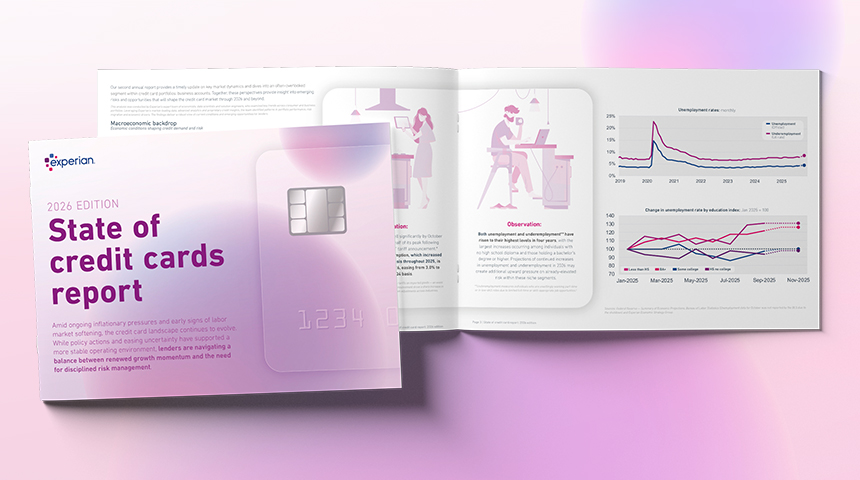
Growth, risk and the rise of "hidden" business accounts As inflation remains elevated and early signs of labor market cooling emerge, the credit card landscape is entering its next phase. Over the past few weeks, policy actions and discussions around potential interest-rate caps have driven increased uncertainty across the credit card industry and broader global markets. Lenders face a careful balancing act: capturing growth opportunities while maintaining disciplined risk oversight. Our second annual State of Credit Cards Report explores the macroeconomic forces influencing the market, key shifts in originations and delinquency trends, and lender mix. New this year, the report also digs into an often‑overlooked segment: business accounts hidden inside consumer credit card portfolios. Additionally, the report offers actionable strategies to help lenders segment risk and drive disciplined growth more effectively. Key insights include: 30+ DPD delinquency rates remained above pre-pandemic levels in 2025, underscoring the need for disciplined asset‑quality monitoring. Fintechs continue to gain ground, posting a 71% YOY increase in account originations. Business accounts masked in the consumer credit card universe represent roughly 14% of balances and are more than 50% larger than the business card universe — a material segment with distinct risk and profitability dynamics that many lenders are not explicitly managing today. The report also outlines practical strategies to: Identify and segment business behavior within consumer portfolios. Align underwriting and account management with actual usage patterns. Capture targeted growth while protecting long‑term portfolio performance. Ready to dive deeper? Download the full 2026 State of Credit Cards Report to uncover insights that can help your organization manage risk more precisely and grow with confidence. Download report

Rental affordability in the U.S. isn’t just about rising prices—it’s about where those increases are happening. Some cities and states are becoming increasingly unaffordable compared to others, and renters are feeling the financial pressure differently across the country. Not all rent increases are equal National rent prices have increased by about 16% in two years, but where you live plays a huge role in how much of your paycheck goes toward housing. In places like California and Massachusetts, the average renter now spends over 56% of their income on rent. That’s nearly double the “affordable” threshold of 30%. But even traditionally affordable states are feeling the heat. Oklahoma, Kentucky, and Louisiana all saw rent hikes between 6% and 10%—with Oklahoma topping out at 9.7%. These increases are hitting renters in places that used to be considered “safe” from housing inflation. Regional breakdown: Here’s how the rent-to-income ratio compares across regions: West: Rent-to-income ratio of 46.4% Northeast: 48.1% South: 43% (but fastest-growing burden) Midwest: 37.7% (still below the national average, but climbing fast) Florida, for example, saw its rent-to-income ratio jump by 12.1% since 2023. Arizona isn’t far behind, with an 11.7% increase. These changes are tied to migration patterns—many people moved to these states during the pandemic, and now demand is far outpacing supply. City-level surprises Some of the biggest rent increases are happening in cities you might not expect: Miami, FL: Up 21.1% YOY Kansas City, MO: Up 16.7% Louisville, KY: Up 14.2% Chicago, OH: Up 13% On the flip side, a few cities have seen rent drops: Jacksonville, FL: Down 3% Atlanta, GA: Down 2.2% Austin, TX: Essentially flat These shifts show how local economic factors and population trends can quickly change a market’s affordability. More renters are moving—and struggling to settle Another sign of pressure: renters are on the move. The percentage of renters with more than one lease has jumped since 2023, especially among Gen X and older millennials. People are relocating more often—sometimes chasing affordability, sometimes being priced out. At the same time, vacancy rates are rising—from 6.6% to 7.1% nationally. That may sound good for renters, but it’s often a sign of mismatch: more units are being built, but not always where people can afford them. The bottom line If you’re a landlord or investor, these geographic insights matter. Rent pressure isn’t universal—but knowing where it’s concentrated can help you adjust screening, pricing, and retention strategies. For renters, this means being more informed and prepared before moving or signing a lease. In our final post, we’ll explore the macro trends shaping the future—like mortgage rates, construction slowdowns, fraud risks, and how better data is helping landlords and lenders keep up.
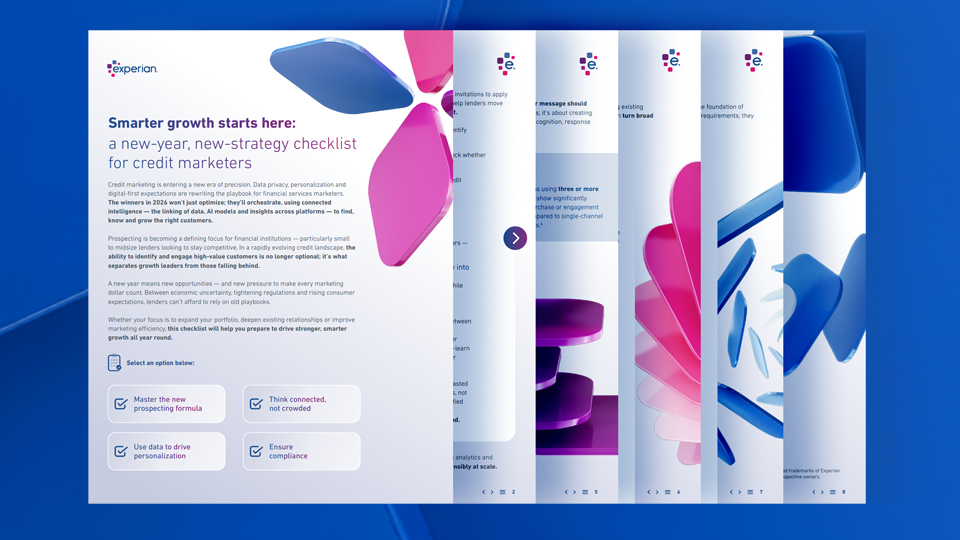
Credit marketing is entering a new era of precision. Data privacy, personalization and digital-first expectations are rewriting the playbook for financial services marketers. The winners in 2026 won’t just optimize; they’ll orchestrate, using connected intelligence — the linking of data, AI models and insights across platforms — to find, know and grow the right customers. Our latest checklist breaks down what it takes to compete in this new environment, including how to: Master the new prospecting formula Use data to drive personalization at scale Create cohesive, compliant messaging across channels Whether your focus is to expand your portfolio, deepen existing relationships or improve marketing efficiency, this checklist can help you drive stronger, smarter growth all year round. And if you're interested in diving deeper, register for our upcoming webinar on January 15, 2026 to hear directly from Experian experts. Access checklist Register for webinar

In today’s fast-evolving digital landscape, fraud prevention is no longer a reactive function, it’s a strategic imperative. As financial institutions, fintechs and government agencies face increasingly sophisticated threats, the need for scalable, transparent and AI-powered solutions has never been greater. Experian stands at the forefront of this transformation, delivering proven technology, unmatched data intelligence and regulatory-ready innovation that empowers organizations to stay ahead of fraud. One platform. Every fraud challenge. Experian’s fraud prevention ecosystem delivers scale, speed and sophistication. Unlike fragmented solutions that require patchwork integrations, Experian offers a unified platform that spans the entire fraud lifecycle from identity verification to transaction monitoring and case management. With the exciting acquisition of NeuroID, Experian is delivering more value than ever before with our shared commitment to staying ahead of emerging fraud threats. Embedding NeuroID’s behavioral expertise into Experian’s data systems and platforms is transformative. Together, we’re redefining what fraud prevention can look like in a real-time, AI-driven world. – Kathleen Peters, Chief Innovation Officer, Experian With tools like NeuroID, FraudNet and Precise ID, Experian delivers real-time decisioning and orchestration across diverse use cases. These technologies are not just buzzwords, they’re battle-tested engines driving measurable impact across millions of daily decisions. Data dominance that drives accuracy Experian’s proprietary datasets and global consortia provide unparalleled access to fraud intelligence. This data advantage enables clients to detect anomalies faster, reduce false positives and optimize fraud strategies with precision. Experian supports over five billion fraud events annually across the largest banks, fintechs and government agencies. That’s 10x more fraud and identity use cases than most competitors can manage across industries and institutions of all sizes. AI innovation with guardrails While many vendors are just beginning to explore AI, Experian has spent the last two decades embedding it into its core products and services. The launch of the Experian Assistant for Model Risk Management exemplifies this commitment. Integrated into the Ascend Platform and powered by ValidMind technology, this AI assistant streamlines model governance, enhances auditability, and accelerates deployment, all while remaining compliant with evolving regulations. Experian’s AI is not a black box. It’s explainable, auditable and developed with governance in mind. This transparency gives clients the confidence to innovate without compromising compliance. Compliance is built in, not bolted on Experian’s solutions are designed with compliance at the core. From FCRA and GLBA to KYC and CIP, Experian has a long-standing track record of aligning with regulatory frameworks. The company’s ability to demystify machine learning and make it transparent and explainable sets it apart in an industry where trust is paramount. As AI adoption accelerates, Experian’s governance models ensure that innovation doesn’t outpace accountability. Clients benefit from automated documentation, synthetic data generation and model transparency which are all essential for navigating today’s complex regulatory landscape. Empowering clients to own their outcomes Experian doesn’t just deliver tools, it empowers users. With self-service model building, clients can customize fraud strategies, optimize performance, and respond to threats in real time. This flexibility ensures that organizations aren’t just reacting to fraud, they’re proactively shaping their defenses. Experian’s fraud prevention solutions are designed to be intuitive, scalable, and user-centric, enabling teams to make smarter decisions faster. A global brand you can trust Trust is earned, not claimed. Experian’s decades-long commitment to data stewardship, innovation and client success has made it a globally recognized authority in fraud prevention. With thousands of enterprise clients and strategic partnerships, Experian delivers unmatched reliability and scale. From supporting the largest financial institutions to enabling fintech startups, Experian’s infrastructure is built to manage complexity with confidence. Thought leadership that moves the industry Experian continues to lead the conversation on fraud prevention and identity verification. As a sponsor of the 2025 Federal Identity Forum & Expo, Experian showcased its latest innovations in behavioral analytics and fraud detection, helping government agencies stay ahead of evolving threats. The company’s U.S. Identity & Fraud Report, now in its tenth year, provides actionable insights into shifting fraud patterns and consumer behavior reinforcing Experian’s role as a trusted thought leader. In a market flooded with noise, Experian delivers clarity. Its unified fraud prevention platform, backed by decades of AI innovation and regulatory expertise, empowers organizations to protect their customers, optimize operations, and lead with confidence. Experian isn’t just keeping up with the future of fraud prevention, it’s defining it. Learn more
Every credit decision relies on data, but traditional credit information may capture only part of a consumer’s financial story. Some of that story is reflected in credit reports, the loans repaid, the cards managed, and the steady progress toward financial goals. Others live quietly in bank statements and transaction histories, like the rent paid on time, the savings set aside, and the bills managed responsibly. Yet for millions of consumers, that second story has rarely been part of the credit conversation. Expanding the credit conversation can give lenders and financial institutions an edge, helping them separate genuine risk from missed opportunity. In a lending environment defined by volatility and evolving consumer habits, having a more complete picture of each applicant can help make the difference between sustainable growth and risk management. At the same time, open-banking frameworks and consumer-permissioned data have made it possible to understand financial health more clearly than traditional models. That’s where Experian’s Credit + Cashflow Score comes in. A unified view of credit and cash flow The Credit + Cashflow Score is the first-of-its-kind model combining multiple data sources into a single score. Based on our pre-production analytics, early results demonstrate a 40% improvement in predictive accuracy compared with conventional credit models. It unites our proprietary and industry-leading credit data, alternative credit insights, 24 months of trended behavior, and consumer-permissioned cashflow information into a single score ranging from 300 to 850.* This goes beyond cashflow-augmented models that rely primarily on transaction data layered over credit files. The result is a data-rich assessment of creditworthiness that allows lenders to strengthen portfolio performance, maintain disciplined risk management, and help identify qualified borrowers that traditional credit models might overlook. Better risk control and stronger growth Today’s lending landscape is being reshaped by rising interest rates, increased capital costs, and heightened regulatory oversight. These pressures are prompting institutions to tighten underwriting standards and reassess risk strategies as they navigate an uncertain economy. At the same time, competition for qualified borrowers continues to intensify, creating pressure to drive sustainable growth without compromising credit quality. Meanwhile, on the consumer side, people are earning income through gig work or multiple income streams and using alternative financial products. According to our recent market estimates, 62 million U.S. consumers are thin-file or credit-invisible1. This is making it harder for lenders to assess true financial capacity using credit data alone. Traditional credit scores continue to remain important, but they can potentially miss key indicators of stability and affordability that appear only in transactional data. The Credit + Cashflow Score bridges that gap, helping enable lenders to expand approvals responsibly while maintaining disciplined risk management. See what's next As credit markets continue to evolve, lenders are looking for new ways to balance growth with risk. Having the whole financial picture may allow organizations to grow stronger portfolios, reach more qualified borrowers, and bring financial opportunity to more people. Partner with Experian to leverage decades of credit expertise, the nation’s largest alternative credit bureau, and industry-leading open-banking solutions to help lenders innovate responsibly. The Credit + Cashflow Score is built to deliver measurable performance lift, model transparency, and ease of integration through the Experian Ascend Platform. Learn more about the Experian Credit + Cashflow Score * New score available in pre-production for analytics 1https://www.experian.com/thought-leadership/business/the-roi-of-alternative-data

Debt collection is rapidly evolving. Traditional methods are becoming increasingly ineffective as consumer preferences shift, regulations tighten and operational inefficiencies lead to bottlenecks.Agencies and debt buyers that rely on outdated strategies are experiencing the consequences: lower recovery rates, increased compliance risks and weaker consumer engagement. However, there’s good news — modern tools, powered by advanced data, analytics and digital platforms, are transforming these challenges into opportunities. Common collections challenges: Real-world scenarios In our latest e-book, we examine four fictional scenarios that illustrate how collections teams are addressing today’s primary challenges by updating their methods. Here’s a preview: Smarter segmentation = Higher recovery: Sally, head of collections at Midwest Debt Solutions, realized her team’s one-size-fits-all approach was costing them. By adopting advanced segmentation powered by data and analytics, she shifted her focus from chasing low-value accounts to targeting those most likely to repay, boosting recovery rates and team morale. Better data in, better decisions out: Jerry, a risk analyst at Bay & Associates, relied on a legacy credit model that overlooked crucial alternative signals. By incorporating trended credit data, utility payments and behavioral signals, his team significantly enhanced their prioritization approach and forecasting accuracy. Modern engagement for the modern consumer: John, a collections agent, was having trouble reaching consumers through traditional methods, such as phone calls and letters. With a digital self-service platform, John’s team gained real-time insight into engagement preferences and was able to connect through the channels consumers use, like SMS and email. Personalization at scale: Rachel, an account manager at Union Collections, knew manual processes were slowing her team down. By implementing personalized communications and multichannel outreach, they enhanced consumer experiences, increased repayment rates and minimized compliance risks — all while saving time. Why it matters These scenarios share a common thread: with the right tools, data and strategy, collections teams can turn today’s pain points into measurable progress. At Experian®, we help agencies: Prioritize accounts more effectively with advanced segmentation. Make smarter predictions using dynamic, modern scoring models. Streamline operations with self-service platforms and automation. Strengthen consumer relationships with personalized outreach. Download the e-book Want to dive deeper into each use case? Access the full e-book to learn how forward-thinking agencies are adapting their collections strategies to recover more, spend less and build stronger consumer relationships. Download the e-book

Buy now, pay later (BNPL) has rapidly matured into a $175 billion market in the U.S. alone, according to PYMNTS, reshaping how consumers approach short-term financing. While early BNPL adoption was often associated with younger, higher-risk borrowers, recent data paints a far more nuanced and encouraging picture. Today’s BNPL consumers are showing signs of financial responsibility, planning, and discipline — offering lenders new opportunities to empower financial futures. BNPL adoption is widening Though Millennials and Gen Z remain the largest user base, usage among Gen X and Baby Boomers continues to grow steadily. Between 2021 and 2025, BNPL adoption among Gen X is projected to rise by 13.7%, and by 8.6% for Baby Boomers. According to a Morgan Stanley report, much of this growth is being fueled by the perceived ease and predictability of BNPL terms. In fact, Experian research1 shows 41% of U.S. adults have used BNPL, with nearly half of those users tapping into the service once a month or more. This increased use of BNPL appears to reflect that BNPL has moved from a niche payment option to a mainstream financial tool. The rise of intentional and responsible spending Contrary to outdated perceptions, most BNPL users are not overleveraged impulse spenders. Instead, Experian data shows: 73% of BNPL users report making payments on time and as agreed.2 75% cite convenience and flexible payments as their primary motivations.3 The desire for control and flexibility is a consistent behavioral theme. Investopedia notes that leading BNPL platforms are leaning into this demand by offering budgeting tools and automatic payment reminders. Why this shift matters for lenders When BNPL data becomes available to lenders, the data it generates will offer a powerful lens into consumer behavior. Beyond challenging old assumptions, these insights can be leveraged to strengthen risk assessment, identify new growth opportunities, and serve consumers who may otherwise be overlooked: Enriched credit risk models BNPL payment data can add an additional layer of insight into consumers’ financial health and behaviors. By integrating this information into their underwriting process, lenders can more accurately assess risk. Serving thin-file consumers Thin-file consumers, such as young adults, may often be overlooked by traditional credit models. BNPL data can provide greater visibility into their financial habits, helping lenders expand credit access more equitably and support greater financial inclusion. Evolving with the BNPL consumer Today’s BNPL users are not who they were five years ago. They are increasingly financially literate, focused on credit health and integrating BNPL into everyday budgeting. When BNPL data becomes available, lenders will have a chance to: Sharpen risk models with alternative data Personalize offers with greater precision Expand financial access to underserved groups BNPL users are changing — and lenders who understand this shift will be ready to serve a broader, more responsible borrower base when the data becomes actionable. We continue to work closely with BNPL providers to support expanded data furnishing and bring greater visibility to both consumers and the industry. Visit our webpage to discover the latest insights and developments on BNPL data. Learn more 1-3Experian commissioned Atomik Research to conduct an online survey of 2,005 adults throughout the United States. The margin of error is +/- 2 percentage points with a confidence level of 95 percent. Fieldwork took place between May 15 and May 20, 2025.

Artificial intelligence (AI) is transforming industries worldwide, and financial services are no exception. One of the most impactful applications is AI credit scoring, a modern approach that uses advanced algorithms to assess consumer creditworthiness with precision, fairness and efficiency.AI credit scoring addresses traditional limitations by introducing more advanced, data-driven techniques. Instead of relying solely on static, historical data points, AI models can process vast amounts of diverse information in real time, spotting patterns and predicting behaviors more accurately. How AI is being used in credit scoring Traditional credit scoring has long relied on structured data such as payment history, credit utilization, and length of credit history. While effective, these models can be limited in capturing a holistic view of an individual’s financial behavior. AI credit scoring expands this view by: Leveraging alternative data: AI models can analyze non-traditional data sources such as rental payments, utility bills, and even digital transaction histories, providing a broader perspective for those with limited credit history. Real-time analysis: Machine learning enables lenders to evaluate applicants faster by instantly processing large amounts of data. Pattern recognition: AI systems identify subtle behavioral and financial patterns that may indicate creditworthiness beyond what traditional models can detect. Continuous learning: Unlike static scoring systems, AI-based models may improve over time as they ingest more data and refine their predictions. Using these methods, AI credit score systems create a richer, more nuanced picture of a borrower’s financial health, making lending more inclusive and predictive. The benefits of AI credit scoring The adoption of AI in credit scoring has created significant benefits for lenders, regulators, and consumers alike: Improved accuracy: AI models draw on a broader range of data, reducing reliance on limited or outdated metrics. Financial inclusion: Millions of consumers globally remain outside the traditional credit system. AI credit scoring allows lenders to evaluate previously overlooked applicants, such as young adults, recent immigrants, or gig economy workers. By factoring in alternative data, lenders can serve historically underserved individuals. Faster and more efficient processes: AI can automate large portions of the decision-making workflow, significantly reducing the time it takes to approve applications. This means faster access to credit for consumers and reduced operational costs for lenders. Fraud detection and risk mitigation: Advanced machine learning models can detect anomalies in borrower behavior that may indicate fraud or identity theft. By flagging these risks earlier, lenders protect both themselves and their customers. Enhanced customer experience: AI-driven insights help lenders design more personalized products and repayment plans. Institutions can better understand customer needs and financial behaviors by offering tailored solutions that improve loyalty and trust. Challenges of AI in credit scoring While the promise of AI is transformative, it also brings new challenges that financial institutions must navigate carefully. Bias and fairness: AI models may inadvertently replicate biases in training data, raising concerns about fairness and equity. Transparency: Complex algorithms can be challenging to explain to regulators, lenders, and consumers, creating a "black box" perception. Data privacy: Using alternative data for credit scoring requires strict compliance with privacy regulations and consumer consent. Regulatory alignment: As AI evolves, credit scoring must comply with evolving financial and consumer protection laws. Why partner with us At Experian®, we understand that trust, accuracy, and transparency are essential in the financial ecosystem. By combining decades of expertise in credit data with AI solutions, we deliver AI credit score solutions that empower lenders to make smarter, fairer, and faster decisions. With us as your trusted partner, you can embrace AI-powered credit solutions confidently and responsibly. Global data expertise: We leverage one of the world’s most comprehensive credit databases, ensuring high-quality insights. Responsible AI: Our solutions are built with fairness, transparency, and regulatory compliance at the forefront. Proven results: We partner with financial institutions worldwide to unlock opportunities for lenders and consumers through AI-driven insights. Commitment to inclusion: Our AI credit scoring tools are designed to expand financial access for underserved communities. The rise of AI credit scoring marks a new era in financial services, where accuracy, speed, and inclusivity converge to benefit lenders and consumers alike. While challenges remain, responsible use of AI ensures that credit scoring becomes more transparent, fair, and effective. Learn more

As fraud continues to rise in the rental housing market, tenant screening practices are evolving. In an earlier blog, I explored how Experian Observed DataTM can provide early indicators of income and employment consistency, offering screening companies a way to reduce reliance on costly or time-intensive verification methods. In this follow-up, I explore two additional tools that strengthen the tenant screening process: Experian VerifyTM for Research Verifications and Experian Verify for Permissioned Verification's AI-powered Document Review. Used together, these solutions enable a layered approach that boosts both efficiency and prevention of fraud. Modernized Research Verifications Manual employment and income and employment checks—once the standard for tenant screening—are time-consuming and often inconsistent. Traditionally, screening companies had to reach out directly to employers and request proof of employment. While still useful, this method puts pressure on internal resources and is not always scalable. To streamline manual verification, many organizations are partnering with third-party providers, especially those that take a digital-first approach. Outsourcing allows screening companies to delegate outreach, follow-ups, and fraud detection to specialized teams trained in document validation and employer communication. These services deliver the same insights internal teams would gather, while freeing up in-house resources for more strategic initiatives. By leveraging digital tools such as conversational AI, online forms, and automated workflows—combined with human oversight—digital-first vendors offer a more scalable and cost-effective alternative to fully manual processes. This approach not only reduces operational costs but also shortens turnaround times, helping screening companies respond faster without compromising accuracy or fraud resistance. Key advantages:[MJ1] Reduces the burden on internal staff Ensures consistency and fraud awareness in document review Provides a reliable fallback when other verification tools return limited data This approach is especially valuable when initial data sources yield incomplete results and further confirmation is required. AI-Enhanced Document Upload and Review Another common scenario in tenant screening is the submission of income documents by the applicant, often in the form of paystubs or bank statements. Manual review of these documents is prone to error and increasingly vulnerable to sophisticated forgeries, including those generated by artificial intelligence. AI-powered document analysis tools are now helping screening companies process uploaded documents more securely and efficiently. These platforms typically work by: Allowing applicants to upload documents through a secure portal Using AI to scan for signs of tampering, fabrication, or inconsistency Returning standardized results that are easier to evaluate and compare By automating the detection of anomalies and potential fraud indicators, these tools reduce the workload for staff while improving the reliability of the review process. Benefits include: Faster review and turnaround times Improved fraud detection capabilities Greater consistency across applicants This method is especially useful when traditional employer APIs are unavailable or when screening companies need additional confirmation beyond initial data sources. A Layered Approach to Verification By combining different verification methods, screening companies can design workflows that adapt to a wide range of applicant profiles and risk scenarios. A layered strategy might include: Starting with an inexpensive source of income or employment data to identify likely matches Using AI-based document review when additional validation is needed Turning to manual research verifications only when necessary This cascading process allows screening companies to control costs while maintaining a strong defense against fraud. It also ensures that higher-cost methods are used only when the earlier steps do not provide enough confidence to proceed. Modern Challenges Require Modern Solutions Fraud in tenant screening is increasing rapidly. According to industry surveys, over 93 percent of screening companies have encountered fraud in the past year, and the majority have dealt with falsified income documentation. Traditional approaches, especially manual review, are no longer sufficient on their own. By rethinking verification strategies and incorporating modern tools like outsourced research verification and AI-enhanced document review, screening companies can reduce risk, improve efficiency, and better prioritize their resources. Learn More For organizations interested in implementing these types of verification tools, several providers—including Experian—offer services designed to support this layered approach. These solutions can help screening companies strike the right balance between cost, compliance, and fraud resistance. To learn more, visit experian.com/verify.

In today’s digital payments landscape, fraudsters are constantly developing new tactics to exploit vulnerabilities. One of the most common credit card schemes financial institutions and merchants face are BIN attacks. But what exactly is a BIN attack, and how does BIN attack fraud work? What is a BIN attack? BIN attacks, a type of card not present fraud, target the Bank Identification Number (BIN) — the first six to eight digits of a credit or debit card number that identify the issuing financial institution. Fraudsters use these digits to systematically generate and test potential card number combinations. The goal of a BIN attack is to discover valid card numbers that can be used for fraudulent transactions. Because BINs are publicly available and consistent across card issuers, they provide a predictable framework for attackers. How does it differ from other types of payment fraud? Payment fraud takes many forms, but BIN attacks stand apart because of their scale and automation. Card testing fraud vs. BIN attacks: Both involve criminals running authorization attempts to identify valid card details. However, card testing typically uses data from a single stolen card, while BIN attacks systematically generate thousands of possible card numbers from a known BIN range. Account takeover fraud vs. BIN attacks: In an account takeover, fraudsters gain access to a customer’s existing account, often through phishing or stolen login credentials. BIN attacks don’t require account access — instead, they exploit card number patterns to guess valid accounts. What are the consequences of a BIN attack? BIN attacks don’t just result in stolen card numbers — they create wide-ranging business risks that can impact operations, revenue and customer trust. For financial institutions and merchants, the ripple effects can be significant: High transaction volumes: BIN attacks are carried out using automated scripts or bots that fire off thousands of transaction attempts per minute. This traffic can overwhelm payment systems, slow down processing and disrupt the checkout experience for legitimate customers. Increased chargebacks: Once fraudsters identify valid cards, they make unauthorized purchases that often result in chargebacks. Both merchants and issuers absorb these losses — merchants lose revenue, while issuers reimburse cardholders. Network and processing costs: Every transaction attempt — even those declined during a BIN attack — still incurs network and processing fees. Merchants and issuers can end up paying for thousands of authorization requests, draining resources. Reputational damage: Today’s consumers expect seamless and secure payments. If they experience frequent declines, blocked cards or fraudulent activity, their trust in the institution or merchant erodes. How to protect against BIN attack fraud Mitigating BIN attacks requires a proactive, layered defense strategy. Financial institutions and merchants should consider: Advanced fraud detection and analytics: BIN attacks generate massive volumes of fraudulent traffic. By leveraging AI-driven analytics and machine learning, institutions and merchants can monitor for unusual transaction patterns, velocity spikes and bot-driven activity. Identity and device intelligence: Fraudsters often hide behind bots, stolen IP addresses and compromised devices. With identity verification and device intelligence solutions, merchants and institutions can better determine whether a transaction is coming from a legitimate customer or a fraudster testing card details. Multi-factor authentication (MFA): BIN attacks succeed on speed and automation, firing off thousands of transactions. MFA can help disrupt this process by requiring additional proof of identity from the customer, such as facial recognition or one-time passcodes. Credit card authentication: BIN attacks exploit the gap between payment credentials and the identity of the person using them. A solution like Experian LinkTM seamlessly connects the payment instrument with the digital identity presented for payment, helping merchants to reduce false declines, fraud and operating expenses. Build a stronger defense against BIN attacks BIN attacks are a growing threat in today’s digital payments ecosystem. But with the right safeguards in place, organizations can stay ahead. Learn how Experian can help you strengthen your fraud defenses to reduce losses and protect customer trust. Learn more