At A Glance
Commerce media needs a neutral connective layer across shopper data, advertiser data, and the broader media ecosystem. Close to 90% of U.S. retail media spend goes to two platforms according to eMarketer, on-site inventory is reaching practical limits, and advertisers want proof that holds up across networks. Experian provides that layer through identity, data collaboration, audience intelligence, activation, and measurement.Key takeaways
- Nearly 90% of U.S. retail media spend goes to Amazon and Walmart, leaving every other network competing for proof, reach, and identity consistency.
- Experian’s identity foundation covers 250 million U.S. consumers and 126 million households, extended across more than 4.2 billion devices.
- A leading retail media network grew addressability by nearly 300% after anchoring shopper data to stable digital identifiers like mobile ad IDs (MAIDs), hashed emails (HEMs), and Unified I.D. 2.0 (UID2).
- Experian’s Audience Engine and Experian Third-Party Onboarding let networks extend first-party audiences into off-site channels without losing match quality or control.
Commerce media spending keeps climbing, and most of it lands in a small number of places. U.S. advertisers are expected to spend roughly $71 billion on retail media in 2026 according to eMarketer, and close to 90% of it will go to Amazon and Walmart. Every other network competes for what’s left, usually by buying identity, enrichment, activation, and measurement from separate partners, on separate timelines, that were never built to work as one system.
That competition hinges on three problems a network can’t solve with owned data and owned inventory alone.
Each of these improves when the data a network already holds connects cleanly to the identity, consumer intelligence, activation, and measurement layers the rest of the ecosystem runs on. Experian brings those pieces together into a single, neutral infrastructure: not another point solution to add to the stack, but the connective layer underneath it, the same shopper data, advertiser data, identity resolution, audience intelligence, activation, and measurement capabilities that already support parts of the ecosystem today, now operating as one connected flow instead of a list of separate capabilities.
What advertisers now expect from a commerce media network
Advertisers evaluate a network on more than its on-site inventory. They’re asking:
- Can you reach my shoppers when they are away from your site?
- Can you describe those shoppers in a way that is useful for planning?
- Can you show that the media impacted sales?
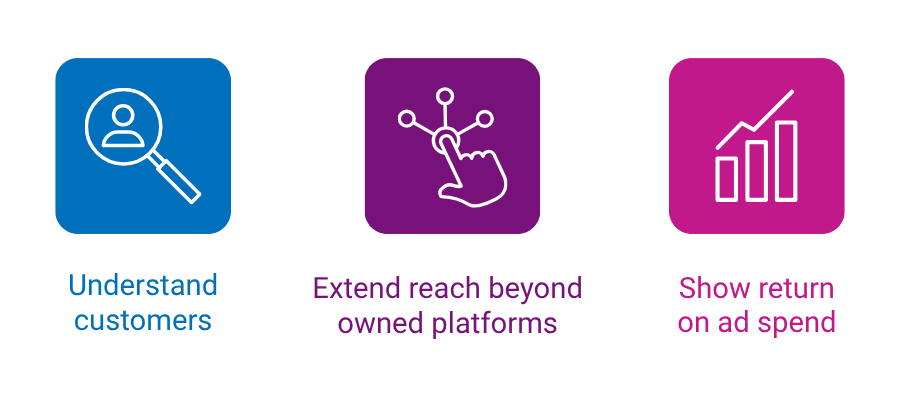
Most networks answer the first question partially, the second in transaction terms, and the third in attributed return on ad spend (ROAS). That gap is where budget is won and lost. Advertisers are also spreading spend across more networks than before, with almost half now funding commerce media from two or three separate budgets, which makes consistency across partners a buying criterion in its own right.
We help networks answer all three questions using the customer data they already hold, connected to identity, consumer intelligence, and measurement that works across channels and partners.
The advertisers those networks sell to are asking themselves the same three questions, using their own first-party data. That’s exactly where the two sides of this connect.
How the flow works: From shopper and advertiser data to measurement
A network and the advertiser it sells to are asking the same three questions, using two different sets of first-party data: who are these shoppers, can I reach them, and can I prove this worked? Our connective layer runs in both directions, through five stages:
Every stage runs on the same identity foundation, which is what keeps the network’s view and the advertiser’s view of the same shopper in agreement, rather than two separate systems producing two different answers.
Where Experian sits in your existing stack
Almost no commerce media network runs on a single vendor. Most operate a mix of identity, onboarding, activation, clean room, and ad serving partners, assembled over several years and expensive to unwind. Which layer is limiting everything above it?
In most networks, that layer is the customer data itself. When loyalty, e-commerce, CRM, and transaction records don’t resolve to the same person or household, every downstream system carries the problem forward. Match rates come in lower than expected, audience counts shrink at the point of activation, and measurement inherits gaps it can’t correct for.
Experian works as the connective layer across that stack. We strengthen the data and identity foundation before it enters the workflows a network already runs, and we stay connected through audience creation, activation, curation, and measurement so match rates, audience scale, and results improve at every stage, not only at the start.
Networks that already work with an onboarding or identity provider keep those relationships. Networks that want a second activation path can add one without a migration.
None of this works unless Experian stays neutral. We are not a competing network, a walled garden, or an identity graph trying to own the record. That neutrality is what lets the same infrastructure sit underneath a network’s own systems and an advertiser’s first-party data at the same time, without either side worrying about who else can see their side of the deal.
This matters more as AI takes on more of the planning, activation, and optimization decisions inside commerce media. Those systems work from whatever view of the customer they are given, which is exactly where our approach to AI starts: AI should make commerce media more human, not less. Our privacy-first identity gives those systems a reliable view of the customer even when signals are missing. Predictive insight turns that view into next-best audience recommendations instead of static reporting delivered after the fact. Real-time intelligence lets activation and curation adjust to context and timing while a campaign is still running. Every one of our capabilities runs on the same transparent, governed foundation that makes the rest of our connective layer trustworthy, which is what keeps AI-driven decisions accurate and accountable, not just fast.
Experian is an independent identity and data partner. We work across the agencies, platforms, publishers, commerce media networks, and clean rooms a network already uses, which keeps identity strategy flexible as the ecosystem changes. Ownership, pricing, and partner priorities all move over time. A network with more than one path to identity and activation keeps its options open.
Case study: How our infrastructure enhanced addressability by 300% for a leading retail media network
A leading RMN has worked with Experian since 2021 to better understand its customers, organize first-party shopper data, and activate audiences across the digital ecosystem. Experian supported this RMN in reducing reliance on third-party cookies by anchoring shopper data to more stable digital identifiers, including mobile ad IDs (MAIDs), hashed emails (HEMs), CTV IDs, and Unified ID 2.0 (UID2). As a result, addressability across owned platforms and programmatic channels increased by nearly 300%. This improvement supported more consistent reach and measurement throughout the shopper journey.
How does Experian help commerce media networks grow media revenue?
Experian helps commerce media networks grow media revenue by:
- Knowing who its shoppers actually are
- Packaging that knowledge into audiences advertisers will pay for
- Activating those audiences at maximum scale beyond its own inventory
- Proving what the media did
Connect fragmented customer data to one identity
Every commerce media network captures authenticated first-party data, online or offline. On its own, that data covers only part of a customer or household’s addressable footprint, and it’s usually spread across loyalty, e-Commerce, CRM, and point-of-sale systems that were never designed to agree with each other. We resolve those records to a single persistent profile, then connect that identity to digital environments. Our identity foundation covers 250 million U.S. consumers and 126 million U.S. households, extended across more than 4.2 billion devices and trillions of digital signals.
Networks get fewer duplicate customers, more complete household views, and higher match rates in the platforms they already activate through. Every audience and measurement result downstream gets more reliable at the same time. Every CMN captures authenticated first-party data, whether collected online or offline. On its own, that data represents only a portion of a customer or household’s addressable footprint. By connecting to Experian’s identity graphs, CMNs gain a broader view of their customers across offline and digital environments, supported by coverage across 126 million households, 250 million individuals, and 4.2 billion digital IDs.
Work with more partners without renegotiating how data moves
Every step a network takes beyond its own environment raises the same question from legal and privacy teams. Where does the data go, who can see it, and what happens to it after the campaign.
Those questions are where commerce media programs stall. Loyalty and transaction data is the most valuable asset a network has and the most tightly governed, and raw customer records usually cannot move between a retailer, a brand, and an activation partner at all. Collaboration has to run on matched, permissioned outputs.
Experian supports that collaboration across the ecosystem. Networks can work with advertisers, agencies, publishers, and measurement partners through Experian’s environment, through crosswalks inside their own infrastructure, or through vetted clean room partners. Match happens on privacy-protected identifiers, so partners can measure overlap, build shared audiences, and evaluate outcomes while each side keeps its records.
Understand shoppers beyond what they bought
SKU-level purchase data shows what someone bought. Advertisers increasingly buy on the fuller picture: who that shopper is, what else they are in the market for, and what shapes the decision.
We add that real-world context. Networks can build customer profiles that go deeper than purchase behavior alone, incorporating demographics, lifestyle attributes, TrueTouchSM, Mosaic® USA, and more. These insights help networks identify high-value segments, understand the customer journeys behind their transaction data, and create differentiated audiences at scale. Audience insights also work as a pre-sales tool, giving sellers something specific to walk an advertiser through before a dollar is committed. That same context is what makes a network appeal to advertisers outside its core categories, which is where a growing share of commerce media revenue is coming from.
Build audiences advertisers will pay more for
Commerce media networks can enrich first-party data with Experian Marketing Data to build custom segments for advertisers. More than 5,000 Marketing Attributes are available, with an average of 250 attributes per consumer, spanning demographics, lifestyle, media preferences, and behavioral signals.
Teams can build, model, and expand those audiences in one place through Audience Engine, drawing on more than 3,500 syndicated audiences from 20+ third-party data providers and activating across more than 200 media platforms, and package first-party audiences alongside trusted third-party data sets through Partner Audiences. Both widen what a network can sell and who they can sell to, without expanding the technology they have to build.
Attract advertisers outside your categories
Endemic advertisers, the brands that sell their products through the network, are finite. The brands that sell through it will only fund so much, and competition for that spend is what compresses rates.
Non-endemic demand is the release valve. These are advertisers with nothing on the shelf: financial services, telecom, travel, and automotive brands that want access to verified shopper audiences and are bidding on different placements. A non-endemic buyer needs demographic, lifestyle, and behavioral context to recognize their customer inside a shopper audience described by one retailer’s categories.
Enrichment gives a network that vocabulary. The same audiences already serving endemic advertisers become legible and buyable to advertisers who have never sold a product in the store, which turns audience monetization into a second revenue line rather than a bigger share of the first.
Extend reach beyond owned inventory
On-site is the most profitable inventory a network owns. It’s also the inventory that runs out first. Off-site is where the next increment of revenue is, and off-site spending is currently growing at roughly twice the rate of on-site.
Off-site runs on different economics and different controls. Margins are thinner, typically 20% to 40% against 70% to 90% on-site, transparency takes more work to maintain, and audiences have to hold their quality once they leave the environment that created them. That’s what the activation layer solves for.
Networks can move audiences from owned platforms into programmatic, connected TV, and social, applying the same identity consistently across more than 200 social, programmatic, TV, curated media, clean room, and partner environments, including The Trade Desk and Magnite through Experian’s Third-Party Onboarding, supported by self-service tools, native integrations, and transparent pricing. Third-Party Onboarding offers data providers a 50% increase in programmatic addressability and a 73% increase in CTV addressability.
Curation brings a network’s audiences and premium off-site inventory together into private marketplace deals, so the audience and the supply travel as one package and advertisers get scale without giving up relevance. Experian can manage those deals through Curated Deals, and networks ready to build and price their own can self-serve through Deal Engine. Either way, the network’s first-party data stays at the center of the offer.
Turn measurement into a reason advertisers reinvest
Measurement decides where next quarter’s budget goes. Networks that help advertisers prove incremental business impact tend to keep and grow those budgets. When proof stops at attributed ROAS, the conversation moves to price.
The obstacle is structural. A network sees what happened inside its own environment. The comparison an advertiser needs also covers what those shoppers did everywhere else, which is how incremental sales get separated from sales that would have happened anyway. Commerce media measurement is still inconsistent across networks, and no single partner changes that. What a network controls is whether its measurement rests on one consistent identity foundation, which is what makes results comparable across channels and defensible to a buyer.

“Accurate data is the backbone of effective commerce media strategies, and Experian’s top-tier data solutions are critical for precise targeting and audience delivery. Experian’s advanced capabilities in data onboarding, customer audiences, and robust identity graphs allow advertisers to seamlessly reach the right audiences.”
NexChapter IncArt Sebastian, CEO
How can commerce media networks partner with Experian?
Experian can partner with CMNs regardless of the challenges they’re looking to solve. Some need identity quality before anything else works. Some have clean data and want a path off-site. Some can activate anywhere and want to prove incrementality to a buyer asking harder questions than last year.
Experian works across whichever of those layers is the constraint, alongside the partners a network already has. Tell us where your network is today and we’ll show you what changes first.
Connect with us
Click here to view Experian’s U.S. Consumer Data Privacy Notice.
This site is protected by reCAPTCHA and the Google Privacy Policy and Terms of Service apply.
FAQs
A commerce media network is a retailer, marketplace, or publisher that sells advertising against its own first-party shopper or customer data, typically across on-site placements, off-site media, and connected TV. Commerce media networks compete for advertiser budgets by proving they can reach real shoppers and show how that media affected sales.
Experian helps commerce media networks increase revenue by resolving fragmented first-party data into one identity, turning that identity into audiences advertisers want to buy, activating those audiences beyond owned inventory, and proving the media’s impact on sales. This turns a network’s existing customer data into packaged, sellable, and measurable audiences across on-site and off-site inventory.
Working with Experian doesn’t mean replacing a network’s existing identity or activation partners. Experian strengthens the data and identity foundation underneath existing onboarding, activation, and clean room relationships, so networks keep what already works and add capability where it’s missing.
Experian stays neutral across the commerce media ecosystem instead of operating as a competing network, a walled garden, or an identity graph trying to own the record. That neutrality lets Experian’s infrastructure sit underneath a network’s own systems and an advertiser’s first-party data at the same time, without either side losing visibility into who can see their data.
Latest posts

With the long-term effects to the economy unknown, many consumers are feeling the financial impact, while others are looking for opportunities, resulting in a transformational shift in spending. Some brands are experiencing decreased or paused marketing budgets, and you may be trepidatious about making the right decisions in your efforts to grow share of wallet. Recent events have been an impetus for change and we’re seeing brands make modifications to traditional marketing strategies. Some are developing innovative technologies and utilizing new sources of data and analytics. As we look at how these changes impact marketing results, we see the gap grow between those brands who are equipped to pivot and implement new strategies quickly, versus those who are not. So what steps can your organization implement now to make the smartest choices for both your customers and your business to secure more share of wallet? Here are four ideas to accelerate the success of your next financial marketing campaign: 1. Meet your customers wherever they are: Digital-first strategies have never been more relevant than they are right now. While consumers have fully embraced online engagement, marketers are even more focused on reaching high-value segments in the channels they utilize. By using an informed, data-driven strategy that includes preferred marketing communication channels and decision-making styles, engagement increases across those channels your target audience frequents the most. For example, are they heavy social media users? Do they prefer streaming TV? Or do they tend to rely on financial advice vs. performing their own research? To drive take rates, your audience must be exposed to a tailored message, in the right channel, and possibly multiple times. 2. Use messaging that resonates: As consumers refocus priorities, their expectations of brands with whom they do business are ever-increasing. Reflecting an understanding of the current needs and interests of your customers and prospects is an undertone that can only help strengthen their view of your brand. Consumer behavior has changed and is unlikely to revert to what was, so you want to be relevant, but you also do not want to be seen as ‘tone deaf’. As a result, consider revising your segmentation strategy to leverage predictive insights, such as household economic indicators, financial behaviors, lifestyle propensities and interests to help shape your message into one that truly makes an impact. 3. Prove the worth of your campaign: New consumer journeys are being formulated and showing ROI is imperative as your marketing budget is scrutinized. Having the right industry-relevant metrics and reports to analyze and share with leadership are key. Demonstrate that your campaigns are contributing to bottom-line success—and justify future campaigns—by using data-driven measurement insights collected across multiple reads and countless touchpoints. Marketing budgets are being scrutinized now more than ever, so showing ROI is critical. Having the right metrics and reports to analyze and share with leadership are key. 4. Follow government regulations—leverage Fair Lending-friendly audiences: Whether you’re cross-selling or prospecting, now is the time to identify the right audiences with rich data insights to not only execute impactful campaigns but adhere to government regulations that protect consumers and your organization. Trusting that the data you are activating follows Fair Lending Laws, including the Equal Credit Opportunity Act (“ECOA”) and the Fair Housing Act (“FHA”) is crucial. The Federal ECOA prohibits creditors from discriminating against credit applicants on the basis of several prohibited factors. Developing people-based segments that are not derived using these factors positions you to follow these regulations. Check out our previous blog post about Fair Lending-friendly audiences here. As you transition to new operating models, access to current and accurate consumer data can provide confidence in campaign potential, help you avoid business risk, enable you to respond to market changes and make better decisions. Experian can help you implement these strategies and put your brand unique position for growth. From start to finish, we provide the marketing solutions you need to plan, build and execute successful, Fair Lending-friendly campaigns to cross-sell to existing customers and acquire new customers. *Experian Fair Lending-friendly audiences do not constitute legal advice or otherwise assure compliance with the FHA, ECOA, or any other applicable laws. It’s recommended to seek legal advice with respect to the use of data in connection with lending decisions or application and compliance with applicable laws. Contact us today
Cross-device matching and pixel-based foot traffic attribution reporting empower digital marketers with greater control of location-based campaigns.RALEIGH, N.C. (PRWEB) AUGUST 04, 2020 Tapad, part of Experian a global leader in digital identity resolution, and Reveal Mobile, a leader in location-based marketing, today announced a collaboration that combines Tapad’s digital cross-device matching technology and pixel-based attribution features with Reveal Mobile’s VISIT Local, the software that hundreds of digital agencies and brands use for location-based analytics. The partnership is designed to drive improved performance by optimizing ad targeting and messaging for location-based campaigns. Powered by Tapad’s privacy-safe cross device matching, marketers using VISIT Local to power location-based campaigns can enhance how they reach shoppers. When one member of a household shops for groceries, clothes, household goods or any other consumer item, a conversation between multiple members of the household typically takes place beforehand. With cross device matching, marketers can reach everyone who has influence over what to buy and where to buy it. VISIT Local users can expand location-based services with a single click to include devices that share the same household, including targeting across multiple devices owned by the same user, allowing advertisers to maximize messaging and increase their share of wallet among consumers. “VISIT Local has always given our customers access to high-intent location-based audiences. With the addition of cross device matching from Tapad, advertisers can boost audience sizes up to 300 percent while maintaining full confidence in quality and relevance,” says Brian Handly, CEO of Reveal Mobile. “VISIT Local users can now apply multiple criteria and attributes to a single location-based audience, giving them the advanced control and transparency they need.” As reliable attribution becomes increasingly complex for marketers and ad buyers who need to prove value, the addition of Tapad’s pixel-based foot traffic attribution to VISIT Local enables the measurement of actual campaign effectiveness by tying ad views to in-store foot traffic. This new feature, which will be available in VISIT Local this fall, lets Reveal Mobile customers understand who visited a retail location as a result of being served an ad, providing a more accurate view into return on ad spend during and after advertising campaigns. “Tapad’s goal is to empower marketers with digital advertising efficiencies at scale across devices,” says Mark Connon, COO of Tapad. “With cross device matching and pixel-based foot traffic attribution, marketers using VISIT Local can better address the consumer’s preferences and habits, and deliver them consistently actionable information on user behavior. These capabilities advance location-based advertising in ways marketers need and want.” In addition to these new features, VISIT Local’s location-based audience builder now enables marketers to create custom audiences made up of people who have visited different places on different dates. This gives VISIT Local users the ability to segment and create the most highly targeted audiences possible. For example, a marketer who wants to advertise for a chain of restaurants can easily target visitors of different competitors in different cities. Or a marketer who wants to advertise vacation destinations can target people who have been to various resorts at different times of year. Or a marketer who wants to advertise the release of new music can target people who have been to concert venues in different cities on different dates. “Many of our customers need to create highly custom audiences so they can run experiments, test messaging, and run increasingly competitive campaigns,” says Handly. “Everyone who uses VISIT Local can now apply multiple criteria and attributes to a single location-based audience, giving them the advanced control and transparency they need.”To learn more about Tapad’s digital identity resolution products, visit our identity solution page. To learn more about Reveal Mobile’s location-based marketing offerings, visit http://www.revealmobile.com. About TapadTapad, Inc. is a global leader in digital identity resolution. The Tapad Graph, and its related solutions, provide a transparent, privacy-safe approach connecting brands to consumers through their devices globally. Our one-of-a-kind Graph Select offering enables marketers the flexibility and freedom of choice to correlate devices to varied objectives, driving campaign effectiveness and business results. Tapad is recognized across the industry for its product innovation, workplace culture and talent, and has earned numerous awards including One World Identity’s 2019 Top 100 Influencers in Identity Award. Headquartered in New York, Tapad also has offices in Chicago, London, Oslo, Singapore and Tokyo. About Reveal MobileReveal Mobile is a leader in location-based marketing, analytics, audiences, and attribution. Creator of VISIT Local, VISIT Match and VISIT Data, the company’s products help digital agencies, brands and retailers of any size leverage location data to understand and reach the right audiences. Reveal Mobile is CCPA compliant and a member of the Network Advertising Initiative, which conducts an annual privacy certification. The company is based in Raleigh, NC. For more information, visit https://revealmobile.com. Contact us today
Overview Chartable leverages The Tapad Graph to improve cross-device attribution rates and remove non-addressable IPs for clients. Challenge Chartable needs to differentiate between consumer and potential business IP addresses to provide accurate household modeling and reduce excess data for their customers. Podcasting generally only has access to IP addresses as a form of digital ID which limits its ability to connect activity to individuals and extend it across all devices. The Tapad + Experian solution Using Tapad, now a part of Experian, Chartable is able to cut through the noise of IP data and discard any addresses deemed a shared IP or business. Then, Tapad + Experian connects individual users to their other digital IDs and users in their household; creating a richer attribution model for Chartable customers. Increase in podcast attribution rates Contact us today