At A Glance
Commerce media needs a neutral connective layer across shopper data, advertiser data, and the broader media ecosystem. Close to 90% of U.S. retail media spend goes to two platforms according to eMarketer, on-site inventory is reaching practical limits, and advertisers want proof that holds up across networks. Experian provides that layer through identity, data collaboration, audience intelligence, activation, and measurement.Key takeaways
- Nearly 90% of U.S. retail media spend goes to Amazon and Walmart, leaving every other network competing for proof, reach, and identity consistency.
- Experian’s identity foundation covers 250 million U.S. consumers and 126 million households, extended across more than 4.2 billion devices.
- A leading retail media network grew addressability by nearly 300% after anchoring shopper data to stable digital identifiers like mobile ad IDs (MAIDs), hashed emails (HEMs), and Unified I.D. 2.0 (UID2).
- Experian’s Audience Engine and Experian Third-Party Onboarding let networks extend first-party audiences into off-site channels without losing match quality or control.
Commerce media spending keeps climbing, and most of it lands in a small number of places. U.S. advertisers are expected to spend roughly $71 billion on retail media in 2026 according to eMarketer, and close to 90% of it will go to Amazon and Walmart. Every other network competes for what’s left, usually by buying identity, enrichment, activation, and measurement from separate partners, on separate timelines, that were never built to work as one system.
That competition hinges on three problems a network can’t solve with owned data and owned inventory alone.
Each of these improves when the data a network already holds connects cleanly to the identity, consumer intelligence, activation, and measurement layers the rest of the ecosystem runs on. Experian brings those pieces together into a single, neutral infrastructure: not another point solution to add to the stack, but the connective layer underneath it, the same shopper data, advertiser data, identity resolution, audience intelligence, activation, and measurement capabilities that already support parts of the ecosystem today, now operating as one connected flow instead of a list of separate capabilities.
What advertisers now expect from a commerce media network
Advertisers evaluate a network on more than its on-site inventory. They’re asking:
- Can you reach my shoppers when they are away from your site?
- Can you describe those shoppers in a way that is useful for planning?
- Can you show that the media impacted sales?
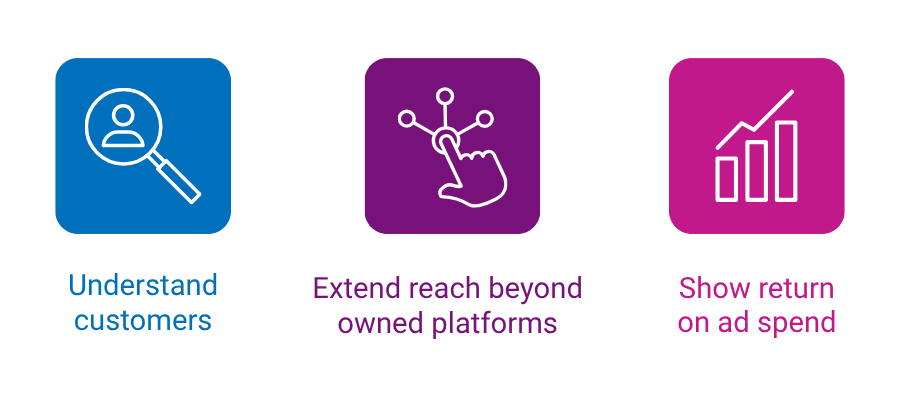
Most networks answer the first question partially, the second in transaction terms, and the third in attributed return on ad spend (ROAS). That gap is where budget is won and lost. Advertisers are also spreading spend across more networks than before, with almost half now funding commerce media from two or three separate budgets, which makes consistency across partners a buying criterion in its own right.
We help networks answer all three questions using the customer data they already hold, connected to identity, consumer intelligence, and measurement that works across channels and partners.
The advertisers those networks sell to are asking themselves the same three questions, using their own first-party data. That’s exactly where the two sides of this connect.
How the flow works: From shopper and advertiser data to measurement
A network and the advertiser it sells to are asking the same three questions, using two different sets of first-party data: who are these shoppers, can I reach them, and can I prove this worked? Our connective layer runs in both directions, through five stages:
Every stage runs on the same identity foundation, which is what keeps the network’s view and the advertiser’s view of the same shopper in agreement, rather than two separate systems producing two different answers.
Where Experian sits in your existing stack
Almost no commerce media network runs on a single vendor. Most operate a mix of identity, onboarding, activation, clean room, and ad serving partners, assembled over several years and expensive to unwind. Which layer is limiting everything above it?
In most networks, that layer is the customer data itself. When loyalty, e-commerce, CRM, and transaction records don’t resolve to the same person or household, every downstream system carries the problem forward. Match rates come in lower than expected, audience counts shrink at the point of activation, and measurement inherits gaps it can’t correct for.
Experian works as the connective layer across that stack. We strengthen the data and identity foundation before it enters the workflows a network already runs, and we stay connected through audience creation, activation, curation, and measurement so match rates, audience scale, and results improve at every stage, not only at the start.
Networks that already work with an onboarding or identity provider keep those relationships. Networks that want a second activation path can add one without a migration.
None of this works unless Experian stays neutral. We are not a competing network, a walled garden, or an identity graph trying to own the record. That neutrality is what lets the same infrastructure sit underneath a network’s own systems and an advertiser’s first-party data at the same time, without either side worrying about who else can see their side of the deal.
This matters more as AI takes on more of the planning, activation, and optimization decisions inside commerce media. Those systems work from whatever view of the customer they are given, which is exactly where our approach to AI starts: AI should make commerce media more human, not less. Our privacy-first identity gives those systems a reliable view of the customer even when signals are missing. Predictive insight turns that view into next-best audience recommendations instead of static reporting delivered after the fact. Real-time intelligence lets activation and curation adjust to context and timing while a campaign is still running. Every one of our capabilities runs on the same transparent, governed foundation that makes the rest of our connective layer trustworthy, which is what keeps AI-driven decisions accurate and accountable, not just fast.
Experian is an independent identity and data partner. We work across the agencies, platforms, publishers, commerce media networks, and clean rooms a network already uses, which keeps identity strategy flexible as the ecosystem changes. Ownership, pricing, and partner priorities all move over time. A network with more than one path to identity and activation keeps its options open.
Case study: How our infrastructure enhanced addressability by 300% for a leading retail media network
A leading RMN has worked with Experian since 2021 to better understand its customers, organize first-party shopper data, and activate audiences across the digital ecosystem. Experian supported this RMN in reducing reliance on third-party cookies by anchoring shopper data to more stable digital identifiers, including mobile ad IDs (MAIDs), hashed emails (HEMs), CTV IDs, and Unified ID 2.0 (UID2). As a result, addressability across owned platforms and programmatic channels increased by nearly 300%. This improvement supported more consistent reach and measurement throughout the shopper journey.
How does Experian help commerce media networks grow media revenue?
Experian helps commerce media networks grow media revenue by:
- Knowing who its shoppers actually are
- Packaging that knowledge into audiences advertisers will pay for
- Activating those audiences at maximum scale beyond its own inventory
- Proving what the media did
Connect fragmented customer data to one identity
Every commerce media network captures authenticated first-party data, online or offline. On its own, that data covers only part of a customer or household’s addressable footprint, and it’s usually spread across loyalty, e-Commerce, CRM, and point-of-sale systems that were never designed to agree with each other. We resolve those records to a single persistent profile, then connect that identity to digital environments. Our identity foundation covers 250 million U.S. consumers and 126 million U.S. households, extended across more than 4.2 billion devices and trillions of digital signals.
Networks get fewer duplicate customers, more complete household views, and higher match rates in the platforms they already activate through. Every audience and measurement result downstream gets more reliable at the same time. Every CMN captures authenticated first-party data, whether collected online or offline. On its own, that data represents only a portion of a customer or household’s addressable footprint. By connecting to Experian’s identity graphs, CMNs gain a broader view of their customers across offline and digital environments, supported by coverage across 126 million households, 250 million individuals, and 4.2 billion digital IDs.
Work with more partners without renegotiating how data moves
Every step a network takes beyond its own environment raises the same question from legal and privacy teams. Where does the data go, who can see it, and what happens to it after the campaign.
Those questions are where commerce media programs stall. Loyalty and transaction data is the most valuable asset a network has and the most tightly governed, and raw customer records usually cannot move between a retailer, a brand, and an activation partner at all. Collaboration has to run on matched, permissioned outputs.
Experian supports that collaboration across the ecosystem. Networks can work with advertisers, agencies, publishers, and measurement partners through Experian’s environment, through crosswalks inside their own infrastructure, or through vetted clean room partners. Match happens on privacy-protected identifiers, so partners can measure overlap, build shared audiences, and evaluate outcomes while each side keeps its records.
Understand shoppers beyond what they bought
SKU-level purchase data shows what someone bought. Advertisers increasingly buy on the fuller picture: who that shopper is, what else they are in the market for, and what shapes the decision.
We add that real-world context. Networks can build customer profiles that go deeper than purchase behavior alone, incorporating demographics, lifestyle attributes, TrueTouchSM, Mosaic® USA, and more. These insights help networks identify high-value segments, understand the customer journeys behind their transaction data, and create differentiated audiences at scale. Audience insights also work as a pre-sales tool, giving sellers something specific to walk an advertiser through before a dollar is committed. That same context is what makes a network appeal to advertisers outside its core categories, which is where a growing share of commerce media revenue is coming from.
Build audiences advertisers will pay more for
Commerce media networks can enrich first-party data with Experian Marketing Data to build custom segments for advertisers. More than 5,000 Marketing Attributes are available, with an average of 250 attributes per consumer, spanning demographics, lifestyle, media preferences, and behavioral signals.
Teams can build, model, and expand those audiences in one place through Audience Engine, drawing on more than 3,500 syndicated audiences from 20+ third-party data providers and activating across more than 200 media platforms, and package first-party audiences alongside trusted third-party data sets through Partner Audiences. Both widen what a network can sell and who they can sell to, without expanding the technology they have to build.
Attract advertisers outside your categories
Endemic advertisers, the brands that sell their products through the network, are finite. The brands that sell through it will only fund so much, and competition for that spend is what compresses rates.
Non-endemic demand is the release valve. These are advertisers with nothing on the shelf: financial services, telecom, travel, and automotive brands that want access to verified shopper audiences and are bidding on different placements. A non-endemic buyer needs demographic, lifestyle, and behavioral context to recognize their customer inside a shopper audience described by one retailer’s categories.
Enrichment gives a network that vocabulary. The same audiences already serving endemic advertisers become legible and buyable to advertisers who have never sold a product in the store, which turns audience monetization into a second revenue line rather than a bigger share of the first.
Extend reach beyond owned inventory
On-site is the most profitable inventory a network owns. It’s also the inventory that runs out first. Off-site is where the next increment of revenue is, and off-site spending is currently growing at roughly twice the rate of on-site.
Off-site runs on different economics and different controls. Margins are thinner, typically 20% to 40% against 70% to 90% on-site, transparency takes more work to maintain, and audiences have to hold their quality once they leave the environment that created them. That’s what the activation layer solves for.
Networks can move audiences from owned platforms into programmatic, connected TV, and social, applying the same identity consistently across more than 200 social, programmatic, TV, curated media, clean room, and partner environments, including The Trade Desk and Magnite through Experian’s Third-Party Onboarding, supported by self-service tools, native integrations, and transparent pricing. Third-Party Onboarding offers data providers a 50% increase in programmatic addressability and a 73% increase in CTV addressability.
Curation brings a network’s audiences and premium off-site inventory together into private marketplace deals, so the audience and the supply travel as one package and advertisers get scale without giving up relevance. Experian can manage those deals through Curated Deals, and networks ready to build and price their own can self-serve through Deal Engine. Either way, the network’s first-party data stays at the center of the offer.
Turn measurement into a reason advertisers reinvest
Measurement decides where next quarter’s budget goes. Networks that help advertisers prove incremental business impact tend to keep and grow those budgets. When proof stops at attributed ROAS, the conversation moves to price.
The obstacle is structural. A network sees what happened inside its own environment. The comparison an advertiser needs also covers what those shoppers did everywhere else, which is how incremental sales get separated from sales that would have happened anyway. Commerce media measurement is still inconsistent across networks, and no single partner changes that. What a network controls is whether its measurement rests on one consistent identity foundation, which is what makes results comparable across channels and defensible to a buyer.

“Accurate data is the backbone of effective commerce media strategies, and Experian’s top-tier data solutions are critical for precise targeting and audience delivery. Experian’s advanced capabilities in data onboarding, customer audiences, and robust identity graphs allow advertisers to seamlessly reach the right audiences.”
NexChapter IncArt Sebastian, CEO
How can commerce media networks partner with Experian?
Experian can partner with CMNs regardless of the challenges they’re looking to solve. Some need identity quality before anything else works. Some have clean data and want a path off-site. Some can activate anywhere and want to prove incrementality to a buyer asking harder questions than last year.
Experian works across whichever of those layers is the constraint, alongside the partners a network already has. Tell us where your network is today and we’ll show you what changes first.
Connect with us
Click here to view Experian’s U.S. Consumer Data Privacy Notice.
This site is protected by reCAPTCHA and the Google Privacy Policy and Terms of Service apply.
FAQs
A commerce media network is a retailer, marketplace, or publisher that sells advertising against its own first-party shopper or customer data, typically across on-site placements, off-site media, and connected TV. Commerce media networks compete for advertiser budgets by proving they can reach real shoppers and show how that media affected sales.
Experian helps commerce media networks increase revenue by resolving fragmented first-party data into one identity, turning that identity into audiences advertisers want to buy, activating those audiences beyond owned inventory, and proving the media’s impact on sales. This turns a network’s existing customer data into packaged, sellable, and measurable audiences across on-site and off-site inventory.
Working with Experian doesn’t mean replacing a network’s existing identity or activation partners. Experian strengthens the data and identity foundation underneath existing onboarding, activation, and clean room relationships, so networks keep what already works and add capability where it’s missing.
Experian stays neutral across the commerce media ecosystem instead of operating as a competing network, a walled garden, or an identity graph trying to own the record. That neutrality lets Experian’s infrastructure sit underneath a network’s own systems and an advertiser’s first-party data at the same time, without either side losing visibility into who can see their data.
Latest posts

See how AdRoll and Experian combine audience data, identity, and CTV measurement to help marketers reach, prove, and grow their funnel.

Buyers can now put Experian’s audience and contextual intelligence to work in Google Ad Manager Curation in two ways: through off-the-shelf solutions available directly in Google Ad Manager, or through Custom Curation packages that Experian builds using Google Ad Manager’s inventory supply. Together, these options bring Experian’s consumer data foundation closer to the Google supply agencies already buy, with the flexibility to choose between a ready-to-use solution and an Experian package tailored to specific campaign goals. Why targeting at the source matters Many audience strategies still apply targeting on the buy side, which means signals pass through multiple systems before an impression is evaluated. Each step can shrink the pool of requests where the audience is still recognizable, so a carefully built strategy can reach the auction at a fraction of the scale it started with. Google Ad Manager Curation moves segment evaluation closer to the ad request. When a request matches the selected Experian segment, Ad Manager sends the bid request with the associated Deal ID to the buyer’s DSP. This more direct path can support stronger match and deal-transaction rates, more accurate forecasting, and better access to the audience defined in the strategy. As AI shapes more media decisions, the quality and provenance of the data feeding those systems matter more. Evaluating audience or contextual criteria closer to the source helps preserve the connection between the strategy and the impression being considered. Two ways to get started The right entry point depends on how much customization the campaign requires. Buyers can access Experian solutions off-the-shelf directly in Google Ad Manager or work with Experian to build a Custom Curation package using Google Ad Manager inventory supply. Start off-the-shelf For buyers who want direct, self-service access to Experian audience and contextual solutions. Experian solutions are available off-the-shelf in Google Ad Manager, giving buyers a straightforward way to select the data or contextual strategy that fits their campaign and create packages through Google Ad Manager’s Curation capabilities. Experian Audiences Experian Audiences draw on a deterministic offline identity foundation that represents more than 250 million U.S. consumers and 126 million U.S. households. Buyers can choose from Experian’s Audiences spanning demographics, lifestyle, financial signals, media habits, and household characteristics. That depth adds real-world consumer context beyond digital behavior alone. Contextual Experian contextual solutions give buyers a way to reach relevant environments without relying on identity. Buyers can select contextual audiences aligned to specific interests, categories, and content to inform where media appears. Experian also offers Predictive Indexed, which uses Experian audiences to predict the contextual categories and pages to target based on the likelihood that consumers visiting those environments fall within the selected audience. This gives buyers an audience-informed way to approach contextual activation without requiring identity at the point of activation. Build a Custom Curation package For buyers who need a strategy tailored to specific audience, contextual, and inventory requirements. Experian can build Custom Curation packages using Google Ad Manager’s inventory supply based on the targeting criteria that matter for a campaign. Where off-the-shelf solutions draw on Experian data, custom packages can also incorporate partner audiences and a brand’s own first-party audiences. Packages can combine Experian audiences, partner audiences, a brand’s own first-party audiences, contextual signals, and inventory or site criteria. Experian applies those criteria against Google Ad Manager inventory supply and brings the data, targeting, and inventory together into a single curated deal. This gives buyers a way to combine audience and supply decisions rather than managing each component separately. The approach can be tailored to the campaign. A buyer might start with a defined audience and add contextual or inventory criteria, bring a brand’s established first-party audience into the strategy, or build around specific supply and audience-quality requirements. Choose the path that fits the campaign Both paths do the same underlying thing: they move the audience or contextual decision closer to the ad request, before signal loss builds across the path. Whether a campaign calls for something ready to use or a package built to spec, the result is a more direct line from strategy to impression. Ready to get started? Explore Experian solutions available off-the-shelf in Google Ad Manager or contact your Experian representative to request a Custom Curation package. Latest posts

See how Experian helped FanThreeSixty clean, match, and enrich 7.6 million fan records through data enrichment and identity resolution.