Tag: personal loans

As digital borrowing continues to gain prominence, fintech lenders must leverage data and analytics to fuel growth while mitigating risk.

To maximize limited marketing spend, lenders will need to be more prescriptive to increase response rates on fewer delivered offers.

The rapid rate at which fintech challengers are becoming established, is in turn, allowing for greater consumer awareness and adoption of fintech platforms.
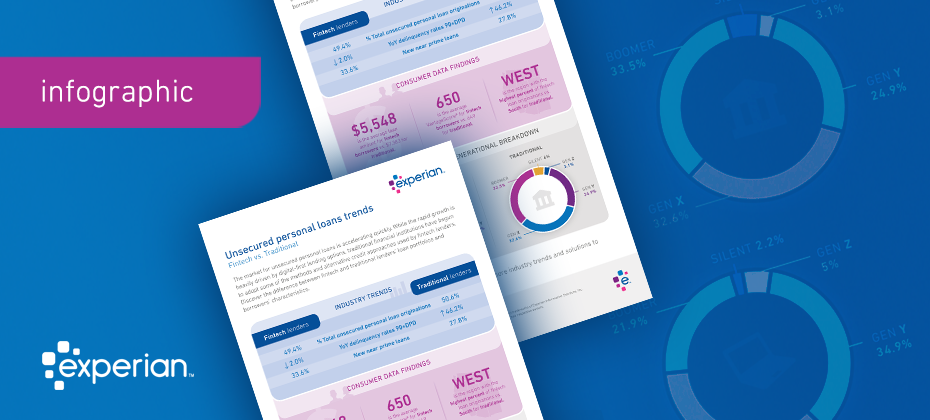
How are fintechs faring against traditional FIs? Our latest infographic uncovers industry trends and key metrics in unsecured personal installment loans.

New year, new personal loans. As Americans kick off the year seeking debt consolidation, consumer insights shed light for your future marketing efforts.

A recent report showcases the results of what happens with FinTechs and financial institutions partner together. Hear their experiences with collaboration.

Not only are personal loans are increasing, but so is the share of those loans originated by FinTechs is also growing quickly across all generations.

Experian took a deep dive into the data and performance surrounding the credit union universe in their first-ever “State of Credit Unions” report, featuring insights utilizing data from both 2015 and 2017.

Recent analysis of the personal loan market revealed a 9-pnt negative shift in the avg VantageScore® credit score for personal loan originations from Q3 to Q4 of '16.

Personal loans have been booming for the past couple of years with double-digit growth year-over-year. But the party can’t last forever, right? In a recent Experian webinar, experts noted they have seen originations leveling off. In fact, numbers indicate it’s gone from leveled off to a slight year-over-year decline. They projected the first quarter of calendar year 2017 may also be down, but then we’ll see a peak again in the second quarter, which is typical with the seasonality often associated with personal loans. The landscape is changing. A recent data pull revealed a 9-point shift in the average VantageScore® credit score for originations from Q3 to Q4 of 2016. Lenders are digging deeper in order to keep their loan volumes up, and it is definitely a more competitive marketplace. The days where lenders were once able to grow their personal loan business with little effort are gone. Kelley Motley, Experian’s director of analytics, noted some of the personal loan origination volume shifts may be due to the rebound in the housing market and increased housing values, enabling super-prime and prime consumers to now also consider home equity loans and lines of credit, in lieu of personal loans. Still, the personal loan market is healthy. Lenders just need to be smart about their marketing efforts and utilize data to improve their response rates, expand their risk criteria to identify consumers trending upward in the credit ranks, and then retain them as their cash-flow and financial situations evolve. In the presentation, experts revealed a few interesting stats: 67% of those that open a personal installment loan had a revolving trade with a balance >$0 5% of consumer that close a personal loan reopen another within a few months of the original loan closure 68% of consumers that re-open a new personal loan within a short timeframe of closing another personal loan do so with the same company Together, these stats illustrate that individuals are largely leveraging personal loans to consolidate debt or perhaps fund an expense like a vacation or an unexpected event. Once the consumer comes into cash, they’ll pay off the loan, but consider revisiting a personal loan again if their financial situation warrants it. The calendar year Q2 peak has been consistent since the Great Recession. For many consumers, after racking up holiday debt and end-of-year expenses, the bills start coming in during the first quarter. With the high APRs often attached to revolving cards, there is a sense of urgency to consolidate and lock in a more reasonable rate. Others utilize the personal loan to fund weddings, vacations and home improvement projects. Kyle Matthies, a senior product manager for Experian, reminded participants that most people don’t need your product, so it’s essential to leverage data find those that do. Utilizing propensity score and attributes, as well as tools to dig into ability-to-pay metrics and offer alignment can really fine-tune both an organization’s marketing and retention strategies. To learn more about the current state of personal loans, access our free webinar How lenders can capitalize on the growth in personal loans.

The holidays are behind us, the presents are unwrapped, resolutions have been made and may already be broken. For many, it’s the most depressing time of the year as the reality of holiday spending settles in. According to the American Consumer Credit Council the average American spends $935 on gifts each holiday season. A recent report by Mintel showed the average consumer held $16,000 in debt at the end of 2015. Now is the time to reach out to consumers who may be suffering from a financial hangover; an Experian study revealed consumers typically look to personal loans for help with credit card debt in the second quarter of each year. What’s the best way to reach these consumers? Direct mail is still one of the most successful paths. Here are four keys to securing new personal loan customers via direct mail marketing: Focus on education: Some of the most successful direct mail campaigns for personal loans in 2015 focused on educating consumers about personal loans first, and then showing options for debt consolidation. Consumers are weary of trusting new lenders, according to Mintel, with 50% viewing them as riskier than banks and credit unions. Marketplace and online lenders should take the extra step of introducing their brand and showing their product as a safe option. Highlight the use of the loan: Consumers generally have a negative attitude toward debt, with 72% feeling uncomfortable holding any type of debt. Stressing that personal loans are a responsible tool for consolidating debt is critical. Some effective campaigns listed the top three reasons to choose a personal loan, while others used customer testimonials to show how a personal loan was used and how they benefited. Provide a competitive comparison: Another way to highlight the benefits of personal loans is by comparing the fixed rates and payments of a personal loan to credit cards. Many consumers consolidate credit card debt to one card immediately after the holidays, according to the Experian study. Simply showing the long-term benefit of a personal loan versus credit card is often enough to trigger action. Personalize the offer: Lenders are delivering more personal, relevant offers that are tailored to the interests of each recipient through the use of the latest personalization technology. For example, highlight the recipient’s specific qualifying loan amount or the qualifying loan rate for which they are eligible. Unsecured loans have experienced growing popularity in the last several years, and originations are poised for a seasonal peak in the coming months. Are you ready?

It’s hard to remember a world without online lenders. Today, fintech players continue to pop up, making it easier to cross-shop loans and land instant approvals. Gone are the days of lengthy applications and waiting to hear if you’ve scored the latest credit line or personal loan. Consumers, especially with top-tier credit, can easily seek lower monthly payments or consolidate another loan with a cash-out option. Whatever the need, there’s a lender ready to serve. Strike that. There’s actually two or three lenders waiting to serve you. In fact, a recent Experian data pull revealed an increasing share of personal loan balances is actually going to lenders outside of the traditional banks and credit union space (they still own the lion’s share of the business). In 2013 (Q4), these more non-traditional lenders had 15.36 percent of personal loan balances. In Q4 of 2015, that number increased to 27.26 percent. The personal loan business today is just over $222.9 billion in outstanding balances. As the competition heats up, lenders will need to diversify, stand out and provide more value to consumers. Those that engage with new, value-added services, and deliver timely, personalized needs-based messages will capture the greatest share of the market. Here is a sampling of ways to draw consumers in and deliver the value they seek in a financial institution: Be Transparent Lending Club, one of the original peer-to-peer lenders and currently the biggest in terms of dollars funded, continues to grow by providing consumers and investors with transparency, good loan terms and speed. Prosper, on the other hand, recently acquired an app that allows their customers to track spending, budget and monitor their credit. They plan to leverage this technology in the near future and offer it to customers and investors for free. Research reveals Millennials especially are looking to tech and free services to manage their personal finances. A recent Experian survey focused on Millennials and credit revealed 48 percent have used free financial services, like Mint, to manage their finances. Additionally, 57 percent use on average three financial apps. Know Your Customers Payoff uses survey data to segment their customers into roughly 10 financial personalities based on how they use and think about their debt. These personality types are used to tailor marketing messages and customer service conversations about how to improve their financial situation. Their site features a quiz, Discover the Secrets of Your Financial Personality, helping consumers and Payoff understand more about trends attached to spending, saving and managing money. Offer Solutions for Debt Consolidation Even after consumers consolidate debt and pay it off successfully, unforeseen expenses, unexpected life events, evolving spending habits and the increasing cost-of-living expenses mean there will always be a market for debt consolidation solutions. Understanding consolidation credit account behavior is mandatory for lenders looking to stand out and stay ahead of the consolidation needs of consumers. Having visibility to consumers’ interest rates, revolving loan balances and the remaining months on existing loans provides unique ways to segment and engage clients with need-based offers. Consumer-tailored messages during the prospecting, acquisition and account management stages of the relationship sets the stage for repeat business. The research is clear. Individuals are willing to switch brands if they feel a different provider will better meet their needs. Lenders – in both the traditional and fintech spaces – should not expect many chances when it comes to getting it right with consumers. Fail to keep them engaged and you’ll fail to keep them. Period. Learn more about identifying profitable consolidation candidates, check out Experian’s annual Vision Conference in May.