Tag: economic outlook
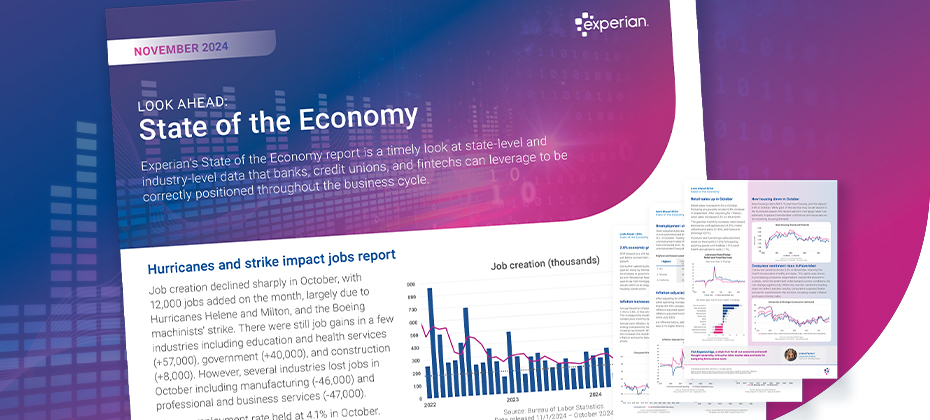
Take a deep dive into this month's economic and credit data, including trends in originations, job openings, and growth.
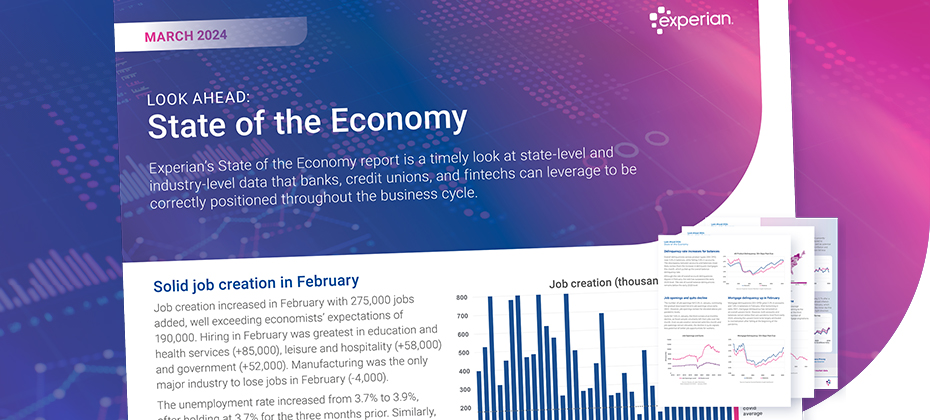
In March's State of the Economy report, we provide insights into consumer spending, the housing market, originations, and more.
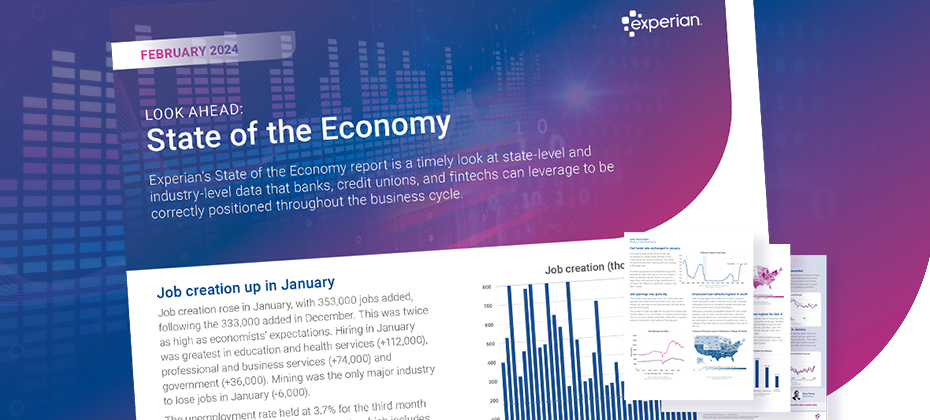
This report provides a snapshot of the top monthly economic and credit data, including inflation, the housing marketing, and card balances.
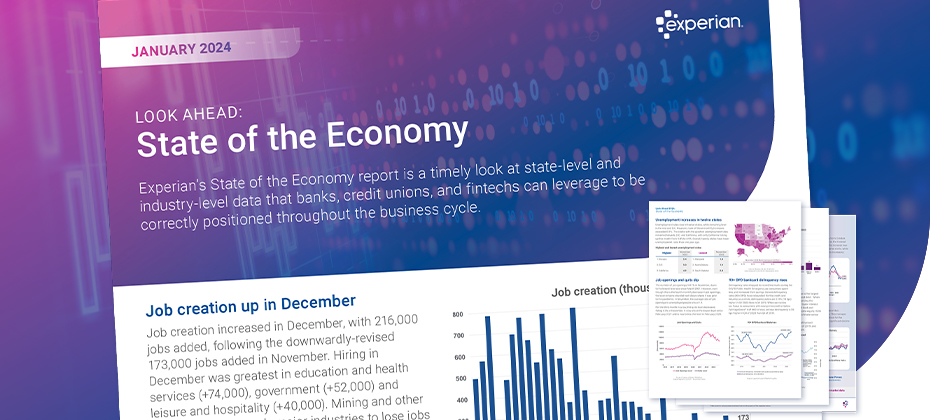
This report provides a snapshot of the top monthly economic and credit data, including student loans, consumer spending, and delinquencies.

Join our fireside chat as Experian experts explore economic and market trends, their impact on consumers, and how financial institutions can adapt.

The only thing constant is change. And as 2022 wraps up and businesses and consumers look toward 2023, the need for insights and data is at an all-time high to help forge the path ahead. With recent slowing economic growth, and uncertain macroeconomic and geopolitical climates, leading organizations are turning to credit, market, and economic trends, to help shape and inform future strategies. The challenge? With so many sources of information, it can be overwhelming to determine which information is relevant. Experian Edge, our new thought leadership hub, compiles proprietary Experian data, and economic, credit and market trends in a single, easy-to-consume place. Covering the automotive, financial services, healthcare, retail and small business sectors, Experian Edge helps businesses navigate tomorrow with today’s insights. Featured Publication: 2022 Experian Edge Chartbook The data stories told during 2022 - particularly credit and economic trends - run the full gamut. From economic growth and the labor market, to consumer health and inflation, there is no shortage of insights to glean. The inaugural 2022 Experian Edge Chartbook compiles those key insights giving a comprehensive look at economic and credit trends and what they could mean for 2023. Download 2022 Experian Edge Chartbook Want more insights? Examples of what else you’ll find on Experian Edge include: State of the Automotive Finance Market Report: Exclusive quarterly report on the latest trends and analysis of the U.S. automotive finance market. State of Alternative Credit Data Report: A deep dive into the uses of alternative data in consumer and small business lending. State of Claims: 200 executive healthcare professionals shed light on the current claims environment. Holiday Retail Guide 2022: Learn what types of behaviors you can expect to see from consumers this holiday shopping season. Beyond the Trends Report: Quarterly insights and commentary on economic conditions and future small business performance. Visit and bookmark Experian Edge for the latest intel you need to propel your business forward. Visit Experian Edge

Matthew Baltzer, Senior Director of Product Marketing, discusses challenges facing the debt collections industry and how to build a profitable portfolio.

Today’s mortgage market is challenging. Read our Q&A with Experian's Susan Allen to discover best practices for leveraging data for profitable growth.

As lenders and consumers emerge from the pandemic, predicting the attributes of the “new normal” will be difficult.

New challenges created by the COVID-19 pandemic have made it imperative for utility providers to adapt strategies and processes that preserve positive customer relationships. At the same time, they must ensure proper individualized customer treatment by using industry-specific risk scores and modeled income options at the time of onboarding As part of our ongoing Q&A perspective series, Shawn Rife, Experian’s Director of Risk Scoring, sat down with us to discuss consumer trends and their potential impact on the onboarding process. Q: Several utility providers use credit scoring to identify which customers are required to pay a deposit. How does the credit scoring process work and do traditional credit scores differ from industry-specific scores? The goal for utility providers is to onboard as many consumers as possible without having to obtain security deposits. The use of traditional credit scoring can be key to maximizing consumer opportunities. To that end, credit can be used even for consumers with little or no past-payment history in order to prove their financial ability to take on utility payments. Q: How can the utilities industry use consumer income information to help identify consumers who are eligible for income assistance programs? Typically, income information is used to promote inclusion and maximize onboarding, rather than to decline/exclude consumers. A key use of income data within the utility space is to identify the eligibility for need-based financial aid programs and provide relief to the consumers who need it most. Q: Many utility providers stop the onboarding process and apply a larger deposit when they do not get a “hit” on a certain customer. Is there additional data available to score these “no hit” customers and turn a deposit into an approval? Yes, various additional data sources that can be leveraged to drive first or second chances that would otherwise be unattainable. These sources include, but are not limited to, alternative payment data, full-file public record information and other forms of consumer-permissioned payment data. Q: Have you noticed any employment trends due to the COVID-19 pandemic? How can those be applied at the time of onboarding? According to Experian’s latest State of the Economy Report, the U.S. labor market continues to have a slow recovery amidst the current COVID-19 crisis, with the unemployment rate at 7.9% in September. While the ongoing effects on unemployment are still unknown, there’s a good chance that several job/employment categories will be disproportionately affected long-term, which could have ramifications on employment rates and earnings. To that end, Experian has developed exclusive capabilities to help utility providers identify impacted consumers and target programs aimed at providing financial assistance. Ultimately, the usage of income and employment/unemployment data should increase in the future as it can be highly predictive of a consumer’s ability to pay For more insight on how to enhance your collection processes and capabilities, watch our Experian Symposium Series event on-demand. Watch now Learn more About our Experts: Shawn Rife, Director of Risk Scoring, Experian Consumer Information Services, North America Shawn manages Experian’s credit risk scoring models while empowering clients to maximize the scope and influence of their lending universe. He leads the implementation of alternative credit data within the lending environment, as well as key product implementation initiatives.

For fintechs who were already challenging existing business models, COVID-19 suddenly accelerated financial services innovation into overdrive.

In our most recent podcast, Experian experts discuss how to enhance your portfolio analysis after an economic downturn and drive greater access to credit.

We’ve entered a new era of loss forecasting. Previously built models are no longer sufficient for the changes in economic conditions due to COVID-19.

The first round of stimulus through the Paycheck Protection Program provided relief for many small businesses around the country.

Jim Bander and Kathleen Peters provided insight into how businesses can work to mitigate fraud and portfolio risk during the COVID-19 pandemic.