
Use of Swap Sets to Measure Impact of Model Changes

by Guest Contributor 3 min read January 7, 2018

Swap Set

You just finished redeveloping an existing scorecard, and now it’s time to replace the old with the new. If not properly planned, switching from one scorecard to another within a decisioning or scoring system can be disruptive. Once a scorecard has been redeveloped, it’s important to measure the impact of changes within the strategy as a result of replacing the old model with the new one. Evaluating such changes and modifying the strategy where needed will not only optimize strategy performance, but also maximize the full value of the newly redeveloped model. Such an impact assessment can be completed with a swap set analysis.

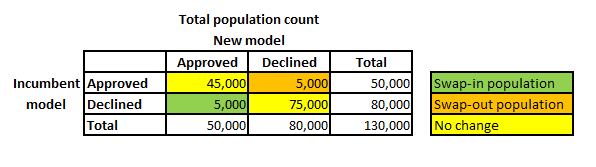
The phrase swap set refers to “swapping out” a set of customer accounts — generally bad accounts — and replacing them with, or “swapping in,” a set of good customer accounts. Swap-ins are the customer population segment you didn’t previously approve under the old model but would approve with the new model. Swap-outs are the customer population segment you previously approved with the old model but wouldn’t approve with the new model. A worthy objective is to replace bad accounts with good accounts, thereby reducing the overall bad rate. However, different approaches can be used when evaluating swap sets to optimize your strategy and keep:

  • The same overall bad rate while increasing the approval rate.
  • The same approval rate while lowering the bad rate.
  • The same approval and bad rate but increase the customer activation or customer response rates.

It’s also important to assess the population that doesn’t change — the population that would be approved or declined using either the old or new model. The following chart highlights the three customer segments within a swap set analysis.
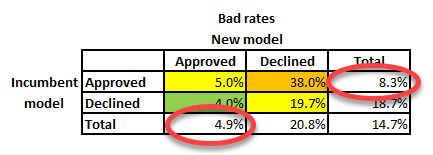
With the incumbent model, the bad rate is 8.3%. With the new model, however, the bad rate is 4.9%. This is a reduction in the bad rate of 3.4 percentage points or a 41% improvement in the bad rate.
This type of planning also is beneficial when replacing a generic model with another or a custom-developed model.

Click here to learn more about how the Experian Decision Analytics team can help you manage the impacts of migrating from a legacy model to a newly developed model.


Related Posts

The American Fintech Council on Responsible Innovation

Ian P. Moloney of the American Fintech Council discusses responsible fintech innovation and Experian’s role in expanding credit access.

Published: July 8, 2026 by Scarlet.Nickel@experian.com
Electric Vehicle Registrations Are Growing Beyond Traditional Locations

For years, most electric vehicle (EV) adoption has been concentrated in California, New York, and other traditional early-adopter markets. And while those markets still lead the nation in total registrations, as of last year, some of the fastest-growing EV markets are in regions that haven’t played a significant role in the past. According to Experian Automotive’s 2025 EV Year in Review Report, EV adoptions seem to be entering a new phase that is spreading well beyond coastal strongholds. In fact, the top designated market areas (DMAs) that saw the fastest year-over-year growth for new retail individual EV registrations in the last five years were Detroit, MI (34.5%), Naples, FL (32.6%), Atlanta, GA (20.6%), Buffalo, NY (18.7%), and Charlotte, NC (17.3%). However, despite the growing demand in these market areas over the last few years, Los Angeles, CA still holds a strong lead in new retail individual EV registrations, with over 164,000 new adopters in 2025. Rounding out the top five were San Francisco, CA (85,000+), New York, NY (78,000+), Miami, FL (45,000+), and Seattle, WA (35,000+). EV adoption expanding well beyond the early-adopter markets could be a result of charging infrastructure growth, vehicle availability improvement, and consumer interest reaching new levels across the country. What does this mean for dealers? The extension of EV adoption into emerging markets signals that these vehicles are becoming a mainstream consideration for more consumers. As dealers look for ways to grow their presence in this segment, adopting marketing strategies, service operations, and inventory planning will be beneficial to meet changing buyer expectations and capitalize on the growing demand. The biggest takeaway isn’t necessarily which markets are selling the most EVs, it’s seemingly where adoption is gaining momentum. As new regions start to embrace these vehicles, it’ll be important to monitor the next phase of growth and where future opportunities may emerge. To learn more about EV insights, visit Experian Automotive’s EV Resource Center.

Published: July 7, 2026 by Kirsten Von Busch
PREMIER Bankcard Expands Financial Access

Learn how PREMIER Bankcard and Experian are helping expand financial access through data, technology and personalized decisioning.

Published: July 6, 2026 by Scarlet.Nickel@experian.com

Subscribe to our thought leadership

Enter your name and email for the latest updates.

This site is protected by reCAPTCHA and the Google Privacy Policy and Terms of Service apply.

Subscribe to our thought leadership

Don't miss out on the latest industry trends and insights!
Subscribe