
Loading...

Reshaping the Future of the Modern Mortgage Landscape

by Scott Hamlin 3 min read April 8, 2024

Current economic conditions present genuine challenges for mortgage lenders. In this environment, first-time homebuyers offer exciting, perhaps unexpected, business growth potential.

Market uncertainties have kept potential borrowers anxious and on the sidelines. The Federal Reserve’s recent announcement that interest rates will remain steady for now has added to borrower anxiety. First-time homebuyers are no exception. They are concerned about the “right” time to jump in, buy a home, and own a mortgage. Despite worries over high interest rates and low inventory, many first-time homebuyers are tired of waiting for rates to drop and inventory to blossom.

First-time buyers are eager to explore all avenues necessary to achieve homeownership. They show a willingness to be flexible when it comes to finding a house, considering options like a fixer upper or expanding their search to more affordable locations.

The desire to escape the uncertainty and financial burden of renting is a strong driving force for first-time buyers. They see homeownership as a way to establish stability and build equity for their future. Despite the obstacles renters face in the competitive housing market, these potential buyers are motivated. Lenders who take time to understand who these buyers are and what matters to them will be ahead of the game.

Notwithstanding stubbornly high interest rates, first-time homebuyers historically have shown remarkable resilience amid market fluctuations.

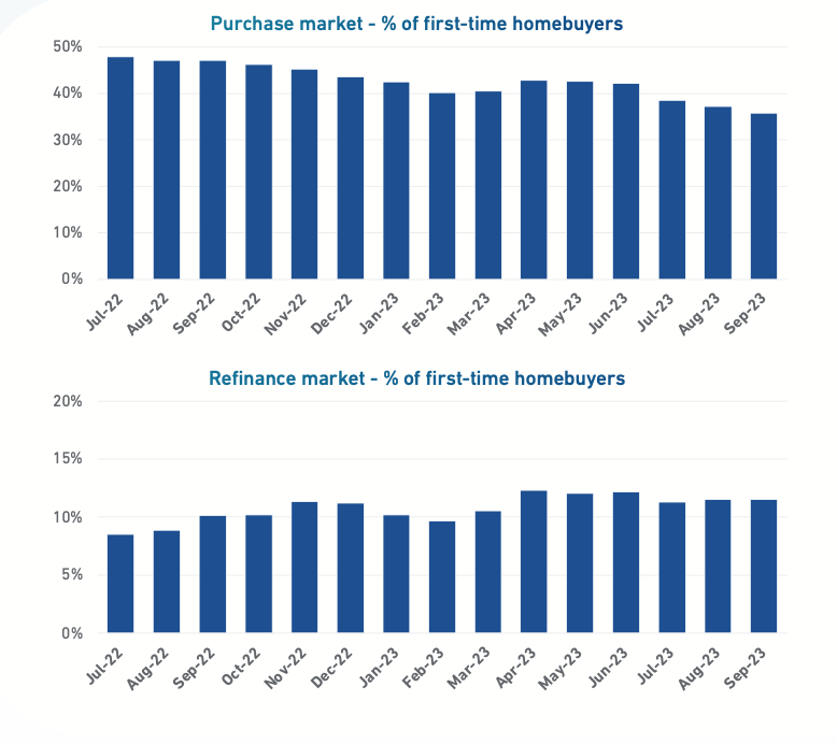
According to a recent deep dive by Experian Mortgage experts into the buying patterns of first-time homebuyers, this group made 35-48% of all new purchases and 8-12% of all refinances between July 2022 and September 2023. First-time buyers represent both immediate potential and long-term client opportunities.
How can lenders attract first-time homebuyers and drive growth from this market?

The first-time homebuyer market largely consists of individuals in their early 40s and younger, also known as Gen Y and Gen Z. Rising costs of renting a home frustrate these individuals who are trying to save money for a down payment on a house and ultimately, buy their dream home. They want to settle down and look ahead to the future.

For mortgage lenders who focus on understanding this younger first-time buyer market and developing targeted business strategies to attract them, great growth potential exists. Often, younger people feel locked out of buying opportunities, which creates uncertainty and apprehension about entering the market. This presents mortgage industry professionals with an incredible opportunity to show their value and grow their client base.

To attract this market segment, lenders must adapt. Lenders must develop a comprehensive picture of this younger generation. Who are they? How do they shop? Where do they want to live? What is their financial situation? What are their financial and personal goals?  Acknowledging difficulties in the housing market and showing them a well-conceived path forward to home ownership will win the day for the lender and the buyer.

As interest rates are poised to decrease in 2024-2025, there is potential for a surge in demand from first-time homebuyers. Lenders should prepare for these potential buyers, now. It is crucial to reevaluate how to approach first-time buyers to identify new opportunities for expansion.

Experian Mortgage examined first-time homebuyer trends to pinpoint prospects with good credit and provide analysis on potential areas of opportunity. For more information about the lending possibilities for first-time homebuyers, download our white paper.


Download white paper

Related Posts

  Experian Verify is redefining how lenders streamline income and employment verification; a value clearly reflected in Marcus Bondraeger’s experience at Freedom Mortgage. With access to the second-largest instant payroll network in the U.S., Experian Verify  connects lenders to millions of unique employer records, including those sourced through Experian Employer Services clients, delivering instant results at scale. This reach enables lenders to reduce manual processes, accelerate loan decisions and enhance the borrower experience from the very first touchpoint. Unlike traditional verification providers, Experian Verify offers transparent, value-driven pricing: it charges only when a consumer is successfully verified, not simply when an employer record is found. As lenders navigate increasing compliance requirements and secondary market expectations, they can also rely on Experian Verify’s FCRA-compliant framework, fully supporting both Fannie Mae and Freddie Mac. Combined with Experian’s industry-leading data governance and quality standards, lenders gain a verification partner they can trust for accuracy, security, and long-term operational efficiency. Perhaps most importantly, Experian Verify delivers 100% U.S. workforce coverage through its flexible, automated waterfall: instant verification, consumer-permissioned verification, and research verification. This multilayered approach ensures lenders meet every borrower where they are, whether they’re connected to a large payroll provider, a smaller employer, or require additional document-based validation. As Marcus highlights in the video, this comprehensive and configurable design empowers lenders to build verification workflows that truly fit their business needs while enhancing speed, completeness, and borrower satisfaction. Explore Experian Verify

by Ted Wentzel 3 min read February 20, 2026

Lenders who want to outperform peers in today’s housing market should embrace a data-driven playbook. These four strategic pillars—borrower insights, efficiency, geography, and refinance readiness—define the path forward. 

by Ivan Ahmed 3 min read February 18, 2026

As the U.S. housing market enters a new phase, the 2026 State of the U.S. Housing Market Report from Experian provides a data-driven overview for lenders, servicers, and property managers. This article synthesizes findings related to mortgage originations, affordability pressures, home equity utilization, credit risk, and generational sentiment, with implications for lender strategy in 2026 (Experian, 2026).  Mortgage market in flux: Opportunity amid transition  The mortgage market presents mixed signals. Rate moderation in late 2025 contributed to renewed demand, while the product mix continued to evolve. Conventional loans remained dominant at approximately 72% of originations, yet Veterans Affairs (VA) loans experienced the highest growth between 2023 and 2025, reaching 10.8% market share (Experian, 2026).  At the same time, second mortgages and home equity lines of credit (HELOCs) gained momentum as homeowners sought liquidity without refinancing out of historically low interest rates. This trend reflects growing demand for equity-based solutions that preserve favorable first-mortgage terms (Experian, 2026).   Pull-through challenges: Only 34% of inquiries become loans  Conversion efficiency remains a key challenge. Only 34% of first-mortgage hard credit inquiries resulted in a completed mortgage origination, highlighting friction between borrower interest and loan fulfillment (Experian, 2026).  Consumer research reinforces this gap. In an Experian survey, 50% of respondents reported that understanding what they could qualify for would be the most helpful step in their homeownership journey, suggesting that improved prequalification tools could materially increase pull-through rates (Experian, 2026).   Affordability pressure goes beyond the mortgage  Between 2021 and 2025, property taxes increased by 15.2%, while non-tax escrow costs—primarily homeowners' insurance—rose by 67.4% nationwide (Experian, 2026).  State-level variation further complicates affordability assessments. Florida recorded the highest average non-tax escrow expenses at $430 per month largely due to sharp increase in home insurance costs. California, by contrast, exhibited the highest average property tax burden at $626, largely driven by elevated home values despite lower statutory tax rates (Experian, 2026). These dynamics underscore the importance of holistic cost modeling, particularly for first-time buyers.   Home equity: A lender’s growth frontier  Home equity remains a significant growth opportunity. An estimated 96.2 million consumers reside in owner-occupied homes, with substantial portions owning their homes outright or holding more than 20% equity (Experian, 2026). HELOC usage is increasing, particularly among younger borrowers, 50% of whom utilize more than 60% of their available HELOC credit, compared with 36% of older borrowers (Experian, 2026).  Market share shifts are also notable. Fintech lenders experienced a 140.2% increase in HELOC originations from 2023 to 2025, significantly outpacing banks and credit unions. These gains suggest that digital-first experiences and streamlined workflows are increasingly decisive factors for borrowers (Experian, 2026).   Risk and resilience: What credit and property data reveal  Overall delinquency rates eased slightly; however, near-prime and prime borrowers demonstrated early signs of stress, particularly within first-mortgage portfolios (Experian, 2026).  Property-level risk is also intensifying. Flood exposure increased by 3.7% nationally, with 26.4% of Florida homes identified as at risk. Rising exposure has contributed to escalating insurance costs, further affecting affordability and credit performance (Experian, 2026).  From a credit hierarchy perspective, secured debt—especially mortgages and auto loans—continued to show the lowest delinquency rates. In contrast, student loans and credit cards exhibited higher delinquency risk, particularly among financially constrained renters and homeowners (Experian, 2026).   Generational optimism versus macroeconomic constraints  Despite affordability headwinds, consumer optimism persists. Approximately 47% of renters believe they will be ready to purchase a home within four years, increasing to 67% within eight years (Experian, 2026).  Structural constraints remain significant. Roughly 70% of homeowners hold mortgage rates below 6%, contributing to limited housing inventory as current owners remain rate-locked. With 30-year mortgage rates still above that level and a softening labor market, even modest increases in unemployment could further pressure affordability (Experian, 2026).   Implications for lenders  Experian’s analysis highlights several strategic priorities for housing industry stakeholders:  Expand access to credit. Incorporate alternative data sources, such as cash-flow analytics and rental payment history, to responsibly extend credit to underserved but qualified borrowers (Experian, 2026).  Capitalize on equity demand. Develop HELOC offerings that are fast, flexible, and digitally enabled to meet the needs of equity-rich, rate-locked homeowners (Experian, 2026).  Enhance risk precision. Integrate credit, property, and behavioral data to identify emerging risk early, particularly among near-prime segments, and to support more accurate pricing and portfolio management (Experian, 2026).   Conclusion  The 2026 housing market reflects a complex interplay of macroeconomic pressure, shifting borrower behavior, and growing reliance on home equity solutions. Agility and data-driven decision-making will be essential for lenders navigating this environment. The 2026 State of the U.S. Housing Market Report offers critical insight to support growth while managing risk in an evolving landscape (Experian, 2026).  📘 Access the full report here: Experian 2026 State of the U.S. Housing Market Report  References  Experian. (2026). 2026 state of the U.S. housing market report. Experian.     

by Upavan Gupta 3 min read February 9, 2026

Subscribe to our blog

Enter your name and email for the latest updates.

This site is protected by reCAPTCHA and the Google Privacy Policy and Terms of Service apply.

Subscribe to our Experian Insights blog

Don't miss out on the latest industry trends and insights!
Subscribe