
Lower Auto Finance Delinquency Rates; Continued Popularity of Used Vehicles in Q1

by Melinda Zabritski 2 min read June 15, 2020

The automotive industry is in the midst of weathering an unexpected storm due to COVID-19. As the Q1 2020 numbers rolled out, everyone was curious to see what the delinquency rates would tell us, and based on the data alone, it tells a positive story: delinquencies were down in Q1 2020.

In Q1 2020, 30-day delinquencies decreased from 1.98 percent in Q1 2019 to 1.93 percent, while 60-day delinquencies dropped from 0.68 percent to 0.67. However, it’s important to note, the pandemic wasn’t officially declared a national emergency until the middle of March. Additionally, consumers are likely leveraging financial resources and assistance programs, such as stimulus checks to manage through financial hardship, meaning the pandemic’s true impact may not be evident until the months ahead.

That said, Q1 data can still be informative as lenders and dealers create strategies to move forward. For instance, the trend of prime consumers continuing to select used vehicle financing. In Q1 2020, prime consumers comprised 50.47 percent of used vehicle loans. As this trend has been ongoing for a while, we took a closer look at where used vehicle loans were most common.
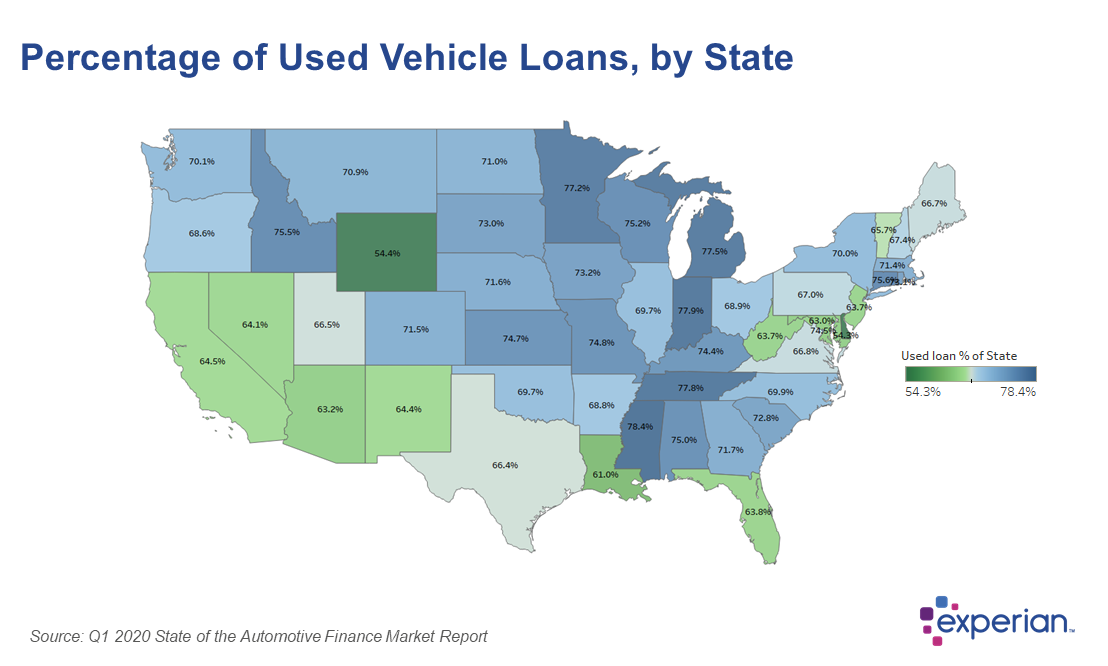
Mississippi topped the list, with used vehicle loans making up more than three-quarters of automotive loans in the state. In fact, this was true across the top nine states.
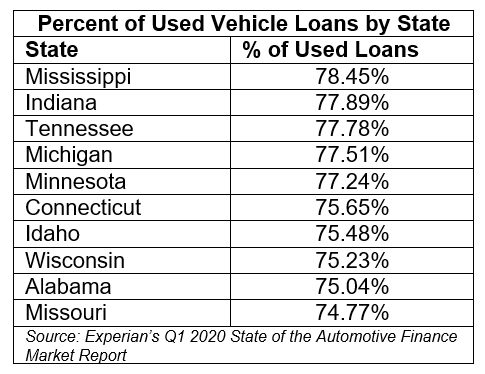
Chart detailing the top ten states with the highest used vehicle loan percentages

The trend towards used vehicles continues as automotive affordability remains a prominent topic of discussion. With many vehicles coming off-lease over the past few years, there are late-model vehicles available—these often offer many of the same features of a new vehicle but at a lower price point.

In addition to finance trends, dealers and lenders should assess the sales trends and consumer sentiment in their local markets. The pandemic created a fluid situation for many Americans and understanding how consumers are reacting to COVID-19 will help inform strategies moving forward. For instance, as of June 1, only 14 percent of survey respondents are considering buying a new vehicle in the next few months—of those 37 percent plan to buy something less expensive than originally planned.

While many aspects of our current situation are unlike anything we’ve experienced before, we know the automotive industry is resilient. Keeping a pulse on trends, sentiment, and other data points can help lenders and dealers make informed decisions and help address consumers’ most pressing needs in the days to come.

To view the entire Experian Q1 2020 State of the Automotive Finance Market report, or to watch the webinar, visit https://www.experian.com/automotive/automotive-webinars.html


Related Posts

How Union Credit Expands Access to Credit Unions with Experian

Discover how Union Credit and Experian help credit unions reach younger consumers through personalized digital lending experiences.

Published: July 1, 2026 by Scarlet.Nickel@experian.com
Faster Decisions, Better Outcomes: Experian Verify™ Now Available Through Centro, Mezzo’s Orchestration Engine 

Explore how Experian Verify™ and Mezzo’s Centro orchestration engine are helping mortgage lenders modernize income and employment verification, reduce workflow complexity, and make faster, more confident lending decisions at scale.

Published: July 1, 2026 by Lizel Ferrer
Used EV Growth Signals a New Phase of Consumer Purchasing Behavior

The electric vehicle (EV) revolution isn’t slowing down, it’s changing lanes. While recent conversations have seemingly focused on softening demand for new EVs, the used segment has been gaining momentum. According to Experian Automotive’s 2025 EV Year in Review Report, new retail individual EV registrations fell 35.9% year-over-year. Meanwhile, the used retail individual EV registrations grew 25.4% from a year ago. As affordability and growing model availability reshapes consumer behavior, buyers are increasingly turning to pre-owned EVs, which has shown an interesting market divergence that is redefining how consumers are adopting this segment and what it can mean for automakers, dealers, and the overall industry. Key players behind rising used EV demand Notably, Tesla accounted for over half (60.5%) of used retail individual EV registrations in 2025, followed by Chevrolet at 6.4% and Nissan (5.5%). Diving a bit deeper, Tesla made up the top three models of the used individual registrations last year, with the Model 3 coming in at 27.2%, Model Y at 21.7%, and Model S (6.6%). The Chevrolet Bolt EV followed at 4.8% and the Nissan Leaf was at 4%. Tesla’s position as the leading make in the used EV market is a natural extension of its long-standing dominance in new EV sales. The brand’s leadership over the years created a large fleet of vehicles that are now entering the pre-owned market. What the used EV boom means for automotive professionals The growing demand for used EVs can present more opportunities for automotive professionals. Dealers that provide a healthy supply of pre-owned EVs can increase accessibility and play a role in adoption for consumers who are actively looking to purchase, while marketers can emphasize value and ownership benefits. As the market continues to evolve, automotive professionals who understand and respond to these changing dynamics will be best positioned to capitalize on the expanding pool of used EV shoppers. To learn more about EV insights, visit Experian Automotive’s EV Resource Center.

Published: June 30, 2026 by Kirsten Von Busch

Subscribe to our Auto blog

Enter your name and email for the latest updates.

This site is protected by reCAPTCHA and the Google Privacy Policy and Terms of Service apply.