
Gen X Makes Up the Largest Segment of New Vehicle Buyers

by Guest Contributor 3 min read July 1, 2021

Smiling women driving a car

If we’ve learned anything from the past year and a half, it’s the need to adapt and pivot in real-time based on the current automotive market trends. One such trend that represents the need for flexibility is the unexpected change in new vehicle registrations by generation in the first quarter of Q1 2021. Namely, Gen X’s significant increase, and millennials’ decrease, in new vehicle registrations. This unexpected change is a reminder of the importance of remaining close to current data throughout the year to inform marketing strategies.

New Vehicle Registration Trends Reverse

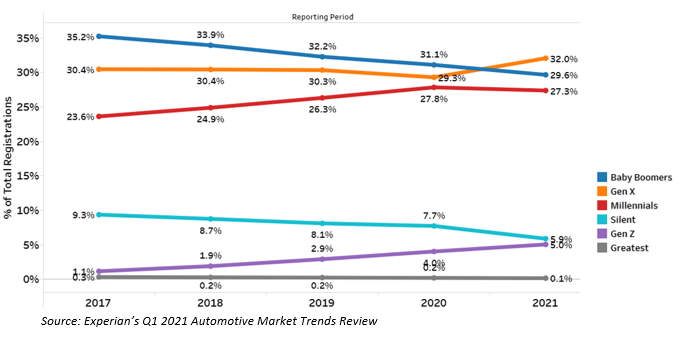
Over the past several years, new vehicle registration trends by generation have remained relatively consistent. For example, baby boomers have seen a steady decrease in new registrations, while millennials and Gen Z have seen a steady increase. But Experian’s Q1 2021 Automotive Market Trends Review revealed that some of these once-consistent trends have reversed.

Gen X had one of the more surprising shifts, with new vehicle registrations increasing from 29.3% in Q1 2020 to 32% in Q1 2021. By comparison, Gen X had previously been steadily decreasing since 2018. As a result, Gen X now makes up the largest cohort of new vehicle buyers, pushing baby boomers from their top spot in 2020 (31.1%) down to 29.6% this year.

Likewise, the decrease in new registrations for millennials was equally as unexpected. Millennials have consistently made up a larger portion of new vehicle registrations over the past few years. But for the first time since 2017, millennials experienced a decrease in new registrations, from 27.8% in Q1 2020 to 27.3% in 2021. While the decrease may be small, it is an interesting and unexpected shift from the data we’ve seen over the last few years. Additionally, while millennials experienced a decrease, Gen Z continued to see an increase. Their generation grew from 4% in Q1 2020 to 5% in Q1 2021.
Generational data chart for new registrations

While we don’t know how these trends will continue to play out moving forward, dealers can stay one step ahead by understanding the generational trends in real-time, so they are prepared to market to them, no matter how the trends shift. This comes down to meeting each group where and how they like to be reached, an even trickier factor now that so much of everyday life has turned digital.

For example, according to Pew Research, around seven-in-ten Americans use social media. But the platforms can vary significantly depending on age. Pew Research found that Gen Z and younger millennials are more likely to use Instagram, Snapchat and TikTok, while Gen X is more likely to use Facebook and YouTube. Meanwhile, Statista found that 67% of millennials prefer online shopping, compared to 56% of Generation X and 41% of Baby Boomers. As consumers continue to leverage the many different digital opportunities for communicating and shopping, it will be important for OEMs and dealers to shift their marketing strategies to ensure they reach these consumers.

The automotive landscape is continually changing and fluctuating. As a result, we can’t be certain if these trends are a long-term or short-term change. As dealers and OEM’s look to fine tune their marketing strategies, staying close to these trends will allow them to be more informed, more strategic and tailor their marketing campaigns accordingly.

To watch the Experian Q1 2021 Automotive Market Trends Review, click here.

Related Posts

Used EV Growth Signals a New Phase of Consumer Purchasing Behavior

The electric vehicle (EV) revolution isn’t slowing down, it’s changing lanes. While recent conversations have seemingly focused on softening demand for new EVs, the used segment has been gaining momentum. According to Experian Automotive’s 2025 EV Year in Review Report, new retail individual EV registrations fell 35.9% year-over-year. Meanwhile, the used retail individual EV registrations grew 25.4% from a year ago. As affordability and growing model availability reshapes consumer behavior, buyers are increasingly turning to pre-owned EVs, which has shown an interesting market divergence that is redefining how consumers are adopting this segment and what it can mean for automakers, dealers, and the overall industry. Key players behind rising used EV demand Notably, Tesla accounted for over half (60.5%) of used retail individual EV registrations in 2025, followed by Chevrolet at 6.4% and Nissan (5.5%). Diving a bit deeper, Tesla made up the top three models of the used individual registrations last year, with the Model 3 coming in at 27.2%, Model Y at 21.7%, and Model S (6.6%). The Chevrolet Bolt EV followed at 4.8% and the Nissan Leaf was at 4%. Tesla’s position as the leading make in the used EV market is a natural extension of its long-standing dominance in new EV sales. The brand’s leadership over the years created a large fleet of vehicles that are now entering the pre-owned market. What the used EV boom means for automotive professionals The growing demand for used EVs can present more opportunities for automotive professionals. Dealers that provide a healthy supply of pre-owned EVs can increase accessibility and play a role in adoption for consumers who are actively looking to purchase, while marketers can emphasize value and ownership benefits. As the market continues to evolve, automotive professionals who understand and respond to these changing dynamics will be best positioned to capitalize on the expanding pool of used EV shoppers. To learn more about EV insights, visit Experian Automotive’s EV Resource Center.

Published: June 30, 2026 by Kirsten Von Busch
How Terrace Finance Uses NeuroID to Respond to Fraud Faster and Smarter

Learn how Terrace Finance used NeuroID behavioral analytics to detect fraud faster, respond to attacks, and strengthen risk management.

Published: June 29, 2026 by Scarlet.Nickel@experian.com
Ask the Expert: A Closer Look at Modern Lending with Jeff Hops and Erin Haselkorn

In this first episode of Ask the Expert, Experian's Jeff Hops, Senior Director of Data Platform and Product, and Erin Haselkorn, Senior Director of Analyst Relations, explore how broader data and new signals can help lenders better understand today’s consumers, while maintaining responsible decisioning. Lending is changing  Interest rates, regulation, embedded finance and AI are reshaping the lending landscape. Consumer behavior is evolving just as quickly. But the core job hasn’t changed. Lenders are still making decisions about people they don’t fully know, and that makes data more important than ever. "There are periods where nothing changes, and periods where it seems like everything changes. We’re in the latter … but the core premise hasn’t changed. You’re still trying to lend to somebody you don’t know."Jeff Hops, Senior Director of Data Platform and Product To make those decisions with confidence, lenders need a strong foundation of identity, history and reliable signals. In a period of rapid change, the quality and completeness of that data become even more critical. A more complex view of today’s consumer What has changed is the consumer. Traditional credit data is foundational but can be further enhanced with visibility on how people earn, manage and move money. Income may come from multiple sources, and financial activity often spans bank accounts, applications (apps) and digital channels. Cash flow data, for example, can provide a clearer view of what’s actually coming into a consumer’s account, beyond what traditional records may show.These additional signals can help lenders better understand: Income variability across multiple earning sources Current financial behavior through cash flow activity Digital and identity-linked activity across channels These signals don’t replace traditional data; they expand it. The result is a more complete and current view of the consumer. From exploration to real-world application The conversation around broader data signals has moved beyond theory. Lenders are no longer just asking whether these signals are useful. They’re asking where, how and under what governance they can be applied across the lending lifecycle. Lenders are actively researching, testing and implementing new data sources across the lending lifecycle. What was once experimental is now operational. Institutions are progressing through a clear path: Research Understanding available signals and use cases Testing Evaluating performance in controlled environments Implementation Applying insights in production Today, alternative data is being used in areas like analytics, channel scoring and decisioning, often within governed environments that allow for safe testing and validation. AI may accelerate this shift by helping institutions identify patterns at scale, but its value depends on the strength of the underlying data: quality, governance, context and clear business use cases. More signal, more responsibility As data availability expands, lenders have access to more granular insights than ever before. That creates opportunity, but also responsibility. The institutions that lead won’t be the ones that use the most data. They’ll be the ones that know which signals to use, how to validate them and how to apply them in ways that are fair, explainable and aligned to consumer outcomes. “Institutions can unlock more granular and powerful decisions, but they have to do it responsibly.”Erin Haselkorn, Senior Director, Analyst Relations The future of lending will be shaped not just by how much data is available, but by how thoughtfully it’s applied. Keeping the consumer at the center of decisioning is essential to building trust and long-term success. Explore alternative data with us A more complete understanding of today’s consumers starts with better data. We help lenders responsibly incorporate broader data signals and advanced analytics into decisioning strategies, enhancing visibility into today’s consumers while strengthening risk assessment and expanding access to credit. Let’s work together to build more confident, more responsible lending decisions. Learn more Contact us About our experts Jeff Hops Senior Director, Data Platform and Product, Experian Jeff Hops is a Senior Director in Experian’s Financial Services and Data business with over eight years of experience driving innovation in credit and data solutions. He has led product development for Experian’s Credit Report and played a key role in launching Ascend Identity Platform™, a leading identity resolution platform. Erin Haselkorn Senior Director, Analyst Relations, Experian Erin Haselkorn is responsible for analyst relations for Experian. She has developed an understanding of key marketing trends across a broad range of verticals. Her market research around data strategy, AI, fraud, identity and data management, paired with her broad Experian product knowledge, gives her a unique understanding of business automation and data trends. Erin is a frequent spokesperson and guest blogger.

Published: June 22, 2026 by Julie.JLee@experian.com

Subscribe to our Auto blog

Enter your name and email for the latest updates.

This site is protected by reCAPTCHA and the Google Privacy Policy and Terms of Service apply.