All posts by Guest Contributor

As credit behavior and economic conditions continue to evolve, using a model that is validated regularly can give lenders greater confidence in the model’s performance. VantageScore® Solutions, LLC validates all its models annually to promote transparency and support financial institutions with model governance. The results of the most recent validation demonstrate the consistent ability of VantageScore® to accurately score more than 30 million to 35 million consumers considered unscoreable by other models — including 9.5 million Hispanic and African-American consumers. The findings reinforce the importance of using advanced credit scoring models to make more accurate decisions while providing consumers with access to fair and equitable credit. >> VantageScore® Annual Validation Results 2016 VantageScore® is a registered trademark of VantageScore Solutions, LLC

Congress recently took several actions signaling a growing interest in regulatory issues surrounding the Fintech sector. This growing attention follows a number of recent inquiries by federal and state regulators into the business practices in the industry. Subcommittee takes a deep dive into Fintech and OML regulatory landscape In July, the House Subcommittee on Financial Institutions and Consumer Credit held a hearing entitled Examining the Opportunities and Challenges with Financial Technology (“Fintech”). Witnesses and lawmakers voiced optimism that online marketplace lending can help to expand access to capital for consumers and small businesses, but the hearing also focused on a growing schism as to whether new regulations or changes to the underlying framework is necessary to ensure consumers are protected. Some lawmakers and the witness from the American Banking Association expressed concerns that the Fintech and marketplace lenders may benefit from being outside of the supervisory scope of prudential regulators and the Consumer Financial Protection Bureau (CFPB). Witnesses from the marketplace lending industry argued that they are obligated to meet all of the same regulatory compliance requirements as traditional lenders. Rep. McHenry introduces package of Fintech bills aimed at spurring innovation In addition, Congressman Patrick McHenry (R-NC), a member of the House Republican Leadership team and the Vice Chairman of the House Financial Services Committee, introduced two bills this month aimed at spurring innovation in the Fintech industry. H.R. 5724, the Protecting Consumers’ Access to Credit Act of 2016, would clarify that federal law preempts a loan’s interest rate as valid when made. The bill is in response to the Supreme Court’s recent decision not to hear Madden v Midland, a case in which the Second Circuit court ruled that the National Bank Act does not have a preemptive effect after the national bank has sold or otherwise assigned the loan to another party. The reading of this law has created uncertainty for Fintech companies and the banks that partner with them. H.R. 5725, the IRS Data Verification Modernization Act of 2016, requires the IRS to automate the Income Verification Express Service process by creating an Application Programming Interface (API). The legislation is aimed at speeding up and improving the automation of the loan application process. In particular, it is aimed at streamlining the process by which lenders gain access to tax transcript data. Currently, lenders may require applicants to fill out IRS form “4506-T,” which gives the lender the right to access a summarized version of their tax transcript as part of the process to confirm certain data points on their application. According to industry reports, this manual process at the IRS takes two to eight days, creating unnecessary delays for Fintech companies and banks that rely on leveraging data and technology to make faster, informed decision for consumer and small business lending Both bills have been referred to the House Financial Services Committee for review.

A recent national survey by Experian revealed opportunities for businesses to build relationships with future homebuyers before they’re ready to obtain a loan. Insights include: 35% of future buyers said they don’t know what steps to take to qualify for a larger loan 75% of future buyers are not preapproved for a home loan 29% of those surveyed would purchase a more expensive home if they had better credit and could qualify for a larger loan A large portion of near-future homebuyers are millennials. Building relationships with this generation now will benefit financial institutions in the future. >> White paper: Building lasting relationships with millennials
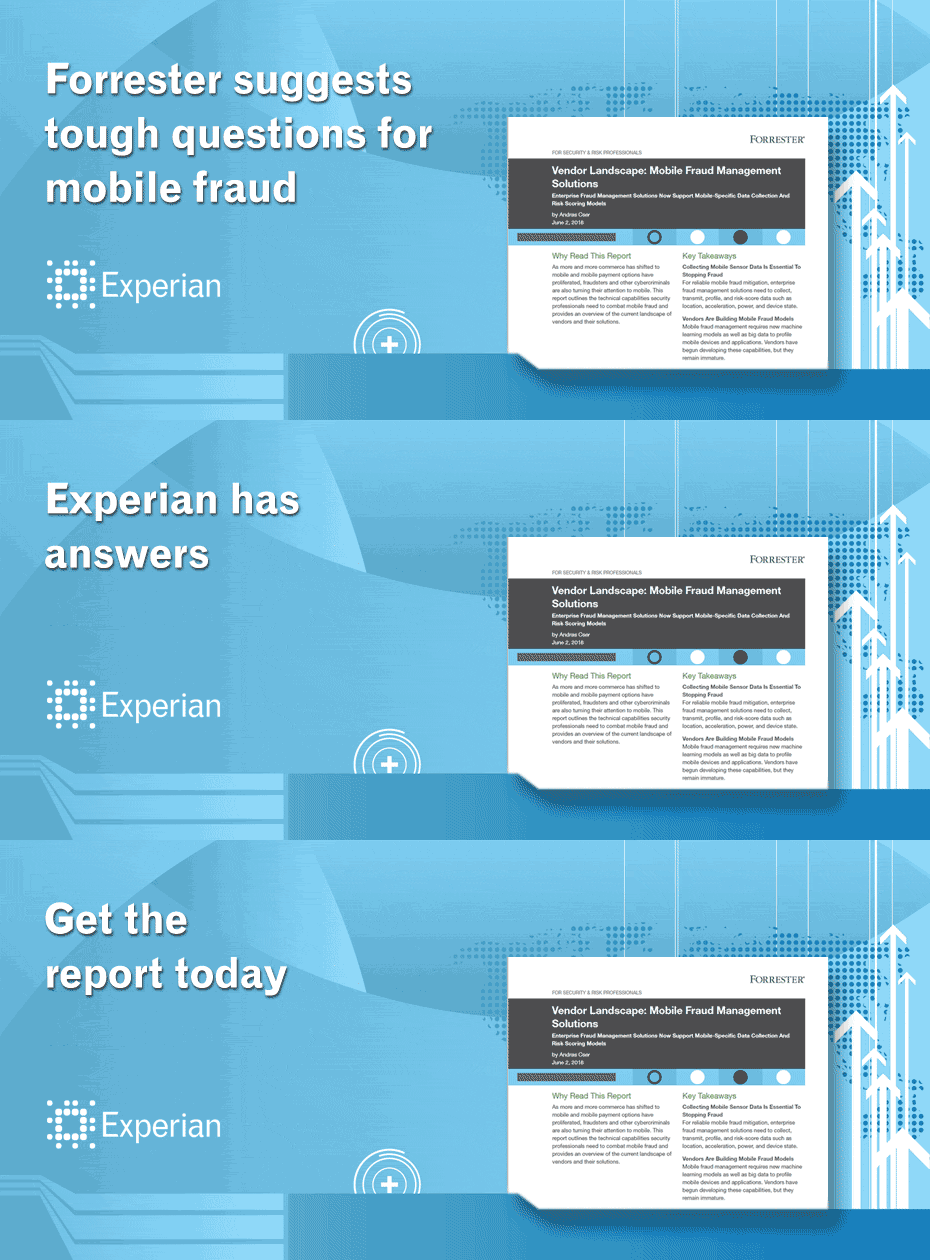
Many fraud and compliance teams are struggling to keep pace with new business dynamics. Here are several of the many mobile device trends affecting business today: 35% year-over-year growth in mobile commerce from 2014-2015 Value of mobile payment transactions is forecasted to reach more than $27 billion in 2016 45% of smartphone owners use a mobile device to make a purchase every month This rapid growth only reinforces the need for aggressive fraud prevention strategies and the adoption of new technologies to prepare for the latest emerging cybersecurity threats. >> Forrester's 2016 Vendor Landscape: Mobile Fraud Management Solutions Report

Every day, millions of new things get connected online, such as toasters, heart monitors and cars. Many of these things have weak security controls that create vulnerabilities in critical private networks. As more products get connected, the casual mindset about the security risks inherent in the Internet of Things must begin to change. Here are 12 tips to help safeguard your systems from the Internet of Things. >> Securing the Internet of Things

According to a national survey by Experian, college students may be receiving their degrees, but their financial management knowledge still needs some schooling. The survey reveals some troubling data about recent graduates: Average student loan debt is $22,813 31% have maxed out a credit card 39% have accepted credit card terms and conditions without reading them Learning to manage debt and finances properly is key to young adults’ future financial success. Since students aren’t receiving credit and debt management education in college, they need to educate themselves proactively. Credit education resources are available on Experian's Website. >> Experian College Graduate Survey Report

Experian cited in Mobile Fraud Management Solutions report from Forrester as having the most capabilities and one of the highest estimated revenues in total fraud management

Part four in our series on Insights from Vision 2016 fraud and identity track It was a true honor to present alongside Experian fraud consultant Chris Danese and Barbara Simcox of Turnkey Risk Solutions in the synthetic and first-party fraud session at Vision 2016. Chris and Barbara, two individuals who have been fighting fraud for more than 25 years, kicked off the session with their definition of first-party versus third-party fraud trends and shared an actual case study of a first-party fraud scheme. The combination of the qualitative case study overlaid with quantitative data mining and link analysis debunked many myths surrounding the identification of first-party fraud and emphasized best practices for confidently differentiating first-party, first-pay-default and synthetic fraud schemes. Following these two passionate fraud fighters was a bit intimidating, but I was excited to discuss the different attributes included in first-party fraud models and how they can be impacted by the types of data going into the specific model. There were two big “takeaways” from this session for me and many others in the room. First, it is essential to use the correct analytical tools to find and manage true first-party fraud risk successfully. Using a credit score to identify true fraud risk categorically underperforms. BustOut ScoreSM or other fraud risk scores have a much higher ability to assess true fraud risk. Second is the need to for a uniform first-party fraud bust-out definition so information can be better shared. By the end of the session, I was struck by how much diversity there is among institutions and their approach to combating fraud. From capturing losses to working cases, the approaches were as unique as the individuals in attendance This session was both educational and inspirational. I am optimistic about the future and look forward to seeing how our clients continue to fight first-party fraud.

On June 2, the Consumer Financial Protection Bureau (CFPB) proposed a rule aimed at “payday lending” that will apply to virtually all lenders, with request for comments by Sept. 14. Here is a summary of the basic provisions of the proposed rule. However, with comments, the proposal is more than 1,300 pages in length, and the proposed rule and examples are more than 200 pages long. It is necessary to review the details of the proposed rule to understand its potential impact on your products and processes fully. You may wish to review your current and future offerings with your institution’s counsel and compliance officer to determine the potential impact if major provisions of this proposed rule are finalized by the CFPB. Coverage The proposal generally would cover two categories of loans. First, the proposal generally would cover loans with a term of 45 days or less. Second, the proposal generally would cover loans with a term greater than 45 days, provided that they have an all-in annual percentage rate greater than 36 percent and either are repaid directly from the consumer’s account or income or are secured by the consumer’s vehicle. Ability to repay For both categories of covered loans, the proposal would identify it as an abusive and unfair practice for a lender to make a covered loan without reasonably determining that the consumer has the ability to repay the loan. Or if the lender does not determine if the consumer can make payments due, as well as meet major financial obligations and basic living expenses during and for 30 days after repayment. Lenders would be required to verify the amount of income that a consumer receives, after taxes, from employment, government benefits or other sources. In addition, lenders would be required to check a consumer’s credit report to verify the amount of outstanding loans and required payments. “Safe Harbor” The proposed rule would provide lenders with options to make covered loans without satisfying the ability-to-repay and payment notice requirements, if those loans meet certain conditions. The first option would be offering loans that generally meet the parameters of the National Credit Union Administration “payday alternative loans” program, where interest rates are capped at 28 percent and the application fee is no more than $20. The other option would be offering loans that are payable in roughly equal payments with terms not to exceed two years and with an all-in cost of 36 percent or less, not including a reasonable origination fee, so long as the lender’s projected default rate on these loans is 5 percent or less. The lender would have to refund the origination fees any year that the default rate exceeds 5 percent. Lenders would be limited as to how many of either type of loan they could make per consumer per year. Outstanding loans The proposal also would impose certain restrictions on making covered loans when a consumer has — or recently had — certain outstanding loans. These provisions are extensive and differ between short- and long-term loans. For example: Payday and single-payment auto title: If a borrower seeks to roll over a loan or returns within 30 days after paying off a previous short-term debt, the lender would be restricted from offering a similar loan. Lenders could only offer a similar short-term loan if a borrower demonstrated that their financial situation during the term of the new loan would be materially improved relative to what it was since the prior loan was made. The same test would apply if the consumer sought a third loan. Even if a borrower’s finances improved enough for a lender to justify making a second and third loan, loans would be capped at three in succession followed by a mandatory 30-day cooling-off period. High-cost installment loans: For consumers struggling to make payments under either a payday installment or auto title installment loan, lenders could not refinance the loan into a loan with similar payments. This is unless a borrower demonstrated that their financial situation during the term of the new loan would be materially improved relative to what it was during the prior 30 days. The lender could offer to refinance if that would result in substantially smaller payments or would substantially lower the total cost of the consumer’s credit. Payments Furthermore, it would be defined as an unfair and abusive practice to attempt to withdraw payment from a consumer’s account for a covered loan after two consecutive payment attempts have failed, unless the lender obtains the consumer’s new and specific authorization to make further withdrawals from the account. The proposal would require lenders to provide certain notices to the consumer before attempting to withdraw payment for a covered loan from the consumer’s account unless exempt under one of the “safe harbor” options. Registered information systems Finally, the proposed rule would require lenders to use credit reporting systems to report and obtain information about loans made under the full-payment test or the principal payoff option. These systems would be considered consumer reporting companies, subject to applicable federal laws and registered with the CFPB. Lenders would be required to report basic loan information and updates to that information. The proposed regulation may be found here.

According to the most recent State of the Automotive Finance Market report, the total balance of open automotive loans increased 11.1% in Q1 2016, reaching $1.005 trillion — up from $905 billion in Q1 2015. This is the first time on record that automotive loans have passed the $1 trillion mark. The report also revealed that subprime loan volumes experienced double-digit growth and overall delinquencies remained low. With more consumers relying on financing, lenders should monitor credit and delinquency trends in order to adjust strategies accordingly. >>Webinar: Hear about the latest consumer credit trends

As net interest margins tighten and commercial real estate concentrations begin to slowly creep back to 2008 levels, financial institutions should consider looking to their branch networks to drive earnings. Why wouldn’t you, right? The good news is branch networks can embrace that challenge by simply using some of the tools they already have access to – most notably the credit report. Credit reports are generally seen as a tool to assist financial institutions in assessing credit risk. However, if used properly, credit reports can provide a wealth of insight on selling opportunities as well. Typically when a customer’s credit report is pulled, the personal banker or customer service representative is primarily focused on whether or not a loan application is approved based on the institution’s approval parameters. Instead, what if a lender elected to view this customer interaction as an opportunity to deepen the relationship? So, here are three ways to utilize credit reports to generate earnings through retail loan growth: 1. Opportunities to Consolidate Debt Looking for debt consolidation opportunities is probably the simplest way to mine for opportunities. For example: Personal Banker: “It looks like you also have a card credit with XYZ and ABC Bank. Based on your application, we can consolidate both of those balances into one and give you a lower interest rate.” Be specific. Tell the customer exactly how much money per month they would be able to save and the benefits of consolidation. Not to mention, debt consolidation often reduces a lender’s credit risk and enhances customer loyalty, so this is a win for the institution as well. 2. Opportunities to Provide Additional Credit Another method would be to “soft pull” a segment of your portfolio to identify customers who qualify for larger credit card balances or refinance opportunities. This strategy is best executed at the portfolio management level, as insight is needed on the bank risk appetite and concentration levels. Layering on a basic prescreen helps qualify and segment your prospect list according to your unique credit criteria. You can also expand the universe with an Experian extract list, identifying new consumers who might be open to new offers. 3. Find Hidden Opportunities Credit scoring models are not perfect. There are times when a person’s credit score does not reflect an applicant’s true risk profile. For example, a person who was temporarily out of work may have missed two to three payments during that period. A deeper scan of the credit report during underwriting may reveal an opportunity to lend to a person rebounding from financial difficulties not yet reflected by their credit score. For example, this individual may have missed two credit card payments but hasn’t missed a mortgage or car payment in 20 years. A score is just one dimension to the story, but trended insights can shine a light on who best to lend to in the future. Conclusion: With the proper tools and training, your retail team can get more out of the basic credit report and find additional opportunities to deepen customer relationships while maintaining your desired risk profile. The credit report can be a workhorse for your team, so why not leverage it for more business. Note: The information above outlines several uses for a credit report. Separate credit reports are required for each use with the intended permissible purpose. Ancin Cooley is principal with Synergy Bank Consulting, a national credit risk management and strategic planning firm. Synergy provides a rangeof risk management services to financial institutions, which include loan reviews, IT audits, internal audits, and regulatory compliance reviews. As principal, Ancin manages a growing portfolio of clients throughout the United States.

A recent study shows that small-business credit conditions remained relatively unchanged in Q1 2016, as delinquency and bankruptcy rates held steady at low levels. Much of the slight decrease in delinquencies was driven by fewer small businesses falling within the 61 to 90 and 91+ days past-due categories. Gaining deeper insight into the health of small businesses is important for both lenders and small-business owners. Experian® provides market-leading tools that enable small businesses to find new customers, process new applications, manage customer relationships and collect on delinquent accounts. >> Q1 2016 report

Part 2 in our series on Insights from the Vision 2016 fraud and identity track With the growing number of data breach incidents taking place the stolen data from those attacks is being used to carry out social engineering attacks used to commit call center fraud. A recent study stated that global call center fraud has increased more than 45% in the last three years as fraudsters use social engineering to steal data and turn profits. The same report found that criminals might make up to 5 calls to a center, pretending to be the victim, before completing a fraudulent transaction. The importance of strong call center authentication procedures is greater than ever. At the 35th annual Vision Conference, Bobbie Paul from Experian’s Global Consulting Practice, Stefan Schubert from JPMorgan Chase and I led a session about call center authentication. After introductions and a discussion about existing call center identity authentication techniques, Stefan took the podium and provided an excellent overview of how his company approaches call center authentication. He made an interesting point — despite introducing friction into his process, he was not of the opinion that knowledge-based authentication (KBA) was going away any time soon because of how deeply it is embedded into their processes and its applicability to most consumers. He also called out the importance of reviewing KBA configurations regularly to adjust which questions are being asked and the positive implication to deterring fraudsters. Bobbie followed Stefan to discuss emerging call center authentication technologies, including a new take on an old tool — document imaging. She also discussed the notion of phone printing, which does not specifically evaluate the voice on the phone, but looks at the characteristics of the call itself, including the type of phone being used and the environment from which the call is being made. One of the highlights of the session was the interaction with the audience — including a demonstration of how, with a little distraction, it was easy to walk away with an audience member’s phone, how a fraudster could access and compromise a phone and how a gummy bear could be used to defeat fingerprint biometrics. What I, and many others, took away from this is that even with newer fraud detection tools available, incorporating tried-and-true methods like KBA is still an important step into a holistic fraud detection strategy.

Industry’s first smart plug-and-play fraud platform allows companies to connect their own solutions, Experian products and third-party vendors in one place to better protect their customers from fraud threats Experian unveiled the fraud and identity industry’s first open platform designed to catch fraud faster, improve compliance and enhance the customer experience. Experian’s CrossCore™ gives companies an easier way to connect any new or existing tools and systems in one place, whether they are Experian, internal or third-party partner solutions. This “plug-and-play” capability allows companies to rapidly adapt to changing conditions and risks. “Our clients have expressed frustration over the lack of a truly holistic industry solution that delivers the level of confidence and control they need without requiring a massive multiyear project to replace everything they have,” said Steve Platt, global executive vice president, Fraud and Identity, Experian. “New fraud threats, updates to regulatory requirements and customer expectations for a hassle-free experience are making it challenging for fraud and compliance teams to keep up. CrossCore will give them the flexibility they need to balance customer protection with customer experience.” The CrossCore open platform enables organizations to manage services through a common access point that supports a layered approach to managing risks across providers. CrossCore includes powerful workflow and strategy design capabilities that allow fraud and compliance teams to create and adapt strategies based on evolving threats and business needs. This helps them to respond more quickly and reduces the burden on IT. Fraud and compliance teams must constantly respond to new fraud threats and changing regulatory requirements by implementing new tools on top of existing solutions. “A layered approach is imperative, because fraudsters can break through each layer individually, but they will face greater barriers with each additional layer imposed,” said Avivah Litan, vice president and distinguished analyst, Security and Privacy, of Gartner.[1] Over time, as layers have been added and fortified, systems have become increasingly complex, expensive to integrate and difficult to manage, often increasing customer friction. A key feature of the CrossCore fraud platform is the ease of integration with third-party partner solutions. At launch, CrossCore will support fraud and identity services provided by third-party partners, including Acxiom® (Identity Solutions), TeleSign and many others already integrated with Experian solutions, with more being added to the platform. Previously, integrating third-party solutions required tremendous time and effort, which often challenged in-house teams to execute in a timely, efficient manner. Through CrossCore, the responsibility of integrating additional tools and systems moves away from those teams to the platform itself, enabling clients to select best-in-class solutions from multiple providers without creating a strain on resources. Al Pascual, senior vice president, research director and head of fraud & security for Javelin, said, “There are so many great niche solutions to work with, and new ones come out almost every day. To really have a world-class approach, the client has to put all those little things together, because there never will be one vendor who does it all. The market challenge is about how to make it faster and easier to bring things together to enable a more dynamic and fluid approach to managing risk.” CrossCore features Common access through a flexible API connects disparate systems to improve risk controls while reducing integration cost and complexity An open approach enables clients to connect and optimize a portfolio of best-in-class solutions across Experian, third-party services and existing systems Powerful strategy design and workflow decisioning functions enable fraud and compliance teams to apply services in any combination to get the level of confidence required A modern Software as a Service (SaaS) architecture provides scalability and the ability to make strategy changes dynamically with no down time Experian, which offers fraud and identity services in more than 44 countries, developed CrossCore to address the widespread market need consistently expressed by its clients for a faster, easier way to get more out of their existing systems and add new tools to improve their customers’ experience while minimizing risk. Companies can begin accessing CrossCore immediately, with the ability to turn on Experian services through a single integration, connect their own fraud and identity capabilities with a common API and turn on new services as they are added. The initial release includes key Experian products: FraudNet for Account Opening; Hunter®, for application fraud detection; Prove-ID, for international identity verification; and Precise ID®, for U.S. identity verification, including knowledge-based authentication. (KBA). Third-party fraud and identity service providers can engage with CrossCore to connect their services. “Now, companies can implement a new approach to managing fraud and identity services — one that will give them greater control over their risk exposure and enable them to provide a safer and more enjoyable experience for their customers,” added Platt. Learn more about CrossCore at https://www.experian.com/crosscore [1]Gartner, Identity Proofing Revisited as Data Confidentiality Dies, Avivah Litan, Dec. 12, 2013; last reviewed on April 28, 2015

According to a national survey by Experian, one in five college grads give their school an “F” in credit education. Additional survey highlights: 69% will have student loan debt after graduation 71% did not learn about credit and debt management in college 55% feel like they are “going it alone” when it comes to their finances 72% express concern about paying off their debt Credit is a skill — one that can be developed through the right education. The Experian Credit Education blog has useful information to help college grads learn the basics of credit and how they can improve their credit score. College Graduate Survey Report