
Why fintech lenders are snatching up more personal loan business

by Denise McKendall 3 min read March 10, 2016

fintech-and-personal-loans

It’s hard to remember a world without online lenders. Today, fintech players continue to pop up, making it easier to cross-shop loans and land instant approvals.  Gone are the days of lengthy applications and waiting to hear if you’ve scored the latest credit line or personal loan.

Consumers, especially with top-tier credit, can easily seek lower monthly payments or consolidate another loan with a cash-out option. Whatever the need, there’s a lender ready to serve. Strike that. There’s actually two or three lenders waiting to serve you.

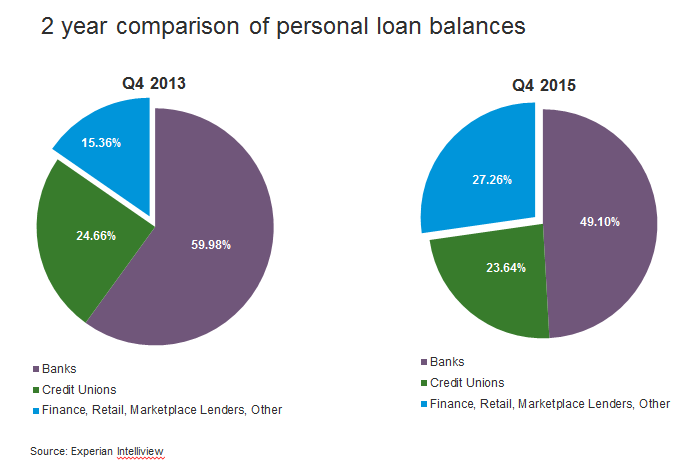
In fact, a recent Experian data pull revealed an increasing share of personal loan balances is actually going to lenders outside of the traditional banks and credit union space (they still own the lion’s share of the business). In 2013 (Q4), these more non-traditional lenders had 15.36 percent of personal loan balances. In Q4 of 2015, that number increased to 27.26 percent. The personal loan business today is just over $222.9 billion in outstanding balances.
personal-loan-growth

As the competition heats up, lenders will need to diversify, stand out and provide more value to consumers. Those that engage with new, value-added services, and deliver timely, personalized needs-based messages will capture the greatest share of the market.

Here is a sampling of ways to draw consumers in and deliver the value they seek in a financial institution:

Be Transparent

Lending Club, one of the original peer-to-peer lenders and currently the biggest in terms of dollars funded, continues to grow by providing consumers and investors with transparency, good loan terms and speed. Prosper, on the other hand, recently acquired an app that allows their customers to track spending, budget and monitor their credit. They plan to leverage this technology in the near future and offer it to customers and investors for free.

Research reveals Millennials especially are looking to tech and free services to manage their personal finances. A recent Experian survey focused on Millennials and credit revealed 48 percent have used free financial services, like Mint, to manage their finances. Additionally, 57 percent use on average three financial apps.

Know Your Customers

Payoff uses survey data to segment their customers into roughly 10 financial personalities based on how they use and think about their debt. These personality types are used to tailor marketing messages and customer service conversations about how to improve their financial situation. Their site features a quiz, Discover the Secrets of Your Financial Personality, helping consumers and Payoff understand more about trends attached to spending, saving and managing money.

Offer Solutions for Debt Consolidation

Even after consumers consolidate debt and pay it off successfully, unforeseen expenses, unexpected life events, evolving spending habits and the increasing cost-of-living expenses mean there will always be a market for debt consolidation solutions.

Understanding consolidation credit account behavior is mandatory for lenders looking to stand out and stay ahead of the consolidation needs of consumers. Having visibility to consumers’ interest rates, revolving loan balances and the remaining months on existing loans provides unique ways to segment and engage clients with need-based offers. Consumer-tailored messages during the prospecting, acquisition and account management stages of the relationship sets the stage for repeat business.

The research is clear.

Individuals are willing to switch brands if they feel a different provider will better meet their needs. Lenders – in both the traditional and fintech spaces – should not expect many chances when it comes to getting it right with consumers.

Fail to keep them engaged and you’ll fail to keep them. Period.

7534-Vision-2016-400x100-F

Learn more about identifying profitable consolidation candidates, check out Experian’s annual Vision Conference in May.

Related Posts

How Caliber Financial Uses Data to Drive Better Decisions

Learn how Caliber Financial uses Experian data to improve lead targeting, underwriting and AI-driven decisioning for better outcomes.

Published: July 14, 2026 by Scarlet Nickel
What Is Agentic Commerce? Why Trust Will Define the Next Era of AI-Powered Shopping

Learn what agentic commerce is, why AI agents are transforming digital commerce and how Agent Trust builds trusted AI interactions.

Published: July 14, 2026 by Laura Burrows
Ask the Expert: A closer look at financial inclusion with Corliss Hill and Dr. Vaneesha Dutra

Consumer visibility is changing Roughly 45 million Americans, or 1 in 5 consumers, are considered credit invisible or unscoreable.[1] They’re working, paying bills and participating in the economy, yet many are not fully visible during the lending process. That creates both a visibility challenge and a growth opportunity for lenders. In this Ask the Expert session, Corliss Hill, Senior Director, Inclusion and Belonging at Experian, joins Dr. Vaneesha Dutra, Endowed Professor of Finance at Morehouse College, to discuss how evolving consumer behaviors are reshaping conversations around financial inclusion and lending decisions. For lenders, visibility matters because confident decisions depend on reliable context and insight. Broader consumer signals can help institutions better understand repayment behaviors, financial stability and consumer capacity. “The benefit of banks using alternative data is that they capture a very significant and new consumer base. That's 20% of the population, 45 million Americans.”Dr. Vaneesha Dutra, Endowed Professor of Finance A more complete understanding of today’s consumers Today’s consumers often manage obligations across a wide range of payment types and financial channels, creating additional signals through cash flow activity, recurring payments and consumer-permissioned financial data. Rent, utilities, subscriptions and mobile phone payments can all provide meaningful insight into how consumers manage their financial lives. What’s changing isn’t the need for risk assessment. It’s the amount of consumer behavior lenders can now evaluate. For example, a consumer experiencing temporary financial disruption may fall behind on certain obligations while continuing to consistently pay rent, utilities and phone bills. Those recurring payment behaviors can provide important context into financial priorities and stability. “These are consumers that pay rent on time every month, pay utilities every month on time and meet many other financial obligations in a timely manner.”Dr. Vaneesha Dutra, Endowed Professor of Finance From visibility to more-informed decisioning Broader consumer insights may help lenders move from limited visibility to more informed decisioning. The conversation shifts when lenders move from asking: “Should we take a risk on this consumer?” to: “Do we have enough information to fully understand this consumer?” That broader context can help institutions: Strengthen risk assessment. Identify financially active consumers with strong repayment behaviors. Support more informed lending strategies. Alternative data isn’t about replacing established credit approaches. It’s about helping lenders build on trusted credit foundations with additional context and insight. Responsible lending starts with better context For lenders, the path forward is practical and actionable. As lenders evaluate broader consumer behaviors, three priorities become increasingly important: Modernize data strategies Incorporate broader consumer signals alongside existing credit data to create a more holistic view of repayment behavior and financial stability. Engage consumers earlier Earlier intervention may help lenders better support consumers before financial challenges become more severe. Create pathways to financial access Smaller lending opportunities can help consumers establish stronger financial profiles and demonstrate positive repayment behaviors over time. The institutions that lead will be the ones that can combine strong risk practices with a broader understanding of consumer behavior. Whitepaper: Bridging the credit divide: income, risk and inclusion in consumer finance Building on the themes discussed in this Ask the Expert session, Dr. Dutra explores how demographic shifts, evolving borrower behaviors and broader consumer visibility are reshaping lending strategies and what they mean for lenders seeking to balance growth, risk management and financial inclusion. Download whitepaper Explore alternative data with Experian Experian can help lenders combine broader consumer insights with trusted credit data to strengthen decisioning, improve risk assessment and support more-informed lending strategies. With solutions spanning identity, cash flow and advanced analytics, lenders can gain a more complete view of consumer behavior and expand access to credit with greater confidence. Learn more Watch episode 1 About our experts Corliss Hill Senior Director, Belonging Business Partner, Experian Corliss Hill is a collaborative leader well-versed in working with executive stakeholders, crossfunctional teams, external partners and community organizations to design and deliver initiatives and programs that create sustainable impact. With over 25 years of extensive experience in multicultural marketing, communications, PR and inclusion and belonging initiatives, she is dedicated to advancing equitable access to financial. Her mission is to drive impactful marketing initiatives that foster meaningful change and address systemic barriers to inclusion and the communities they serve.Hill has been a part of the Experian family since 2021, and resides in Atlanta with her daughter who is a rising 11-year-old entrepreneur. Vaneesha Dutra, Ph.D. Endowed Professor of Finance and Associate Dean, Morehouse College Vaneesha Dutra, Ph.D., serves as Associate Dean in the Division of Business and Economics. With more than 20 years of experience spanning higher education, banking and real estate, Dr. Dutra’s work focuses on the racial and gender wealth gap, financial literacy and financial decision-making. She is an active researcher and consultant whose work has earned numerous grants and fellowships, including serving as the inaugural Tracy A. Pruitt Visiting Research Faculty Fellow at the Wharton School of Business. Dr. Dutra has also been named a Research Faculty Fellow for both the Center for Black Entrepreneurship and the PNC Bank Center for Entrepreneurship. [1] Consumer Financial Protection Bureau, Expanding access to credit.

Published: July 13, 2026 by Julie.JLee@experian.com