Tag: claims management

Loading...

Could the era of manual claims processing be coming to an end? Experian Health's State of Claims 2022 survey revealed that more than half of healthcare providers have embraced advanced automation, freeing up staff from time-consuming and inefficient manual tasks. Automation has dominated as the key strategy used by providers to reduce denials in the previous 12 months. This evident optimism about technology's ability to address challenges in the claims process suggests that automation is here to stay. However, while automation has cracked open the doors to more efficient claims processing, the predictive power of artificial intelligence (AI) in claims processing can unlock exponentially higher rates of reimbursement. Providers may be increasingly aware of the benefits of automation, but many have yet to step into the world of AI. This article considers the advantages to be found in layering AI technology on top of automated claims processing and looks at how two new AI solutions are helping providers reduce denials and expedite payments.  How automation helps with claims processing Healthcare organizations with automated claims processing report improvements in speed, accuracy, financial performance and patient experience. For example: Automated claims management solution ClaimSource® helped Hattiesburg Clinic in Mississippi accelerate cash flow, reduce denials to 6.1%, and expedite claims from secondary and tertiary payers. Summit Medical Group Oregon used Enhanced Claim Status and Claim Scrubber to reduce accounts receivable days by 15% and achieve a first-time pass-through rate of 92%. These tools improve efficiency across the entire claims cycle by automating repetitive tasks, executing effective workflows and generating data-driven insights into root causes of denials so staff can prioritize high-impact tasks and errors are far less likely. Industry reports corroborate these positive results: CAQH reports that the medical industry could save as much as $22.3 billion per year through further automation. Unlocking the untapped potential of AI in claims processing Despite automation's impressive results, claim denials remain a thorn in the side of many revenue cycle leaders. This is where AI can help, thanks to its ability to predict and respond to payer behavior and claims data. But while 51% of survey respondents were using automation, only 11% had introduced AI-based technology to their claims process. For the AI-curious, combining automation and AI could be a good starting point to supercharge claims processing. AI technology can predict potential issues before they even occur by analyzing claims and denials and making suggested corrections or interventions in real-time. It can also assist in identifying fraudulent claims and denials, leading to improved claims processing accuracy and revenue cycle management. By using automation and AI together, healthcare providers can gain better insights into their claims and denial data, resulting in improved financial performance and greater efficiency. What does that look like in practice? More efficient and accurate claims predictions Automation can relieve staff of manual data handling activities, increasing the speed and accuracy of claim processing, from patient intake through scrubbing, submission and adjudication. AI enables staff to perform remaining tasks with greater confidence and accuracy. They no longer need to wonder, “which claim should I rework first?” – AI has the answer. Without AI, the logical approach would be to rework what appear to be the highest-value denials first. But in many cases, these aren't the ones most likely to result in reimbursement. AI can help staff prioritize by analyzing historical payment data and undocumented payer adjudication rules to flag denials that are most likely to be paid. This is exactly how AI Advantage™ – Predictive Denials works. Experian Health's new AI-based solution checks for any changes to the way payers handle denials and assesses these against previous payment behavior. Providers can set their own threshold for the probability of denial, and if the solution determines that a claim will exceed this threshold, it alerts staff so they can act quickly and decisively before the claim is submitted. Schneck Medical Center was an early adopter of this tool and used it to complement their existing claims workflow (built around ClaimSource®). Within six months, they saw average monthly denials drop by 4.6%. Predictive alerts allowed staff to focus efforts on submitting clean claims the first time, so both the number of denials and hours spent reworking them were drastically reduced. “Learning” from denials data to drive financial performance By definition, automated claims processing systems will repeat the same tasks over and over. This is great for operational efficiency but has limited capacity to handle variation. A major advantage of an AI-based solution is its capacity to “learn” and predict, so each claim can be individually assessed and directed to the most appropriate workflow. AI Advantage™ – Denial Triage uses advanced algorithms to identify and intelligently segment denials so that providers can prioritize accordingly. Just as Predictive Denials uses historical payment data to predict the claims that may be at risk of rejection, Denial Triage learns from payers' past decisions to predict the denials that are most likely to be reimbursed if reworked. Read more about Schneck Medical Center's experience with AI Advantage. How does using AI benefit healthcare staff? The use of AI in claims management can be met with different reactions: some staff are enthusiastic about the prospect of having manual tasks taken off their plate and being able to use their time more effectively. Others may be concerned about the impact of AI on jobs and recruitment. The reality is that many providers face ongoing staffing shortages, and therefore have little option but to augment their existing teams with new technology. Maintaining pre-pandemic headcounts in light of post-pandemic work patterns and budgets may not be possible. Automation and AI can resolve these short-term challenges while generating a positive ROI in the long term, as the volume and complexity of claim denials continue to grow. As noted in the State of Claims 2022 report, technology should no longer be viewed as a threat to jobs, but as a way of making life easier for staff. Automation and AI work hand in hand to execute tasks that many staff find time-consuming and laborious, leaving the more stimulating and high-value tasks for the human workforce. Improving operational performance can therefore have a positive effect on job satisfaction and retention. The integration of AI in claims processing is not about replacing human expertise, but about harnessing the power of AI-powered algorithms to enhance efficiency and minimize denials. The optimal approach lies in combining the strengths of automation, AI and staff. Automation handles repetitive processes, AI expedites decision-making, and human expertise brings contextual understanding and empathy to the process. Learn more about how Experian Health can help organizations utilize AI in healthcare claims processing with AI Advantage.

Published: July 10, 2023 by Experian Health

Artificial intelligence (AI) is changing the healthcare industry. From disease detection to chatbots, AI is having a significant impact on the way healthcare providers operate and deliver care to patients. Additionally, AI is transforming the revenue cycle management process by automating tasks, such as claim denials management. By leveraging AI tools, healthcare providers can reduce the time and resources required for manual claims processing, ensuring that claims are paid faster and with greater accuracy. As claim denials continue to rise by 10-15%, healthcare organizations continue to grapple with the adverse effects on their finances. That's why Experian Health created AI Advantage™ – an innovative solution that helps providers with better claim denial management. The first component, AI Advantage – Predictive Denials, proactively identifies claims that are at high risk of being denied, so providers can edit the claim prior to submission. The second component, AI Advantage – Denial Triage, steps in after claims have been denied to identify those with the highest potential for reimbursement. Schneck Medical Center is one example of a healthcare organization that has seen significant results from implementing AI Advantage. After just six months, they successfully reduced denials by an average of 4.6% each month. Corrections that would previously have taken their organization 12 to 15 minutes to rework could now be processed in under 5 minutes. With AI Advantage, healthcare organizations can improve their claim denials management processes, increase efficiency, and reduce administrative costs. The solution's ability to prevent and reduce claim denials in real time can help healthcare providers maximize revenue while delivering high-quality patient care. As healthcare organizations continue to face mounting financial pressures and staffing shortages, AI-powered solutions will be increasingly important in helping them navigate these challenges and achieve long-term success. Learn more about how healthcare organizations can begin their journey towards improving efficiency and reducing claim denials with AI Advantage.

Published: May 22, 2023 by Experian Health

“The challenge we sought to overcome by leveraging AI Advantage at our organization was just gaining more insight into how denials originate and what actions we can take to prevent those from happening.” — Skylar Earley, Director of Patient Financial Services, Schneck Medical Center Challenge Starting as a 17-bed hospital more than 100 years ago, Schneck Medical Center now serves four counties in Indiana, with a staff of more than 1,000 employees, 125 volunteers and nearly 200 physicians. The organization’s vision is to deliver excellence, lead transformation and advance health, underpinned by a patient-first philosophy. For the Patient Financial Services team at Schneck Medical Center, reworking denied healthcare claims was often time-consuming and inefficient. Billers tended to prioritize high-value claims, without knowing the probability of reimbursement. They sought a denial management solution that would reduce the risk of denied claims and minimize their impact on the revenue cycle. Solution Schneck worked with Experian Health to test two new denial management solutions that use artificial intelligence (AI) to reduce the likelihood of denials and prioritize rework to maximize reimbursement. The first, AI Advantage™ – Predictive Denials, uses AI to predict claims that have a high chance of being denied, so they can be corrected before the claim is sent to the payer. If a claim review exceeds the suggested threshold for denial probability, an alert is triggered, and the flagged claim is automatically routed to the appropriate biller. The biller investigates the alert to understand what changes are needed. This might include checking insurance eligibility, reviewing coding errors or reviewing authorization status. Once the alert is resolved, the claim can be automatically resubmitted. The second solution, AI Advantage™ – Denial Triage, prioritizes denials based on the potential for reimbursement so staff can focus recovery efforts on the right claims. The triage process starts with identifying between 2 and 10 denial segmentation categories based on likelihood of reimbursement. Schneck chose to identify 5 categories to start. Individual remits are evaluated and automatically assigned to the appropriate category, so they can be routed to the correct specialist. The tools use historical claims data and a continuously learning AI model to detect patterns in payer decisions. Staff can customize denial probability thresholds and segmentation criteria to ensure claims are routed to the correct specialist. The solutions integrate seamlessly with Schneck’s existing claims management system, ClaimSource®, and other health information workflows. Outcome After just six months, AI Advantage helped Schneck reduce denials by an average of 4.6% each month. Corrections that would previously have taken 12 to 15 minutes to rework can now be processed in under 5 minutes. Staff report that the thresholds determined by AI Advantage – Predictive Denials are highly accurate, leading to better decision-making when reworking claims prior to submission. And with AI Advantage – Denials Triage, staff feel confident that they’re focusing their attention on the right segments, rather than wasting time on high-value claims that are unlikely to be reimbursed. Skylar Earley says, “Before, we had no insight into whether we were performing value-added work when we followed up and worked denials. Now we see those percentages.” Learn more about how AI Advantage generates insights to help healthcare organizations reduce time spent working denials and maximize reimbursement.

Published: March 22, 2023 by Experian Health

Healthcare is undergoing a digital revolution driven by artificial intelligence (AI) and machine learning (ML) technology. While some organizations have been slow to adapt, others incorporated new solutions that have helped their organization identify patterns, reduce claim denials, and more. This infographic breaks down common phrases related to artificial intelligence and machine learning so that healthcare organizations can understand what they mean and how they're utilized. Introducing: AI Advantage™ Experian Health is the top-performing claims management vendor, according to the 2023 Best in KLAS: Software and Professional Services report. Experian Health’s ClaimSource® solution, an automated, scalable claims management system designed to prevent claim denials, ranked number one in the Claims Management and Clearinghouse category. With denials and staffing shortages on the rise, an efficient claims management strategy is essential. Experian Health is here to help with AI Advantage™ – a new solution that utilizes true artificial intelligence that proactively helps reduce denials and, when necessary, identifies the best denials to resubmit.

Published: February 28, 2023 by Experian Health

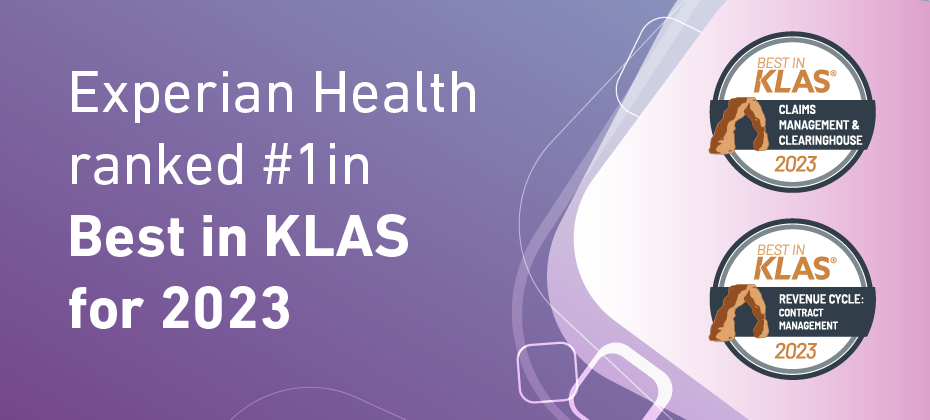
Experian Health is very pleased to announce that it ranked #1 in Best in KLAS, Software and Professional Services, for two segments:  #1 in Claims Management and Clearinghouse, for our ClaimSource® claims management system  #1 in Revenue Cycle, Contract Management, for our Contract Manager and Contract Analysis product.   According to KLAS CEO Adam Gale, “The 2023 Best in KLAS report highlights the top-performing healthcare IT solutions as determined by extensive evaluations and conversations with thousands of healthcare providers. These distinguished winners have demonstrated exceptional dedication to improving and innovating the industry, and their efforts are recognized through their inclusion in this report. Congratulations to all the winning vendors for setting the bar for excellence in healthcare IT! KLAS continues to be committed to creating transparency and helping providers make informed decisions through our accurate, honest, and impartial reporting.”  Experian Health’s 2022 State of Claims survey reveals that 47% of providers said that improving clean claims rates was one of their top pain points, with 42% reporting that denials have increased in the past year. Read how Hattiesburg Clinic in Mississippi, which uses both Contract Manager and Analysis and ClaimSource, leverages ClaimSource to automate claims management and reduce denials. Learn more about how ClaimSource and Contract Manager and Contract Analysis can help your healthcare organization. 

Published: February 8, 2023 by Experian Health

Hattiesburg Clinic is Mississippi’s largest multispecialty clinic with over 450 physicians serving 19 counties. Claims management, patient collections and payer contract management are handled by the clinic’s Financial Services Department, which includes around 70 staff members. Challenge Hattiesburg Clinic in Mississippi sought to improve financial performance in the wake of the COVID-19 pandemic by focusing on reducing claim denials. The Financial Services Department had been hit by staffing shortages, which affected financial results. A more efficient digital claims management solution would attract and retain a high-performing virtual team, while supporting the shift away from existing paper-based systems. To submit more clean claims the first time, the Department set specific goals to: meet or exceed Epic benchmarks for primary denials maintain accounts receivable (AR) days at 42 or less process secondary and tertiary claims without waiting for the primary electronic remittance advice (ERA) to be posted. Solution Already impressed with Experian Health’s Contract Manager and Eligibility solutions, the Department chose another Experian product, ClaimSource®, to help reduce denials. Loretta McLaughlin, Assistant Director of Financial Services, said she was confident ClaimSource was a good candidate for the clinic’s claims platform: “ClaimSource seemed like the right fit for the department’s goals. The platform’s ability to customize edits, along with the level of customer support available, really set the solution apart from the alternatives.” ClaimSource uses scalable automation to prioritize claims, payments and denials. This allows staff to use their time as efficiently as possible, by working on the highest-impact accounts first. Using customizable edits and extensive national and local payer edits, it checks each claim for inconsistencies before the claim is submitted. ERA data is automatically integrated into Epic so that staff can check a claim’s status quickly and easily. With real-time reporting, staff gets insights from across the entire claim lifecycle to improve performance. Outcome The ability to integrate customizable edits was a big advantage for the clinic. They now have over 90 custom edits that help eliminate time-consuming errors, reduce denials, and allow staff to focus on the right accounts. As a result, Hattiesburg Clinic has achieved a 6.1% primary denial rate, which exceeds the Epic Financial Pulse benchmark. Despite staffing shortages, they’ve been able to accelerate receivables. They’re also seeing accelerated cash flow, now they can pursue claims from secondary and tertiary payers without awaiting the outcome of primary claims adjudication. ClaimSource is also creating a better staff experience: the tool eliminates the need for claims to be printed, so staff can work from any location. Now, over 50% of the team work from home. Thanks to automated workflows, output has been consistent despite a reduced workforce. Being able to submit clean claims the first time has a positive impact on AR days as well as staff workload. Loretta McLaughlin says: “Through ClaimSource’s automation and level of quality work, we have had to do less manual intervention.” To build on this success, the team intends to explore further opportunities to use automation to improve productivity. Options include automatically generating patient estimates, automating bad debt and refund workflows, and allowing patients to verify insurance eligibility through their patient portals. Find out more about how ClaimSource helps hospitals, health systems and physician groups reduce denials, protect profits and increase productivity through automated and scalable claims management.

Published: January 6, 2023 by Experian Health

With 2023 just around the corner, healthcare executives are teasing out their strategic priorities for the next 12 months. Where should they be focusing their attention? Here are the top 3 healthcare predictions to watch in 2023 and the actions needed to help providers prepare. Prediction 1: AI and automation will continue to gain traction “The time is now for providers to get ready, prepare and implement these technologies.” - ­Jason Considine, Chief Commercial Officer at Experian Health Automation came to the forefront during the pandemic, enabling essential access to care and filling in gaps created by staffing shortages. By now, the use of remote and digital tools is pretty well-established. Automation is the norm, but there’s room to leverage these solutions for an even greater ROI. As Jason Considine says, investing in technology that makes it easier for providers to get paid will be a particularly effective use of digital tools. One such example is in the digitalization of healthcare claims. Healthcare claims management processes have typically relied on manual systems. These can be slow and error-prone, creating avoidable extra work for staff and friction for patients. In the State of Claims 2022, 78% of executives said their organization would be likely to replace their existing claims management solution if convinced something else can deliver better ROI. Eliminating inefficiencies and optimizing reimbursement would certainly check that box. Tools like Denials Workflow Manager, Enhanced Claim Status and ClaimSource® use automation and detailed analytics to improve claims management performance. More claims can be processed more accurately, resulting in fewer denials and faster reimbursement. With denials increasing by 10–15%, claims automation is likely to be a top priority for many providers in 2023. Prediction 2: Patients will increasingly choose providers that offer a user-friendly financial experience  “The immediate path to better billing and payment processes may escalate pressures on providers right now, but it will yield better financial outcomes in the future for patients.” - Victoria Dames, Vice President of Product Management at Experian Health The economic downturn has put pressure on providers and patients, which we can expect to last into 2023. Patients are concerned about healthcare costs, but they’ve also come to expect a more transparent and compassionate financial experience. Experian Health's top healthcare predictions finds that reliable pricing estimates, support to find the right payment plan, and convenient and flexible payment options will be table stakes in 2023. For providers, implementing digital payment options to meet these needs may be challenging, but it’s an investment that will yield positive long-term results. More than 6 in 10 patients who have received an unexpected bill or inaccurate estimate would switch healthcare providers for a better experience in future, placing transparent medical billing at the core of attraction and retention strategies. The medical billing software outsourcing market is already experiencing historic growth as providers respond to patient demand for a digital financial experience: the market’s value is expected to grow over the next decade, from $11.1 billion in 2021 to $55.6 billion in 2032. Experian Health leads the way when it comes to creating a patient-friendly billing and payment experience, with solutions such as Patient Financial Advisor and Patient Estimates. Giving patients greater control over their financial journey with upfront estimates and tailored payment plans makes it easier for them to prepare for payments. Prediction 3: Providers that fail to create a welcoming digital front door could be closing off revenue opportunities  “Deliver convenience. People are consumers before they are patients.” - Tom Cox, President at Experian Health Automation offers opportunities for optimization throughout the revenue cycle, but one of the most crucial points is in patient access. Making patient access easier is on the list of top healthcare predictions, and for good reason - a frictionless first impression can have a powerful lasting effect. What should this look like? Cox advises that providers should “anticipate the needs of digital-first customers.” Patients expect the same personalized service they are accustomed to in other sectors, with convenience, choice and control at the center. Administrative “relics” such as the traditional waiting room clipboards and repetitive forms must be minimized where possible. A report from Experian Health and PYMNTS found that a third of patients chose to fill out registration forms for their most recent healthcare visit using digital methods. 61% of patients even said they’d consider changing healthcare providers to one that offers a patient portal. Online scheduling software and self-service registration makes it easy for patients to complete these tasks in advance. Providers can then round out a user-friendly patient experience with Patient Payment Solutions. This gives patients a choice of payment methods, leading to faster payments. Providers have realized that many patient access functions can be achieved more efficiently and cost-effectively using self-service and remote digital tools. By streamlining intake operations, organizations can make better use of staff time, reduce errors and increase productivity, while improving the patient experience simultaneously. As revenue cycle technology continues to develop in 2023 and beyond, providers need to ensure they are capitalizing on the latest software to improve their bottom line, deliver on patients’ service expectations, and keep pace with healthcare predictions. Learn more about Experian Health's revenue cycle management solutions and contact us to find out how these solutions can help healthcare organizations open their digital front door and prepare for 2023.

Published: December 15, 2022 by Experian Health

The medical billing software outsourcing market is experiencing historic growth as providers respond to patient demand for digital payment options. The market’s value is expected to grow by five times over the next decade, from $11.1 billion in 2021 to $55.6 billion in 2032, according to a recent Future Market Insights report.  The pandemic has been the main driver of digital transformation in healthcare billing, embedding patient expectations for the same friction-free experience that has become the norm in other retail environments. By implementing medical billing software and digital collections solutions, providers can offer patients the flexibility and choice they desire. They can also capitalize on operational efficiencies ­– but only if they choose the right tools. Without the time or resources to undertake these activities in-house, many revenue cycle management teams are starting to outsource, in order to optimize medical billing processes, reduce costs and improve the patient payment experience. Choosing the right medical billing software Digital solutions can support every step of the patient’s financial journey, from receiving initial pricing estimates to paying at the click of a button. What criteria should providers consider when evaluating solutions that cater to patient demands for a better payment experience? Here are a few to look out for: Automation - Digital solutions do more than simply remove the need for paper-based billing. Software and machine learning can complete tasks to reduce the burden on staff and patients. Patient payment reminders, auto-filled claims forms and coverage checks are just a few examples of how automation can deliver speed and simplicity to patients, while saving staff time. User-friendly interfaces - A digital tool that’s difficult to use is never going to gain traction. Whether patient-facing or for use by front or back-office staff, user interfaces should be clean, simple and intuitive. Tracking and reporting - Digital billing solutions should offer the ability to monitor progress and generate instant status updates on payments and claims. With real-time insights, staff can further optimize collections and reimbursements. Reliable and secure data - Software and digital solutions are only as good as the data on which they’re built. Fresh, accurate patient data is essential. Data should be held in standardized and interoperable formats to streamline data exchange between different electronic records management systems. This will help to avoid errors, keep data secure and ensure compliance with HIPAA. A single vendor - A piecemeal approach can result in tools that don’t speak to each other. Instead, it makes sense to select a vendor that offers integrated systems for greater reliability and ease of use. Information from multiple billing and claims tools can be pulled into a single dashboard, so staff can capture the details they need at a glance. Setting up and optimizing digital solutions can be easier with a single vendor too. That’s why Experian Health offers consultancy and technical support to help users get started quickly. Here are 4 medical billing solutions that check these boxes: 1. Generate accurate estimates during patient registration with Patient Payment Estimates Providers can set the tone for a positive financial experience by deploying digital billing solutions from the start of the patient journey. One example is to offer patients accurate estimates of the cost of care before or at the point of service, so they can concentrate on treatment without worrying about unexpected bills. Patient Payment Estimates give patients a breakdown of their financial responsibility along with information about relevant payment plans and links to convenient payment methods. These can be accessed via a web-based tool or sent straight to their mobile device. Given that 6 out of 10 patients who received inaccurate cost estimates would switch providers for a better payment experience, tools like these could deliver a strong ROI. 2. Verify coverage as early as possible with Insurance Eligibility Verification and Coverage Discovery Verifying a patient’s active insurance coverage is a painstaking task when undertaken by hand. Staff must pore over payer websites and call insurance agents to check what the patient’s plan will cover. Automated tools like Insurance Eligibility Verification and Coverage Discovery can identify coverage quickly and accurately. Not only does this reduce the patient’s financial responsibility, but it also lowers the risk of uncompensated care and saves valuable time for staff. 3. Submit clean claims the first time with Claims Management Software Automating claims management takes a huge amount of pressure off staff teams. It also guarantees a higher level of accuracy than if claims were managed manually. Claims management software can automatically add patient information to claims, incorporate customized edits and review coding to ensure claims are correct before they are submitted electronically. Claims adjudication can be monitored in real-time to reduce the risk of denials. 4. Provide personalized payment plans and point-of-service payment options with PatientSimple Ideally, bills will be settled as early as possible. Neither providers nor patients want a protracted process of overdue statements and repeated phone calls from collections agencies. If patients are offered a choice of convenient payment methods at each touchpoint, they’re more likely to pay before or at the point of service. PatientSimple leverages Experian Health’s unrivaled data to identify the most suitable payment pathway for each patient and helps them manage it through a user-friendly, self-service portal. Patients can view statements online and pay balances immediately with cards kept on file. With the right medical billing solutions, providers can alleviate pressures on staff, reduce the risk of errors and support compliance with new regulatory requirements. But more importantly, it creates a healthcare experience that’s efficient, flexible and simple for patients, resulting in higher consumer satisfaction and faster patient collections. Find out more about how Experian Health’s medical billing solutions help providers maintain a healthy revenue cycle and meet patient expectations for a 21st-century consumer experience.

Published: November 11, 2022 by Experian Health

In 2009, processing claims was listed as the second greatest contributor to “wasted” healthcare dollars in the US, at an estimated $210 billion. A decade later, that amount was estimated at $265 billion. Today, healthcare providers are still grappling with denied healthcare claims, with both challenges and solutions accelerated by the pandemic. To put the scale of operational and delivery changes into perspective, Experian Health recorded well over 100,000 payer policy changes for coding and reimbursement between March 2020 and March 2022. The implications for claims processing are immense, which is why healthcare providers need to reevaluate their denial management strategies and invest in new technology that can help increase reimbursements. In June 2022, Experian Health surveyed 200 revenue cycle decision-makers to understand how they feel about the current situation. What are the priorities of those on the front line of denials management? And how can technology contribute to improvements? This article breaks down the key findings. Takeaway 1: Denials are increasing and reducing them is priority #1 30% of respondents say denials are increasing by 10-15% Nearly 3 out of 4 respondents say that reducing denials is their top priority For most respondents, claims management is more important now than it was before the pandemic, because of payer policy changes, reimbursement delays and increasing denials. Respondents attribute this to insufficient data analytics, lack of automation in the claims/denials process and lack of thorough staff training. When it comes to improving denial rates, staffing seems to be the greatest challenge. More than half of respondents say staff shortages are slowing down claims submissions and hampering efficiency. Shrinking offices mean there is less staff to handle the growing volume and complexity of claims. It’s no surprise, then, that around 4 in 10 respondents are also concerned about keeping up with rapidly changing payer policies and keeping track of pre-authorization requirements. Providers recognize that technology can help reduce denials while easing the burden on staff. A tool like ClaimSource manages the entire claims cycle using customizable work queues that make it easy to prioritize accounts, saving staff time and avoiding the errors that lead to denials. This also incorporates payer edits to ensure that claims are clean before being submitted to the payer. And if claims do end up needing further attention, Denials Workflow Manager eliminates time-consuming manual processes and allows providers to attend to high-risk claims quickly, so there’s less chance of delayed reimbursement. Takeaway 2: Automating denials management in healthcare is critical 52% of respondents upgraded or replaced previous claims process technology in the last 12 months 51% are using robotic processes, including automation, but only 11% are using artificial intelligence Prior to the pandemic, automation was sometimes perceived as a threat to jobs. But with changing employment patterns and evidence of the broader benefits of automation, attitudes are shifting. Automation can make life easier for staff by removing manual tasks to allow them to focus on other priorities. It speeds up the healthcare claims processing workflow, reduces the risk of errors, and enables better communication between providers, patients and payers. Providers recognize that automation drives more efficient claims management. The survey revealed that 45% of respondents turned to automation to keep track of payer policy changes, 44% had automated patient portal claims reviews, and 39% had digitized patient registration in the last year. Automation supports all stages of the claims management process, from auto-filling patient data during registration, to generating real-time claim status reports for back-office staff. Payer authorizations were a common challenge for providers, and a perfect fit for automation. Experian Health’s Prior Authorizations solution eliminates the need for staff to visit multiple payer websites, automates inquiries, and offers real-time updates on pending and denied submissions so staff knows when to intervene. Takeaway 3: Providers are searching for denial management solutions that will achieve the greatest ROI 91% of those likely to invest in claims technology say they will replace existing solutions if presented with a compelling ROI The majority of providers may be on the lookout for better claims management solutions, but they vary in how they measure ROI. Predictably, one of the most common metrics is how much staff time can be saved, with 61% concerned with hours spent appealing or resubmitting claims, and 52% looking at time spent reworking claims versus reimbursement totals. Rates of clean claims and denials were also popular metrics, at 47% and 41%, respectively. Using Denials Workflow Manager and ClaimSource alongside additional claims management solutions like Claim Scrubber and Enhanced Claim Status can deliver an even stronger performance against the above metrics. Each solves a specific challenge within the claims management workflow, but when used together, the ROI is multiplied. Overall, there’s optimism that digital technology and automation can help healthcare providers improve claims and denial management and reduce the amount of “wasted” dollars. This survey shows that providers are keen to grasp the opportunities offered by automation to optimize the reimbursement process and get paid sooner. Download the report to get the full results on the State of Claims 2022, and discover how Experian Health can help organizations with their denial management strategies.

Published: October 27, 2022 by Experian Health

Subscribe to our blog

Enter your name and email for the latest updates.

This site is protected by reCAPTCHA and the Google Privacy Policy and Terms of Service apply.

Subscribe to the Experian Health blog

Get the latest industry news and updates!
Subscribe