At A Glance
Hospitals that treat Medicaid patients should update their eligibility and billing systems now to prepare for the One Big Beautiful Bill Act (OBBBA), which will bring major changes to Medicaid.
Key takeaways:
- New Medicaid reforms under OBBBA are expected to bring increased financial risk for hospitals, and over half of providers say they face moderate to high risk to Revenue Cycle Management (RCM) performance.
- Around 40% of healthcare organizations anticipate a need for major updates across revenue cycle systems – particularly in areas of eligibility, billing and compliance processes.
- Compared to other types of providers, hospitals have a better understanding of OBBBA’s impact on Medicaid, are better prepared and may only need to make minor process adjustments.
The budget reconciliation bill, known as H.R. 1 of the One Big Beautiful Bill Act, was signed into law on July 4, bringing major shifts to Medicaid, Medicare and Affordable Care Act (ACA) marketplace plans.
For hospitals that treat Medicaid patients, OBBBA reforms are reshaping eligibility criteria, reimbursements and demand for charity care – and could bring significant financial risk. To keep revenue cycles on track, hospitals must brace for the impact of higher uncompensated care costs, rapidly evolving compliance needs, and a growing administrative burden.
Here’s what hospitals need to know about OBBBA’s changes to Medicaid and strategies to improve resilience.
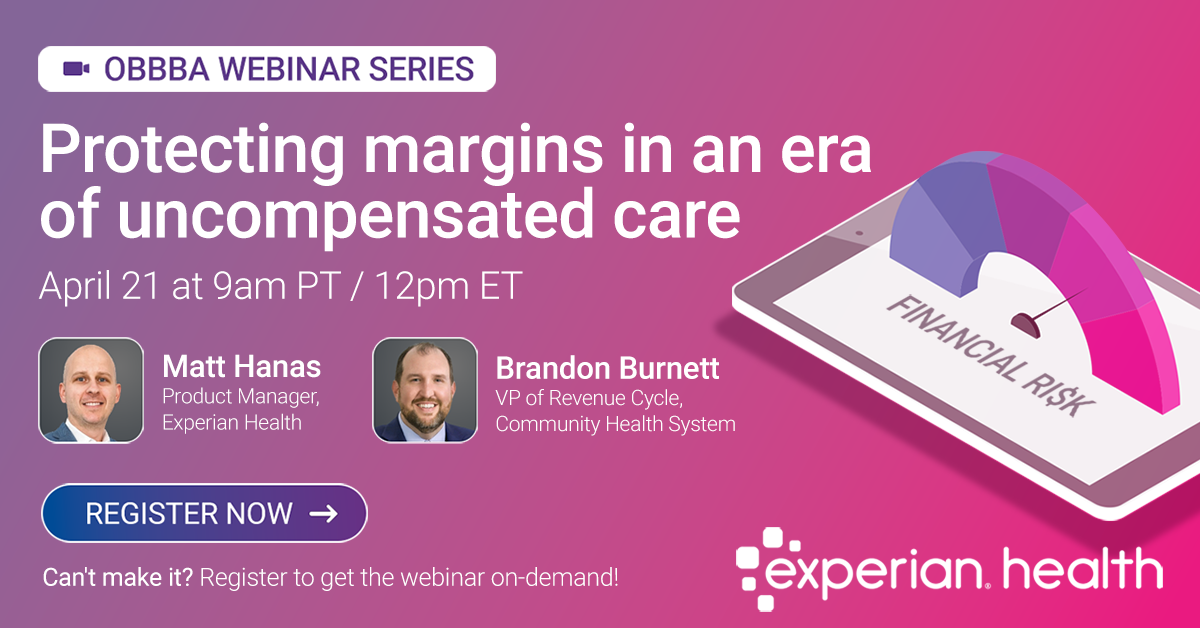
Register for Webinar 3: Defending margins under OBBBA
This session closes our OBBBA series by showing how leading health systems are using data and automation to protect margins in a high–uncompensated care environment.
What do hospitals need to know about Medicaid changes?
For hospitals, Medicaid changes will affect enrollment, eligibility, cost-sharing and funding. These One Beautiful Bill Act Medicaid changes reflect a broader push by lawmakers to improve fiscal sustainability, curb federal spending and return control to states.
What hospitals need to know about the upcoming changes for Medicaid:
- More frequent eligibility checks: Beginning in 2027, states will be required to run automated eligibility checks every six months for adults covered under ACA Medicaid expansion. Quarterly cross-checking against federal databases to remove ineligible or deceased enrollees will also become mandatory.
- Pause on Biden-era federal rules: Under the OBBBA, a moratorium goes into effect on implementing previous federal rules tied to streamlining enrollment in Medicaid and the Children’s Health Insurance Program (CHIP).
- Community engagement requirement: Starting in 2027, some Medicaid enrollees, including adults ages 19 to 64 who don’t have disabilities or dependents, will need to show proof that they work, volunteer or are in schooling at least 80 hours a month, unless exempted.
- Immigration eligibility restrictions: Some lawfully present immigrants will lose their Medicaid eligibility. Additionally, Medicaid payments for emergency health services in expansion states will be banned for most migrants.
- Cost-sharing requirements: Beginning in 2028, Medicaid enrollees with incomes above the federal poverty level will be subject to cost-sharing mandates—up to $35 per service—to ensure beneficiaries have a financial stake in their care.
- Funding limits and financial penalties: States will face new limits on how provider taxes and supplemental payments can be used to boost federal matching funds. States must phase down existing taxes from 6% to 3.5% over several years, and penalties will be issued for failure to recover overpayments.
How will rising uninsured volumes create more financial risk for hospitals?
Rising uninsured volumes likely mean new financial risks for hospitals. However, 31% of hospitals say the financial risks of Medicaid changes are low and feel they can adapt with minimal revenue impact, while 44% say they face moderate financial risk.
Here’s what hospitals can expect:
- Reimbursements are likely to decrease. Cost-sharing and funding provisions may constrain reimbursement for Medicaid services — especially for hospitals in non-expansion states.
- Patients may require more charity care and greater financial assistance to cover costs. One in five patients currently reports experiencing distress over healthcare costs they can’t afford. As more Americans find themselves without Medicaid coverage, self-pay volumes are likely to rise, along with emergency uninsured visits.
- Hospitals may be left with bad debt. The latest Congressional Budget Office (CBO) data estimates providers will have to shoulder $36 billion in uncompensated care by 2034, with safety-net and rural organizations shouldering the biggest impact.
- Operating margins may be impacted. Data also suggests key policy milestones will impact health system operating margins — with the effects compounding over the next several years. By 2028, margins may go down as much as 17% for systems with a median $1B to $2B net operating revenue system.
How can hospitals upgrade revenue cycle systems and processes for OBBBA?
Hospitals must prepare for upcoming Medicaid reforms by upgrading key RCM systems and processes. For many revenue cycle leaders, eligibility and billing processes are top of mind, along with meeting new compliance and regulatory requirements.
The following strategies can help hospitals maximize system and process upgrades for OBBBA:
1. Leverage collections optimization solutions
With self-pay patient volumes growing, overhauling billing system configurations is a top priority for 42% of hospitals. Billing systems must be able to keep up with new Medicaid billing requirements while also helping hospitals improve patient collection rates.
Upgrades for hospitals to consider:
- Collections optimization technology streamlines the collections process and helps hospitals leave less revenue on the table.
- With tools like Experian Health’s Collections Optimization Manager, billing teams quickly understand a patient’s ability and willingness to pay.
- It also identifies charity eligibility and can implement effective and compassionate outreach — creating a smoother patient financial journey.
2. Reduce coverage gaps with real-time eligibility and discovery
Hospitals can better reduce the risk of coverage gaps by proactively strengthening front-end eligibility and financial clearance processes. For 43% of hospitals, upgrading systems to handle more frequent eligibility checks and verify compliance with new Medicaid work requirements is a must.
Upgrades for hospitals to consider:
Health insurance lookup tools, such as Experian Health’s Eligibility Verification and Coverage Discovery, help providers easily verify coverage prior to service. Coverage Discovery uses proprietary data and advanced machine learning to identify unknown or forgotten insurance coverage across the entire revenue cycle – before, during, and after care.
Coverage Discovery identified over $60 billion in insurance coverage across 45+ million unique patient cases in 2024 alone, turning missed opportunities into paid claims.
Accurate patient information at intake is essential to reducing claim denials. Together, Experian Health’s Patient Access Curator™ (PAC) and AI Advantage™ solutions help ensure accurate patient information and cleaner claim submissions. PAC uses artificial intelligence to automatically check and verify patient demographic information in real-time. AI Advantage works downstream to predict claim outcomes mid-cycle and push urgent tasks to the front of the queue.
3. Support patient payment readiness with estimates and transparency
By 2034, the Congressional Budget Office (CBO) estimates 10 million people will lose Medicaid or CHIP – likely shifting more patients to self-pay. Price transparency regulations are also getting tighter, making compliance with new transparency laws a priority.
Upgrades for hospitals to consider:
- 81% of patients report that accurate estimates help them better prepare to pay their medical bills. Solutions like Experian Health’s Patient Estimates generate real-time estimates using up-to-date payer contracts, fee schedules and historical claim data.
- Patient Estimates also ensures hospitals are ready using four built-in reports that align estimates with actuals, track collections and prove compliance.
- Self-service payment portals, like PatientSimple® from Experian Health, allow patients to conveniently access personalized estimates.
- Complementary tools, like Patient Financial Advisor, text estimates to patients or download PDFs in-office.
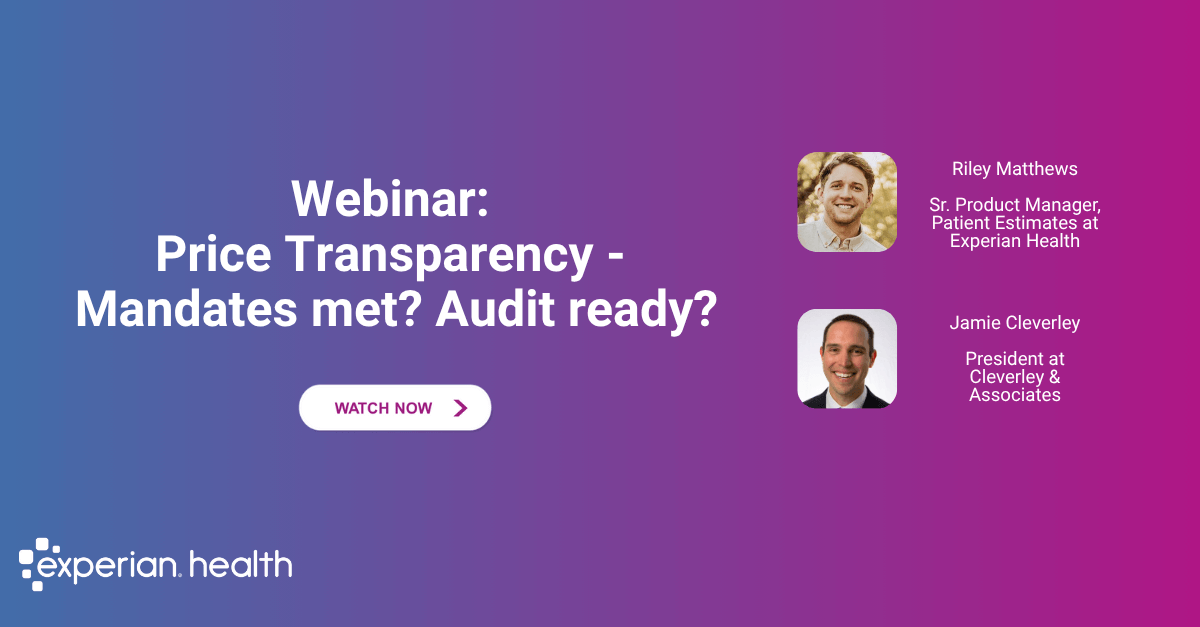
The CMS Hospital Price Transparency Rule is evolving—and so are the expectations. Find out what’s changing, what’s at stake, and how to prepare your organization for audit-readiness and long-term success.
4. Automate charity care to offset uncompensated care
As patients lose Medicaid coverage, hospitals could see increased patient need for financial assistance, like charity care programs.
A third (33%) of providers feel Medicaid financial assistance or charity screening processes are ripe for upgrades. Additionally, 30% of hospitals say call center training and scripting for Medicaid patient financial communications needs improvement.1
Upgrades for hospitals to consider:
- Automating financial assistance screening with tools like Patient Financial Clearance can foster compassionate financial conversations and ensure more patients are connected to support at scale.
- Patient Financial Clearance uses real-time data to identify patients who may qualify for charity care – recommending suitable payment plan options while reducing administrative burden.
See how Patient Financial Clearance is helping Community Health System prepare for a potential rise in uninsured patients in 2026 by automating eligibility verification and coverage screening.
The bottom line: Hospitals must future-ready operations for an uncertain payer mix
Under the One Big Beautiful Bill Act, Medicaid policies are evolving rapidly – with many unknowns ahead. As hospitals work hard to bolster key revenue cycle management processes and systems in order to minimize financial risks, a flexible, technology-first approach may prove to be crucial.
Scalable, automated solutions help organizations get eligibility right, minimize the risk of uncompensated care and enable patients to better understand their financial obligations. With the right tools in place, hospitals can better weather any new challenges OBBBA brings.
Find out how Experian Health is helping hospitals prepare for Medicaid reforms by modernizing eligibility checks and reducing exposure to revenue loss.
Sources:
1. Experian Health – OBBBA 2025 Research. Quantitative survey of 200 healthcare professionals responsible for financial, billing and RCM decisions. This survey was conducted in October 2025.