



Small and mid-size businesses, or “SMBs”, serve as the foundation of the nation’s economic vitality. The number, diversity, and significance of SMBs have mushroomed in recent years, with a corresponding growth in the tools and technology available to them. But, as with SMBs, the commercial lending institutions that service them are also experiencing fluctuating interest rates, payment hierarchy shifts, and competition from other lenders. These growth aspects are conducive for both rapidly growing cash flows and borrowing volumes, but they are also conducive to something more nefarious. With digital transformations still very much underway in many firms, and economic uncertainty looming, one constant remains: Application fraud is relentless, persistent, and always increasing in sophistication. What’s causing the rise in application fraud? The growing problem of SMB loan fraud has been keeping compliance and risk management professionals up at night for years. But, to understand how loan and application fraud morphed from primarily a consumer issue into a crisis for commercial lenders, it’s important to understand what led fraudsters to these types of institutions in the first place. Prior to 2020, credit risk professionals were struggling to process SMB loan applications, and while modernizing that process was something they hoped to tackle further down the line, the COVID-19 pandemic disrupted those plans. In a recent report the SBA identified more than 70,000 potentially fraudulent loans totaling over $4.6 billion were released by August 2020, mere months after the inception of the program. Lenders shored up online applications to handle the millions of PPP loan applications on behalf of the SBA and, naturally, fraudsters saw this as a massive opportunity. They turned their attention towards PPP loans by picking off more diminutive, less sophisticated regional banks and lenders, submitting fraudulent credit applications using false information. SBA identified more than 70,000 potentially fraudulent loans totaling over $4.6 billion were released by August 2020, mere months after the inception of the program.Oversight.gov When the Recovery Act funds dried up, fraudsters shifted their attention back to larger commercial lenders, using a combination of tactics to defraud them out of loans they had no intention of paying back. In fact, one study found that 98% of B2B businesses reported fraud attacks in 2021, losing on average 3.5% of their annual sales revenues. Commercial lenders began to understand the extent of their vulnerabilities, which prompted a rapid increase in digital transformations, modernizing customer journeys to be more mobile friendly and capable of screening for fraud. And although many had already begun to ramp up their digital transformations, this process ultimately presented them with three distinct problems. Weak identity screening bodes well for fraudsters First, the online environment is attractive to fraudsters because they can exploit weaknesses in identity screening technology. So as consumer channels fortified their anti-fraud capabilities, it forced scammers to redirect their efforts and move on to new targets. Looking for big payouts, they turned to commercial lending institutions, who had yet to fully implement proper protections. Older infrastructure a primary weakness Second, because many online lending application systems lacked the type of sophistication necessary for real-time, accurate fraud screening, criminals could quickly leverage that lack of sophistication in their favor. As a result, commercial lenders across all industries felt vulnerable, especially those with limited or untrained staff who could not complete thorough manual reviews of suspect applications. As a result, fraud rates among commercial lenders increased dramatically. Manual application reviews sap resources Finally, in the wake of this sharp increase in SMB application fraud, many commercial lenders struggled to implement advanced analytics and fraud protection software to combat the growing issue. When Forrester Research polled credit services decision-makers in 2019 for Experian, one of the most interesting findings was the amount of time they spent processing new applications for credit. They spent 41.9 hours a week on average, with 1 in 3 businesses struggling to deploy advanced analytics or automated account reviews: SMB application fraud: As diverse as the businesses themselves A common misconception among commercial lenders is that they do not have an SMB fraud problem. For those that do recognize instances of fraud, there is a lack of certainty around how much it affects their bottom line, and what type of fraud it is. So, it’s important to understand what SMB application fraud is, and how it manifests. SMB application fraud occurs when an individual or set of individuals applies for financial assistance with a commercial lender using deceptive means for personal profit. This deception can occur in several ways, presenting as first-party fraud, third-party fraud, or synthetic fraud and usually impacts commercial lenders during the account opening or onboarding process. First-party fraud occurs when: A person willfully misrepresents their personal information to take out credit with no intention of repaying. Third-party fraud occurs when: A fraudster uses another individual’s personal details without consent to gain credit or steal products. Synthetic fraud occurs when: An individual uses a combination of true and false personal information to fabricate an identity or application. SMB application fraud affects commercial lenders across multiple industries, from traditional banking and fintechs, to trade credit, telecommunications, energy, and manufacturing firms. While these lenders range widely in scale, diversity, and sophistication, all are subject to SMB application fraud. One of the reasons fraudsters have disguised themselves as SMBs and increased their targeting of commercial lenders is that most of these institutions don’t have adequate protections to catch instances of fraud at this early stage. As a result, it has already affected the bottom line by the time it becomes clear that a loss was due to fraud. Commercial lenders engaged in markets with high inherent fraud risk generally understand the safeguards to achieve nominal fraud protection. Still, they seldom have the right solutions in place at the right time. Alternatively, commercial lenders with minimum exposure to SMB application fraud are generally less aware of how these different types of fraud are impacting their revenue. Consider the following realistic scenarios: Equity Bank Southeast (EQBS) is a large financial services institution with branches and operations from Texas to West Virginia, with roughly $5 billion in assets. EBS facilitates cash management services for individuals and SMBs. Like most other financial services institutions, they were caught off guard by the widespread and rapid impacts of the COVID-19 pandemic and struggled to scale their efforts and fraud protections quickly. They have misclassified fraud losses as credit losses and bad debt, unsure of their true fraud exposure. They are looking for a solution that can integrate seamlessly into their current systems to improve their direct deposit account (DDA) opening and loan application processes. Broadband Communications Inc. is a telecommunication holding firm with close to $450 million in net profits per year. The 2020 shift to remote working proved challenging for them as they struggled to reconcile the number of new customer applications with their diminished workforce. They do not currently have a team dedicated to mitigating fraud, despite observing an increase in losses over the last three consecutive quarters. They are vetting various organizations and solutions to help them establish a comprehensive fraud mitigation strategy, to deter fictitious applications at the onset of account onboarding. Logistical Mechanical Supply (LMS) Inc. is a nationwide supplier of tractors, compressors, boilers, and other mechanical goods to local dealers and contractors. They have struggled in their recent operations to adjust to a more virtual environment with less physical staff and more technology. For example, their SMB application approval processes ran for decades with face-to-face authentication checks, a fitting procedure for a lender dealing with tangible goods and services. However, they noticed a major uptick in losses with less staff available to perform physical checks ahead of equipment deliveries. In addition, a few large-scale shipments have gone missing, resulting in over $850k in losses. Consider how these businesses approach fraud: Protecting your business from SMB application fraud As fraudsters continue to advance in sophistication and awareness, siloed fraud strategies are no longer sufficient, and commercial lenders should consider arming themselves on multiple levels to stay ahead of losses. Without a holistic fraud protection strategy and modern, digital tools in place, commercial lenders are facing a reality of limited business growth and the potential for significant losses in revenue. A recent PYMTS study found that 47% of B2B businesses had chosen not to onboard new clients due to fraud concerns. Of course, developing a comprehensive anti-fraud strategy requires resources and the right tech stack. The same study found that 71% of organizations plan to implement better digital solutions for fraud prevention in the near future. Commercial lenders will need to remain vigilant to prevent fraudsters from enacting SMB loan scams. Manual, reactive strategies and models with limited scope ultimately cost businesses more in the long run than investment in the right software and strategies. By investing in competitive, automated anti-fraud solutions commercial lenders can eliminate friction with honest customers and prevent unnecessary losses from scammers. Don’t wait until fraud losses affect your bottom line Experian can help you. No matter where you are on your journey, Experian is a trusted industry leader in fraud prevention. The new Sentinel™ fraud suite offers solutions specifically designed to help commercial lenders detect entity fraud during the application stage of the customer lifecycle. Backed by industry-leading data repositories containing over 250 million consumer data files and more than 28 million business records, the Sentinel suite works in concert to provide unparalleled coverage and predictive value. Learn more about the Sentinel Commercial Entity Fraud Suite: Sentinel Commercial Entity Fraud Suite

Labor market gives the Fed cover to keep hiking Experian Business Information Services and the economists at Oxford Economics have just released the Q3 2022 Main Street Report. The report brings deep insight into the overall financial well-being of the small-business landscape, as well as providing commentary around what specific trends mean for credit grantors and the small-business community. Report Overview Sustained consumer spending and strong job market performance have perpetuated U.S. small business health and positive market sentiment. The third quarter highlighted open and growing commercial lending markets, inclusive of all tiers of credit risk, even as measured commercial delinquencies returned to pre-pandemic levels. Signals in the financial market point to a heightened risk of a more significant U.S. economic slow-down in 2023, as consumers change spending behavior as affordability tightens and personal cashflows are challenged first in the lower income segments. Download Report

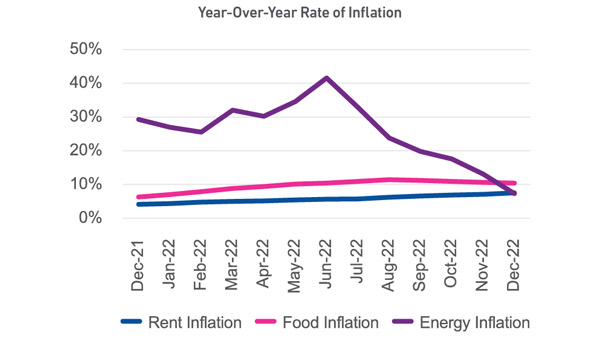
The Federal Reserve increased interest rates at each of their last six meetings. The goal is to combat inflation with higher interest rates that make borrowing more expensive and saving more beneficial, thereby reducing consumer demand and spending so that prices stabilize. Despite the interest rate hikes, consumers are still spending at a high rate and saving at a low rate yet October data show that inflation is beginning to subside. The October inflation rate of 7.7% is the lowest since January. However, the reduction was primarily driven by lower gas prices. Core inflation, excluding food and energy, decreased slightly to 6.3% from 6.6% in September. Producer price inflation (PPI), also known as wholesale inflation, decreased for the fourth month in a row to 8% and is now the lowest since July 2021. For a while, businesses have passed the higher costs to produce goods on to the consumers. With four consecutive months of declining PPI, there is hope that consumer prices will stabilize soon. What I am watching: Heading into the holiday season, it will be interesting to see if consumers continue to spend at high levels or if the headwinds of higher prices, higher interest rates and lower savings create a drag on retail sales. According to the Adobe online shopping forecast, retailers will offer record high holiday discounts for categories such as electronics, toys and computers in order to combat some of the pressures facing consumers. In addition, many retailers built up inventories as they navigated supply chain constraints and will not want to carry excess inventories beyond the holiday season. The October consumer inflation rate of 7.7% is the lowest since January, driven by lower fuel costs. However, core inflation, excluding food and energy, only decreased slightly to 6.3% from 6.6% in September. Producer price inflation decreased for the fourth month in a row to 8% and is now the lowest since July 2021.

Mark your calendars! Experian and Oxford Economics will present key findings in the latest Main Street Report for Q3 2022 during the Quarterly Business Credit Review. Ryan Sweet, Oxford’s U.S. Chief Economist will share his take on Experian’s most recent small business credit data and a macroeconomic outlook for the coming quarter. Brodie Oldham, Experian’s V.P. of Commercial Data Science, will cover commercial credit trends. Our Presenters Brodie Oldham, V.P. Commercial Data ScienceExperian Ryan Sweet, U.S. Chief EconomistOxford Economics Q3 2022 Main Street Report The Q3 2022 Experian/Oxford Economics Main Street report will release at the end of November. If you are not already subscribed to thought leadership updates, be sure to sign up for updates on our Commercial Insights Hub. Event Details Date: Tuesday, December 6th, 2022Time: 10:00 a.m. (Pacific), 1:00 p.m. (Eastern) Why you should attend: Leading Experts on Commercial and Macro-Economic TrendsCredit insights and trends on 30+ Million active businessesAsk our panel questions in real-timeIndustry Hot Topics Covered (Inclusive of Business Owner and Small Business Data)Commercial Insights you cannot get anywhere elsePeer Insights with Interactive Polls (Participate)Discover and understand small business trends to make informed decisionsActionable takeaways based on recent credit performance Save My Seat

The Pandemic drove a tidal wave of small business creation, with over 5.4 million new small businesses in 2021 alone, and millions more this year. Now, the U.S. economy is continuing to change, but becoming more uncertain amid rising interest rates and worries over inflation. With the cost of money rising for small businesses, many are turning to different credit offerings to keep the cash flowing. Application fraud on the rise Some borrowers don’t always have good intentions, and credit issuers struggle to control fraud rates. If you manage risk for a financial institution, trade credit issuer or just want to understand the persistent wave of fraudulent small business applications you should attend our upcoming webinar. Attend our webinar A Perfect Storm for Business Credit RiskDate: Tuesday, November 29th, 2022Time: 10 a.m. Pacific | 1p.m. Eastern. In this talk, Experian's Fraud Products lead, Li Mao, is joined by Sr. Analytical Consultant Emily Garrett and Brian Stack, Experian's V.P. of Engineering Services, to discuss the fraud problem and what to do about it. Li Mao, Sr. Product Manager, Experian Fraud Solutions Emily Garrett, Sr. Analytical Consultant Manager, Experian Brian Stack, V.P. Engineering Services, Experian We'll cover: New business formation, how to assess younger businessesEconomic pressures on B2B's that you are not yet reading aboutStatistics on the gathering fraud storm3 tips for smooth sailing in your credit operations Register to attend

We are pleased to announce the publication of our Fall 2022 Beyond the Trends report. The Sales are coming!! Small businesses have been building inventory over the last year driven by fears that the global supply chain could break down at any moment. This anxiety created an environment of pre-ordering behavior intended to elevate the worry felt during the height of the pandemic that their business would fail not due to a lack of shoppers, but an empty shelf. Global economic environments change quickly, and our world is seeing heightened inflation. This increase in the price of goods and services is leading to softened consumer demand. Will holiday sales keep small business afloat before consumer behavior changes. Tough challenges for newer businesses and lenders Forty percent of small business have been operating for less than 1 year. These new businesses will be challenged by a tightening credit market, rising costs, and softening consumer demand. Commercial lenders are originating 13% less high risk subprime accounts since the 2021 even as through the door high risk inquiries have increased by 59%. Average credit lines on new commercial originations dropped 3% since the beginning of the pandemic as lenders look for growth while limiting exposure. In Q22022 those lines rose 1.4% as 40% less small businesses were accessing commercial credit. Download Fall 2022 Beyond the Trends Report

The team from Experian is very excited to be attending the TRMA 2022 Fall Conference in Louisville, Kentucky October 18-20th. As a Gold Sponsor, we can't wait to meet with you in person to hear your challenges, your goals and to share some of the things we have been working on. Please reach out and connect with us on LinkedIn to get a conversation started. Beth Bayer Neal Rogers Meg Wilson Mathew Robey James Brezack Don't miss Neal Rogers breakout session on Oct 20th at 10:45: Data-driven strategies to deliver consistent growth and maintain positive customer experiences As telco companies face an increasingly competitive environment, they are looking for ways to drive continuous growth. With industry-wide efforts to capture market share, telco providers are looking to enhance personalized targeting while mitigating risk and fraudulent activities while continuing to focus on serving underserved communities. In this session, we will explore how to acquire and approve more consumers with better data, less friction, fewer deposits, fewer vendors, and potentially less cost.Learning Objectives: Learn about enhanced, unrivaled data to bolster growth while mitigating risk and spearheading DEI.A case study illustrating the effectiveness of Experian’s composite risk model in helping to decrease deposits and increase approval time. It promises to be a great session, see you all in Louisville, KY!

There has been so many changes for marketers to deal with related to email marketing in particular. For the final installment of our three-part B2B marketing-focused Business Chat discussion, Tony Romero from the Experian product team shares tips marketers can employ to improve email performance. In today's chat, we focus on ways marketers can improve campaign performance by incorporating analytics and models. Be sure to register to attend Tony's 15-Minute Sip and Solve talk "Increasing Email Campaign Performance With Analytics", he will go into greater depth and offer actionable tips to you execute successful B2B campaigns. Watch Our Interview What follows is a lightly edited transcription of our talk. [Gary Stockton]: Tony, can you share some examples of models marketers can use to segment and target prospects? [Tony Romero]: It's very important for a marketing manager or CMO to take a deep dive into their marketing plan. What are the objectives? What are they trying to do? You know, it could be a variety of things. One is that they could try to grow their existing market space with the same type of customers they already have, or they could be trying to penetrate new markets or try to go after a specific type of company or consumers. So, depending on the marketing plan, it's important then to do deep dive analytics to provide the right type of target audience for that marketing plan. [Tony Romero]: So what custom modeling can do is identify what attributes constitute the ideal customer. Again, whether that ideal customer is an existing type of customer or penetrating a new market, it could be using SIC or NAICS codes to identify those new market spaces or looking at specific attributes on demographics or credit data. It could be numerous things. And so Experian Data Sciences scientists can create custom modeling to clearly define those types of businesses and individuals to promote them effectively. [Gary Stockton]: Excellent. Now let's talk a bit about metrics because some metrics are no longer helpful, such as open rate with the iOS update. What other metrics should marketing departments focus on now with all of these changes? [Tony Romero]: Open rates are not going to be significant anymore because Apple has set up a proxy server to take in emails coming in from a service provider. The provider opens them up in a proxy server first before it reaches the actual individual who's opening that email. And the purpose of that is to disassociate the IP address so that the consumer has privacy. So open rates are no longer a valid KPI for marketers to use. You'll see very, very high open rates, but what you can do to effectively email marketing to consumers is, first of all, ensure that your deliverability is high. And again, that's where data hygiene comes in. You want to make sure you have the most current and correct email address possible. You want to ensure they're not part of the don't email list. So again, deliverability is one of your key KPIs now to focus on. The second one to focus on is your clicks, making sure that your content is as effective as possible so that your audience is actually going to click on that call to action. And again, that's where segmentation, as we discussed, is very important. So your message is hitting the mark. It's resonating with your audience. And then finally landing on the site. So once the user clicks on that and lands on your site, ensure that that individual is then taken to the right place to be given the information they need. So making sure all of that is effective throughout their journey is going to be critical. [Gary Stockton]: Yeah, because with the Apple changes, you know, open rate, that used to be quite important. But now the proxy server will look like everything's opened, and you can't always trust that. So you do have to be looking at other metrics. But the other thing I hear about is intent-based campaigns where people have implied interest or shown an intent to buy. Can you talk a little bit about how those campaigns work? [Tony Romero]: Intent data is excellent information. Basically, when a consumer is on a website, they're clicking on particular things. For example, they may be downloading a white paper, or they may be asking for more information or having a salesperson contact them. Those are very specific triggers that can be used to identify that a consumer has intent on purchasing, and all of that can be pulled together to create a score to provide a marketer with information about how much intent a consumer has. So intent data is very valuable, and here too, Experian can provide intent data to marketers to be able to use that to promote and do effective campaigns. Now, one other thing too about intent data is, again, third-party cookies can track it. It can be tracked by first-party cookies, or it could be tracked by tracking pixels. And as Gary had mentioned, you know, third-party cookies are going away, but that doesn't mean that intent data is going away. There are still plenty of other ways to track intent. [Gary Stockton]: Yes, also for account-based campaigns too, you can use that intent-based data to show you which accounts have got that market problem that if you're listening to those signals solutions like 6 Sense, a lot of B2B sites are using things like that. So, on the analytics front, any final thoughts on how marketers can improve campaign performance? [Tony Romero]: On the analytics side? Again, I think the main thing is focus on your target segments and be able to define your objectives; how can you really focus in hyper-focus on who that target audience is so that your message will resonate. Also, one other thing I would say with analytics is to measure your KPIs. You know, after a completed campaign, look at your KPIs and say what went right? What went wrong? or what needs to be changed? And then being able to then either assess, pivot, or refine whatever your next campaign will be, is a very critical thing to do. [Gary Stockton]: Assess, pivot, excellent stuff. It's been great to get your perspectives on marketing here Tony, I've learned a great deal in these chats, and ladies and gentlemen, if you would like to get a level deeper on this, don't miss Tony's upcoming marketing analytics, Sip and Solve webinar. He's going to be talking in much greater detail about this element of optimizing marketing campaigns. And you can find a link to that session in the description of this video and our blog posts, or remember to like this video and subscribe to our channel.

Mark your calendars! The Experian Insurance team is heading to Vegas for InsureTech 2022, September 20 – 22, 2022. We're super excited because ITC Vegas is the world's largest insuretech event – offering unparalleled access to the most comprehensive and global gathering of tech entrepreneurs, investors, and insurance industry incumbents. Over the course of three days, the Experian crew will be showcasing lots of great solutions and answering your questions in booth #2020. Want to increase productivity and reduce costs while enriching the lives of your policyholders? Be sure to stop by booth #2020. Want to set something up before the show? Get In Touch

Experian and Oxford Economics have just released the Q2 2022 Main Street Report, offering a unique glimpse into the credit performance of main street businesses.

If you want to get the most out of your marketing campaigns, it's important that they are tailored for a specific audience. We invited Tony Romero on Business Chat to talk about part two of his three-part Sip and Solve webinar series focused on B2B marketing where he explains how segmentation and targeting can make all aspects (landing page or email) more effective by using industry SIC as well as NAICS codes. Look-a-like analysis CMO's challenged with restricted budgets Analyzing portfolio diversity and targeting minority-led, women-led businesses Profiling prospects with limited data attributes Watch Our Interview What follows is a lightly edited transcription of our talk. [Gary Stockton]: So in our last chat, we talked about maintaining robust marketing data to power effective campaigns and how clean data really helps businesses conduct effective marketing campaigns. This week, we switch gears to discuss the power of segmentation and targeting using industry SIC and NAICS codes to optimize your marketing budgets. So let's dive in. In our previous chat, we spoke about the changes that tech companies have enacted to make the job of targeting business prospects harder, but it's not game over for marketers. [Tony Romero]: No, definitely not. You know, it's really important to know that there's still a lot of a wealth of data out there that can be used to identify and segment target customers. You know, the first-party data obviously is really key, as well as being able to take information that may be spotty. If, for example, you only have a name or address, you can be able to through services like ours, be able to get a full, comprehensive set of data on that customer, both firmographic, demographic, and credit information, and then be able to use that to promote to customers. [Gary Stockton]: So can you share some examples of how Experian data can help marketers hone in on their target customer, for example, how SICs and NAICS codes can help? [Tony Romero]: Yeah, Gary, you're right. SIC and NAICS codes provide information about what industry the business is in. And so, by knowing that, you're able to target those consumers. So again, as I mentioned before, you can take a look at your existing customer base and find out who's your ideal target customer. And from that, then you can compare that to prospective businesses that look just like that. And that's what's called a lookalike analysis. And by using SIC and NAICS codes, you're able to use that to segment the market and then be able to promote effectively. And Gary, you also mentioned that with the economic state, CMOs have to watch their budgets and be as efficient as possible these days. So again, by doing very good segmenting of your target audience, you are making sure that your finance and financial output to a campaign are as efficient as possible. [Gary Stockton]: Excellent, regulators, they're focusing on diversity, equity, and inclusion. How can Experian help clients in that effort? [Tony Romero]: You know? Yeah. That's a very key point and definitely more than ever. It's important to focus on identifying your existing portfolio and seeing how many customers in your portfolio are minority-led or women-led businesses. So you can do benchmarking, you can see how you fare against other businesses in your market space. And that helps you to determine how much more do you need to market to these minority or women-led businesses. So what's number one is the benchmarking, but secondly, you need to be able to go out and look at your prospective target list and find out who are minority-led or women-led. And there, getting an indicator about a Woman-led or Minority-led business allows you to promote specifically to those types of businesses to help increase your portfolio. [Gary Stockton]: That's good. So if all I have is a name and an email address, and in a lot of cases, you know, if we're driving a newsletter, can I still profile this contact? Or are there other ways to do that with minimal info? [Tony Romero]: Yes, there is. You know, even just having a name and address is enough data to go through our type of service and be able to append all of the other information that we talked about, whether it's firmographic with SIC or NAICS codes, it could be demographic information where we look at the business and find out who the consumers that are tied to that business are? So that's called a B2C linkage. And from that now, you know who the actual individual is and go target those specific individuals. So that's also another key point to bring out [Gary Stockton]: Excellent stuff, Tony. Well, folks, if you enjoyed this chat and want to go a level deeper, don't miss Tony's campaign targeting Sip and Solve webinar – Fine Tuning B2b Campaign Targeting. He goes into greater detail on targeting B2B prospects, just click the image to be taken over to the recording.

Mark your calendars! Experian and Oxford Economics will present key findings in the latest Main Street Report for Q2 2022 during the Quarterly Business Credit Review for Q2 2022. Kathy Bostjancic, Oxford's U.S. Chief Economist will share her take on Experian's most recent small business credit data and a macroeconomic outlook for the coming quarter. Brodie Oldham, Experian's V.P. of Commercial Data Science, will cover commercial credit trends. Q2 2022 Main Street Report The Q2 2022 Experian/Oxford Economics Main Street report is expected to release on August 23rd. If you are not already subscribed to thought leadership updates, be sure to sign up for updates on our Commercial Insights Hub. Mark Your Calendar Quarterly Business Credit Review Webinar Date: Wednesday, September 7th, 2022 Time: 10:00 a.m. (Pacific), 1:00 p.m. (Eastern) Why you should attend: Leading Experts on Commercial and Macro-Economic Trends Credit insights and trends on 30+ Million active businesses Ask our panel questions in real-time Industry Hot Topics Covered (Inclusive of Business Owner and Small Business Data) Commercial Insights you cannot get anywhere else Peer Insights with Interactive Polls (Participate) Discover and understand small business trends to make informed decisions Actionable takeaways based on recent credit performance Register To Attend