At A Glance
Delinquencies are rising in the logistics sector. This article explores credit risk trends in transportation and warehousing from Experian’s latest insights.As the U.S. economy continues to recalibrate post-pandemic, the transportation and warehousing segments of the logistics sector are signaling caution. While the broader logistics industry has remained in expansion mode, Experian’s latest Commercial Pulse Report reveals that delinquencies are rising—an early warning of growing risk in two of the economy’s most critical subsectors.
Watch the Commercial Pulse Update
Below, we explore how sector-specific credit trends, employment data, and market activity are evolving, and what they may mean for lenders, suppliers, and investors as we head into the final quarter of 2025.
Slowing Growth in the Logistics Sector
The U.S. logistics sector has experienced remarkable growth over the past decade. Between 2013 and 2023, the number of private logistics businesses doubled, peaking in Q4 2023. Since then, business formation has slowed, and for the first time in years, the number of logistics firms has declined—down by 2%.
Employment trends echo this slowdown. Between April 2020 and July 2022, logistics employment rose 25%. Since then, growth has nearly stalled, increasing by just 1.5%. This softening suggests that many logistics firms are adjusting operations and tightening resources in response to shifting demand and rising costs.
Inventory Pressure and LMI Performance
The Logistics Managers Index (LMI)—a diffusion index that tracks key logistics components like transportation, inventory, and warehousing—fell to 57.4 in September 2025. While still in expansion territory (above 50), it’s the lowest reading since March, indicating cooling momentum across the sector.
Inventory levels remain elevated, but rising inventory costs are beginning to pressure future planning. Since December 2023, inventory costs have steadily increased. Retailers typically adjust inventory levels in response to cost changes with a lag, meaning elevated costs could soon lead to leaner inventories—potentially pulling the LMI down further.
Warehousing utilization is also up, and prices have followed. As available space tightens, warehousing costs are rising, adding to the financial strain for logistics firms. This dynamic has the potential to further compress margins and reduce cash flow flexibility for small- and mid-sized operators.
Transportation Trends: Warning Signs Ahead
Transportation—a cornerstone of the logistics network—is showing early signs of contraction. Transportation utilization fell to 50 in September, right on the edge of entering contraction territory. A decline in utilization typically leads to an increase in transportation capacity, as seen in the most recent data, and declining transportation prices.
Lower prices benefit shippers but challenge carriers, particularly smaller players who operate on tighter margins. With costs rising across warehousing and inventory management, declining transportation revenue could tip the balance for many firms, increasing financial vulnerability.
Credit Demand and Originations Continue to Fall
Experian’s credit data paints a picture of declining demand for commercial credit within logistics. Since the pandemic, the percentage of monthly credit originations in the logistics sector has dropped sharply—from 4.5% to just 0.5%. This suggests businesses are becoming more cautious about taking on new debt.
Interestingly, while originations have declined, outstanding balances have remained steady, and in warehousing, they’ve even exceeded pre-pandemic levels. This could reflect longer repayment cycles, reduced cash flow, or delayed investment decisions—all potential risk flags.
Trucking: Dominant but at Risk
Within the logistics sector, trucking remains dominant, accounting for 82% of all open commercial credit trades. This segment relies heavily on commercial cards, which now make up 79% of open credit trades. These cards are often the first credit instrument used by new businesses, making them a leading indicator of early-stage credit performance.
While the prevalence of commercial cards reflects flexibility, it also comes with limitations. Lower credit limits and higher interest rates can create challenges during periods of cash flow strain, especially for operators managing fuel, maintenance, and payroll costs.
Rising Delinquencies and Declining Credit Scores
Perhaps the most concerning trend in this month’s report is the increase in late-stage delinquencies within the logistics sector. Since mid-2021, delinquencies have shifted from early-stage (1–30 days past due) to more serious late-stage (91+ days past due) balances.
In August 2025, 1–30 day delinquencies accounted for just 20 basis points of total past-due balances, while late-stage delinquencies accounted for 47 basis points—nearly double the 2019 average. As these deeper delinquencies mount, average commercial credit scores are declining, despite slight improvements earlier in 2024.
This trend is especially critical for lenders and suppliers. A shift toward aged receivables can signal liquidity challenges, operational inefficiencies, or broader sector stress. For businesses operating on thin margins or in highly competitive sub-industries, rising delinquencies could signal a tipping point.
What to Watch Going Forward
The outlook for the logistics sector remains mixed. While growth hasn’t reversed completely, the combination of rising costs, falling credit originations, and growing delinquencies indicates rising risk, particularly in transportation and warehousing.
Stakeholders should closely monitor:
- Changes in LMI component trends
- Late-stage delinquency rates across business segments
- Shifts in credit utilization and origination patterns
- Warehouse pricing and utilization metrics
These signals can offer early insight into shifting risk exposure across commercial portfolios.
Explore More Insights
Experian continues to provide actionable data to help businesses, lenders, and policymakers navigate uncertainty. To access the full Commercial Pulse Report and explore more insights on small business credit and sector-specific performance:
- ✔ Visit our Commercial Insights Hub for in-depth reports and expert analysis.
- ✔ Subscribe to our YouTube channel for regular updates on small business trends.
- ✔ Connect with your Experian account team to explore how data-driven insights can help your business grow.
Related Posts
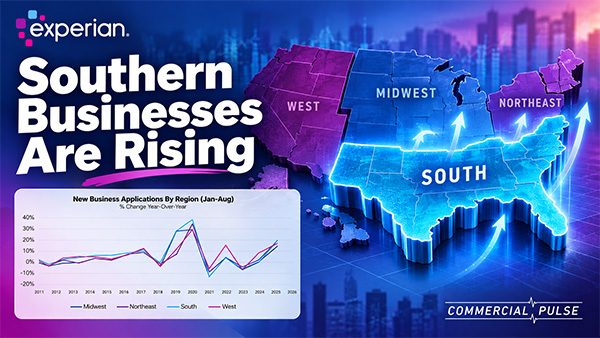
Small business formation remains one of the more notable trends in the U.S. economy. In August 532,000 new businesses launched across the country. While that was down from July, it remained well above historical averages. Since July 2020, an average of 455,000 new businesses have opened each month—56% higher than the pre-pandemic monthly average in 2018 and 2019. But the national numbers only tell part of the story. Watch The Commercial Pulse Update Experian’s latest Commercial Pulse report analysis examines where this growth is occurring and what it means for the commercial credit market. The data show that the South has emerged as an important center of small-business growth. And the businesses driving that expansion tend to have a different profile from their counterparts in other regions. For commercial lenders, understanding those differences can provide valuable context when evaluating new opportunities, credit demand and portfolio risk. Business growth is shifting geographically New business formation has increased across all U.S. regions, but the pace has not been uniform. Prior to 2018, regional differences in growth were relatively modest. During the pandemic years of 2020 and 2021, the South led the country in new business application growth. Since 2022, the West has posted the strongest growth, while the South continues to account for the greatest volume of new business openings. One factor providing context for that growth is population. The population of the South has grown more than 7% since 2019. Since 2020 alone, the region has added more than 3.6 million residents, outpacing every other U.S. region. Meanwhile, populations in other parts of the country declined between 2020 and 2022 before beginning to recover. Business formation and population movement do not necessarily have a simple cause-and-effect relationship. But their parallel growth highlights how the geographic makeup of both consumers and businesses has been changing. Credit-active businesses are growing even faster in the South The shift becomes even clearer when looking at businesses using commercial credit. Experian data shows the number of credit-active businesses in the United States has increased 55% since 2018. Every region participated in that expansion, but the South experienced the greatest growth at 70%, followed by the North at 52%, West at 50% and Midwest at 36%. The South now represents approximately 39% of U.S. credit-active businesses. It also accounted for more than 40% of newly opened commercial accounts in 2026, compared with 37% in 2019. For commercial credit organizations, that means the South represents not just a growing population of businesses, but an increasingly significant share of businesses participating in the commercial credit ecosystem. Southern businesses tend to be smaller and younger The composition of this growth is just as important as its scale. Credit-active businesses in the South and West tend to skew smaller and younger than those in the North and Midwest. In the South, 53% of businesses generate less than $500,000 in annual revenue, while 59% have fewer than five employees. Only 36% have been operating for more than 10 years, compared with 43% in the Midwest. Those characteristics can influence how businesses interact with credit. A younger business, for example, may have had less time to establish multiple commercial credit relationships. That pattern appears in Experian’s data. Across the United States, the average number of commercial credit accounts per business has declined from approximately 1.8 in 2018 to 1.5 in 2026. The South experienced the steepest decline and currently has the fewest accounts per business. At the same time, commercial credit inquiries have increased since 2023, most recently peaking in early 2026. Inquiry rates have typically been higher in the Midwest and South. The combination of fewer existing accounts and elevated inquiry activity provides useful context for lenders seeking to understand the credit needs of a growing population of younger businesses. Credit utilization tells another part of the story Regional differences also appear after businesses establish credit relationships. Businesses in the Midwest and North opening new commercial accounts tend to receive higher lines than businesses in the South and West. At the same time, businesses in the South show higher commercial card utilization despite carrying somewhat lower average balances. Experian’s analysis points to lower credit lines as an important factor behind that relationship. These trends reinforce why looking beyond a single credit metric can be important. Higher utilization, for example, can take on additional context when considered alongside credit-line size, business age, balances and regional business formation. Growth brings opportunities—and risk factors to monitor Despite significant growth and changes in business composition, regional credit performance has remained relatively steady. Commercial delinquencies across all regions are near pre-pandemic levels, while commercial credit risk scores have been relatively stable. There are regional differences worth monitoring, however. Businesses in the South have lower average commercial credit scores than businesses in the other regions analyzed, and delinquency rates tend to be higher in the North and South than in the Midwest and West. The broader takeaway is not simply that there are more small businesses in the South. It is that the composition of the commercial market is evolving alongside that growth. The South represents a growing share of credit-active businesses and new commercial accounts. Many of those businesses are younger, smaller and have fewer established commercial credit relationships. Their credit needs and behaviors may therefore differ from those of more mature businesses in other parts of the country. For commercial lenders and risk leaders, understanding those distinctions can help provide greater context around acquisition, underwriting and portfolio management decisions. As small business formation continues, Experian will continue monitoring where that growth is occurring—and how the changing business landscape is showing up in commercial credit behavior. Learn more ✔ Visit our Commercial Insights Hub for in-depth reports and expert analysis. ✔ Subscribe to our YouTube channel for regular updates on small business trends. ✔ Connect with your Experian account team to explore how data-driven insights can help your business grow. Download the Commercial Pulse Report Visit Commercial Insights Hub Where are small businesses growing in the U.S.? Experian data points to significant growth in the South. While new business formation has increased across the country, the South has consistently recorded the highest volume of new business openings and has seen the number of credit-active businesses grow 70% since 2018—compared with 55% nationally. Where are small businesses growing the most? The South has consistently had the largest volume of new business openings. The South led application growth during 2020–2021, while the West has posted the strongest growth rates since 2022. That distinction is important because it prevents the SEO headline from overstating what the data shows. Why has small business growth been so strong in the southern U.S.? The South has added more than 3.6 million residents since 2020, substantially outpacing other regions. Our report establishes a correlation rather than causation. Related Posts

Explore Experian insights on U.S. manufacturing investment, AI and automation adoption, employment trends, and commercial credit performance.

Experian’s latest Commercial Pulse analysis examines these trends using retail spending data alongside Experian commercial credit data.