At A Glance
As sole proprietors and microbusinesses continue to account for a growing share of the small business economy, lenders may need to remain agile in balancing portfolio growth with disciplined underwriting and risk management strategies.The U.S. small business landscape is undergoing a structural transformation — and commercial lenders may need to rethink what a “small business borrower” looks like.

According to Experian’s May 26th, 2026 Commercial Pulse Report, new business formations remain at historically elevated levels, averaging approximately 450,000 per month since the pandemic. That pace represents a 54% increase compared to pre-pandemic averages from 2018 and 2019.
Watch the Commercial Pulse Update
According to Experian’s latest Commercial Pulse Report, new business formations remain at historically elevated levels, averaging approximately 450,000 per month since the pandemic. That pace represents a 54% increase compared to pre-pandemic averages from 2018 and 2019.
But perhaps more importantly, the composition of those businesses has changed dramatically.
In early 2026, approximately 93% of newly formed businesses were sole proprietorships, up from 85% in 2018. Many of these businesses have no employees, limited operating history, and different borrowing behaviors than the traditional small businesses lenders historically underwrote.
That shift is creating a fundamentally different commercial credit environment.
A Different Kind of Small Business Owner
Historically, many small business lending models were designed around businesses with employees, established operations, recurring revenue streams, and longer credit histories. Today’s wave of new businesses often looks very different.
Many newer firms are being launched by individuals pursuing consulting work, freelance opportunities, side businesses, creator-economy income streams, or post-retirement self-employment. These businesses may operate leaner, carry lower fixed costs, and rely more heavily on revolving credit products rather than traditional financing structures.
In many cases, the business owner and the business itself are financially intertwined.
That evolution matters because underwriting a sole proprietor is not the same as underwriting a mature operating company.
The rise in sole proprietorships is being driven by several long-term labor force and demographic trends now reshaping the U.S. economy.
Demographic Shifts Are Driving Entrepreneurship
One of the most important forces behind the surge in sole proprietorships is the aging U.S. population.
By 2050, individuals aged 55 and older are projected to represent nearly 40% of the total U.S. population. At the same time, Americans are increasingly working later in life. Labor force participation among older workers has steadily increased over the past two decades, while participation among younger workers has trended lower.
Retirement itself is also evolving.
Many retirees are no longer fully exiting the workforce. Instead, they are remaining economically active through part-time consulting, contract work, side businesses, and self-employment arrangements. According to research highlighted in Experian’s report, 59% of workers expect to continue working during retirement, while 61% of recent retirees express interest in continued employment.
These trends are contributing to a growing segment of “microbusinesses” — businesses with few or no employees operating primarily around the skills, experience, or services of an individual owner.
At the same time, broader workplace dynamics are also influencing entrepreneurial activity.
Employee Engagement Is Falling
According to Gallup, employee engagement in the U.S. and Canada declined to 31% in 2025, down from post-pandemic highs. Gallup estimates that low engagement costs the global economy nearly $10 trillion in lost productivity.
Younger workers in particular appear increasingly affected by workplace stress, burnout, and changing expectations around flexibility and career mobility.
As a result, more individuals may be pursuing alternative work arrangements, independent income streams, or self-employment opportunities.
The side-hustle economy continues to expand as well. A recent PYMNTS study found that nearly 20% of workers engaged in regular side work during the previous six months.
Collectively, these labor force dynamics are reshaping not only how Americans work, but also how small businesses are formed, financed, and evaluated from a credit perspective.
Commercial Credit Usage Looks Different
Experian data shows meaningful differences in how smaller and larger businesses use commercial credit.
Smaller businesses and sole proprietors rely more heavily on commercial credit cards, while larger firms tend to utilize a broader mix of leases, lines of credit, and term loans.
Businesses with four or fewer employees received average commercial card credit lines of roughly $8,900 in 2025. By comparison, businesses with more than 100 employees averaged approximately $29,500 in new commercial card credit lines.
Even when loan origination rates appear similar across business sizes, loan amounts differ substantially. Businesses with fewer than four employees averaged approximately $119,000 in term loan originations, while larger businesses averaged closer to $268,000.
Risk performance differs as well.
Larger firms generally continue to demonstrate lower delinquency rates and stronger commercial credit scores, reflecting greater operational scale, more established financial histories, and broader access to capital.
Why Risk Models May Need to Evolve
For lenders, these shifts present both opportunity and complexity.
The surge in new business formation creates potential growth opportunities across commercial credit markets. However, many of today’s borrowers may not fit historical underwriting assumptions.
Traditional business risk models often relied heavily on factors associated with mature operating businesses — payroll size, years in business, trade depth, and established commercial borrowing history.
Today’s newer firms may instead require a more blended view of risk that incorporates both commercial and consumer-level behaviors, cash flow dynamics, and alternative indicators of financial stability.
As sole proprietors and microbusinesses continue to account for a growing share of the small business economy, lenders may need to remain agile in balancing portfolio growth with disciplined underwriting and risk management strategies.
The definition of “small business” is evolving — and commercial risk models may need to evolve alongside it.
Learn more
- ✔ Visit our Commercial Insights Hub for in-depth reports and expert analysis.
- ✔ Subscribe to our YouTube channel for regular updates on small business trends.
- ✔ Connect with your Experian account team to explore how data-driven insights can help your business grow.
Related Posts
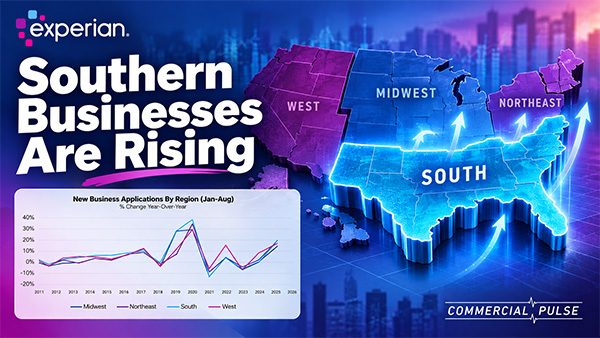
Small business formation remains one of the more notable trends in the U.S. economy. In August 532,000 new businesses launched across the country. While that was down from July, it remained well above historical averages. Since July 2020, an average of 455,000 new businesses have opened each month—56% higher than the pre-pandemic monthly average in 2018 and 2019. But the national numbers only tell part of the story. Watch The Commercial Pulse Update Experian’s latest Commercial Pulse report analysis examines where this growth is occurring and what it means for the commercial credit market. The data show that the South has emerged as an important center of small-business growth. And the businesses driving that expansion tend to have a different profile from their counterparts in other regions. For commercial lenders, understanding those differences can provide valuable context when evaluating new opportunities, credit demand and portfolio risk. Business growth is shifting geographically New business formation has increased across all U.S. regions, but the pace has not been uniform. Prior to 2018, regional differences in growth were relatively modest. During the pandemic years of 2020 and 2021, the South led the country in new business application growth. Since 2022, the West has posted the strongest growth, while the South continues to account for the greatest volume of new business openings. One factor providing context for that growth is population. The population of the South has grown more than 7% since 2019. Since 2020 alone, the region has added more than 3.6 million residents, outpacing every other U.S. region. Meanwhile, populations in other parts of the country declined between 2020 and 2022 before beginning to recover. Business formation and population movement do not necessarily have a simple cause-and-effect relationship. But their parallel growth highlights how the geographic makeup of both consumers and businesses has been changing. Credit-active businesses are growing even faster in the South The shift becomes even clearer when looking at businesses using commercial credit. Experian data shows the number of credit-active businesses in the United States has increased 55% since 2018. Every region participated in that expansion, but the South experienced the greatest growth at 70%, followed by the North at 52%, West at 50% and Midwest at 36%. The South now represents approximately 39% of U.S. credit-active businesses. It also accounted for more than 40% of newly opened commercial accounts in 2026, compared with 37% in 2019. For commercial credit organizations, that means the South represents not just a growing population of businesses, but an increasingly significant share of businesses participating in the commercial credit ecosystem. Southern businesses tend to be smaller and younger The composition of this growth is just as important as its scale. Credit-active businesses in the South and West tend to skew smaller and younger than those in the North and Midwest. In the South, 53% of businesses generate less than $500,000 in annual revenue, while 59% have fewer than five employees. Only 36% have been operating for more than 10 years, compared with 43% in the Midwest. Those characteristics can influence how businesses interact with credit. A younger business, for example, may have had less time to establish multiple commercial credit relationships. That pattern appears in Experian’s data. Across the United States, the average number of commercial credit accounts per business has declined from approximately 1.8 in 2018 to 1.5 in 2026. The South experienced the steepest decline and currently has the fewest accounts per business. At the same time, commercial credit inquiries have increased since 2023, most recently peaking in early 2026. Inquiry rates have typically been higher in the Midwest and South. The combination of fewer existing accounts and elevated inquiry activity provides useful context for lenders seeking to understand the credit needs of a growing population of younger businesses. Credit utilization tells another part of the story Regional differences also appear after businesses establish credit relationships. Businesses in the Midwest and North opening new commercial accounts tend to receive higher lines than businesses in the South and West. At the same time, businesses in the South show higher commercial card utilization despite carrying somewhat lower average balances. Experian’s analysis points to lower credit lines as an important factor behind that relationship. These trends reinforce why looking beyond a single credit metric can be important. Higher utilization, for example, can take on additional context when considered alongside credit-line size, business age, balances and regional business formation. Growth brings opportunities—and risk factors to monitor Despite significant growth and changes in business composition, regional credit performance has remained relatively steady. Commercial delinquencies across all regions are near pre-pandemic levels, while commercial credit risk scores have been relatively stable. There are regional differences worth monitoring, however. Businesses in the South have lower average commercial credit scores than businesses in the other regions analyzed, and delinquency rates tend to be higher in the North and South than in the Midwest and West. The broader takeaway is not simply that there are more small businesses in the South. It is that the composition of the commercial market is evolving alongside that growth. The South represents a growing share of credit-active businesses and new commercial accounts. Many of those businesses are younger, smaller and have fewer established commercial credit relationships. Their credit needs and behaviors may therefore differ from those of more mature businesses in other parts of the country. For commercial lenders and risk leaders, understanding those distinctions can help provide greater context around acquisition, underwriting and portfolio management decisions. As small business formation continues, Experian will continue monitoring where that growth is occurring—and how the changing business landscape is showing up in commercial credit behavior. Learn more ✔ Visit our Commercial Insights Hub for in-depth reports and expert analysis. ✔ Subscribe to our YouTube channel for regular updates on small business trends. ✔ Connect with your Experian account team to explore how data-driven insights can help your business grow. Download the Commercial Pulse Report Visit Commercial Insights Hub Where are small businesses growing in the U.S.? Experian data points to significant growth in the South. While new business formation has increased across the country, the South has consistently recorded the highest volume of new business openings and has seen the number of credit-active businesses grow 70% since 2018—compared with 55% nationally. Where are small businesses growing the most? The South has consistently had the largest volume of new business openings. The South led application growth during 2020–2021, while the West has posted the strongest growth rates since 2022. That distinction is important because it prevents the SEO headline from overstating what the data shows. Why has small business growth been so strong in the southern U.S.? The South has added more than 3.6 million residents since 2020, substantially outpacing other regions. Our report establishes a correlation rather than causation. Related Posts

Explore Experian insights on U.S. manufacturing investment, AI and automation adoption, employment trends, and commercial credit performance.

Experian’s latest Commercial Pulse analysis examines these trends using retail spending data alongside Experian commercial credit data.