From Online Transactions to Portfolio Risk: How E-Commerce Fuels Fraud

This week the Commercial Pulse report dives into the growing problem of commercial forms of fraud.
In some ways, fraud can be seen as a cost of doing business, but the nature of the threat is changing. Today’s fraud environment is larger, faster, and more scalable than at any point in recent history. For Chief Risk Officers and commercial lenders, the challenge is no longer simply preventing isolated incidents. It is understanding how evolving fraud patterns can affect portfolio performance, underwriting decisions, operational costs, and long-term risk exposure.
Watch the Commercial Pulse Update
According to recent industry estimates, fraud and scam losses reached $38 billion in 2025, impacting approximately 36 million victims across the United States. While these headline figures are concerning, they only tell part of the story. The more important question for risk leaders is what these trends signal about future portfolio performance and whether existing fraud controls are prepared for what comes next.
Digital Growth Has Expanded the Attack Surface
One of the most significant drivers behind the current fraud environment is the continued expansion of digital commerce.
E-commerce now accounts for nearly 17% of total U.S. retail sales, exceeding even peak pandemic levels. The digital transformation of commerce has delivered meaningful efficiencies and growth opportunities, but it has also dramatically expanded the amount of personal and business information available online.
Every digital interaction creates data. When that data is exposed through breaches, phishing attacks, account compromises, or other forms of cybercrime, it becomes fuel for fraud. Stolen information can be leveraged to create synthetic identities, establish fictitious businesses, facilitate account takeover attempts, and support increasingly sophisticated fraud schemes.
For lenders, this means that fraud risk is no longer confined to isolated bad actors. The scale of available compromised information is enabling fraud operations to become more industrialized and difficult to detect through traditional methods.
The Dark Web Has Become a Leading Indicator
Many organizations focus on fraud reports as a measure of current risk. However, some of the most valuable insights may come from indicators that emerge well before losses appear in portfolio performance. Dark web activity is one such indicator.
Experian’s Dark Web Monitoring data identified more than 1.4 billion stolen records during the first quarter of 2026 alone. This sustained volume of compromised information suggests that fraudsters continue to have access to a large and growing inventory of credentials and personal information.
For risk leaders, the implication is straightforward: a growing supply of compromised records creates the conditions for future fraud attempts. By the time fraud appears in application activity, payment performance, or loss reporting, the underlying data exposure has often existed for months.
Monitoring dark web trends can provide an early warning signal that helps organizations prepare for increases in synthetic identity activity, business impersonation attempts, and account takeover events.
First-Party Fraud Is Reaccelerating
While external fraud schemes often receive the most attention, Experian’s commercial data suggests that first-party fraud deserves equal scrutiny.
First-party fraud occurs when an applicant intentionally misrepresents information or obtains credit without the intention of meeting repayment obligations. Unlike traditional third-party fraud, these cases often involve legitimate identities, making detection significantly more challenging.
After a relatively stable period between late 2022 and early 2024, first-party fraud has been steadily increasing since mid-2024.
This trend matters because first-party fraud often appears similar to conventional credit deterioration in its earliest stages. Accounts may initially perform normally before rapidly transitioning into delinquency or charge-off status. As a result, organizations that rely exclusively on traditional credit risk models may underestimate the true level of fraud-related losses within their portfolios.
Business leases experienced some of the highest first-party fraud incidence rates during 2025, but the trend is not isolated to a single product category. Elevated fraud activity has been observed across term loans, lines of credit, commercial cards, and leasing products.
For CROs, this raises an important question: how much of today’s portfolio deterioration is actually fraud-related rather than purely credit-driven?
The AI Gap Is Creating New Risk
Artificial intelligence is reshaping both sides of the fraud equation.
On one hand, fraudsters are leveraging AI to create more convincing synthetic identities, automate attacks, generate fraudulent documentation, and scale operations more efficiently than ever before.
On the other hand, AI-powered analytics offer organizations powerful new tools for fraud detection, behavioral monitoring, and anomaly identification.
The challenge is that adoption has not kept pace with awareness.
Recent research found that 72% of businesses expect AI-generated fraud and deepfakes to become a major operational challenge within the next two years. Yet only 37% report actively using AI-enabled fraud prevention capabilities today.
This disconnect represents one of the most significant vulnerabilities in the current fraud landscape.
Many organizations continue to rely heavily on traditional authentication methods such as passwords, PINs, security questions, and CAPTCHA controls. While these tools remain useful, they were not designed to address today’s increasingly sophisticated fraud tactics.
Organizations that delay modernization efforts may find themselves operating with controls that were built for a fundamentally different threat environment.
Three Indicators Every CRO Should Monitor
As fraud risk continues to evolve, three areas deserve particular attention.
Looking Ahead
Fraud is no longer simply an operational issue. It has become a strategic risk management challenge that intersects with credit performance, customer experience, regulatory expectations, and enterprise resilience.
The organizations that succeed in this environment will not be those that simply react to fraud events. They will be the ones that identify leading indicators earlier, integrate fraud intelligence across the customer lifecycle, and modernize their risk frameworks before losses force the issue.
For CROs, the question is no longer whether fraud risk is increasing. The question is whether existing controls, analytics, and governance structures are evolving quickly enough to keep pace.
Learn more
- ✔ Visit our Commercial Insights Hub for in-depth reports and expert analysis.
- ✔ Subscribe to our YouTube channel for regular updates on small business trends.
- ✔ Connect with your Experian account team to explore how data-driven insights can help your business grow.
Related Posts
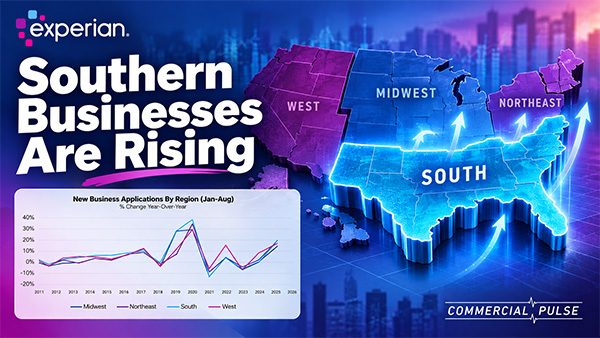
Small business formation remains one of the more notable trends in the U.S. economy. In August 532,000 new businesses launched across the country. While that was down from July, it remained well above historical averages. Since July 2020, an average of 455,000 new businesses have opened each month—56% higher than the pre-pandemic monthly average in 2018 and 2019. But the national numbers only tell part of the story. Watch The Commercial Pulse Update Experian’s latest Commercial Pulse report analysis examines where this growth is occurring and what it means for the commercial credit market. The data show that the South has emerged as an important center of small-business growth. And the businesses driving that expansion tend to have a different profile from their counterparts in other regions. For commercial lenders, understanding those differences can provide valuable context when evaluating new opportunities, credit demand and portfolio risk. Business growth is shifting geographically New business formation has increased across all U.S. regions, but the pace has not been uniform. Prior to 2018, regional differences in growth were relatively modest. During the pandemic years of 2020 and 2021, the South led the country in new business application growth. Since 2022, the West has posted the strongest growth, while the South continues to account for the greatest volume of new business openings. One factor providing context for that growth is population. The population of the South has grown more than 7% since 2019. Since 2020 alone, the region has added more than 3.6 million residents, outpacing every other U.S. region. Meanwhile, populations in other parts of the country declined between 2020 and 2022 before beginning to recover. Business formation and population movement do not necessarily have a simple cause-and-effect relationship. But their parallel growth highlights how the geographic makeup of both consumers and businesses has been changing. Credit-active businesses are growing even faster in the South The shift becomes even clearer when looking at businesses using commercial credit. Experian data shows the number of credit-active businesses in the United States has increased 55% since 2018. Every region participated in that expansion, but the South experienced the greatest growth at 70%, followed by the North at 52%, West at 50% and Midwest at 36%. The South now represents approximately 39% of U.S. credit-active businesses. It also accounted for more than 40% of newly opened commercial accounts in 2026, compared with 37% in 2019. For commercial credit organizations, that means the South represents not just a growing population of businesses, but an increasingly significant share of businesses participating in the commercial credit ecosystem. Southern businesses tend to be smaller and younger The composition of this growth is just as important as its scale. Credit-active businesses in the South and West tend to skew smaller and younger than those in the North and Midwest. In the South, 53% of businesses generate less than $500,000 in annual revenue, while 59% have fewer than five employees. Only 36% have been operating for more than 10 years, compared with 43% in the Midwest. Those characteristics can influence how businesses interact with credit. A younger business, for example, may have had less time to establish multiple commercial credit relationships. That pattern appears in Experian’s data. Across the United States, the average number of commercial credit accounts per business has declined from approximately 1.8 in 2018 to 1.5 in 2026. The South experienced the steepest decline and currently has the fewest accounts per business. At the same time, commercial credit inquiries have increased since 2023, most recently peaking in early 2026. Inquiry rates have typically been higher in the Midwest and South. The combination of fewer existing accounts and elevated inquiry activity provides useful context for lenders seeking to understand the credit needs of a growing population of younger businesses. Credit utilization tells another part of the story Regional differences also appear after businesses establish credit relationships. Businesses in the Midwest and North opening new commercial accounts tend to receive higher lines than businesses in the South and West. At the same time, businesses in the South show higher commercial card utilization despite carrying somewhat lower average balances. Experian’s analysis points to lower credit lines as an important factor behind that relationship. These trends reinforce why looking beyond a single credit metric can be important. Higher utilization, for example, can take on additional context when considered alongside credit-line size, business age, balances and regional business formation. Growth brings opportunities—and risk factors to monitor Despite significant growth and changes in business composition, regional credit performance has remained relatively steady. Commercial delinquencies across all regions are near pre-pandemic levels, while commercial credit risk scores have been relatively stable. There are regional differences worth monitoring, however. Businesses in the South have lower average commercial credit scores than businesses in the other regions analyzed, and delinquency rates tend to be higher in the North and South than in the Midwest and West. The broader takeaway is not simply that there are more small businesses in the South. It is that the composition of the commercial market is evolving alongside that growth. The South represents a growing share of credit-active businesses and new commercial accounts. Many of those businesses are younger, smaller and have fewer established commercial credit relationships. Their credit needs and behaviors may therefore differ from those of more mature businesses in other parts of the country. For commercial lenders and risk leaders, understanding those distinctions can help provide greater context around acquisition, underwriting and portfolio management decisions. As small business formation continues, Experian will continue monitoring where that growth is occurring—and how the changing business landscape is showing up in commercial credit behavior. Learn more ✔ Visit our Commercial Insights Hub for in-depth reports and expert analysis. ✔ Subscribe to our YouTube channel for regular updates on small business trends. ✔ Connect with your Experian account team to explore how data-driven insights can help your business grow. Download the Commercial Pulse Report Visit Commercial Insights Hub Where are small businesses growing in the U.S.? Experian data points to significant growth in the South. While new business formation has increased across the country, the South has consistently recorded the highest volume of new business openings and has seen the number of credit-active businesses grow 70% since 2018—compared with 55% nationally. Where are small businesses growing the most? The South has consistently had the largest volume of new business openings. The South led application growth during 2020–2021, while the West has posted the strongest growth rates since 2022. That distinction is important because it prevents the SEO headline from overstating what the data shows. Why has small business growth been so strong in the southern U.S.? The South has added more than 3.6 million residents since 2020, substantially outpacing other regions. Our report establishes a correlation rather than causation. Related Posts

Explore Experian insights on U.S. manufacturing investment, AI and automation adoption, employment trends, and commercial credit performance.

Experian’s latest Commercial Pulse analysis examines these trends using retail spending data alongside Experian commercial credit data.