Social Responsibility
Experian is deeply committed to making an important difference in each of the communities we operate and live all over the world. Through our relationships with nonprofit organizations, our dedication to consumer education and our encouragement of employee volunteerism, we are able to champion a number of important causes. Read about our latest corporate social responsibility news below:

In 2021, Experian announced that United for Financial Health programme would be launching in two EMEA markets - Italy and South Africa. Today we are pleased to bring you more news of our plans in South Africa. Our partnership with the National Small Business Chamber is focused on supporting Small and Medium-sized Enterprises (SMEs) to improve their financial fitness. As a result of the pandemic, many small businesses are under enormous strain in the current environment. As the backbone of the South African economy, any challenges faced among these enterprises may have far-reaching implications on the number of unemployed people. Our campaign with the NSBC aims to support SMEs to stay in business and become more resilient to economic disruptions as they continue to be a driving force of inclusive economic growth and job creation in the country. Many SMEs are harming their chances of gaining access to credit, getting better deals from suppliers, and securing additional funding to help grow their business due to a lack of awareness and understanding of their business credit profile. Working alongside the NSBC, we aim to educate, encourage and assist SMEs to become creditworthy. The programme aims to provide tangible ways to help improve financial health, help SMEs overcome the financial difficulties that have resulted from the effects of the pandemic and kick-start people on the road to recovery. Mike Anderson, the CEO of our partners the NSBC, said: “We are extremely excited to launch a ‘How to become financially fit’ campaign in partnership with Experian South Africa, one of the leading credit bureaus, where we can equip SMEs with key tips and strategies to assist them in understanding their financial and credit health. The aim is to empower them to understand the impact of both their personal and business credit profiles on their business’s reputation and ultimately their ability to access the funding required to maintain and grow their businesses.” As part of this financial education drive, we’ll support a series of webinars hosted by the NSBC, with topics ranging from how to improve both your personal and business credit profiles, managing your cash flow, understanding what credit providers are looking for as well as protecting your own business from credit risk. The webinars are open to all NSBC members and will kick off on 28 January 2022 and run until the end of March. For more information on the ‘How to get financially fit’ NSBC campaign in partnership with Experian South Africa visit www.nsbc.africa.

For the past several years, we’ve been on a journey to improve financial access for millions of people around the world. We’ve made it our job to help consumers get the best financial outcomes. This focus on consumers defines us and informs everything we do. In 2019, we reshaped how consumers access credit with Experian Boost™. Since then, nearly 9 million consumers have connected to the product. While we are proud of what we have and continue to accomplish with Experian Boost, we know there is more to be done to ensure more consumers can access fair and affordable credit. Improving outcomes for underserved consumers When credit is used responsibly, it can create new opportunities from getting a college degree, buying a car or home and starting or expanding a business. These are milestones that help people establish careers, build wealth and ultimately achieve greater financial freedom. Yet, there are millions of consumers who are unable to participate in the mainstream financial ecosystem today because they don’t have a financial identity. Without an established credit history, these consumers struggle to qualify for everything from an auto loan to a mortgage and even an apartment or employment. This problem more frequently impacts communities of color with 28 percent of all Black and 26 percent of all Hispanic consumers currently unscoreable or credit invisible. Increasing financial inclusion depends on creating opportunities for underrepresented consumers to succeed. And this starts with ensuring all consumers have a financial identity. Bringing financial power to all with Experian Go The challenge is many consumers who are not in the credit ecosystem today are unsure where to start. Today, we reached a pivotal and exciting milestone in our commitment to consumers with the launch of Experian Go™. This new program opens the front door to the financial ecosystem for millions of consumers by helping them establish their financial identity and move from credit invisible to scoreable. Within minutes, credit invisibles can have an authenticated Experian credit report, tradelines and a credit history by using Experian Boost™[1], and instant access to financial offers through Experian Go. In fact, early analysis shows 91 percent of consumers with no credit history who connect to Experian Boost, a free feature that allows users to contribute their on-time cell phone, video streaming service, internet, and utility payments directly to their Experian credit report, can become scoreable in minutes with an average starting near-prime FICO® Score of 665[2]. Throughout the experience, we’ll provide ongoing credit education and access to tools like Experian Boost™ to make it easy for consumers to learn how to use and responsibly grow their credit histories. Until now, our industry has struggled to verify the identity of credit invisibles. Over the last several years, we’ve introduced new identity verification technologies to our toolbox. With Experian Go, we’re leveraging these technologies to verify a credit invisible’s identity and get them in the front door to start building credit. No other credit bureau or organization is doing this today. During our pilot, we helped more than 15,000 consumers establish their credit history. This is a great start. Now that Experian Go has launched, I look forward to helping millions more consumers get the credit they deserve. To learn more about Experian Go, visit www.experian.com/go. [1] Results may vary. Some may not see improved scores or approval odds. Not all lenders use Experian credit files, and not all lenders use scores impacted by Experian Boost. [2] Experian analysis based on an anonymized and statistically relevant sample of consumer credit reports with only Experian Boost tradelines included and FICO® Scores. December 2021.

In the early 1960s, Simon Ramo had a vision of a cashless society made possible by information and technology. This vision led to the creation of our business in North America. Ramo believed information could change the way people lived. Today, we know this to be true and continually see the ways data and technology can create enormous good in the lives of millions of consumers. While much has changed since the 1960s, Ramo’s vision holds true and continues to fuel the way we work at Experian. These principles have put consumers at the center of our business, which has forced us to think outside the box and do things differently. Let me give you an example. Until 2019, consumers had never been able to contribute information directly to their credit report. When we launched Experian Boost, we fundamentally changed the game. We put consumers in the driver’s seat and empowered them to contribute their on-time bill payments directly to their Experian credit report. By doing so, we’ve helped millions of consumers instantly improve their FICO® Score. This was a game changing move that is making a tangible difference for consumers. In fact, Experian Boost users have accessed more than $1.7 billion in credit due to improved credit scores. While we are proud of what we continue to accomplish with Experian Boost, we know financial inclusion depends on all of us doing more. On all of us doing things differently. We recently released new research in partnership with Oliver Wyman which shows 106 million Americans, or 42% of the adult population, lack access to mainstream credit because they are credit invisible, unscoreable or have a subprime credit score. Communities of color are more likely to lack access to mainstream credit, with 28% of Black and 26% of Hispanic consumers unscoreable or invisible, which is perpetuating historic disadvantage. While we have made a lot of progress in recent years by incorporating new data in decisions, as an industry, we can and must do better to ensure all consumers have access to fair and affordable credit. The old way of doing things, the old tools, will not work to ensure more consumers can access the financial services they need when they need them. The score models historically used by lenders are leaving nearly 50 million Americans behind. We need better data and better technology to help more consumers. When advanced analytics and machine learning are combined with expanded data sets as they are with Experian’s Lift Premium™ score, 96% of the population can be scored, including an estimated 65% credit invisibles and the entire conventionally unscoreable population. This is significantly greater than the 81% of consumers that can be scored by conventional scores today. Scoring 100% of Americans and expanding fair access to credit to creditworthy consumers is our goal. This is an exciting time as we are nearing a point where we can say, no matter who you are, where you live or what part of your financial journey you’re on, we can score you and help you access the financial services you need. We can’t do it on our own. Financial inclusion depends on industry adoption of these new tools and insights. As we begin a new year, I believe the financial services industry is at an inflection point. And I am hopeful. I think we can all agree it’s time for a new way of doing things and today we have the tools available to make it happen.

It’s a privilege to be recognized for a cause that’s important to so many of us at Experian. I am honored to be awarded a bronze Stevie® Award in the “Women Helping Women – Business” category for supporting women in Decision Analytics (DA) and overseeing our employee resource groups across DA. The award specifically calls out our long-standing Accelerated Development Program (ADP), which identifies and mentors women business leaders within our organization The Stevie Award trophy is one of the world's most coveted business prizes, representing more than 60 countries. The awards have been given to small, medium and large businesses for an array of categories since 2002. In 2018, HR Director Richard Teague and I helped launch ADP, which has identified 44 mid-career, high-potential women on the Global Decision Analytics team in a leadership training program. Around half of the women who participate have been promoted within two years. The ADP program also complements our DEI initiatives, which includes our five employee resource groups that have played a valuable connecting and our engagement our team members during both the pandemic and personal challenges. If you would like to find out more about any of the GDA DEI networks, including how you can get involved, please contact the relevant network lead: Mental Health – Chris Fletcher Disability and Neurodiversity – David Bernard LGBTQ+ - David Gallihawk Gender Network – Marika Vilen or Jen Cosgrove Race and Ethnicity – Shri Santhanam
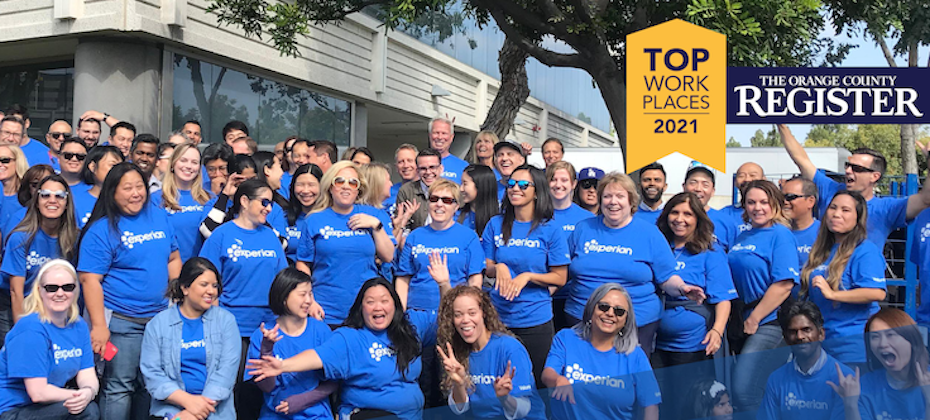
For the ninth year, the Orange County Register has named Experian North America as a Top Workplace, securing the #1 ranking for the second consecutive year. The award, which is based on employee feedback in a survey of hundreds of leading companies in Orange County, recognizes our company’s culture of inclusion, and our commitment to employees and communities. Orange County is the home of our North America operations, and we are especially honored to be recognized again for our inclusive work environment and achieving higher performance while giving back. This honor demonstrates the talent and compassion of all the people who work at Experian. Thank You All our decisions are driven by our desire to ensure our employees feel valued and protected. As part of this, we issued a ‘Thank You’ Share Award to all employees at the beginning of this year to recognize perseverance through the pandemic, giving thousands of employees an equity stake in the company. Coming Together Our Employee Resource Groups (ERGs) continue to grow and support employees in different ways, which include activities that bring employees together internally to serve their communities externally. For example, our Asian American ERG worked closely with Pan-Asian leadership organization Ascend to support the Asian American community and employees, considering increasing discrimination and xenophobia during the pandemic. Together they kicked off Feed Your Hospital, which facilitated the delivery of meals to frontline COVID-19 healthcare workers by supporting local Asian restaurants. Meals were purchased at the restaurants and delivered to participating hospitals. The campaign raised funds for hospitals in Orange County. Social Good This year, we also awarded two OC-based organizations with major grants – the OC Hispanic Chamber of Commerce and TGR Foundation (a Tiger Woods Charity). For the OC Hispanic Chamber of Commerce, we funded and facilitated credit education initiatives for the Youth Chamber Program – funds went towards scholarship awards and event costs. We also added credit education to the ‘Pre-Venture Business Program’ curriculum – with funds going into marketing, training, one-on-one consulting, and event costs offered in both Spanish and English. For the TGR Foundation grant, we are working on ongoing projects with the foundation to support credit education, small business entrepreneurship, homeownership, and financial inclusion efforts. In total, employees volunteered more than 900 hours to Orange County-based nonprofits and Experian matched funds to those organizations that employees volunteered with and donated to. Our employees continue to help people who are facing unprecedented and unforeseen challenges. Different groups and employees of all levels are working together to help our clients, customers and communities persevere. We are honored that the Orange County Register continues to recognize our tireless efforts to make a difference in the communities in which we live and work.

Growing up, my family rarely talked about money. So, in college, when I had the opportunity to get my first credit card, I also found myself in a little trouble when the first bill came. Most of us simply don’t learn about money matters until we find ourselves in these difficult situations. That’s one of the reasons why we’re excited to launch a creative and new program to teach young adults about the basics to building a financial legacy. “Protect The Bag” debuts today. It’s a six-part web series produced in partnership with Grammy-award winning artist, entrepreneur, author and community advocate, Lecrae. We first met Lecrae when he supported a United for Financial Health initiative in his hometown last year. “Protect The Bag” is a hip master class with finance and credit basics presented in an authentic way. Lecrae describes it as “edutainment” that includes scripted skits and interviews with everyday people. His friends Tyler Lockett, Coco Jones and WHATUPRG, among others, join him and share their financial health journeys as part of the shows as well. “Protect The Bag” is not just about credit. It’s about all aspects of personal finance. We’re proud of this innovative way to help consumers understand topics like saving, investing, budgeting and identity protection through someone they admire and trust. We hope you tune in every Tuesday, starting today, for the next six weeks. Episodes will appear on Lecrae’s YouTube channel starting at 7:00 p.m.EST/4 p.m.PST.

Over the last 19 months the pandemic has disproportionately impacted underserved and low-income communities and exacerbated the health and economic situations of millions of consumers, making it even harder to recover from financial hardships. We’ve made it our mission to change this, and we’re doing so by unlocking the power of data to facilitate access to fair and affordable credit and create new opportunities for people and businesses. We use our products, services, and time to make a real difference to the financial lives of people in many ways. This is at the heart of what we do as a company, and it’s one of the many reasons why it’s such a great honor to be named by Fortune to its global ranking of the top 50 companies making measurable progress addressing social problems. Experian Boost is one example of our commitment to improving financial inclusion, providing users access to credit as a result of improved credit scores. Two years ago, we created this first-of-its-kind service designed to help consumers instantly improve their credit score by giving them credit for on-time utility, telecom, and streaming service payments. Experian Boost in the USA and UK, combined with Serasa’s Score Turbo in Brazil, are empowering consumers to take more control of their financial well-being and promoting financial inclusion. United for Financial Health is another new financial recovery program we created to help consumers who don’t typically have access to credit. Through this initiative we teamed up with 11 NGOs to reach 35 million people in less than a year, smashing our first-year target of 15 million. The partnerships this year have focused on three primary consumer markets – the USA, the UK and Ireland and Brazil. That said, we recognize there is more work to be done. In our 2021 Sustainable Business Report, we made several commitments, including to reach 100 million people through our United for Financial Health campaign by 2024. We remain focused on using our business to make real, sustainable change. Being named on Fortune’s 2021 'Change the World' list is also a testament to our truly inclusive culture at Experian, where everyone’s hard work and commitment is proving to deliver a positive impact to society. Through our investments in data and advanced analytics, we will continue to help lenders identify consumers who are excluded from the credit ecosystem, but who can fulfill their financial obligations and pay responsibly. We want to empower consumers to take control of their financial lives, and we will continue to take strides to do so, ensuring we do the right thing for those we serve.

Last week, I had the chance to take part in a few really important conversations and further exemplify our leadership and commitment to driving financial inclusion. On July 13, I had a frank dialogue with Derrick Johnson, President of the NAACP, during their 112th NAACP Virtual Annual Convention. Our conversation centered around economic inclusion, the wealth gap and the ways companies, like ours, can help provide education and access to financial services. During my conversation with Derrick, he referred to credit as a currency. I think that’s absolutely the right way to talk about it. Credit gives people access to financial services. It can divide people or bring them together to achieve their goals. We recognize there are millions of consumers who lack access to credit today. That’s why we continue to innovate through tools like Experian Boost, our free tool that enables consumers to contribute positive payment data to their Experian credit report. Especially in underserved communities, consumers may not get credit for paying their utility bills, cell phone bills, or even their streaming services, and they should. This provides a more accurate picture of their financial situation. I also participated in a virtual press conference with the U.S. Office of the Comptroller of the Currency and leaders from PNC, HomeFree-USA and Fifth Third Bank to discuss our participation in Project REACh, which stands for Roundtable for Economic Access and Change. It brings together leaders from the banking industry, national civil rights organizations, business and technology to reduce barriers that prevent full, equal and fair participation in the nation’s economy. We were approached to participate because of our deep understanding of credit risk and our ability to help financial institutions make informed credit decisions through data and advanced analytics. Our role is to help develop programs with the Alternative Credit Scoring Utility Team and Small Business Opportunity Team that drive financial inclusion. Our participation in Project REACh is the latest example in a string of efforts to address this important issue, including Experian Boost and our flagship lender score Experian Lift, which leverages all Experian assets to improve consumer’s access to credit. We believe that every individual deserves the opportunity to reach their fullest financial potential through fair and affordable access to credit. By sharing information around tools like Experian Boost, expanding credit education through partnerships like the NAACP, and working with leaders in the industry through Project REACh, we can help increase financial access and empower consumers to enter into the credit ecosystem – some for the first time. We’re committed to working side-by-side with regulators, businesses and consumers to eliminate credit invisibility and improve financial equity and access.

The financial services industry is poised to take advantage of the unprecedented availability of accurate, comprehensive, and timely data. Through increased lender adoption, the growing array of insightful data can create meaningful change and provide access to credit for more consumers and businesses than ever before. At Experian, we feel we have a responsibility to consumers seeking credit. Ensuring lenders can obtain the insights needed for responsible lending is key to supporting this. By leveraging the most accurate traditional credit data as well as expanded data sources that improve how risk can be assessed for thin-file or no-file consumers, lenders can form a precise picture of an individual’s financial situation and improve financial access for millions of Americans who have been unfairly excluded from the credit ecosystem. Extend credit responsibly. Some of the most predictive information available today is employment data, including how long a consumer has been at a job and how much they earn. Layering verified income and employment information with credit data can improve financial outcomes for consumers and help lenders say ‘yes’ when they otherwise couldn’t or wouldn’t. To help, Experian has released Experian Verify™ - a suite of solutions that provide lenders with real-time access to verified information about a consumer’s income and employment status. Through Experian Verify, credit card, personal loan, auto and mortgage lenders have near-instant access to millions of active employer records to verify an applicant’s income and employment status for use across the lifecycle, including pre-qualification, originations and account review. The products are powered by Experian’s growing network of exclusive employer records and payroll partner data, which includes data from recent acquisitions of Corporate Cost Control (CCC), Tax Credit Co. (TCC) and EmpTech. We are answering the industry’s call for change in income and employment verification while providing lender’s with deeper insights to increase financial access. Putting consumers in control. This is the latest example of many that illustrate our commitment to improve financial access for consumers. The new products complement Experian Boost – a free tool that empowers consumers to contribute their on-time telecom, utility, streaming services and mobile phone payments directly to their Experian credit report. Incorporating this information has been proven to increase the predictiveness of a consumer’s credit reputation and can complement the data derived from their lending history. Experian Boost provides consumers with the ability to immediately impact their credit scores, while providing lenders with deeper insight into a consumer’s financial situation. With Experian Boost, nearly 70 percent see an uplift in their credit score. Since the product was released in 2019, more than 7 million consumers have connected to Experian Boost with over 50 million cumulative points added to FICO Scores. The financial impact to the industry is significant, with Experian Boost users gaining access to more than $1.7 billion in credit as a result of improved credit scores. Serving credit invisibles. Our commitment to consumers does not end there. Through our investments in expanded data sources and advanced analytics, we are helping lenders identify consumers who are excluded from the traditional credit ecosystem, but who can fulfill their financial obligations and pay responsibly. Experian Lift, our suite of lender credit scores, has the potential to help more than 40 million credit invisible consumers gain access to credit while providing first and second chances to millions more. Experian Lift uses proprietary technology, advanced analytics, and machine learning models to combine exclusive credit data attributes, trended data and expanded Fair Credit Reporting Act (FCRA) regulated data sets. This combination of data and technology is creating new opportunities for consumers who are often overlooked. Looking ahead. Data has the power to unlock financial opportunities for millions of consumers. Collaboration between Experian, lenders and consumers that is informed by data is key to keeping the economy flowing and improving livelihoods of Americans. As we look to the road ahead, we are committed to working side-by-side with lenders, credit scoring companies and consumers to eliminate credit invisibility and improve financial equity and access.