Tag: ecommerce
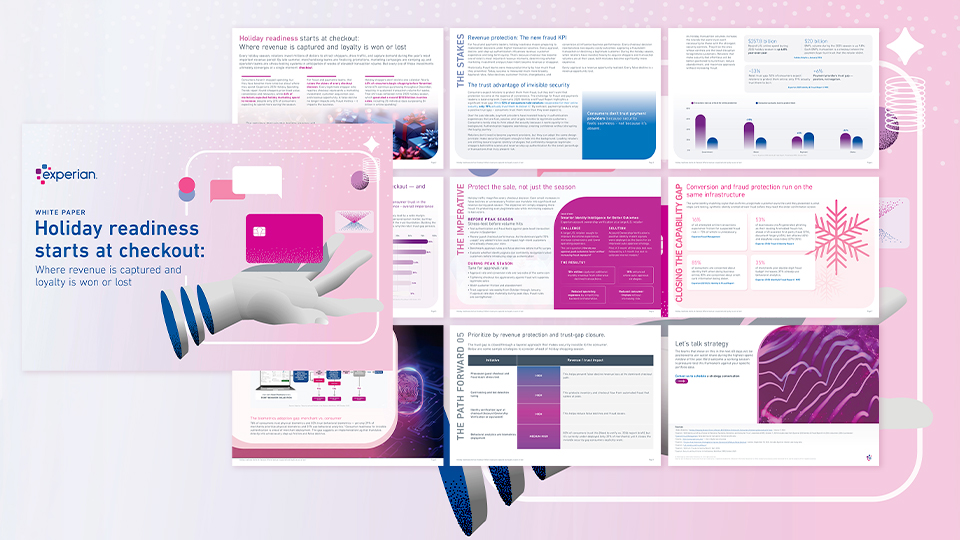
Every retailer invests heavily to drive shoppers to its website during the holidays. But after months of planning and thousands to millions of dollars spent on marketing, every customer journey comes down to one critical moment: Checkout. Today, fraud prevention means protecting revenue by ensuring legitimate customers complete their purchase, not just stopping bad actors. That's becoming increasingly important as holiday shopping evolves. In 2025, U.S. online holiday spending reached a record $257.8 billion,1 with shoppers spreading their purchases across months rather than just Black Friday and Cyber Monday. Every approval and every false decline has a bigger business impact than ever. Trust is becoming a conversion strategy Consumers expect retailers to protect them from fraud, but they don't want that protection to slow them down. That's where a significant opportunity exists. Experian research found that 52% of consumers expect retailers to protect them online, yet only 19% trust them to do so.2 Meanwhile, payment providers enjoy a positive trust gap because security happens quietly in the background with minimal friction. The takeaway? Customers don't equate more authentication with more trust. Instead, they equate less friction with better experiences. Learn how retailers can improve approvals, reduce false declines and build customer trust through layered identity intelligence. Download the white paper Invisible security is the future of checkout Modern identity verification, behavioral analytics and account intelligence allow retailers to recognize trusted customers behind the scenes – reserving step-up authentication only for higher-risk transactions. Why does that matter? Because friction is measurable. Research from Experian and cited in our white paper, shows that 16% of online transactions encounter suspected fraud friction, and 70% of that friction is unnecessary.3 Meanwhile, 25% of consumers abandon the purchase after experiencing onboarding friction, choosing a competitor instead. Reducing unnecessary friction isn't just good customer experience; it's good business. One retailer that used Experian's account ownership verification and identity intelligence captured more than $8 million in additional monthly revenue by improving auto-approval strategies and reducing customer friction. Learn how to protect revenue, not just prevent fraud As holiday traffic ramps up, retailers have an opportunity to rethink checkout as more than a fraud control. It's a revenue engine. Our latest white paper explores how layered identity strategies can help retailers improve approvals, reduce false declines and deliver the frictionless experiences customers increasingly expect. Download the full white paper to learn how invisible security can help strengthen customer trust while maximizing holiday conversion. Download now
Learn how behavioral analytics, device and network intelligence, and credit card owner verification can help e-commerce merchants combat key fraud threats.

Businesses must be aware of the risks associated with card not present fraud and take steps to protect themselves and their customers.

Online transactions face a higher chance of being declined because face-to-face transactions come with a higher degree of confidence. Businesses who fail to address this problem run the risk of losing the customer permanently, damaging their reputation and bottom line. What can e-commerce marketplace merchants do to increase the approval rate of online payments without making fraud worse? Here are three tips: 1. Broaden access to data beyond what’s in the authorization stream. Merchants use a variety of solutions to prevent fraud and verify identities, but typically use very limited data to approve a transaction through the authorization stream between a merchant and issuer. The issuing bank often only compares the purchase data to the address listed on the card owner’s account, which can create discrepancies when a customer is trying to send an order to an alternate address from their primary home. That’s why it’s important for merchants to augment their decisioning with additional data sources to help inform the true customer risk profile. 2. Leverage capabilities that can assess risk for both the transaction and the individual behind it. Today, merchants leverage limited data including email address data, device information and other technologies in silos to augment their address verification capabilities. The challenge with these tools is that each judge the risk of a specific component of the transaction or the individual. Where integration is lacking, false positives are amplified. 3. Collaborate and share expertise and data across merchants and issuers. How can Experian help? Leveraging our multidimensional data, technical expertise and advanced analytics capabilities, we can help businesses frictionlessly authenticate valid customers, thus increasing revenue by increased approval rates, without increasing fraud or operating expenses. Only Experian, through our frictionless account ownership verification solution, can connect a payment card to a provided identity at checkout beyond a name or address match. This solution combines Experian’s vast data assets – including over 500 million credit card account numbers on file in the U.S. across 250 million consumers – with our advanced analytics capabilities to match and assess the risk of the identity attributes presented to the merchant to the identity attributes contributed by the credit card’s issuer and to Experian’s network of credit and identity inquiries. The result: Experian's patent-pending REST API simply and frictionlessly improves a merchant’s customer experience and helps increase revenue while reducing their fraud and operating expenses. Get started with Experian's account ownership verification solution now.

Pre COVID-19, operations functions for retailers and banks had not consisted of a remote workforce. Now retail and banking have changed for good.

According to research, only 15% of American consumers have swapped out their go-to credit card in the past year. Here's how to keep your card top of mind.

Our recent Webinar looked at the current state of e-commerce fraud, and what to prepare for in the coming year

Florida, Delaware, Oregon and New York were the riskiest states for e-commerce fraud

It's the holiday season - you've been breached. Fraudsters and other criminals can make one of the busiest shopping times of the year, a miserable one.

Device emulators are devices that pretend to be another. Innovative technology used for site testing for Web developers, attackers use to wreak havoc across industries

I recently read a study about the profile of an online Fraudster. One may jump to conclusions about what is a good indicator for catching cybercriminals.
I recently facilitated a Webinar looking at myths and truths in the market regarding the EMV shift and what it means for both merchants and issuers.

What will the EMV shift really mean for consumers and businesses here in the U.S.? Businesses and consumers across the U.S. are still adjusting to their new EMV credit cards. The new credit cards are outfitted with computer chips in addition to the magnetic strips to help prevent point-of-sale (POS) fraud. The new system, called EMV (which stands for Europay, MasterCard and Visa), requires signatures for all transactions. EMV is a global standard for credit cards. In the wake of the rising flood of large-scale data breaches at major retailers – and higher rates of counterfeit credit card fraud – chip-and-signature, as it is also called, is designed to better authenticate credit card transactions. Chip-and-signature itself is not new. It has been protecting consumers and businesses in Europe for several years and now the U.S. is finally catching up. But what will the EMV system really mean for consumers and businesses here in the U.S.? There is the potential for businesses that sell both offline and online, to see an increase in fraud that takes place online called Card Not Present (CNP) fraud. Will credit card fraud ever really be wiped out? Can we all stop worrying that large-scale point-of-sale breaches will happen again? Will the EMV shift affect holiday shopping and should retailers be concerned? Join us as we explore these questions and more on an upcoming Webinar, Chipping Away at EMV Myths. Our panel of experts includes: David Britton, Vice President, Industry Solutions, Experian Julie Conroy, Research Director, Aite Group Mike Klumpp, Director of Fraud Prevention, Citibank Moderated by: Keir Breitenfeld, Vice President, Product Management, Experian