Solving the Fraud Problem: What is First-Party Fraud?

Updated: August 26, 2026 by Chris Ryan 5 min read October 31, 2023

First-party fraud refers to instances in which an individual intentionally misrepresents their identity in exchange for goods or services. Borrowers may falsify income, misrepresent employment or exploit credit systems without the intention of repaying. In the financial services industry, it’s often miscategorized as credit loss and written off as bad debt, which masks true fraud exposure and distorts credit risk forecasting.

Types of first-party fraud

First-party fraud can take many forms and occur at different stages of the customer lifecycle, from application and account opening to transactions, repayments and disputes. Understanding the most common types of first-party fraud can help organizations recognize suspicious behaviors, identify emerging risks and strengthen their fraud prevention strategies. Common types of first-party fraud include:

  • Chargeback fraud: Also known as “friendly fraud,” chargeback fraud occurs when an individual knowingly makes a purchase with their credit card and then requests a chargeback from the issuer, claiming they didn’t authorize the purchase.
  • Application fraud: This takes place when an individual uses stolen or manipulated information to apply for a loan, credit card or job. First-Party fraud comprised of 29% of application fraud cases in 2025,
  • Fronting: Done to get cheaper rates, this form of insurance fraud happens when a young or inexperienced individual is deliberately listed as a named driver, when they’re actually the main driver of the vehicle.
  • Goods lost in transit fraud (GLIT): This occurs when an individual claims the goods they purchased online did not arrive. To put it simply, the individual is getting a refund for something they actually already received.
  • Bust-out: This occurs when an individual builds what appears to be good credit behavior over time, making small purchases and on-time payments, and then suddenly maxes out their credit lines or abandons repayment entirely. The account looks legitimate until the “bust-out,” making it one of the hardest forms of first-party fraud to detect.
  • Credit washing: This happens when an individual falsely disputes legitimate accounts or debts to have them removed from their credit report. By portraying valid obligations as fraudulent, the individual can temporarily improve their credit standing or access new credit they wouldn’t otherwise qualify for.

A first-party fraudster can also recruit “money mules”, individuals who are persuaded to use their own information to obtain credit or merchandise on behalf of a larger fraud ring. This type of fraud has become especially prevalent as more consumers are active online, with money mule transfers accounting for an estimated $3 billion annually in financial losses in the U.S. alone.

How it impacts your organization

Firstly, first-party fraud can cause significant losses. According to our latest study, first-party fraud costs an average of $36.7 million annually. 

An imperfect first-party fraud solution can also strain relationships with good customers and hinder growth. When lenders have to interpret actions and behavior to assess customers, there’s a lot of room for error and losses. Those same losses hinder growth when misclassification inflates credit-risk estimates and masks true fraud exposure.

This type of fraud isn’t a single-time event, and it doesn’t occur at just one point in the customer lifecycle. It occurs when good customers develop fraudulent intent, when new applicants who have positive history with other lenders have recently changed circumstances or when seemingly good applicants have manipulated their identities to mask previous defaults.

Finally, misclassified first-party fraud losses can impact how your organization categorizes and manages risk,  and that’s something that touches every department.

AI-assisted first-party fraud

Artificial intelligence (AI) is making first-party fraud more sophisticated, scalable and difficult to detect. AI-assisted first-party fraud accounts for 51% of AI-enabled fraud

Fraudsters can use generative AI and other automated tools to create convincing supporting documents, manipulate application information, fabricate employment or income details and generate realistic communications that help false claims appear legitimate. AI can also enable individuals and organized fraud rings to test different identities, applications or behaviors at greater speed and scale, while adapting their tactics to avoid traditional fraud controls. Because first-party fraud often involves a real person using their own identity or a mixture of genuine and manipulated information, AI-enhanced activity can be particularly challenging to distinguish from legitimate customer behavior.

As these capabilities become more accessible, organizations may need to combine identity, device, behavioral and credit insights to identify patterns and connections that individual transactions or applications may not reveal.

Solving the first-party fraud problem

First-party fraud detection requires a shift in how we think about the problem of fraud. It starts with the ability to separate first-party fraud and credit risk, since they are often indiscernible at origination. 

To effectively combat first-party fraud, businesses should consider the following actions:

  • Define first-party fraud as its own risk: Don’t blend it into credit loss. Build targeted models that use behavioral, identity and activity signals. Start with first-payment default as a key indicator.
  • Use a longer risk window: A 12-month view helps surface early fraud patterns and supports stronger credit and fraud analysis.
  • Unify fraud, credit and compliance decisions: Coordinated strategies reduce blind spots and improve customer experience.
  • Upgrade your models: Apply machine learning and segment by factors like credit age or product type to better detect bust-outs and early defaults.
  • Combine credit and non-credit data: Use device intelligence, identity velocity and behavioral data to help separate fraud from financial hardship.
  • Benchmark against peers: Regular comparisons help assess exposure, validate performance and refine strategies.

How we can help

The fraud problem is complex. However, by leveraging fraud risk management strategies, you can better distinguish among types of fraud and determine the best course of action going forward.

Our robust fraud management solutions can be used for synthetic identity fraud and account takeover fraud prevention, which can help you minimize customer friction to improve and deepen your relationships while preventing fraud.

Connect with us to learn more about using our identity expertise, data and analytics to improve identity resolution and detect and prevent all types of fraud.

Related Posts

New Data Available for MBS Investors: Current Credit Score 

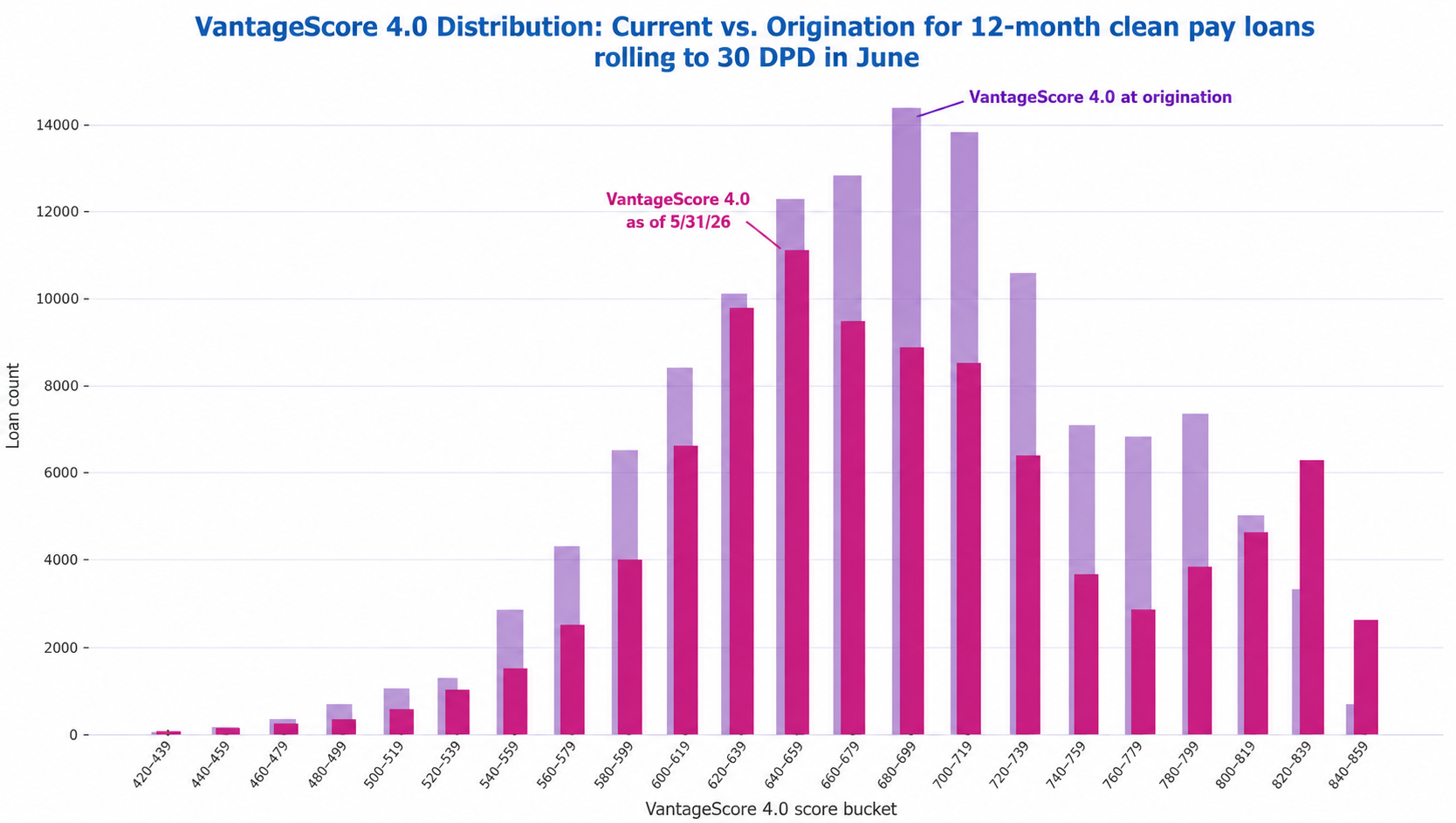
In a previous post, we described how every mortgage borrower’s financial situation and credit profile evolve over time.  After a borrower opens a loan, their financial status evolves—jobs are gained and lost; incomes can rise or fall, and financially stressful situations or windfalls can occur. These effects are often reflected in the consumer’s evolving credit score, which changes with the consumer’s payment behavior on open loans, credit inquiry activity, credit card utilization, and other revolving lines, among other things.    Even though MBS, whole loan, and MSR investors ultimately bear borrower credit risk, they may have access to less current borrower credit information than other participants in the mortgage ecosystem.   In securitized markets (both agency MBS and private-label MBS), updated scores are not provided in disclosure to bondholders, even as loans age year over year.  In whole loan and MSR markets, a single origination credit score is often provided at the time of bid, and after a successful bid, the investor may have a permissible purpose to pull individual scores on an owned portfolio. But until recently, there was no single loan-level dataset that included continuously refreshed credit scores across the U.S. mortgage market—the type of foundational dataset needed to build and tune credit and prepayment models.  A monthly-refreshed Current Credit Score field meets our three-pronged materiality standard for new data delivery to MBS markets:  New: Provides information not available in existing datasets (i.e., orthogonal to currently available data). Neither private-label MBS nor agency MBS standard market data includes a monthly-refreshed borrower credit score.  Material: Impacts a sizeable portion of the MBS universe. For the vast majority of loans in MBS, borrowers credit scores are available.  Significant: Differentiates collateral performance by a large enough margin to influence trading and risk management decisions.  A current credit score wraps all of a borrower’s credit-related behaviors into a single numerical value and has historically been associated with a borrower’s likelihood of becoming 60+ days past due on any obligation within the subsequent 24 months.    In fact, a current credit score is among the most informative indicators of near-term mortgage default risk, as shown in the image below, which depicts 30+ DPD rates by current credit score bands for the entire U.S. mortgage market, controlling for origination score <=650.    Without access to current credit scores, investors are limited to the score at origination—causing the four distinct performance trends shown here to appear as a single averaged line. In reality, score migration since origination reveals significant divergence in credit risk, with the lowest current-score bucket exhibiting a nearly 10 times higher 30+ DPD rate than the highest-score bucket in the latest period shown.  Source:  Experian Mortgage Loan Performance (MLP) dataset hosted on IVolatility DataDriven Platform  In this article, we’ll take a quick look at how score migration acts as an early predictor of a performing loan’s first roll into 30-day delinquent status.    MBS Investors’ Current Credit Score Blindspot: Solved   An MBS investor relying on standard market data and securitization remittance reports sees no sign of borrower stress until the subject mortgage loan in the securitization misses a payment and is reported at 30 days delinquent. Of course, in the vast majority of cases, a borrower begins struggling financially well before missing a mortgage payment:  The borrower may miss payments on other types of loans (credit card, auto loan, personal unsecured, or payday loans) as they prioritize their home and mortgage.  Outstanding balances on credit cards may grow as the borrower begins to make only minimum payments on revolvers.  The borrower may apply for additional credit cards, personal or payday loans   The borrower may apply to increase limits on existing credit cards as outstanding balance nears spending limit  All these stress-indicative behaviors result in a decreasing credit score, many months before the borrower misses their first mortgage payment. An MBS investor with access to each borrower’s current credit score, refreshed each month, can predict increased likelihood of default many months before the first missed mortgage payment—and is therefore at a major information advantage relative to the market generally.  Experian’s Mortgage Loan Performance (MLP) dataset contains thousands of fields describing mortgage performance from each borrower, loan, and property perspective, all refreshed monthly (including, amongst other things, new credit scores and refinance inquiry activity, loan performance on all types of debt, filed junior liens, and AVM values).   MLP is much more comprehensive than loan-level data provided by Freddie Mac, Fannie Mae, Ginnie Mae, and PLS data vendors in several ways:   Standard market datasets may not contain certain data elements that some market participants consider useful when evaluating mortgage prepayment or credit performance. Basic, critical fields such as the borrower’s current credit score and the current junior lien balance on the property are missing.    MLP contains borrower, loan, and property data fields spanning a broad portion of the mortgage universe, including Agency, Non-Agency, and Esoteric mortgage products (CES, HELOC, Reverse), including both securitized and non-securitized loans.   MLP enables full three-dimensional (borrower + loan + property) tracking with persistent keys for borrower (before and after refinancing), loan (in securities/deals even after exit due to payoffs or buyouts, including before and after MSR sales), and property.  This enables end-to-end analysis of each borrower’s (and property’s) mortgage experience throughout their credit lifecycle.  Is Downward-Trending Credit Score a Signal for Impending Delinquency?  MLP contains thousands of fields describing each loan, borrower, and property across all U.S. mortgages.  It allows for virtually unlimited segmentation and granular analysis.   For purposes of this illustrative article, we’ll take a high-level look at the entire U.S. mortgage market and perform a quick analysis to confirm intuition that a declining credit score provides a signal for higher likelihood of near-term mortgage delinquency.  Figure 1 illustrates the current pay status (as of 6/30) for the entire U.S. mortgage market, as contained in the MLP dataset, along with count, UPB and UPB-weighted Vantage 4.0 credit score for each bucket.  Figure 1  Source:  Experian Mortgage Loan Performance dataset  As illustrated in Figure 1, approximately 772,000 individual mortgage loans were reported to Experian as 30 days delinquent as of 6/30/2026.  Of the 772,000 30d delinquent loans in the June snapshot, approximately 426,000 were current in the prior (May) snapshot.  Some of these 426,000 loans were reperformers which had been bouncing from 30 DPD to current over the prior few snapshots. To remove reperformance score noise, we further parsed out the population which: 1) had rolled from current to 30 DPD from May to June; and 2) was consistently current for a full year prior to the 6/30 missed payment.  The population meeting both conditions totaled approximately 123,000 loans.  Figure 2 below shows, for this population of 123,000 “clean current” loans, the UPB-weighted average Vantage4 credit score for each of the 12 months leading up to the June missed payment, as well as the impact of the missed payment on the 6/30 score.  Figure 2  Source:  Experian Mortgage Loan Performance Dataset  Figure 2 reveals a rather slow and steady ~20-point deterioration of score in the 12 months prior to first missed payment – as well as the 80-point drop once the missed payment hits.  When we compare this cohort’s Vantage 4.0 score trend to the broader Current population across the entire dataset in Figure 3, we see a marked difference in both absolute value and trend:  Figure 3  Source:  Experian Mortgage Loan Performance Dataset  Not only is the cohort’s starting Vantage 4.0 score lower than the broader current population, but it also displays a dropping trend (with a notable 2 to 3x acceleration in monthly score drop the month before the first missed mortgage payment) while the broader Current population’s score (of which the isolated cohort is a subset) remains rock steady.  Lastly, we present Figure 4, a histogram comparing the distribution of at-origination and as-of 5/30 (i.e., the period just before the missed June mortgage payment) credit scores for the clean current population. The distribution appears to shift toward lower credit scores. To the extent credit scores are correlated with credit risk, this shift may indicate elevated credit risk relative to origination. Since this degradation occurs during a period of perfect mortgage pay performance, it is invisible to MBS investors who lack access to current borrower credit scores. Experian MLP provides monthly refreshed credit scores for mortgage borrowers contained within the MLP database.  Figure 4  Source:  Experian Mortgage Loan Performance Dataset 

September 22, 2026 by Michael Pyatski, Perry DeFelice
Ask the Expert: The Future of Lending Starts With Identity With Shawn Rife and Brian Cardona

Identity intelligence and alternative data can help lenders validate consumers and support more informed decisions across the customer lifecycle.

September 16, 2026 by Julie Lee
Financial Institutions Are Rethinking Customer Acqusition

Customer acquisition strategies are constantly evolving toward more precise targeting. From a marketing lens, you can track every step, optimize communication channels and still miss the person most likely to convert. Attribution can tell us which channels work and automation can make marketing spend more efficient. But both assume we know who is actually on the other end. Financial institutions are learning that finding audiences and targeting them is no longer the biggest challenge. As acquisition optimization marketing becomes more sophisticated, teams can measure and act on more signals than before. What they can't always know is whether the person on the receiving end is real. Customer acquisition has evolved into an identity problem. The challenge is not that every questionable signal represents malicious activity. It's that acquisition systems must make increasingly intelligent decisions with an imperfect understanding of who they're actually engaging. When identities are fragmented, duplicated, temporary or synthetic, optimization becomes a question of trust as much as targeting. When your signals don't reliably identify customers The customer journey often includes searching, filling out a form, creating an account, requesting a quote and subscribing. All of these signals work well when identity is relatively stable.  However, financial institutions are finding that these signals are becoming less reliable. A single person can operate across multiple personas, devices, browsers, aliases, accounts and intermediaries while several apparent “people” may actually represent one underlying actor. Financial instituions are finding: Fragmented customer signals Difficulty distinguishing an old account from a new one Different digital pathways associated with the same individual Signals that are generated by automation Real customers getting flagged because signals are too thin to evaluate confidently Legacy signals continue to be challenged Marketing has historically treated intent as a valuable signal because intent was relatively difficult to produce. A search required human intent. A form required someone to fill it out. An inquiry implied a meaningful amount of human effort. Financial institutions are already combating AI-enabled fraud, and now marketing teams are starting to face it on a massive scale. AI can mimic human behavior by researching products, comparing prices, filling out forms, creating accounts and signing up for services. A valid email address is no longer enough. Marketers need to know: How long has it existed? How recently has it been active? Does its activity appear consistent or suddenly anomalous? Has it gone dormant and returned? Is it associated with patterns that suggest stability or unusual behavior? How to build on your strongest signal Email remains one of the most persistent identifiers in digital commerce, following people across devices, platforms, transactions, subscriptions, accounts and years of activity. For over two decades, this has shaped how AtData thinks about identity. Now, as part of Experian, it’s shaping how an entire platform and team approach identity. A marketer doesn’t need every prospect to have existed online for twenty years. But understanding whether a newly acquired prospect has meaningful identity context can dramatically improve the quality of the decision being made around it. Better identity intelligence can help organizations reduce unnecessary friction by improving their ability to recognize legitimate customers. With a strong identity foundation, marketing teams can better address: Which audiences are more likely to convert? Which leads are high quality? Which channels are driving incremental growth? What do the best prospects look like? The value isn't simply having an email address. It's understanding the history and behavioral context associated with it. That context can provide a stronger digital identity signal, helping marketers understand how long they have been active, whether its behavior is consistent with that of a real person and whether current activity aligns with past patterns. It continues to be one of the most persistent identifiers in digital commerce. An infrastructure built for what's coming The acquisition of AtData by Experian reflects a fundamental shift in how identity infrastructure needs to work. Experian's scale and decisioning capabilities, combined with AtData's real-time email intelligence, create a strong platform. Read more about the why behind the acquisition and see how email works as an identity anchor for fraud prevention. Contact us to learn about our customer acquisition solutions

September 15, 2026 by Zohreen Ismail

Subscribe to our Newsletter

Enter your name and email for the latest updates.

This site is protected by reCAPTCHA and the Google Privacy Policy and Terms of Service apply.

Subscribe to our Newsletter

Don't miss out on the latest industry trends and insights!
Subscribe