
While EV Registrations Grow Through the First Half Of 2021, Non-Electric Remains Dominant

by Guest Contributor 3 min read October 18, 2021

You can’t open an automotive magazine or listen to a podcast without some sort of reference to electric vehicles (EVs). As the industry looks to move toward more sustainable fuels, EVs are making quite a splash.

But how does that hype compare with the numbers? In Experian’s Automotive Market Trends Review: Q2 2021, we looked at the data to better understand EV and internal combustion engine (ICE) registration trends.

EV registration sees significant growth

Through the first half of 2021, electric vehicles comprise just 0.43% of all of vehicles in operation. But that small number has seen significant growth year-over-year. From January – June 2021, EVs made up 2.4% of all new vehicle registrations—which is 117.4% growth year-over-year.

While it will come as no surprise to anyone that Tesla was the dominant brand of all registered EVs, what may be surprising is that its share is decreasing. Through Q2 2020, Tesla held 79.5% of EV registrations, but that has dropped to 66.3% a year later. The difference is due to gains by brands like Chevrolet, which grew from 8.3% to 9.6% year-over-year, along with growth from Ford (5.2%), Nissan (3.9%) and Audi (3.3%).
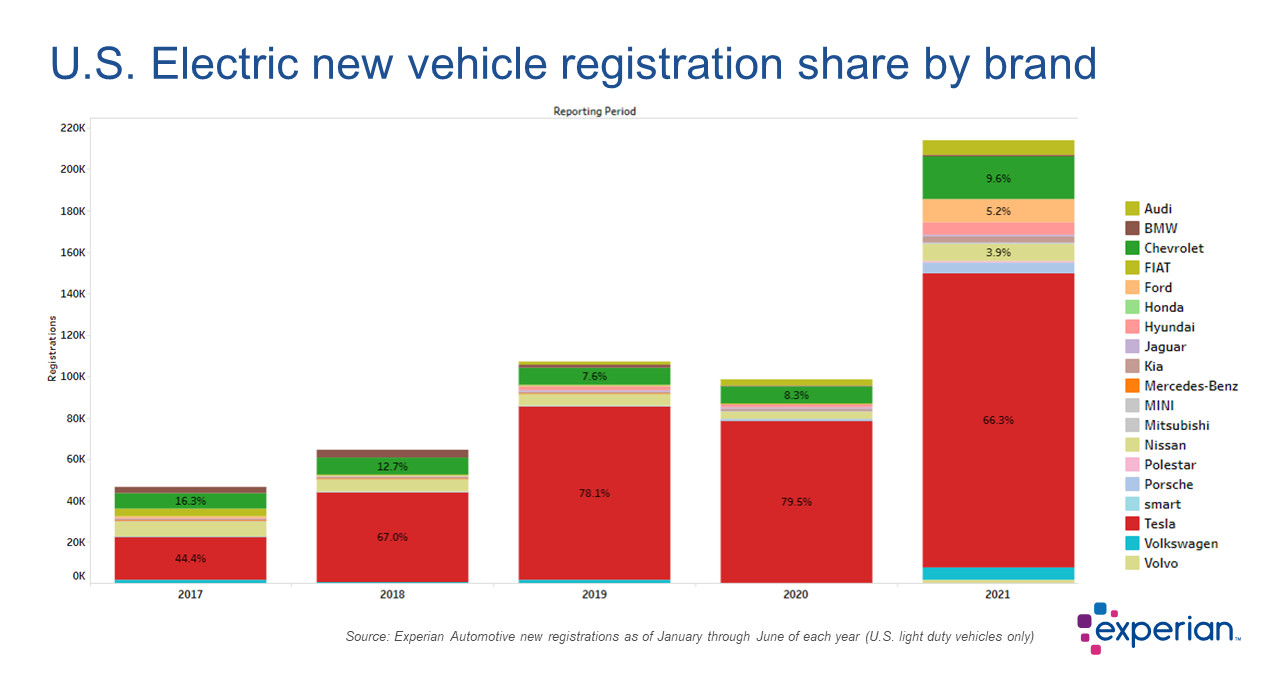
A graph showing the percentage of electric vehicle registration by brand

With numerous brands promising new EV models in the coming years, market share will be an interesting trend to monitor.

ICE registration trends

Despite significant growth in the EV market, the reality is, ICEs still made up 97.63% of new vehicle registrations in Q2 2021 and will continue to take up the lion’s share for some time, even as more EV models are introduced.

Taking a closer look at the data, we see that Toyota makes up the largest share of new vehicle registrations through the second quarter, making up 13.8% of new vehicle registrations, followed by Ford (11.2%) and Chevrolet (10.5%).
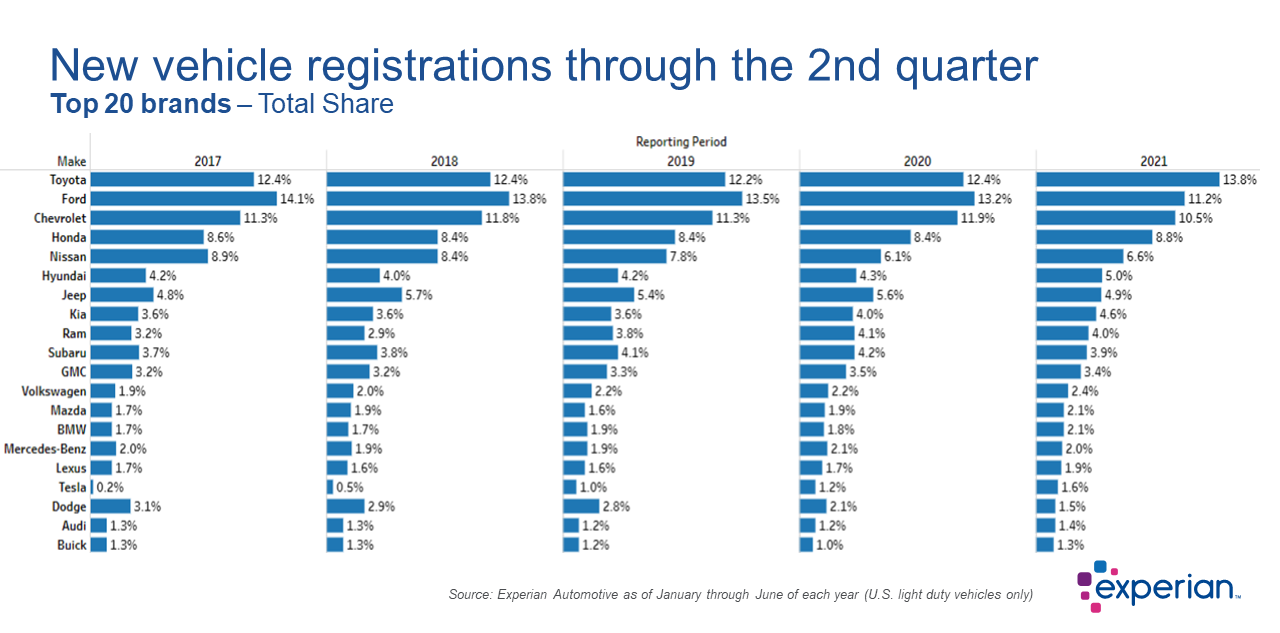
Graph showing new vehicle registration by brand

Crossover vehicles (CUVs) and SUVs continue to be the most popular vehicle segment, growing from 49.5% in Q2 2020 to 53.4% in Q2 2021. The other two most popular segments, sedans and pickups, saw year-over-year decreases. Sedans decreased from 19.4% of new vehicles registered in Q2 2020 to 18.5% in Q2 2021, while trucks declined from 19.9% to 17.3% in the same time frame.

Understanding audiences to market more effectively

Since EVs will remain a small percent of the mix, it’s even more important to understand what’s unique about the consumers who are inclined to purchase them. Leveraging data-based solutions that help identify propensities toward specific vehicle types, such as EVs, can help marketers create messaging that resonates with these consumers, ultimately resulting in a higher return on ad spend.

To learn more about EV and other vehicle registration trends watch the full Automotive Market Trends Review: Q2 2021 webinar.

Related Posts

How Union Credit Expands Access to Credit Unions with Experian

Discover how Union Credit and Experian help credit unions reach younger consumers through personalized digital lending experiences.

Published: July 1, 2026 by Scarlet.Nickel@experian.com
Faster Decisions, Better Outcomes: Experian Verify™ Now Available Through Centro, Mezzo’s Orchestration Engine 

Explore how Experian Verify™ and Mezzo’s Centro orchestration engine are helping mortgage lenders modernize income and employment verification, reduce workflow complexity, and make faster, more confident lending decisions at scale.

Published: July 1, 2026 by Lizel Ferrer
Used EV Growth Signals a New Phase of Consumer Purchasing Behavior

The electric vehicle (EV) revolution isn’t slowing down, it’s changing lanes. While recent conversations have seemingly focused on softening demand for new EVs, the used segment has been gaining momentum. According to Experian Automotive’s 2025 EV Year in Review Report, new retail individual EV registrations fell 35.9% year-over-year. Meanwhile, the used retail individual EV registrations grew 25.4% from a year ago. As affordability and growing model availability reshapes consumer behavior, buyers are increasingly turning to pre-owned EVs, which has shown an interesting market divergence that is redefining how consumers are adopting this segment and what it can mean for automakers, dealers, and the overall industry. Key players behind rising used EV demand Notably, Tesla accounted for over half (60.5%) of used retail individual EV registrations in 2025, followed by Chevrolet at 6.4% and Nissan (5.5%). Diving a bit deeper, Tesla made up the top three models of the used individual registrations last year, with the Model 3 coming in at 27.2%, Model Y at 21.7%, and Model S (6.6%). The Chevrolet Bolt EV followed at 4.8% and the Nissan Leaf was at 4%. Tesla’s position as the leading make in the used EV market is a natural extension of its long-standing dominance in new EV sales. The brand’s leadership over the years created a large fleet of vehicles that are now entering the pre-owned market. What the used EV boom means for automotive professionals The growing demand for used EVs can present more opportunities for automotive professionals. Dealers that provide a healthy supply of pre-owned EVs can increase accessibility and play a role in adoption for consumers who are actively looking to purchase, while marketers can emphasize value and ownership benefits. As the market continues to evolve, automotive professionals who understand and respond to these changing dynamics will be best positioned to capitalize on the expanding pool of used EV shoppers. To learn more about EV insights, visit Experian Automotive’s EV Resource Center.

Published: June 30, 2026 by Kirsten Von Busch

Subscribe to our Auto blog

Enter your name and email for the latest updates.

This site is protected by reCAPTCHA and the Google Privacy Policy and Terms of Service apply.

