
Vehicle Detail Pages with a Free Vehicle History Report Have Higher Lead and Sale Conversion Rates

by Kirsten Von Busch 3 min read March 15, 2022

Woman shopping for a vehicle with a vehicle history report

We recently collaborated with our integration partner, TrueCar, to analyze vehicle history data’s impact on online listings. We analyzed millions of records over months of data and matched online listings to DMS sales to confirm closing rates.

The short story – dealership Vehicle Detail Pages (VDPs) on TrueCar.com that offer consumers a Free Experian AutoCheck vehicle history report had a higher lead conversion rate. We expected the data to confirm that VDPs with a Free VHR would have a higher lead conversion rate. However, we uncovered additional insights that even surprised us!

The most common search filter

Consumers value transparency from a dealership and expect to be informed if a vehicle they are looking at has been in an accident. We learned from the study that when consumers used vehicle history data to filter their user’s search results, the “accident” filter was the most common vehicle history data filter used. More than one-third of consumers using vehicle history data to filter search results use “accident” as a filter criterion.

Why is this important? There are over 280 million vehicles in operation, and four out of ten of those vehicles have been in an accident. That means more than 100 million vehicles on the road have been in an accident—and 20% of vehicles on the road have had multiple events.

Higher conversion rates (with a twist)

Having been in the automotive data and analytics space for years, we were not surprised that the analysis continued to support our previous research that vehicle detail pages with a free vehicle history report have a higher lead conversation rate!

Things started to get even more interesting, though: VDPs with a free AutoCheck VHR converted at a 27% higher rate. That holds true if the VDP page had a Free AutoCheck report available to the consumer, but if the consumer clicked on the free AutoCheck vehicle history report to view the details of the information, the lead conversion rate jumped to 318% (no, that’s not a typo). The lead conversion rate increased to 318% if the consumer viewed the AutoCheck vehicle history report!
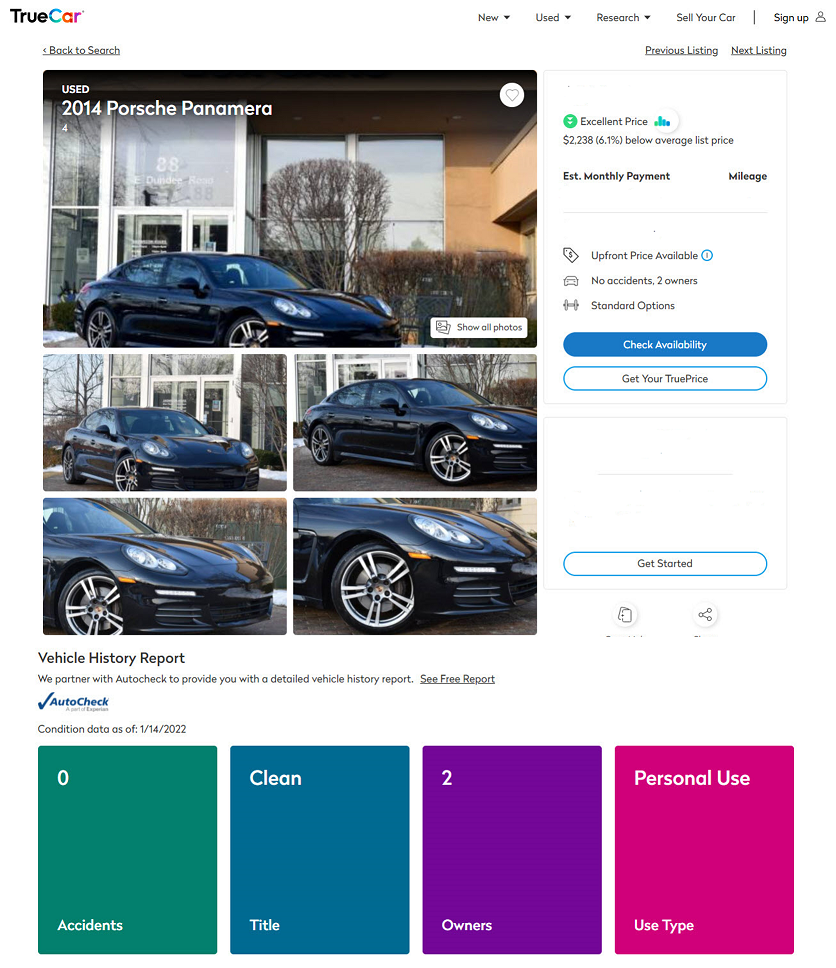
TruCar AutoCheck vehicle history detail page

VDP sale conversion rates

And while we all appreciate a good lead conversion success story, we also wanted to analyze sale conversion rates. We learned that TrueCar VDPs that offered consumers a Free AutoCheck vehicle history report on behalf of a dealership had a higher sales conversion rate. Not only is the rate higher—the sale conversion rate is 50% higher for VDPs that offer a free VHR.

Here are a few more interesting pieces of information we uncovered with this latest analysis:

  • VDP’S without an accident close at about 200% higher than those with an accident
  • Vehicles without frame damage had a 250% greater close rate
  • Vehicles without a salvage indicator had a 634% greater close rate

Consumers want to make informed decisions when purchasing vehicles, and automotive dealerships can help by providing them with a free AutoCheck Vehicle History Report on every Vehicle Detail Page. Help improve lead conversation rates, sale conversation rates, and build customer trust by offering vehicle history transparency.

For dealers with an AutoCheck subscription, you can activate your vehicle listings for free on TrueCar by calling AutoCheck Customer Service at 1 888 409 2204.

Dealers interested in learning more about the benefits of becoming an AutoCheck subscriber, contact us today!


Related Posts

Rewriting the Road Ahead with Longer Loan Terms and Increased Refinancing Options

The automotive market is entering a new phase defined not just by what consumers are buying, but by how they’re choosing to finance it. According to Experian Automotive’s State of the Automotive Finance Market Report: Q1 2026, nearly one-third (35.55%) of all new vehicle loans now stretch more than six years, up from 30.83% in Q1 2025. Similarly on the used side, 31.54% of loans extended more than six years, an increase from 28.60% last year. The shift highlights why affordability is reshaping how consumers are financing their vehicles, particularly in larger and higher-priced vehicles. Refinancing gains traction as interest rates stabilize In addition to longer-term loans, consumers are becoming increasingly deliberate with their financing decisions and managing monthly payments as refinancing activity has gained momentum. For instance, consumers who refinanced this quarter lowered their interest rate by 2.2% and saved an average of $81 on their monthly payment. Credit unions, in particular, continued to play a major role in helping consumers secure more affordable payment options. In Q1 2025, credit unions accounted for the lion’s share of automotive refinancing at 63.43%, from 62.31% a year ago. By comparison, banks went from 23.51% to 22.59% year-over-year. Furthermore, those who refinanced with a credit union saved an average of $101 this quarter, whereas those who refinanced with banks saved $60. Expanding credit access through flexible financing Another notable trend this quarter was the incessant growth in subprime financing as credit accessibility across the market continues to increase. In the first quarter of this year, subprime borrowers made up 15.75% of total vehicle financing, from 14.40% last year. For new vehicles in particular, the subprime market went from 5.61% to 6.88% year-over-year, while subprime in used vehicle financing grew to 20.60% this quarter, from 19.36% a year ago. Increased activity in the subprime segment highlights continued confidence in the automotive market and underscores the importance of expanded financing options. As consumers seek greater flexibility with financing decisions that fit their lifestyle, lenders and dealers have the opportunity to approach them with more personalized solutions. These trends are helping keep both new and used vehicle markets moving forward, while creating new opportunities for consumers to manage payments and purchase confidently. To learn more about automotive finance trends, view the full State of the Automotive Finance Market Report: Q1 2026 presentation on demand.

Published: June 2, 2026 by Melinda Zabritski
Staying Competitive After Trigger Leads Evolve: A Roadmap For Lenders

Trigger leads have long been the preferred solution for identifying high-intent mortgage borrowers. But with the implementation of the Homebuyers Privacy Protection Act (HPPA), which introduces new limitations and consumer protections around trigger leads, that playbook will need to shift. Now, lenders are quickly facing a pivotal shift in how they discover, engage, and convert prospective borrowers into customers. The industry now stands at a crossroads. Lenders who adapt early—leaning into predictive tools, consent-based engagement, and smarter prescreening—will redefine borrower acquisition in a more privacy-centric era.  HPPA: A structural change to mortgage marketing  The HPPA amends the Fair Credit Reporting Act by significantly restricting the use of mortgage inquiries for prescreen purposes. As of March 5, 2026, credit bureaus may only provide or utilize mortgage inquiries to:  End users with explicit borrower consent  The originator of the consumer’s current mortgage  The servicer of the consumer’s current mortgage  An insured depository institution or credit union where the consumer has an existing account  While these exemptions may provide continuity for banks and credit unions, many mortgage brokers and nonbank lenders will need to overhaul their prescreen practices—or risk being cut off entirely from a previously high-performing acquisition channel.  Why this isn’t just a compliance shift—It’s a strategic recalibration  Mortgage triggers in prescreen allow lenders to react instantly to consumer intent. Lenders rely on a prompt and convincing narrative to entice applicants to switch lenders. Mortgage inquiry triggers are effective and were, therefore, a prospecting strategy for many lenders. Recent legislative changes significantly restrict the availability of these inquiry triggers, and impacted lenders are focusing on a more intentional prospecting strategy to compete.   Without these mortgage triggers in prescreen, lenders need to ask:  Who are we trying to reach?  What early signals can we act on?  How do we earn permission and attention before a mortgage inquiry ever happens?  Transforming the funnel: From reaction to anticipation  The shift in mortgage inquiry-based prescreen isn’t the end of high-intent lead targeting. It’s the beginning of a more strategic and intentional approach—one that leverages earlier indicators of mortgage readiness and focuses on building relationships, not just closing transactions.  Here’s where the momentum is evolving, creating a new and smarter funnel:  Prescreen marketing: Using credit and behavioral attributes to help identify consumers who meet specific lending criteria before they signal active intent.  Predictive modeling: Leveraging propensity scores or custom models to prioritize outreach based on conversion likelihood.  Consent-based engagement: Implementing compliant mechanisms to capture and manage borrower opt-ins at scale.  The power of predictive modeling  According to recent industry interviews, propensity modeling is emerging as one of the most effective replacements for trigger-based prescreen. These models analyze hundreds of credit attributes—such as utilization, account mix, account age, and depth—to help identify consumers statistically more likely to seek a mortgage.  For lenders just beginning to use predictive modeling, off-the-shelf models can be a quick way to identify potential borrowers. For example, when layering propensity scores on top of credit eligibility, which can improve borrower targeting, many lenders see an increase in open mortgage loan rates.  Meanwhile, custom-built models, which analyze a lender’s own campaign performance over time, offer the highest level of precise targeting. These models isolate the attributes most predictive of conversions within a specific product mix—optimizing not just volume, but fit.  Speed without traditional triggers? It’s possible  One of the biggest concerns among lenders is maintaining the speed historically enabled by trigger leads. But that concern may be overblown.  Self-service prescreen platforms now allow marketers to generate qualified lead lists in as little as 24 hours, enabling rapid response during rate drops, competitive shifts, or seasonal demand spikes.   For those new to prescreening, batch campaigns still offer value, especially with analyst support.   Don’t overlook retention  In an era of intense acquisition competition, retention becomes a key differentiator.  Lenders who monitor property status, cash flow, and consumer credit behavior can proactively identify when an existing borrower is likely to list, refinance, or exit. Armed with that intelligence, lenders can re-engage with the borrower at the right moment—sometimes before a competitor is considered or contacted.  This level of behavioral intelligence may soon separate proactive lenders from reactive ones.  Actions instead of reactions  The evolution of trigger-based prescreen doesn’t just require new tools; it demands new thinking. Lenders should begin by auditing their current pipelines and determining:  What percentage of our acquisition is dependent on triggers?  What share of our book falls under the HPPA exemptions?  How will we scale compliant opt-in collection?  Are our current prescreen or modeling capabilities future-ready?  Those who answer these questions today—and act on them—won’t just be in compliance with the new laws, they’ll lead in a transformed market. Lenders should also be asking:   Do we have the infrastructure to collect and act on borrower consent?  Are our acquisition teams equipped to run prescreen campaigns — both batch and self-service?  What predictive models are we using (or could we use) to prioritize leads?  Are we proactively monitoring our portfolio to catch retention risks early?  How are we preparing our sales teams for longer, more consultative buying journeys?  Conclusion  The HPPA signals a shift away from relying on passive, inquiry-based prescreen acquisition and the beginning of smarter, more strategic engagement with potential borrowers. Lenders who embrace this transition early will find themselves not just compliant, but competitive—with deeper borrower insights, better conversion rates, and stronger long-term customer relationships.  The market is moving. The only question is: will you lead the change or chase it?  Citation  Experian. (2025, November). Interview: How the Homebuyers Privacy Protection Act is reshaping mortgage marketing—and what lenders should do now [transcript]. Experian Mortgage Insights. Insights based on lender feedback, campaign performance data, and analysis of prescreen marketing strategies and predictive modeling outcomes were gathered from Experian client engagements and internal mortgage analytics between May and October 2025. Homebuyers Privacy Protection Act timeline and legal context referenced from legislation signed September 5, 2025, with implementation beginning March 5, 2026.   

Published: April 22, 2026 by Ivan Ahmed

Subscribe to our Auto blog

Enter your name and email for the latest updates.

This site is protected by reCAPTCHA and the Google Privacy Policy and Terms of Service apply.