Tag: mortgage

Experian's annual State of Credit Report includes consumer credit data trends and a 10 year look back to when America started to enter the recession.

An Experian study revealed 86% of millennials believe that buying a house is a good financial investment - they just don't have the credit scores they need.

Market trends and insight from Q1 2018. The economy remains steady as we transition from 2017. Keep an eye on inflation and interest rates.

Recent research shows Hispanics—especially Millennials who are entering their home-buying years—are particularly eager for homeownership.

The economic expansion just passed the eight-year mark, and consumer credit defaults across mortgages, bankcards and auto loans are at pre–financial crisis levels

Experian took a deep dive into the data and performance surrounding the credit union universe in their first-ever “State of Credit Unions” report, featuring insights utilizing data from both 2015 and 2017.

Average mortgage rate was >4% at the end of Q1 with mortgage originations nearly $450 billion—a 5% increase over the $427 billion a year earlier.

It was two years ago when I found myself sitting cross-legged on my home office floor, papers strewn about as I organized piles of tax returns, W-2s, pay stubs, 401k and bank statements, and previous escrow docs. My task? Sort through it all, scan them (if I couldn’t access them digitally) and then upload/email them to a site for my mortgage broker to print and package for my refinance application. For a girl accustomed to Amazon Prime, mobile banking, social media and smart TVs, this monumental financial task seemed utterly archaic – even in 2015. Fast forward two years later, and the mortgage space has failed to make much progress. Clearly, the financial meltdown and Great Recession placed more regulation and compliance stresses on financial institutions. Verification steps and requirements needed to be strengthened – and that made sense. We want to make sure people are capable of paying for those sizable mortgage payments, right? Even now, I get flashbacks to scenes from The Big Short. Still, the hunt for paper, the endless scanning, the emailing, the document uploads required? In an era where the smartphone rules, how has the mortgage industry failed to evolve in the digital age? It’s no secret the financial services industry is typically slow to adopt the latest in technology advancements, but consumers are pushing. A 2016 Accenture survey reveals online banking is now the top choice of consumers at 28%, followed by branch banking at 24%. In the mobile banking space, there has additionally been a significant increase. From 2011 to 2015, mobile banking doubled (22% to 43%) and rose from 43% to 53% for smartphone users in particular. But what about mortgage? Finally, it seems, shifts are underway. In a recent Oliver Wyman paper titled Digital Mortgage Nirvana, the authors state, “Gone are the days when the only way to properly underwrite a mortgage was with long application forms and tall stacks of documents.” Once easy to carry in one hand, the average mortgage application file has ballooned to 500 pages, according to David Stevens, CEO of the Mortgage Bankers Association. And while the application may not shrink, portions of the application process can be digitized and automated. Today, lenders have the ability to partner with data aggregators to verify a consumer’s assets and income with online solutions. In fact, lenders can take this a step further, feeding the data into their automated decision engines, providing the consumer with an approval, decline or conditions that must be met in order to clear the loan process. Nonbanks have been picking off business and disrupting the onerous mortgage process for the past several years. Think Quicken, LoanDepot and GuaranteedRate. But all mortgage lenders have the ability to speed up consumer verification and decisioning by partnering with data aggregators and leveraging solutions like Experian’s digital verification suite. Are we talking a one-click shopping experience? No. This is a mortgage after all, not your average online purchase. But banks now have the opportunity to dramatically enhance the mortgage experience for consumers. The question is whether they are ready to finally embrace a digital journey in the mortgage space in 2017, or will they let another year pass them by?

Experian recently acquired a minority stake in Finicity, a leading financial data aggregator enabling innovation in the FinTech industry through its modern RESTful API and Finicity Aggregation Platform. Steve Smith—chairman, CEO and co-founder of Finicity—has a passion and experience in developing innovative and disruptive technology, products and services that leads to efficiency for markets and, ultimately, improvements for consumers. Here he shares his thoughts about disruptive technology in the lending space and its benefits to lenders and consumers. Q: Finicity has said its objective is to take a loan application approval from weeks to minutes using its technology. That sounds pretty great, but how is that possible? How does this play out behind the scenes? A: Well, we’re living in a world where we, as consumers, expect very user-friendly experiences and we expect things to happen at digital speeds. The loan process is no exception. To deliver the experience consumers are expecting requires us to leverage the technology trends of digitization, mobility and big data. Finicity plays a foundational role by leveraging thousands of digital connections across financial institutions to aggregate consumer-permissioned account data. Once we have this data, we’re able to deliver real-time insights into an individual's financial health. This financial health assessment includes income and assets, two critical components to the loan approval process. All that’s required is the borrower to permission use of the data. Once that’s done, we’re able to gather all appropriate data across multiple accounts, rapidly analyze it and send a verification report to the lender. No papers. No multiple requests. No questions on the validity of the data. All done in minutes, not weeks. Q: This is very disruptive technology. What are the benefits for lenders? Consumers? A: Well, as we discussed, one of the major benefits is the speed to a loan. Furthermore, this reduces cost for the lender by maximizing loan officer’s time, while also freeing up loan capital as they can move through loans more quickly with a higher quality assessment. Another benefit for lenders is reduced fraud. Our information on income and assets is coming from real-time bank validated information. This eliminates the possibility of altered data. For consumers, it’s a dramatically simplified process. No need to chase down multiple documents. There are virtually no second requests for information, which we often see in the process. And they’re always in control of their information. All in all, it’s a dramatically better experience for both the lender and the borrower. Q: What sets this solution apart from others in the market? A: A few things set Finicity apart in delivering the quality of insights required. First, we are an industry leader in the number of financial institutions we connect with, ensuring broader access for more customers. Second, 95 percent of our integrations provide access to formatted data, something that’s critical to credit decisioning solutions. In these cases, we’re not screen scraping. This enhances our ability to collect bank validated transactions; we provide the financial institution transaction ID. This provides assurance of data quality. Finally, is our ability to categorize and analyze the transactions. This allows us to identify income streams and assets. Through this process, we’re also able to flag unusual transactions, like large deposits, that may skew actual assets. Q: The future of financial technology is still evolving. What lies ahead? A: We’re very excited about the future of financial technology and the impact that aggregation will have. Whether it’s financial management, digital payments or credit decisioning, real-time data will improve the experiences and the outcomes. As we’re talking about lending, this is one of the spaces that could see significant disruption. Our ability to generate a richer view of an individual’s or organization’s financial health will more accurately determine their ability to repay a loan. This will be a great benefit for those that have thin file or no credit history. We see a world where suitability for a loan will be driven by their actual financial life independent of their use of credit. One of the largest markets in the US is millennials. However, for consumers under 30, two-thirds have subprime or non-prime credit scores and one-third of millennials don't have any credit history. This is just one group underserved because legacy models don’t leverage the full extent of data available. Q: Is there anything else you can tell us about Finicity and its role changing customer experiences across financial service? A: For us, it all comes down to one thing: enabling individuals and organizations to have the information and insights they need to make smarter financial decisions. The data is there. We’re helping to unlock the potential of that data by working with innovative partners like Experian. To learn more about Experian and Finicity's account aggregation solutions, visit www.experian.com/finicity
Experian analysis shows that 2.5M consumers will have a foreclosure, short sale or bankruptcy fall off their credit report between June 2016 and June 2017

The mortgage meltdown and Great Recession have translated into big shifts as it relates to financial services regulations. What's to come with a new administration coming soon?

Millennials are coming of age and experiencing big life moments — college graduation, their first job, getting married and moving out.

With HELOC end of draw peaking, lenders must consider best practices and actions to take to manage and optimize their portfolios.

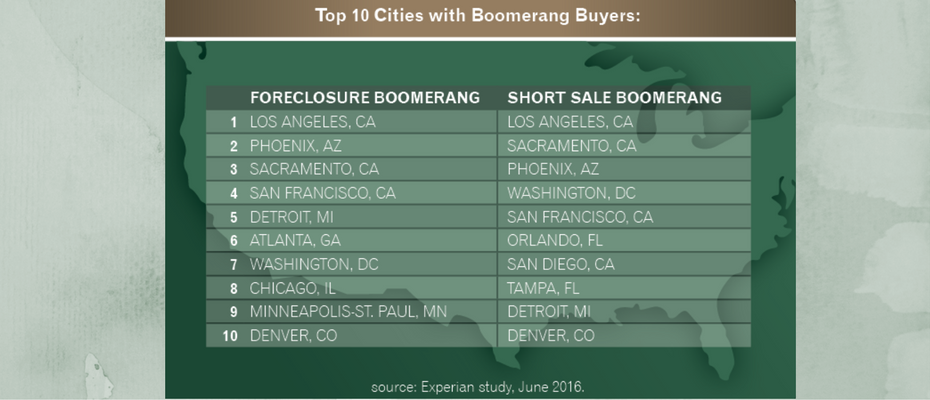
Time heals countless things, including credit scores. Many of the seven million people who saw their VantageScore® credit scores drop to sub-prime levels after suffering a foreclosure or short sale during the Great Recession have recovered and are back in the housing market. These Boomerang Buyers — people who foreclosed or short sold between 2007 and 2014 and have opened a new mortgage — will be an important segment of the real estate market in the coming years. According to Experian data, through June 2016 roughly 800,000 people had boomeranged, with Los Angeles, Phoenix, and Sacramento housing the most buyers. Some analysts believe more than three million Americans will become eligible for a home over the next three years. Are potential Boomerang Buyers a great opportunity to boost market share or a high risk for a portfolio? Early trends are positive. The majority of Boomerang Buyers who opened mortgages between 2011 and June 2016 are current on their debts. An Experian study revealed more than 29 percent of those who short sold have boomeranged, and just 1.5 percent are delinquent on their mortgage —falling below the national average of 2.8 percent. This group is also ahead of or even with the national average for delinquency on auto loans (1.2 percent vs. the national average of 2.2 percent), bankcards (3 percent vs. 4.3 percent) and retail (even at 2.7 percent). For those Boomerang Buyers who had foreclosed, the numbers are also strong. More than 12 percent have boomeranged, with just 3 percent delinquent on their mortgage. They also match or are below national average delinquency rates on auto loans (1.9 percent) and bankcards (4.1 percent), and have a slightly higher delinquency rate for retail (3.5 percent). Due to their positive credit behaviors, Boomerang Buyers also have higher VantageScore® credit scores than before. On average, the overall non-boomerang group’s credit score sunk during a foreclosure but went up 10 percent higher than before the foreclosure, and Boomerang Buyers rose by nearly 14 percent. For people who previously had a prime credit score, their number dropped by nearly 5 percent, while those who boomeranged returned to the score they had prior to the foreclosure. By comparison, the overall non-boomerang and boomerang group saw their credit score drop during a short sale and increase more than 11 percent from before the short sale. For people who previously had prime credit, they dropped 2 percent while those who boomeranged were almost flat to where they were before the short sale. Another part of the equation is the stabilized housing market and relatively low loan-to-value (LTV) limits that lenders have maintained. In the past, borrowers most often strategically defaulted on their mortgages when their LTV ratios were well over 100 percent. So as long as lenders maintain relatively low LTV limits and the housing market remains strong, strategic default is unlikely to re-emerge as a risk.

Recent survey by Experian revealed opportunities for businesses to build relationships with future homebuyers before they’re ready to obtain a loan.