Tag: identity authentication

What Is Identity Proofing? Identity proofing, authentication and management are becoming increasingly complex and essential aspects of running a successful enterprise. Organizations need to get identity right if they want to comply with regulatory requirements and combat fraud. It's also becoming table stakes for making your customers feel safe and recognized. 63 percent of consumers expect businesses to recognize them online, and 48 percent say they're more trusting of businesses when they demonstrate signs of security. Identify proofing is the process organizations use to collect, validate and verify information about someone. There are two goals — to confirm that the identity is real (i.e., it's not a synthetic identity) and to confirm that the person presenting the identity is its true owner. The identity proofing process also relates to and may overlap with other aspects of identity management. Identity proofing vs identity authentication Identity proofing generally takes place during the acquisition or origination stages of the customer lifecycle — before someone creates an account or signs up for a service. Identity authentication is the ongoing process of re-checking someone's identity or verifying that they have the authorization to make a request, such as when they're logging into an account or trying to make a large transaction. How does identity proofing work? Identity proofing typically involves three steps: resolution, validation, and verification. Resolution: The goal of the first step is to accurately identify the single, unique individual that the identity represents. Resolution is relatively easy when detailed identity information is provided. In the real world, collecting detailed data conflicts with the need to provide a good customer experience. Resolution still has to occur, but organizations have to resolve identities with the minimum amount of information. Validation: The validation step involves verifying that the person's information and documentation are legitimate, accurate and up to date. It potentially involves requesting additional evidence based on the level of assurance you need. Verification: The final step confirms that the claimed identity actually belongs to the person submitting the information. It may involve comparing physical documents or biometric data and liveness tests, such as a comparison of the driver's license to a selfie that the person uploads. Different levels of identity proofing may require various combinations of these steps, with higher-risk scenarios calling for additional checks such as biometric or address verification. Service providers can implement a range of methods based on their specific needs, including document verification, database validation, or knowledge-based authentication. Building an effective identity proofing strategy By requiring identity proofing before account opening, organizations can help detect and deter identity fraud and other crimes. You can use different online identity verification methods to implement an effective digital identity proofing and management system. These may include: Document verification plus biometric data: The consumer uploads a copy of an identification document, such as a driver's license, and takes a selfie or records a live video of their face. Database validations: The proofing solution verifies the shared identifying information, such as a name, date of birth, address and Social Security number against trusted databases, including credit bureau and government agency data. Knowledge-based authentication (KBA): The consumer answers knowledge-based questions, such as account information, to confirm their identity. It can be a helpful additional step, but they offer a low level of assurance, partially because data breaches have exposed many people's personal information. In part, the processes you'll use may depend on business policies, associated risks and industry regulations, such as know your customer (KYC) and anti-money laundering (AML) requirements. But organizations also have to balance security and ease of use. Each additional check or requirement you add to the identity proofing flow can help detect and prevent fraud, but the added friction they bring to your onboarding process can also leave customers frustrated — and even lead to customers abandoning the process altogether. Finding the right amount of friction can require a layered, risk-based approach. And running different checks during identity proofing can help you gauge the risk involved. For example, comparing information about a device, such as its location and IP address, to the information on an application. Or sending a one-time password (OTP) to a mobile device and checking whether the phone number is registered to the applicant's name. With the proper systems in place, you can use high-risk signals to dynamically adjust the proofing flow and require additional identity documents and checks. At the same time, if you already have a high level of assurance about the person's identity, you can allow them to quickly move through a low-friction flow. Experian goes beyond identity proofing Experian builds on its decades of experience with identity management and access to multidimensional data sources to help organizations onboard, authenticate and manage customer identities. Our identity proofing solutions are compliant with National Institute of Standards and Technology (NIST) and enable agencies to confidently verify user identities prior to or during account opening, biometric enrollment or while signing up for services. Learn more This article includes content created by an AI language model and is intended to provide general information.
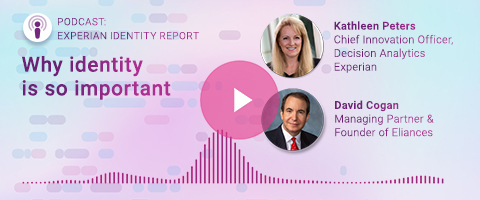
Kathleen Peters, Chief Innovation Officer, Decision Analytics for Experian, was recently featured on the Eliances Heroes podcast as part of the new weekly segment, the “Experian Identity Report.” In the introductory show, podcast host David Cogan, spoke with Kathleen about why identity is so important to our society. Listen to the podcast for the full discussion and see the transcript below. Learn more about Experian Identity David Cogan: How critical is it? Well, I’ll tell you. Payment fraud will exceed $206 billion in the next five years and let’s face it. Managing one’s personal identity is very complicated on its own and if the business enterprise managing customer identities in a strategic and secure way and scale across countless interaction is extremely complicated. And it’s only going to get more complex with the future from what I understand and all the technology that’s coming out if not by the day, by the hour. And that’s why we’re bringing this to you. Interviews with the world’s leading experts on the game changing impact of identity and the need to use reliable data to make confident decisions that securely accelerate customer engagement and that’s why we’re honored here today to have with us Kathleen Peters, Chief Innovation Officer, Experian Decision Analytics North America. Kathleen Peters: Thanks so much David, it’s great to be here with you. DC: $206 billion of payment fraud in the next five years? I mean who’s going to want to turn on their computer after this. That is a serious number. What do we do? KP: It’s really important that we get our arms around this both as consumers as well as businesses because we want to engage online. So much of what we’re doing is digital. It especially started in COVID when we were having our groceries delivered and everything else and even our grandparents are having to do their banking transactions online. The world is changing, and fraudsters take notice of that as well. Fraudsters are opportunistic and when they see a bunch of folks doing stuff online that they’ve never done before, they’re seeing that as an opportunity too. DC: You know the days of people horseback riding and overtaking trains are long gone and now it’s all digital. KP: It’s a lot easier these days. DC: Why is identity so important to our daily digital lives and in business? KP: It’s a great question, David. And as a consumer myself, you, and I when we transact online whether that’s to have food delivered, or I’m buying something for my kids or I’m even paying a bill, I want to be able to trust that my information will be safe, that my privacy will be protected and that my experience will be as smooth as possible. I think that’s what we all want. So as consumers and as businesses, how do we enable all the opportunities this new digital world is presenting to us in a way that we are safe and also businesses can transact with us securely and have confidence on who’s engaging with them online. DC: Let’s talk about identity. What really makes identity so challenging to manage at a business enterprise level especially with how complex the business portion is? KP: Absolutely. It really comes down to there are so many elements that comprise our identity. It’s multidimensional. So historically, when we think about identity, we probably think about the things that were on our DL or passport the kind of information that’s pretty static – name, address, SSN, date of birth – those kinds of things. Once we get online, that identity becomes a little more challenging. We’re not necessarily physically in front of the business that we’re engaging with so the business needs to determine if the person is who we say we are. There’s a famous Far Side comic from years ago where a dog is sitting in front of the computer and he says “On the internet, no one knows you’re a dog.” And that still rings true in that you need to be able to ensure that the customer that’s coming to your business online is a real person and not a bot, is a person with good intent and not a fraudster. You need to look no farther than some of the recent controversies around Twitter and Elon Musk’s on-again, off-again, on-again intent to buy the company. A few months ago he had pulled back because he wanted to know definitively how many users on Twitter are humans versus bots and sometimes determining that can be really hard. And that comes down to managing all these new definitions of identity. DC: That’s very important. The thing is businesses and consumers want to know really what to be able to do. So, what kinds of things is Experian able to offer to help with all of that? KP: We’re in a great position as Experian because we have such a depth and breadth of identity data. We have the analytics horsepower and really touchpoints that are really unique when it comes to thinking about identity. So we’ve been talking about these traditional identity elements and digital, online identity. When you think about it, Experian also really understands your financial identity. So when you bring those things together and a consumer is looking to maybe understand what their financial identity means, their credit score or even how to improve their credit score, Experian’s there. We’ve got a robust direct to consumer business, we’ve got offerings like Boost and Go that help people establish and build their credit. We’ve got marketplaces for cards, insurance, etc. And then when consumers want to open a new account at a financial institution, or a fintech, or a retailer, or even maybe buy some crypto or log into a business, Experian can bring that wealth of capability to help our clients, help businesses, separate those good consumers with good intent from the fraudsters and do that very quickly and efficiently so that consumers can have a great experience and build that trust with who they’re engaging with. DC: Kathleen, that’s really amazing. Alright, now with all of that going on, what is Experian doing now with innovating for the identity space? KP: This is a real passion of mine David and this is where I spend a lot of my time. We’re always looking ahead to see what is the new data, new capabilities that can help us improve that consumer experience and engagement, help clients find the right consumers online to engage and target, and really allow our clients to grow their businesses safely. So, we’re building some products in house, where we’re connecting new pieces that might be new to Experian like linking some of that traditional identity data with particular payment instruments. Is this Kathleen’s credit card? Is this my bank account? When I come and try to do transactions online. But we’re also partnering with new companies. There are a number of startups that are being formed that have been in business looking at new ways to stop fraud and new ways to help identify and authenticate users online. So, as we innovate, we’re building some things in house, we’re partnering, we’re investing in young companies, and sometimes we’re even acquiring. So, bringing together that breadth of data, analytics, really trying to think about what will be the next way that we’ll think about identifying ourselves online is some of the ways we’re innovating. DC: Well, we’re very fortunate to have you and your company here to be able to do that because it’s growing by leaps and bounds. I’m amazed by the number $206 billion which is probably going to go higher, so we’re very fortunate that Experian is around and really identifying this issue and trying to do something now. What do you think our audience will learn about these weekly, critical chats about identity with Experian experts? KP: These are going to be great conversations that we’re going to be able to share and talk about how rapidly things are changing and evolving and how this really relates to our daily lives and the things that are going on in this very dynamic economic climate, digital climate, the way things are changing the way we’re engaging. I think people are also going to learn a lot about Experian’s mission around financial inclusion and opportunity creation. We’re a very mission driven company and we’re the consumer’s bureau, so we want to do this journey in partnership with consumers so that you can take an active part in protecting yourself, understanding what’s going on, helping us fight fraud, but also just really be able to take advantage of all of these new opportunities in a safe way.

Since 2002, lenders have been aware of the importance of Know Your Customer (KYC) and the associated Customer Identification Program (CIP) requirements.

Our experts discuss how emerging fraud trends and changes in consumer behavior will have long-term impacts on businesses.

COVID-19 and the rush to transition to a remote lifestyle made it clear that many businesses need a refreshed fraud prevention strategy.

A new free photo editor has taken the internet by a storm, offering an AI-powered image-altering application that allows users to see their “future self.”

NIST helps government agencies implement their digital services while still mitigating the identity risks that come with online service provision.