Tag: credit card
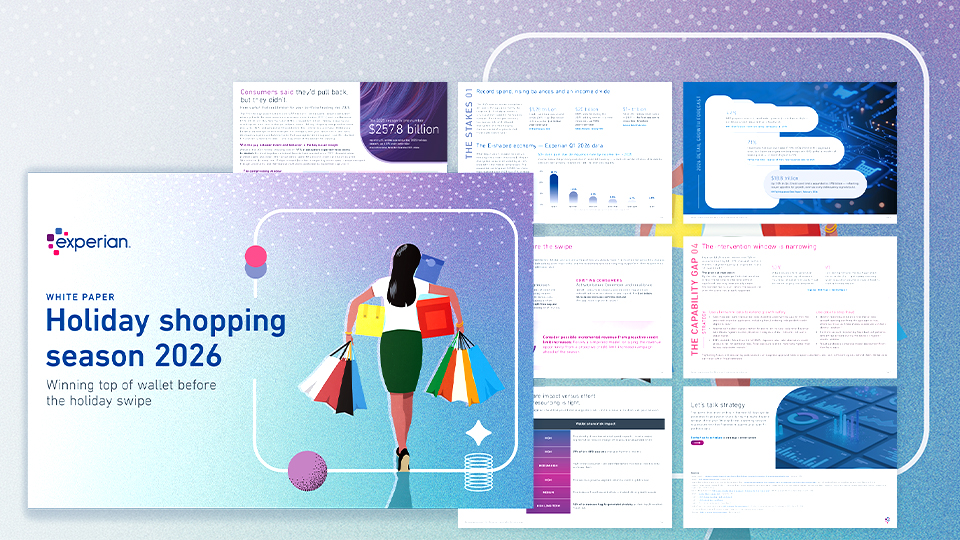
Every year, consumers say they'll spend less during the holidays. Every year, many do the opposite. Ahead of the 2025 holiday shopping season, 57% of consumers told Deloitte they expected the economy to weaken, the most pessimistic outlook recorded in the survey's history. Planned holiday spending was down 10%. Yet by the end of the season, online holiday sales reached a record $257.8 billion, up 6.8% year over year. Credit card balances climbed to $1.28 trillion, and Buy Now, Pay Later (BNPL) financing surpassed $20 billion during the holiday period. For lenders, the takeaway is to identify and engage the right consumers before the holidays were best equipped to capture that spending while effectively managing risk. As the 2026 holiday season approaches, Experian's latest market insights suggest that while credit performance appears relatively stable at the portfolio level, important shifts beneath the surface are changing how lenders should evaluate both opportunity and risk. Holiday shopping season 2026 Winning top of wallet before the holiday swipe Download the white paper now Holiday lending decisions happen long before the holidays It’s been observed that the holiday shopping season has expanded – beginning before Black Friday – over recent years. While Cyber Week continues to generate headlines, holiday spending is becoming more distributed throughout the quarter. For lenders, that means strategies must be in place before peak shopping begins. Credit line increases, portfolio reviews, acquisition strategies and risk segmentation completed in late summer often determine how much holiday spending an institution can safely capture. At the same time, early signs of credit deterioration are emerging faster than traditional portfolio metrics suggest reinforcing the importance of identifying emerging portfolio risk early rather than relying solely on broad portfolio performance indicators. Income is becoming a stronger predictor of credit performance One of the most notable shifts in today's lending environment is the growing relationship between income and future credit performance. Experian's data suggests the market is becoming increasingly polarized. The population earning more than $250,000 annually has more than doubled since 2023, but more than one-quarter of those consumers have since moved into lower income brackets, often following retirement or job loss. Meanwhile, consumers earning less than $50,000 annually show relatively little income mobility, with approximately 85% remaining in the same income band year-over-year. These trends highlight an important reality: a credit score alone may no longer provide a complete picture of borrower risk. Four priorities before peak holiday spending With only a short window before holiday borrowing accelerates, lenders have an opportunity to strengthen both growth and risk strategies. Key areas of focus include: Refine acquisition strategies Move beyond score-only targeting by incorporating verified income, cash flow and existing credit relationships to identify qualified borrowers. Optimize existing portfolios Identify customers demonstrating positive credit migration and proactively evaluate opportunities to increase credit lines before peak spending begins. Monitor emerging credit risks Use early-stage delinquency indicators and behavioral signals to identify potential performance issues before losses accelerate. Strengthen fraud management and prevention Seasonal account openings and increased transaction volumes create greater fraud exposure. Identity verification, synthetic identity detection and dormant account monitoring remain critical during high-volume acquisition periods. Preparing for the holiday shopping season ahead The 2025 holiday season demonstrated that consumer spending decisions don't always align with consumer sentiment. How does that translate for the 2026 shopping season? For lenders, success will depend less on reacting to spending trends in November and more on making informed credit decisions months earlier. As consumer financial behavior continues to evolve, combining traditional credit data with income, cash flow and alternative data can provide a more complete understanding of both opportunity and risk. Institutions that incorporate these broader insights into acquisition, portfolio management and fraud strategies will be better positioned to grow responsibly during one of the year's most active lending periods. Ready to learn more? Access the full white paper

Learn how e-commerce merchants can reduce card abandonment and increase conversions during the holiday shopping season.

Explore credit card marketing trends and strategies to help you identify, engage, and acquire the right customers.

Learn how Washington State Employees Credit Union increased their revenue and member satisfaction by implementing a digital prequalification process.

Experian Link helps businesses remove unnecessary friction from card-not-present transactions by authentication consumer identities.

As card issuers go head-to-head in the battle to reach and connect with new consumers, they must implement more inclusive lending strategies.

Rewards are among the most appealing features of any credit card. While upfront benefits, like sign-up bonuses and cashback, are most influential in card acquisition, ancillary benefits, like fraud and identity protection, can amplify a card’s overall value.1 Credit card fraud ranked as the second most common form of identity theft in 2021,2 and is expected to become even more frequent as consumers continue to bank and shop online.3 42% of consumers are concerned for the safety of their banking and shopping transactions. With digital identity theft and fraud on the rise, it’s no surprise that safety measures are “very” or “extremely” important to consumers when deciding between different credit cards.4 In response, many card issuers have started to market their security and protection-related benefits more frequently to better capitalize on their cards’ value to consumers. The ways they’ve highlighted these benefits include: A fraud protection campaign From spotlighting their fraud protection benefits in card welcome kits to providing privacy tips on social media, credit card issuers have crafted compelling campaigns to demonstrate their commitment to protecting their customers from fraud and identity theft. In turn, issuers can differentiate their cards from the competition and improve response rates. Reminders about their fraud prevention efforts Issuers have also sent out ongoing reminders outlining the protections their credit cards offer, such as credit monitoring services 5 that notify cardholders of suspicious activity on their credit report. By consistently promoting their efforts to keep their customers’ accounts and data safe, issuers can earn their cardholders’ trust, build loyalty and drive card usage. While benefits like cashback and travel points can help with card acquisition, fraud and identity protection benefits can help drive long-term customer relationships, especially now that card fraud is becoming a growing concern.6 To learn more about how businesses have worked to meet the consumer demand for secure interactions, check out our 2021 Global Identity and Fraud Report. Learn more 1Jonathan O'Connor. "Most Consumers Aren't Aware of Their Credit Cards' Ancillary Benefits. How Does This Impact Card Acquisition and Usage?" TSYS, January 2019 2FTC. "Consumer Sentinel Network" Data Book, 2021 3April Berthene. "Coronavirus pandemic adds $219 billion to US ecommerce sales in 2020-2021" Digital Commerce 360, March 2022 4"Consumers Consider as Many as Six Factors When Choosing Credit Card" PYMTS.com, December 2021 5David McMillin. "Identity theft is a major problem, but these 5 credit card protection programs can help keep you safe" Business Insider, June 2021 6"New FICO Survey Finds Overconfidence Could Put US Consumers at Risk From Scams" Business Wire, February 2022

With consumers having more banking options than ever before, loyalty has become the most valuable currency for financial institutions (FI). As fintechs and big tech companies continue to roll out innovative banking and payment options, traditional FIs must rethink their strategies to drive new business, retain existing customers and remain competitive. According to a recent Mintel report, rewards, transparency and customer service are the top three constants when it comes to building loyalty. Here’s how financial institutions can deliver on these fronts to create and maintain lasting customer relationships: Rewards programs and incentives Rewards have long been a key customer retention strategy, with 39% of consumers stating they would remain loyal to their financial service providers if they offered incentives and rewards. While traditional rewards programs that offer points or cash back on everyday purchases remain popular, many companies are expanding beyond the conventional rewards structure to attract new customers and stand out from the competition. For example, one California-based startup enables its cardholders to earn points at every winery, wine club or wine shop, while a health and wellness company rewards its cardholders with extra cash back when they meet their weekly fitness goals. To build and maintain customer loyalty, FIs can follow suit by incentivizing positive financial behavior, such as offering points to customers when their credit score increases or when they reach their monthly savings goal. Being rewarded for improving their financial health can encourage customers to continue making positive and responsible financial decisions. When customers see how much their financial institution invests in their financial well-being, they are more likely to remain loyal to the brand. Nurturing existing customers through rewards programs is also more cost-effective than acquiring new ones. Rewards program members spend 5-20% more than non-members on average, which not only covers operating costs but leads to increased sales and revenue. Transparency over fees Beyond rewards programs and incentives, many FIs have created innovative tools to help customers avoid overdraft fees, such as real-time alerts for low balances. To take it a step further, some have eliminated these fees altogether. While overdraft fees can be an easy source of revenue for financial institutions, they are a pain point for customers, especially for those who are financially vulnerable. Rather than continuing to be saddled with hefty penalties, customers are likely to switch to providers that are more upfront about their fees or have eliminated them outright. To avoid losing current and prospective customers to new competition, FIs need to be more transparent and work toward establishing fairer practices. Quick, friendly, and accessible customer service With today’s consumers having increased expectations for easy, convenient and accessible customer service, many FIs have refined their strategies by becoming digital-first. When customers have a question or concern, they can engage with financial institutions at any time through digital channels, including chat, email or social media. Being accessible at any hour of the day to assist their customers provides FIs with a great opportunity to build trust, loyalty and a positive reputation. By providing exceptional customer service, compelling rewards and being transparent, financial institutions have the power to create long-lasting customer relationships. Learn more about what you can do to retain your best customers or check out how to build lifetime loyalty with Gen Z. Learn more Build loyalty with Gen Z

The payments landscape is rapidly evolving, and as businesses set their strategic agendas for the new year, it’s important to analyze and adapt to changing consumer payment behaviors. Here are a few payment trends to look out for: Consumer sentiment remains low while inflation hits 39-year high According to the University of Michigan’s latest consumer sentiment survey, sentiment rose to 70.4 in December 2021 from 67.4 in November. While this was a slight improvement from the 10-year low logged in November, the figure was roughly in line with the average reading of the past four months (70.6). Additionally, consumer prices increased 6.8% over the past year, the highest in nearly 40 years. When asked whether inflation or unemployment was the more serious problem facing the nation, 76% of survey respondents selected inflation while 21% selected unemployment. Rising prices and the uncertainty surrounding the Delta and Omicron variants may cause consumers to remain pessimistic about their personal financial progress and delay large purchases. Payment preferences vary by age and purchase type According to a recent Mintel report, credit cards are the most preferred method of payment among U.S. adults. Despite the overall preference for credit cards, attitudes toward this payment option differ based on consumer age. Credit card preference skews strongly toward older consumers, with 46% of Baby Boomers opting to use credit cards for most of their purchases and 72% of the World War II generation preferring credit cards to any other payment type. Conversely, younger generations are turning to cash, debit cards and digital payment alternatives for most of their purchases. This difference can be explained by younger consumers’ fear of debt and lack of credit education. While older consumers may feel more comfortable and capable of paying off their credit card bill each month, most Gen Z consumers are not creditworthy enough to own a credit card or are afraid of falling behind on their monthly payments. Though Gen Z’s low ownership rate may seem concerning to credit card issuers, there’s an enormous opportunity for them to reach and engage this younger cohort. By educating younger consumers about their products and the importance of building credit, credit card issuers can build lasting customer relationships and maintain their standing in the payments hierarchy. Payment preferences also vary by purchase type. Consumers mostly use debit cards and credit cards for in-store purchases, while direct payments from bank accounts are used to pay off recurring bills. Despite these preferences for card and online payments, cash remains a popular secondary payment method across age demographics. Older consumers use cash to make small, personal transactions, while younger consumers are more likely to use cash or debit cards for large purchases. Digital payment popularity continues to soar From 2019 to 2020, peer-to-peer payment (P2P) services, like Venmo, Zelle and Cash App, saw usage increases of 2 to 3 percentage points. In 2021, that year-over-year increase jumped to 8, 9 and 7 percentage points respectively. This jump indicates that while consumers may have been reluctant to adjust their payment behaviors at the beginning of the pandemic, ongoing social distancing measures forced them to adapt to a new reality, leading to the widespread adoption of digital payment methods. As consumers continue to embrace P2P services, traditional payment powerhouses must pivot their strategies to capitalize on this trend and remain competitive in today’s payments landscape. To keep up with the latest consumer and economic trends, register for our upcoming Monthly Credit and Economic Trends webinar.

Direct mail isn’t outdated, antique or ineffective – it has evolved and adapted to meet the expectations of today’s consumers.

Performance reports are foundational and are one of the key elements of a sound and prudent risk management framework. Learn how effective reports evolve.

Inactive credit card accounts pose challenges to lenders. Discover potential reasons for inactivity and learn how to manage these accounts.

A high-level review of risk-adjusted yields across three common retail products offered by credit unions show that credit cards can be very profitable.

To maximize limited marketing spend, lenders will need to be more prescriptive to increase response rates on fewer delivered offers.

Shannon Lois, Experian’s Head of DA Analytics and Consulting and Bryan Collins, Senior Product Manager, tackled questions for lenders amidst COVID-19.