
Recession Ready: Pro-Cycle vs. Counter-Cycle vs. Cycle Neutral Economies

by Stefani Wendel 2 min read July 22, 2019

Recession ReadinessPreparation is key – whether you’re an amateur/professional sports, free-soloing up El Capitan, or business contingency planning as part of a recession readiness strategy.

It’s not so much predicting when events will occur, or trying to foresee and pivot for every possible outcome, but rather, acting now so that your business can act faster and smarter in the future.

There are certain priorities that have come to be associated with what are widely accepted as the three environments the economy can sustain at any one time:
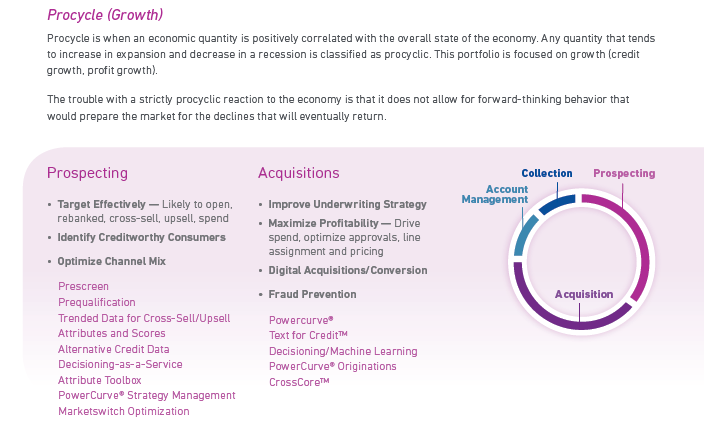
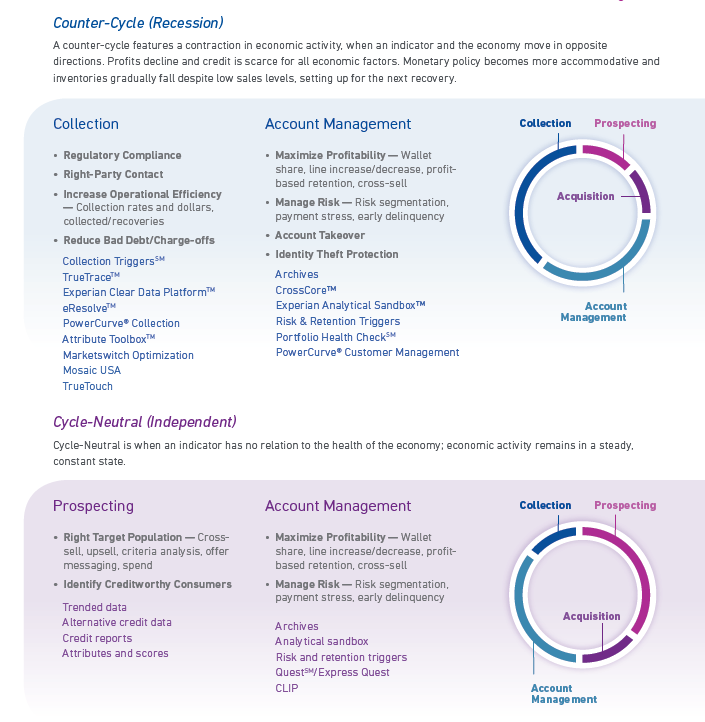
As with recessions throughout the country’s history, those periods have often been characterized by layoffs, charge-offs, delinquencies, and other behaviors as the economy turns to a counter-cycle environment. Rather than wait to implement reactive strategies , the time to manage accounts, plan, stress test and implement contingency plans for when the next economic correction comes, is now.

While economists and financial services industry experts argue over when a recession will hit and how severe its implications may be (in comparison with the Great Recession of 2008), there’s a  need to start tactical business discussions now.

Even in the face of a strong economy, that has seen high employment levels and increased spending, 45% of Americans (112.5 million) say they do not have enough savings to cover at least three months of living expenses, according to a 2018 survey by the Center for Financial Services Innovation.

Regardless of the economic environment – pro-cycle, counter-cycle, and cycle-neutral – those statistics paint an alarming picture of consumers’ financial health as a whole.

These are four crucial considerations you should be taking now:

  1. Create individualized treatments while reducing manual interactions
  2. Meet the growing expectation for digital consumer self-service
  3. Understand your customer to ensure fair treatment
  4. React quickly and effectively to market changes

While it may not be on the immediate horizon just yet, it’s important to prepare.

For more information, including portfolio mixes, collections considerations and macroeconomic trends, download our latest white paper on recession readiness.


Download white paper now

Related Posts

How Union Credit Expands Access to Credit Unions with Experian

Discover how Union Credit and Experian help credit unions reach younger consumers through personalized digital lending experiences.

Published: July 1, 2026 by Scarlet.Nickel@experian.com

Explore how Experian Verify™ and Mezzo’s Centro orchestration engine are helping mortgage lenders modernize income and employment verification, reduce workflow complexity, and make faster, more confident lending decisions at scale.

Published: July 1, 2026 by Lizel Ferrer
Used EV Growth Signals a New Phase of Consumer Purchasing Behavior

The electric vehicle (EV) revolution isn’t slowing down, it’s changing lanes. While recent conversations have seemingly focused on softening demand for new EVs, the used segment has been gaining momentum. According to Experian Automotive’s 2025 EV Year in Review Report, new retail individual EV registrations fell 35.9% year-over-year. Meanwhile, the used retail individual EV registrations grew 25.4% from a year ago. As affordability and growing model availability reshapes consumer behavior, buyers are increasingly turning to pre-owned EVs, which has shown an interesting market divergence that is redefining how consumers are adopting this segment and what it can mean for automakers, dealers, and the overall industry. Key players behind rising used EV demand Notably, Tesla accounted for over half (60.5%) of used retail individual EV registrations in 2025, followed by Chevrolet at 6.4% and Nissan (5.5%). Diving a bit deeper, Tesla made up the top three models of the used individual registrations last year, with the Model 3 coming in at 27.2%, Model Y at 21.7%, and Model S (6.6%). The Chevrolet Bolt EV followed at 4.8% and the Nissan Leaf was at 4%. Tesla’s position as the leading make in the used EV market is a natural extension of its long-standing dominance in new EV sales. The brand’s leadership over the years created a large fleet of vehicles that are now entering the pre-owned market. What the used EV boom means for automotive professionals The growing demand for used EVs can present more opportunities for automotive professionals. Dealers that provide a healthy supply of pre-owned EVs can increase accessibility and play a role in adoption for consumers who are actively looking to purchase, while marketers can emphasize value and ownership benefits. As the market continues to evolve, automotive professionals who understand and respond to these changing dynamics will be best positioned to capitalize on the expanding pool of used EV shoppers. To learn more about EV insights, visit Experian Automotive’s EV Resource Center.

Published: June 30, 2026 by Kirsten Von Busch