
New Vehicle Financing Returns to Pre-Pandemic Levels in Q2 2021

by Melinda Zabritski 2 min read August 31, 2021

Woman looking at red sports car

As we reflect on the challenges the pandemic forced on the automotive finance market, there is no doubt the industry remained resilient, all things considered. That’s not to say there weren’t some impacts, which become even more noticeable as we look at Q2 2021 data.

Because of the industry’s quick pivot to ensure forward momentum, we know the year was somewhat of an anomaly. One example was manufacturer incentives to bring people back into showrooms, which caused interest rates, loan terms and consumer preferences to shift significantly. Now, we see these things leveling out, so rather than comparing directly to an anomalous quarter, it’s helpful to compare to Q2 2019 to provide better context.

For example, the average new vehicle loan amount dropped year-over-year, which isn’t something we typically see. However, we know that last year, in Q2 2020 we saw consumers finance more full-size pickup trucks, likely due to strong incentives, which drove up the average loan amount.

In Q2 2021, the average new vehicle loan amount was $35,163, down from $36,121 in Q2 2020, and up from Q2 2019, when the average new vehicle loan amount was $32,345. We see a similar trend in average new vehicle loan terms, which was 69.36 months in Q2 2021, down from 71.31 in Q2 2020, but still up slightly from Q2 2019, when the average was 68.84 months.
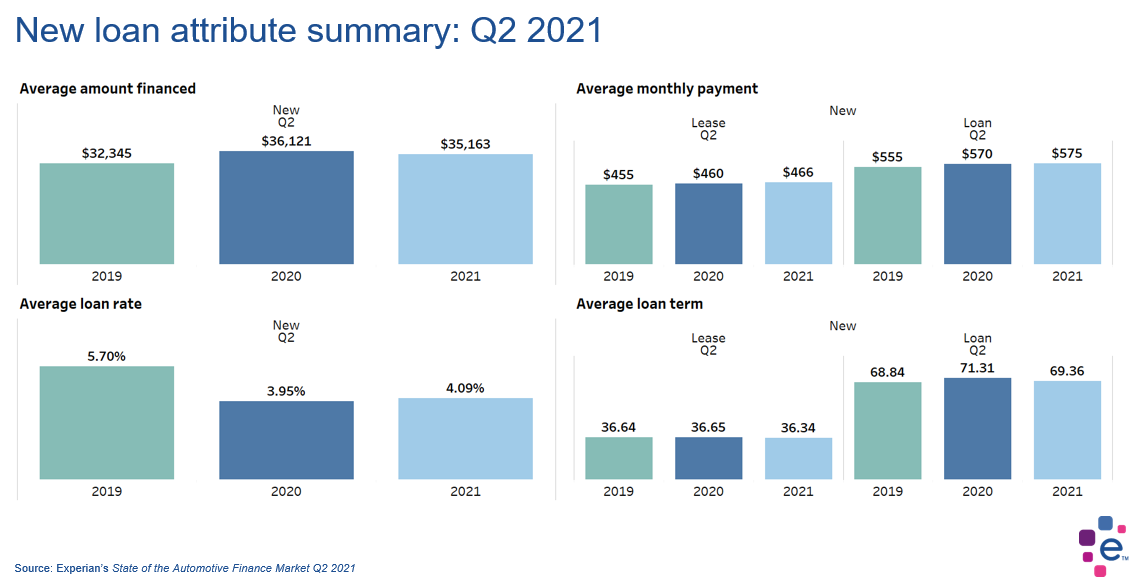
Chart shows the finance attributes of new vehicles financed

Average interest rate saw a significant drop last year as well, from Q2 2019 to Q2 2020, from 5.7% to 3.95% year-over-year. In Q2 2021, we see it come back up slightly, at 4.09%. Ultimately, the decrease in average term and increase in average loan rate drove average payments up slightly year-over-year, which clocked in at $575 in Q2 2021, up from $570 in Q2 2020 and $555 in Q2 2019.

Loan term distribution is another area we’re seeing return to a more normal range. In Q2 2020, as part of incentive packages, we saw a notable increase in the percentage of loans falling into the 73-84 month category, with these terms making up 33.77% of new vehicle loans, compared to 30.28% in Q2 2019. We saw this level back out, coming in at 31.72% of loans in Q2 2021.
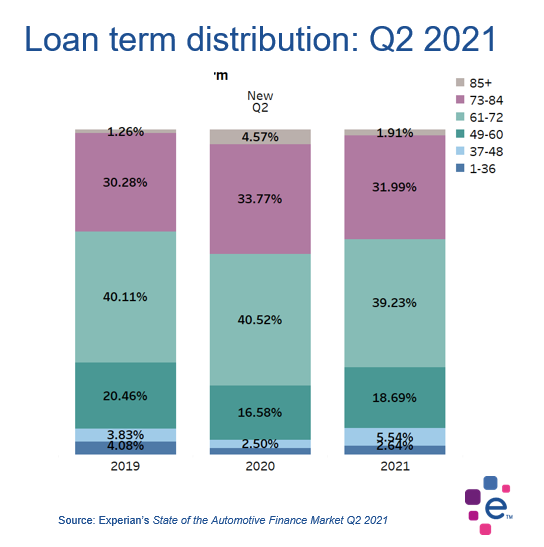
Chart shows the distribution of loan terms by credit band.

While the industry proved resilient at navigating last year’s challenges, it is encouraging to see things begin to level out to pre-pandemic levels. As we continue to manage current challenges, like the microchip shortage, understanding the full context of data will likely require comparisons that go beyond year-over-year for a more useful baseline of market performance.

To learn more, and see deeper comparisons to  2019, watch the full webinar: State of the Automotive Finance Market: Q2 2021.

Related Posts

How Union Credit Expands Access to Credit Unions with Experian

Discover how Union Credit and Experian help credit unions reach younger consumers through personalized digital lending experiences.

Published: July 1, 2026 by Scarlet.Nickel@experian.com
Faster Decisions, Better Outcomes: Experian Verify™ Now Available Through Centro, Mezzo’s Orchestration Engine 

Explore how Experian Verify™ and Mezzo’s Centro orchestration engine are helping mortgage lenders modernize income and employment verification, reduce workflow complexity, and make faster, more confident lending decisions at scale.

Published: July 1, 2026 by Lizel Ferrer
Used EV Growth Signals a New Phase of Consumer Purchasing Behavior

The electric vehicle (EV) revolution isn’t slowing down, it’s changing lanes. While recent conversations have seemingly focused on softening demand for new EVs, the used segment has been gaining momentum. According to Experian Automotive’s 2025 EV Year in Review Report, new retail individual EV registrations fell 35.9% year-over-year. Meanwhile, the used retail individual EV registrations grew 25.4% from a year ago. As affordability and growing model availability reshapes consumer behavior, buyers are increasingly turning to pre-owned EVs, which has shown an interesting market divergence that is redefining how consumers are adopting this segment and what it can mean for automakers, dealers, and the overall industry. Key players behind rising used EV demand Notably, Tesla accounted for over half (60.5%) of used retail individual EV registrations in 2025, followed by Chevrolet at 6.4% and Nissan (5.5%). Diving a bit deeper, Tesla made up the top three models of the used individual registrations last year, with the Model 3 coming in at 27.2%, Model Y at 21.7%, and Model S (6.6%). The Chevrolet Bolt EV followed at 4.8% and the Nissan Leaf was at 4%. Tesla’s position as the leading make in the used EV market is a natural extension of its long-standing dominance in new EV sales. The brand’s leadership over the years created a large fleet of vehicles that are now entering the pre-owned market. What the used EV boom means for automotive professionals The growing demand for used EVs can present more opportunities for automotive professionals. Dealers that provide a healthy supply of pre-owned EVs can increase accessibility and play a role in adoption for consumers who are actively looking to purchase, while marketers can emphasize value and ownership benefits. As the market continues to evolve, automotive professionals who understand and respond to these changing dynamics will be best positioned to capitalize on the expanding pool of used EV shoppers. To learn more about EV insights, visit Experian Automotive’s EV Resource Center.

Published: June 30, 2026 by Kirsten Von Busch

Subscribe to our Auto blog

Enter your name and email for the latest updates.

This site is protected by reCAPTCHA and the Google Privacy Policy and Terms of Service apply.