
Five Best Practices For Getting The Most Out Of Your Vehicle History Reporting Service

by Kirsten Von Busch 4 min read June 20, 2018

When it comes to vehicle history reporting, there are many offerings on the table. Some are better known than others, but only one comes from the global leader in data-driven solutions. AutoCheck® vehicle history reports are backed by Experian Information Solutions and have many key features that competitors don’t have.

You and your customers can make more confident decisions knowing that the vehicle’s history is backed by data from Experian. Selling is made easier by providing greater transparency which strengthens consumer confidence in your inventory and brand to sell more cars. Below, we will help you better understand the value of AutoCheck throughout your dealership and take you through the five best practices for using AutoCheck.

AutoCheck Best Practice #1: Integrate AutoCheck in all your dealership’s applications and websites.

The good thing about AutoCheck is the ease of integration within a dealership’s applications and websites. AutoCheck works with hundreds of software providers, meaning it is highly flexible with whatever your dealership is using. It doesn’t matter if the user is a buyer, manager, technician, or any other role at a dealership. There are no additional costs for multiple users since there is an unlimited number of users for a dealership. If a dealership works with someone that AutoCheck doesn’t already work with, Experian will still set the dealership up and work with them to make sure they have a seamless integration.

AutoCheck Best Practice #2: Run an AutoCheck on every vehicle acquisition.

Since AutoCheck is a vehicle history reporting software, it can uncover unknown history that could pass off to a dealer or a consumer. AutoCheck checks for multiple owners, title brands, open recalls, previous auction announcements, prior vehicle uses, odometer fraud, accidents and so much more! The reason why this is so important comes down to the number of vehicles in operation. Per NADA Data, there were over 264 million cars and light-duty trucks in operation in the United States in 20161. If approximately 20% of the cars and light-duty trucks on the road have been in an accident, that is over 50 million vehicles currently on the road that have been in an accident².  The average diminished value of a vehicle in an accident is $3,0193. Finding only one accident per month you did not know about justifies and pays for the cost of an AutoCheck subscription.

AutoCheck Best Practice #3: Promote your inventory with AutoCheck.

AutoCheck can also be used to directly promote a dealer’s inventory. All a dealer does is integrate AutoCheck with their dealership’s website. An AutoCheck link is automatically added to every vehicle. There is no additional charge which provides savings to both the dealer and the consumer. The most current data is provided with every click to give feedback to dealers. AutoCheck is the only vehicle history provider on all the top online shopping sites. Consumers can look for AutoCheck on Autotrader℠, Cars.com™, CarGurus®, ebay™ Motors, Edmunds®, and Kelly Blue Book®.

AutoCheck Best Practice #4: Build confidence in every sale with AutoCheck.
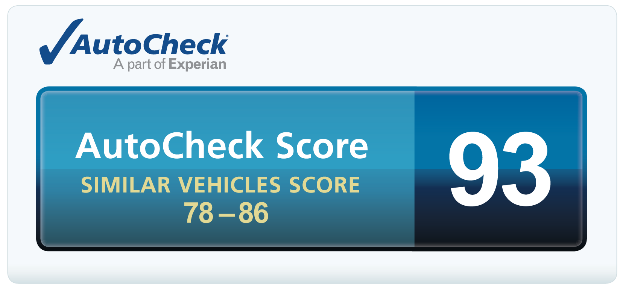
The patented AutoCheck Score is a numerical rating summarizing the events about the vehicle. This helps dealers and consumers to compare vehicles of similar class and age based on a scale of 1 to 100. It also predicts the likelihood the car will be on the road in 5 years. The Score helps to understand a vehicle’s reliability as it pertains to the vehicle’s age, number of owners and accidents. When comparing two vehicles, it is also important to look at the Similar Vehicles Score. Even though a vehicle may have a score of 89 compared to a similar vehicle which scored an 85, the first vehicle may have a score range of 91-96. This would mean the vehicle that scored an 89 is lower than the average. The AutoCheck Score is based on many variables including age, vehicle class, mileage, number of owners, and vehicle use and event.

Along with the AutoCheck Score, the BuyBack Protection program from AutoCheck will help build confidence. Experian will buy back a vehicle if the AutoCheck report fails to list certain brands available to Experian at the time the report was issued. This program is up to 110% of NADA Guides retail value, plus up to $500 in aftermarket accessories. Registered and qualified vehicles have this protection available at no cost and will have a badge on their report.

AutoCheck Best Practice #5: Promote your service department by providing service data.

The final aspect and best practice focuses on the service department and service data. Dealers can display services they have performed within AutoCheck. With AutoCheck, dealers and consumers can see that a vehicle has been well maintained with reported service data. Reporting service data provides an easy to understand format for customers and builds confidence for shoppers. All-in-all, AutoCheck can be used in every department successfully.

To recap, these are the five best practices for AutoCheck. Integrate AutoCheck in all your dealership’s applications and websites. Run an AutoCheck on every vehicle. Promote your inventory with AutoCheck. Build consumer confidence in every sale with AutoCheck. Promote your service department and display service records on AutoCheck.

¹Source: NADA DATA, Annual General Overview 2016, page 3. https://www.nada.org/2016NADAdataHighlights/  

²Source: Experian Analysis, more than 18 % of cars and light duty trucks in operation have been in an accident.

3Source: Mitchell Industry Trends Report, Q1 2017, page 32 http://www.mitchell.com/Portals/0/Assets/industry-trends/itr-vol-17-no-1-winter-2017-apd.pdf


Related Posts

Ask the Expert: A closer look at financial inclusion with Corliss Hill and Dr. Vaneesha Dutra

Consumer visibility is changing Roughly 45 million Americans, or 1 in 5 consumers, are considered credit invisible or unscoreable.[1] They’re working, paying bills and participating in the economy, yet many are not fully visible during the lending process. That creates both a visibility challenge and a growth opportunity for lenders. In this Ask the Expert session, Corliss Hill, Senior Director, Inclusion and Belonging at Experian, joins Dr. Vaneesha Dutra, Endowed Professor of Finance at Morehouse College, to discuss how evolving consumer behaviors are reshaping conversations around financial inclusion and lending decisions. For lenders, visibility matters because confident decisions depend on reliable context and insight. Broader consumer signals can help institutions better understand repayment behaviors, financial stability and consumer capacity. “The benefit of banks using alternative data is that they capture a very significant and new consumer base. That's 20% of the population, 45 million Americans.”Dr. Vaneesha Dutra, Endowed Professor of Finance A more complete understanding of today’s consumers Today’s consumers often manage obligations across a wide range of payment types and financial channels, creating additional signals through cash flow activity, recurring payments and consumer-permissioned financial data. Rent, utilities, subscriptions and mobile phone payments can all provide meaningful insight into how consumers manage their financial lives. What’s changing isn’t the need for risk assessment. It’s the amount of consumer behavior lenders can now evaluate. For example, a consumer experiencing temporary financial disruption may fall behind on certain obligations while continuing to consistently pay rent, utilities and phone bills. Those recurring payment behaviors can provide important context into financial priorities and stability. “These are consumers that pay rent on time every month, pay utilities every month on time and meet many other financial obligations in a timely manner.”Dr. Vaneesha Dutra, Endowed Professor of Finance From visibility to more-informed decisioning Broader consumer insights may help lenders move from limited visibility to more informed decisioning. The conversation shifts when lenders move from asking: “Should we take a risk on this consumer?” to: “Do we have enough information to fully understand this consumer?” That broader context can help institutions: Strengthen risk assessment. Identify financially active consumers with strong repayment behaviors. Support more informed lending strategies. Alternative data isn’t about replacing established credit approaches. It’s about helping lenders build on trusted credit foundations with additional context and insight. Responsible lending starts with better context For lenders, the path forward is practical and actionable. As lenders evaluate broader consumer behaviors, three priorities become increasingly important: Modernize data strategies Incorporate broader consumer signals alongside existing credit data to create a more holistic view of repayment behavior and financial stability. Engage consumers earlier Earlier intervention may help lenders better support consumers before financial challenges become more severe. Create pathways to financial access Smaller lending opportunities can help consumers establish stronger financial profiles and demonstrate positive repayment behaviors over time. The institutions that lead will be the ones that can combine strong risk practices with a broader understanding of consumer behavior. Whitepaper: Bridging the credit divide: income, risk and inclusion in consumer finance Building on the themes discussed in this Ask the Expert session, Dr. Dutra explores how demographic shifts, evolving borrower behaviors and broader consumer visibility are reshaping lending strategies and what they mean for lenders seeking to balance growth, risk management and financial inclusion. Download whitepaper Explore alternative data with Experian Experian can help lenders combine broader consumer insights with trusted credit data to strengthen decisioning, improve risk assessment and support more-informed lending strategies. With solutions spanning identity, cash flow and advanced analytics, lenders can gain a more complete view of consumer behavior and expand access to credit with greater confidence. Learn more Watch episode 1 About our experts Corliss Hill Senior Director, Belonging Business Partner, Experian Corliss Hill is a collaborative leader well-versed in working with executive stakeholders, crossfunctional teams, external partners and community organizations to design and deliver initiatives and programs that create sustainable impact. With over 25 years of extensive experience in multicultural marketing, communications, PR and inclusion and belonging initiatives, she is dedicated to advancing equitable access to financial. Her mission is to drive impactful marketing initiatives that foster meaningful change and address systemic barriers to inclusion and the communities they serve.Hill has been a part of the Experian family since 2021, and resides in Atlanta with her daughter who is a rising 11-year-old entrepreneur. Vaneesha Dutra, Ph.D. Endowed Professor of Finance and Associate Dean, Morehouse College Vaneesha Dutra, Ph.D., serves as Associate Dean in the Division of Business and Economics. With more than 20 years of experience spanning higher education, banking and real estate, Dr. Dutra’s work focuses on the racial and gender wealth gap, financial literacy and financial decision-making. She is an active researcher and consultant whose work has earned numerous grants and fellowships, including serving as the inaugural Tracy A. Pruitt Visiting Research Faculty Fellow at the Wharton School of Business. Dr. Dutra has also been named a Research Faculty Fellow for both the Center for Black Entrepreneurship and the PNC Bank Center for Entrepreneurship. [1] Consumer Financial Protection Bureau, Expanding access to credit.

Published: July 13, 2026 by Julie.JLee@experian.com
The American Fintech Council on Responsible Innovation

Ian P. Moloney of the American Fintech Council discusses responsible fintech innovation and Experian’s role in expanding credit access.

Published: July 8, 2026 by Scarlet.Nickel@experian.com
Electric Vehicle Registrations Are Growing Beyond Traditional Locations

For years, most electric vehicle (EV) adoption has been concentrated in California, New York, and other traditional early-adopter markets. And while those markets still lead the nation in total registrations, as of last year, some of the fastest-growing EV markets are in regions that haven’t played a significant role in the past. According to Experian Automotive’s 2025 EV Year in Review Report, EV adoptions seem to be entering a new phase that is spreading well beyond coastal strongholds. In fact, the top designated market areas (DMAs) that saw the fastest year-over-year growth for new retail individual EV registrations in the last five years were Detroit, MI (34.5%), Naples, FL (32.6%), Atlanta, GA (20.6%), Buffalo, NY (18.7%), and Charlotte, NC (17.3%). However, despite the growing demand in these market areas over the last few years, Los Angeles, CA still holds a strong lead in new retail individual EV registrations, with over 164,000 new adopters in 2025. Rounding out the top five were San Francisco, CA (85,000+), New York, NY (78,000+), Miami, FL (45,000+), and Seattle, WA (35,000+). EV adoption expanding well beyond the early-adopter markets could be a result of charging infrastructure growth, vehicle availability improvement, and consumer interest reaching new levels across the country. What does this mean for dealers? The extension of EV adoption into emerging markets signals that these vehicles are becoming a mainstream consideration for more consumers. As dealers look for ways to grow their presence in this segment, adopting marketing strategies, service operations, and inventory planning will be beneficial to meet changing buyer expectations and capitalize on the growing demand. The biggest takeaway isn’t necessarily which markets are selling the most EVs, it’s seemingly where adoption is gaining momentum. As new regions start to embrace these vehicles, it’ll be important to monitor the next phase of growth and where future opportunities may emerge. To learn more about EV insights, visit Experian Automotive’s EV Resource Center.

Published: July 7, 2026 by Kirsten Von Busch

Subscribe to our Auto blog

Enter your name and email for the latest updates.

This site is protected by reCAPTCHA and the Google Privacy Policy and Terms of Service apply.
