State of Credit 2021: Rise in Scores Despite Pandemic Challenges

by Stefani Wendel 5 min read September 7, 2021

Despite an unprecedented 18 months since the pandemic was in full force and many Americans were sent home, financial wellness continues to be on the up and up. Consumers continue to manage credit well and the average credit score climbed seven points since 2020 to 695, the highest point in more than 13 years.

In Experian’s 12th annual State of Credit report, the headlines are hopeful regarding how Americans are managing personal finances in the face of the pandemic. The report provides a comprehensive look at the credit performance of consumers across America by highlighting consumer credit scores and borrowing behaviors. This year’s report features data from 2019 pre-pandemic, the 2020 pandemic year, and the start of 2021.

“The findings from this year’s report show something I’ve always believed: Americans are resilient, for the most part they make smart decisions in the face of adversity and they are agile in adjusting their financial habits when the environment or circumstances change,” said Alex Lintner, President, Experian Consumer Information Services.

Highlights of Experian’s State of Credit report:

2021 State of Credit Report 2019 2020 2021
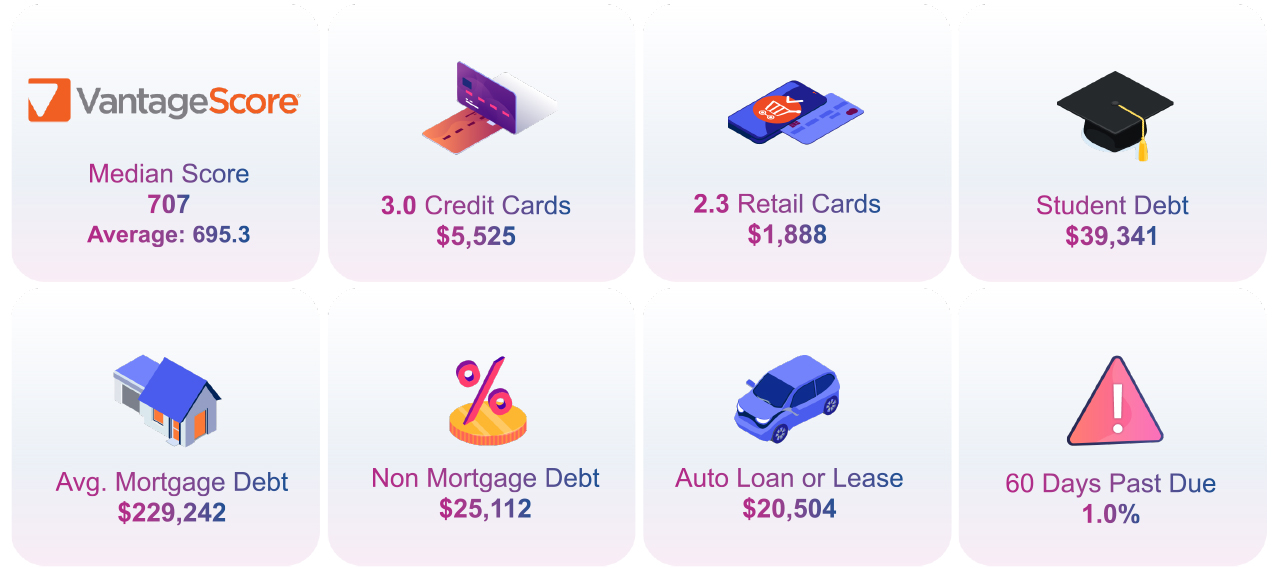
Average VantageScore® credit score [1] 682 688 695
Median VantageScore® credit score 687 697 707
Average number of credit cards 3.0 3.0 3.0
Average credit card balance $6,494 $5,897 $5,525
Average revolving utilization rate 30% 26% 25%
Average number of retail credit cards 2.50 2.42 2.33
Average retail credit card balance $1,930 $2,044 $1,887
Average nonmortgage debt $25,057 $25,483 $25,112
Average mortgage debt $210,263 $215,655 $229,242
Average auto loan or lease $19,034 $19,462 $20,505
Average 30–59 days past due delinquency rates 3.8% 2.4% 2.3%
Average 60–89 days past due delinquency rates 1.9% 1.3% 1.0%
Average 90–180 days past due delinquency rates 6.6% 3.8% 2.5%

We asked Joseph Mayans, Principal Economist at Advantage Economics, LLC, for his reactions to the findings:

“The State of Credit Report captures the three central themes of the pandemic. First, it shows the overwhelming success of the fiscal support packages. By far, the most striking example of this is the broad based and significant decline in delinquencies during a time when millions of people were out of work. Second, the report showcases the resiliency of American households. People used their stimulus dollars to stay on top of their bills and pay down debt, which boosted average credit scores across all generations. And third, it highlights the unique behavioral shifts brought on by the pandemic. We can see these changes in the rise of housing and auto debt as people bought larger homes and sought to drive rather than ride public transportation.”
Generational Trends

As indicated in the findings, consumers across all generations except Gen Z saw decreased utilization rates and decreased credit card balances year over year. Consumers are also missing fewer payments with notable improvements seen among the youngest consumers.

Mortgage debt was up across every generation, which may correlate with the record low interest rates on mortgages, refinances and moves. According to the CBRE, “the pandemic accelerated several long-standing American migration patterns” as evidenced by more than 15.9 million people filing change-of-address requests with the United States Postal Service. Compared with 2019, 2020 change-of-address requests show a 4% increase in total movers, 2% increase in permanent movers and 27% increase in temporary movers, according to a study by MyMove.

Mayans also made note of the mortgage trends.

“It’s becoming clearer that millennials are stepping into the homebuying phase in a big way. Once thought to be the generation of apartments and urban revival, many older millennials are now buying homes and moving to the suburbs much like their parents before them,” Mayans said. “This will have significant implications for the post-pandemic world, especially as work from home becomes more prevalent.”

State Trends

The states with the highest and lowest average credit score remained unchanged from last year with the highest average score of 726 held by Minnesota and an average score of 666 held by Mississippi.

New Jersey had the highest number of credit cards and retail cards at 3.37 and 2.54 respectively, and Alaska had the highest credit card debt at $7,089 (U.S. average is $5,525) and Texas had the highest retail debt at $2,248 (U.S. average is $1,888).

What Lies Ahead

Some have argued that the past year of the pandemic and quarantine forced a lot of time for reflection. The continued positive trends of consumer behavior seem to indicate some of that effort was put toward better financial health practices. That said, like any sourdough bread recipe or DIY home glow-up, there’s always more to learn and opportunities to seize when it comes to financial health.

“We are committed to working with lenders and the industry to help consumers gain access to credit, driving broader financial inclusion, while also teaching consumers how to responsibly build and use credit responsibly,” Lintner said.

In addition to the free weekly credit report at AnnualCreditReport.com, Experian also offers consumers free access to their credit report and ongoing credit monitoring at Experian.com.

Additional credit education resources and tools

  • Join Experian’s #creditchat hosted by @Experian on Twitter with financial experts every Wednesday at 3 p.m. Eastern time. Bilingual and Spanish speakers are also invited to join Experian’s monthly #ChatdeCredito hosted on Twitter at 3 p.m. Eastern time beginning September 16.
  • Visit the Ask Experian blog for answers to common questions, advice and education about credit.
  • Add positive telecom, utility and streaming service payments to your Experian credit report for an opportunity to improve your credit scores by visiting experian.com/boost[2]
  • For additional resources, visit https://www.experian.com/consumereducation

To see all the findings, download the 2021 State of Credit Report.

Download the full report

[1] VantageScore® is a registered trademark of VantageScore Solutions, LLC. VantageScore® credit score range is 300 to 850.

[2] Results may vary. See Experian.com for details

Related Posts

From Hybrids to Refinancing: Consumers are Finding New Roads to Vehicle Affordability

For today’s automotive consumers, considering a vehicle purchase isn’t just about the price they see on the window, it’s about finding the right combination of their vehicle preference and monthly payment. In fact, data from Experian Automotive’s State of the Automotive Finance Market Report: Q2 2026 highlighted how affordability continues to shape the automotive finance market. For instance, hybrids offered the lowest average new vehicle loan payment across all fuel types, coming in at $646 in Q2 2026, compared to electric vehicles (EVs) at $692, and gasoline-powered vehicles at $721. This led to considerable growth in new vehicle market share for hybrids this quarter, accounting for 16.80%, from 12.99% last year. While the automotive market continues to offer consumers an expanding mix of fuel types, the combination of growing hybrid share and comparatively lower monthly payments is something worth watching. Affordability isn’t just about what consumers drive, it’s how they finance it While hybrid vehicles are continuing to pave their way in the vehicle market, consumers who already have an auto loan are finding greater savings through refinancing. In the second quarter of 2026, automotive refinancing reached approximately 140,000 loans. More notably, the financial benefit associated with refinancing has grown. Consumers who refinanced this quarter reduced their average interest rate by more than 2.4%, with the average rate moving from 10.40% on the original loan to 7.97% on the refinanced loan. Those rate reductions translated into meaningful monthly savings, especially when refinancing through particular lenders. In Q2 2026, refinancing saved consumers an average of $83 per month, compared to an average monthly savings of $64 this time last year. However, credit unions delivered the largest average payment difference among lender types at $102 this quarter, followed by banks ($65), and finance companies ($38). It’s important for automotive professionals to acknowledge that affordability is not a single moment in the vehicle journey. It can influence the vehicle a consumer chooses, the financing they opt for during that transaction, and the decisions they make years after driving off the lot. Understanding and leveraging those different moments can help professionals identify opportunities to better serve consumers throughout the vehicle ownership lifecycle. To learn more about automotive finance trends, view the full State of the Automotive Finance Market Report: Q2 2026 presentation on demand.

August 27, 2026 by Melinda Zabritski
AI Agent Identity Verification: How to Verify AI Agents in Digital Transactions

AI agents are changing the way consumers interact with businesses online. Learn how you can establish greater confidence in AI transactions.

August 26, 2026 by Laura Burrows
Ask the Expert: Turning Insight into Advantage with Michelle Goeppner and David Elmore

What if some of your best potential borrowers are the ones your traditional credit strategy can't fully see? A credit score can tell lenders a lot about a consumer, but it doesn't always capture the full picture of how someone is managing their financial life. For consumers with nontraditional income patterns or limited credit histories, that incomplete view can mean missed opportunities. In this Ask the Expert session, David Elmore of Experian talks with Michelle Goeppner, Chief Lending Officer at Vantage West Credit Union, about how alternative data can provide additional context around consumer risk, uncover opportunities traditional data alone might miss and help lenders expand their reach without disrupting strategies that already work. Who could lenders be missing? That question is especially important when a consumer’s financial life doesn’t fit neatly into a traditional credit profile. Take gig workers. Someone driving for Uber or delivering for DoorDash likely has a different income pattern than a salaried employee — irregular, seasonal, spread across platforms. That doesn't mean they aren't reliably managing bills, rent and other obligations. It just means a traditional file may not show it. Goeppner has a name for the risk of overlooking that context: FOMM — Fear of Missing Members. You've heard of FOMO — Fear of Missing Out. I think about it as FOMM — Fear of Missing Members. Who are we leaving behind if we're not using it?Michelle Goeppner, Chief Lending Officer For credit unions especially, that's not just a data question — it's a mission question. A partial view of a member's finances can mean missing a member the institution exists to serve. The credit score alone doesn't tell you where someone's headed Traditional credit data is still  foundational to lending decisions. But alternative data — income, cash flow, payment behavior — adds a layer that a credit score alone can't provide. Goeppner illustrates the distinction with two consumers who have exactly the same credit score: I don't know if you're a 640 score on your way to 720 — or are you a 640 headed southwards to 580? It doesn't show me how you're managing your day-to-day financial lifeMichelle Goeppner, Chief Lending Officer Two borrowers can share the same score and be moving in opposite directions. Alternative data helps lenders tell the difference — and put that score in context rather than treating it as the whole story. Start small and layer it in Adopting alternative data doesn't mean overhauling an existing strategy. As Goeppner puts it, it's additive, not a replacement: It's not a rip and replace. You don't have to let go of your existing playbook. It's additive — you layer it in.Michelle Goeppner, Chief Lending Officer Her advice for getting started: Define the problem first. Are you trying to increase approvals, reach more underserved borrowers, or improve decisioning for a specific product? Test before you scale. Revisit loans you've already booked and ask whether alternative data would have changed the outcome — or pilot it on a single product before rolling it out further. Build in governance from day one. Document what changed, where the new data was used, and what results followed. As Goeppner puts it: “Crawl, walk, run. Slow and grow.” More loans without changing the risk profile For Vantage West, the value of that approach has shown up in its lending results. It has been an absolute game changer for us at Vantage West. We have been able to make more loans to our target members, our target segments, without changes to our risk profile.Michelle Goeppner, Chief Lending Officer That distinction matters. The goal isn't approving more loans for its own sake — it's having enough information to recognize good borrowers that traditional data alone would have missed. The result is a fuller picture of the people behind the credit file, and more confidence in deciding who a lender can serve. Explore alternative data with us Alternative data can help lenders add context to traditional credit information for a more complete view of consumers. Experian works with institutions of all sizes to incorporate additional consumer signals into existing lending strategies — strengthening decisioning, managing risk and identifying new opportunities for growth. Learn more Contact us About our experts Michelle Goeppner Chief Lending Officer, Vantage West Credit Union Michelle Goeppner is a dynamic financial services executive with over two decades of experience driving strategic growth, product innovation, and operational excellence across leading credit unions and financial institutions. Currently serving as the Chief Lending Officer at Vantage West Credit Union, Michelle leads the strategic vision for multi-billion-dollar consumer loan and deposit portfolios, as a member of the Executive Coalition. Her expertise spans consumer lending, product management, integrated marketing, and talent development, with a proven track record of leveraging fintech partnerships, automation, and data-driven strategies to optimize portfolio performance and member engagement. Throughout her career, Michelle has held pivotal leadership roles in organizations such as Alliant Credit Union and Discover Financial Services. She is recognized for her collaborative approach, detail-oriented execution, and commitment to developing future female leaders. Michelle’s contributions include founding Alliant’s Women’s Resource Group, serving on advisory councils and boards, and earning multiple industry awards for excellence and innovation. She holds an Executive Certification in Product Management from UC Berkeley, a Master of Science in Integrated Marketing Communications from Roosevelt University, and a Bachelor of Science in Marketing from Northern Illinois University. David Elmore Vice President of Fintech Sales, Experian David Elmore leads a team of fintech sales professionals at Experian focused on helping fintech organizations drive responsible, scalable growth through data-driven analytics and decisioning. With more than 20 years in financial services — a decade of it focused on fintech — he brings deep expertise in applying traditional and alternative data across the customer lifecycle. David and his team partner with fintech leaders to navigate opportunities across acquisition, underwriting, portfolio management, and collections, balancing innovation, risk, and trust.

August 26, 2026 by Julie Lee

Subscribe to our Newsletter

Enter your name and email for the latest updates.

This site is protected by reCAPTCHA and the Google Privacy Policy and Terms of Service apply.

Subscribe to our Newsletter

Don't miss out on the latest industry trends and insights!
Subscribe