




At Experian, we are continually innovating and using technology to find solutions to global issues, modernize the financial services industry and increase financial access for all.

Our deep commitment to social and financial inclusion is reflected in our workplace culture, our partnerships and our efforts to break down the barriers to financial equity.

Our initiatives are dedicated to getting tools, resources and information to underserved communities so that consumers can best understand and improve their financial health.

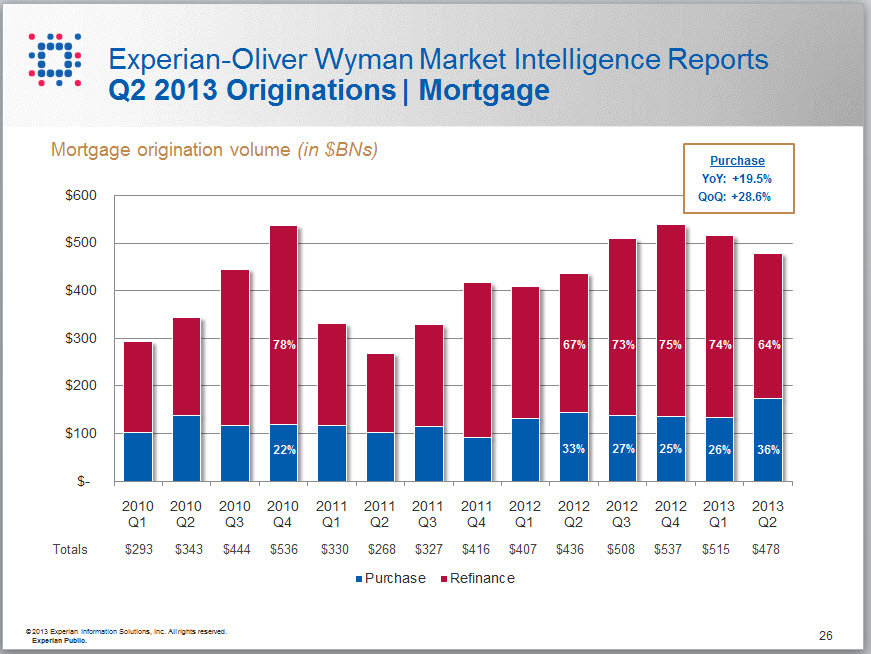
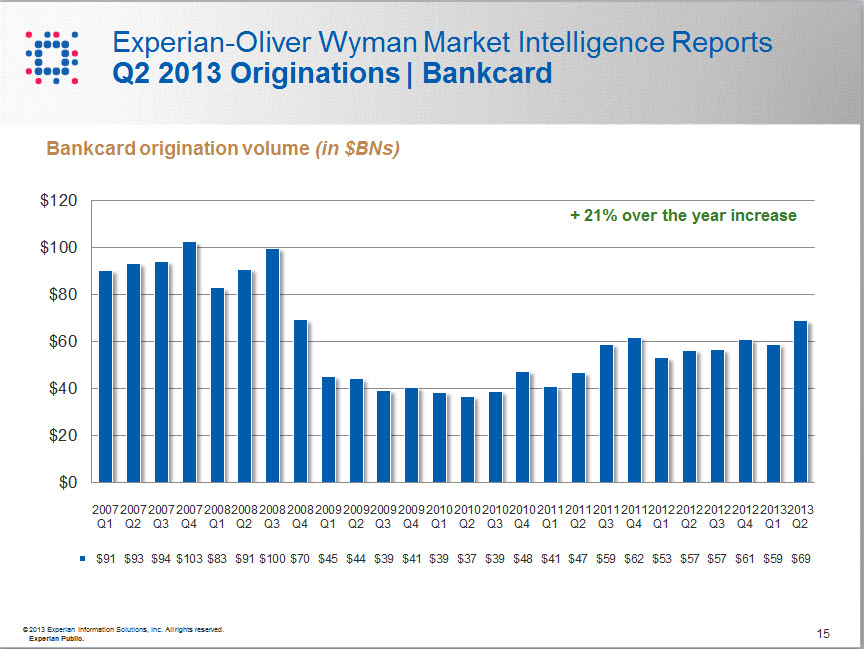
Further evidence of economic recovery throughout the nation, an Experian trends analysis of new mortgages and bankcards from Q1 2013 showed a 16 percent year-over-year increase in mortgage origination volume and a 20 percent increase in bankcard limits. Other insights offered by Experian, include evidence of a strong rebound in the Midwest as well as unprecedented lows in bankcard delinquencies. Mortgage trends Mortgage origination volume saw a 16 percent increase over the same quarter a year ago. This upward trend in volumes over the past eight quarters points to a consistently improving housing market. Average home prices increased slightly from 2011. California continues to lead the way, with an average home price of $325,000. The South Central region increased to $169,000, surpassing the Midwest, which came in at $163,000. However, regional share of originated mortgage dollars showed strong activity in the Midwest as the new year began, with the Midwest rebounding by growing 27 percent year over year to $101 billion. For the first time in two years, the region surpassed California, which grew by 6 percent to $92 billion. Mortgage delinquency rates also continued to improve, reaching multiyear lows. There was a slight increase in late-stage 90- to 180-day delinquency that may be the result of continued stress in some specific housing markets. Bankcard trends Bankcard lending continues to slowly build every quarter, reaching a 20 percent year-over-year increase in total origination volume limits extended into the market during Q1 2013, which is up about $11 billion. According to the analysis Experian is seeing increased bankcard lending taking place in the prime and super-prime space. Significant year-over-year growth rates occurred within the near-prime segment, which saw a 42 percent increase, while the prime space grew 30 percent. Bankcard performance is also near record lows for each of the delinquency periods. Experian saw a slight seasonal uptick in charge-offs from 3.9 percent to 4.3 percent, but other than that, it was another very strong quarter for payment performance. The 30 to 59 days past due (DPD) went to 0.94 percent — six basis points lower than the previous quarter. Also, the 60 to 89 DPD went to 0.59 percent from 0.65 percent, and the 90 to 180 DPD was flat at 1.56 percent. In looking at the 30-plus-day delinquency rate by state for the quarter, Experian saw North Dakota lead the best-performing states, with the lowest rate of 1.94 percent. This was followed by Alaska at 2.23 percent, Wyoming at 2.34 percent, South Dakota at 2.41 percent and Iowa at 2.42 percent. The states that did not perform well for the quarter were Nevada at 3.81 percent, Arizona at 3.79 percent, Florida at 3.71 percent, Mississippi at 3.51 percent and Alabama at 3.40 percent. This information shows that the spread between the highest- and lowest-performing states for bankcards is continuing to close. The data for this insight and analysis was provided by Experian’s IntelliViewSM product. IntelliView data is sourced from the information that supports the Experian–Oliver Wyman Market Intelligence Reports and is easily accessed through an intuitive, online graphical user interface, which enables financial professionals to extract key findings from the data and integrate them into their business strategies. This unique data asset does this by delivering market intelligence on consumer credit behavior within specific lending categories and geographic regions.

Experian has provided World Omni Financial Corp. (World Omni) with a flexible decision management solution based on its PowerCurve™ and Attribute Toolbox™ software that will streamline the processing and decisioning of automotive finance applications. “We needed a decision management solution, and Experian could deliver cost-effective, robust technology that quickly and seamlessly integrated with our loan origination system. This tool will enable us to grow our automotive finance business,” said Bill Shope, vice president of Portfolio Management at World Omni Financial Corp. “The solution also needed to be flexible enough to provide us with long-term support and growth capabilities as customer needs and market dynamics change.” As part of the solution, Experian’s PowerCurve Strategy Management software will enable World Omni to quickly design, test, execute and continuously improve decision strategies. Experian’s Attribute Toolbox will allow World Omni to tap into the wealth of credit and noncredit data available in today’s market. It also contains Experian’s Premier Attributes, the credit industry’s most robust and predictive tri-bureau credit attributes, and Custom Attributes, which enable users to make risk decisions within their application processing system that are specific to their financing processes. “Organizations like World Omni are constantly trying to better understand consumers, analyze areas for risk and look for new growth opportunities,” said Charles Chung, president of Decision Analytics North America at Experian. “This requires empowering business users, without overburdening IT, to make and monitor decisions that result in both loyal customers and improved profits. To accomplish this, they need the power of today’s best decision management software and the intelligence of advanced analytics that will provide them with more agility, flexibility, control and insight into every lending decision.” Experian provides software, analytics and services in a number of ways to meet individual client needs. The World Omni solution has been implemented in a secure, hosted environment within the Experian firewall at one of its state-of-the-art data centers. World Omni also will utilize Experian’s Precise IDSM product for verification and fraud detection. These services are integrated with Experian’s PowerCurve Strategy Management and Attribute Toolbox.

Most people shopping for a new car ask themselves that question all the time. In fact, there are many questions that surround whether to buy or lease a vehicle. What are the benefits of one over the other? Would my payment be lower if I leased? What if I decided to buy the car after, would there be a penalty? Recently, these questions became very real to me when I found myself having to shop for a new car following the untimely death of my husband’s previous vehicle. The deceased was the typical “Dude” car – huge engine, power everything and it was bright yellow. For the new car, I wanted him to get something a bit more sensible; He wanted everything he had before and then some. So, as you can imagine, shopping was a lot of fun (insert sarcasm here). I am glad to say, however, that what we ended up with made us both very happy and satisfied. We ultimately agreed upon a brand new dark gray metallic mid-sized sedan with lots of nice features to please the gadget fanatic in my husband, and a fuel efficient engine to please the economical budgetista in me. And for the first time in our adult lives, we leased! As it turns out, Experian Automotive’s recently released State of the Automotive Finance Market report showed that lots of folks are making that same decision. In fact, this quarter’s report said that automotive leasing achieved the highest level since the organization began tracking the data in 2006. According to the report, leasing accounted for a record 27.5 percent of all new vehicles financed, up from 24.4 percent in Q1 2012. Additionally, findings showed that the average monthly payment for a new vehicle financed in Q1 was $459, down from $462 in Q1 2012. While leasing a vehicle can help consumers achieve a lower monthly payment, the report also showed a rise in loan term lengths (65 months in Q1 2013, up from 64 months in Q1 2012) and a decrease in interest rates (4.5 percent in Q1 2013, down from 4.6 percent in Q1 2012), which helped to keep payments low for new vehicles financed. In Q1, the average loan amount for a new vehicle financed increased by $628, going from $26,020 in Q1 2012, to $26,648 in Q1 2013. The average used vehicle loan increased $461, going from $17,071 in Q1 2012, to $17,532 in Q1 2013. Check out the full press release. For more information on this report and other automotive-related insights, please visit www.Experian.com/Automotive.

Consumers are can now be notified when their personal information is being used in an authentication transaction, allowing them to assess whether or not they recognize and expect their identity to be in review by a business. The service enables consumers to respond to the notification, and in cases of potential fraud, to be directed to seamless and effective resolution assistance. “In the war against fraud, financial institutions, retailers and identity monitoring service providers must deploy innovative technologies that can accurately detect identity theft as close to a transaction as possible,” said Julie Conroy, research director for Aite Group. “Bringing consumers themselves into the fraud prevention process provides another layer of vigilance, which enables businesses not only to better protect their customers and prevent losses, but also to establish a stronger relationship with the consumer.” The ability to accurately alert potential fraud victims as close to a transaction as possible provides business clients and their monitored consumer base with the tools needed to head off potential identity theft while it is in flight. With this service, Experian is helping its clients give consumers additional insight to their identity usage well beyond traditional credit inquiries. As online and mobile transactions continue to explode, consumers want to be alerted not only to inquiries to their credit profile, but also to any use of their personal information in non-face-to-face transactions. Precise ID Personal Protection Alerts enable direct-to-consumer service providers to engage consumers by notifying them when their identity has been verified across any of Experian’s identity authentication services. Within seconds, the service alerts consumers via text, email or mobile app during a transaction involving their identity and gives them the opportunity to stop identity theft before it occurs. The product is designed to provide accurate and timely notification to consumers via its partners that provide identity monitoring services. Alerts contain detailed information that allows individuals to quickly recognize and assess the legitimate or fraudulent use of their identity. In cases of potential fraud, consumers are directed to reconciliation services and, if necessary, to the financial institution, retailer or other service provider that initiated the transaction.
![The Great Credit Divide: Men vs. Women [Infographic]](https://www.experian.com/blogs/news/wp-content/uploads/default-post-image.png)
When it comes to credit, who is winning the battle between men and women? The latest credit trends study, released today from global information services company Experian, compares the financial differences between men and women, revealing that, overall, women are better at managing their money and debt.

When it comes to credit, who is winning the battle between men and women? The latest credit trends study, released today from global information services company Experian, compares the financial differences between men and women, revealing that, overall, women are better at managing their money and debt. For the first time, Experian® analyzed credit scores, average debt, utilization ratios, mortgage amounts and mortgage delinquencies of men and women in the United States. While the national credit scores only vary slightly — with a one point difference — other differences between the population of men and women include the following: Men have 4.3 percent more debt than women Men have a 2 percent higher credit utilization amount Mortgage loan amounts for men are 4.9 percent higher Men have a higher incidence of late mortgage payments by 7 percent Below is a top-line look at how men and women fared when compared with each other: “When looking closer at our data and cross-referencing it with other data sources, we see that women working full-time in the United States earn approximately 23 percent less income3 than men but that women are taking steps to manage their finances better than men,” said Michele Raneri, vice president of analytics, Experian. “The most notable difference is that men are taking bigger individual mortgage loans than women, but it would appear that they are having a slightly more difficult time making those payments on time.” Mortgage insights Some of the most compelling differences in the study were found in the mortgage category. On average, 72 percent of consumers have joint mortgages (a home loan given to more than one party) and the remaining number represents men and women who borrowed on an individual/independent basis. The data reveals that throughout the United States, men have 18.3 percent more independent mortgages than women, with one exception: Women in Washington, D.C., take out 33 percent more loans than men. See below for a closer look at the states with most and least independent mortgages by gender. With men having more individual mortgages and higher loan amounts when compared with women, where are the most interesting trends when it comes to their loans and financial health? The most significant difference at the state level is in Connecticut, where the average man has a mortgage loan of $229,510 and the average for women is $175,276, creating a gap of 24 percent between them. Men in Connecticut also have late payments 13.6 percent more often than women, carry an average debt that is 8.6 percent higher and have a 5.6 percent higher utilization amount than women. Florida stands out in the study, as the men and women in the Sunshine State both have some financial strain, but women still maintain a better financial picture on average. West Palm Beach, Fla. — Men have 24 percent higher mortgage amounts than women, and their occurrences of late payments on them are 17.5 percent higher than women. Miami, Fla. — Both sexes are struggling to pay their mortgages on time, with men’s occurrences of late payments at 13.1 percent and women’s at 12.7 percent, with a difference of only 2.8 percent between the two. The women in Miami, though, have a 6.9 percent lower average debt than men, which indicates they are approaching their debts better. “Seeing the divide between how men and women approach credit is interesting, but what’s most important is understanding the value of building a good credit history. How you manage credit and debt is critical to your financial well-being,” said Maxine Sweet, Experian vice president of public education. “Paying attention to what’s in your credit report, never missing a payment, and keeping your utilization rates low are three key steps to financial success.” Additional data resources More details from the analysis — including an infographic and statistics for more than 100 U.S. cities and states — are available at Experian’s LiveCreditSmart.com. Experian is sponsoring a TweetChat with @Wisebread on May 23 at 3 p.m. Eastern time focused on the credit differences between men and women. Register at wisebread.com and follow #wbchat. Experian hosts a #CreditChat on Twitter every Wednesday at 3 p.m. Eastern time with consumer credit experts Maxine Sweet and Rod Griffin. Follow @Experian_US to join in. Analysis methodology The analysis is based on a statistically relevant, sampling of depersonalized data of Experian’s consumer credit database from December 2012. Gender information was obtained from Experian Marketing Services.
![Give Yourself Some Credit [Infographic]](https://www.experian.com/blogs/news/wp-content/uploads/default-post-image.png)
In the spirit of National Financial Literacy Month, freecreditscore.com created this infographic to share some simple credit tips: [Download the full infographic here.]

When Kermit the frog said, “It’s not that easy being green,” he may not have been referring to the automotive market, but he may have been on to something. Hybrid/alternative power vehicles are one of the smallest segments in the U.S., and have only just recently achieved a little more than one percent of the total vehicles in operation. However, according to Experian Automotive’s recently released Earth Day report, the segment has witnessed steady market share growth, increasing by 40.9 percent since 2011. The report focused on some of the characteristics of a hybrid owner, as well as the financial attributes of hybrid vehicle loans. The infographic here provides a snapshot of a hybrid owner, highlighting that 53 percent are women and that 16 percent of hybrid owners are 25 to 34 years old. Additionally, the report found that it’s not just “green” consumers that purchase hybrids: only eight percent want to be viewed as environmentally conscious. The analysis, in fact, showed consumers purchasing a hybrid have significantly higher credit scores than those purchasing another type of new vehicle. For example, the average credit score for a loan on a new hybrid was 790 compared with the national average credit score of 755 for a loan on any new vehicle. Other loan attributes in the analysis included the average amount financed, monthly payment, interest rate and loan terms of hybrid vehicles purchased in 2012. The analysis also showed that Toyota hybrid vehicles made up more than 62 percent of the vehicles financed in 2012. For more information on this report or other automotive-related insights, please visit ExperianAutomotive.com.

When I think of large, successful companies, a couple of thoughts come to mind; excellent customer service, constant innovation and the unmistakable ability to attract new customers. While each of these is important in its own right, some would argue, the mark of a truly successful company is one that satisfies its existing customers, and keeps them coming back for more. In our recently released Loyalty and Market Trends Report, we found that Ford did just that, as they passed GM and Toyota to take the top spot in corporate loyalty during Q4 2012. During the time period, 47.9 percent of the customers who owned a Ford vehicle returned to market to buy another Ford or Lincoln. General Motors had the second highest corporate loyalty ranking at 47.7 percent, followed by Toyota Motor Corporation at 46.9 percent. The remaining auto manufacturers in the top 10 were Mercedes-Benz (43.4%), Honda (41.8%), Kia (40.0%), Hyundai (38.9%), Subaru (38.9%), Chrysler (38.1%) and BMW (37.0%). Not only did Ford surpass its rivals in corporate loyalty, but it also remained as the top automaker in overall brand loyalty, with 47.1 percent of Ford owners returning to the market to purchase another Ford vehicle. Mercedes Benz was second in brand loyalty with 43.7 percent (a significant increase over the previous quarter when they came in ninth place with 34.6 percent), followed by Mercedes-Benz, Toyota, Honda and Chevrolet, to round out the top five. As if that wasn’t enough good news for Ford, it also had a record eight out of the top 10 models in brand loyalty, led by the Ford Fusion, Ford Flex and Ford Edge. Other Ford vehicles included the Ford Five Hundred, Ford Fiesta, Ford Escape, Ford Focus and Ford Taurus. The only non-Ford models included were the Kia Forte and Chevrolet Sonic. The report also highlighted several other key areas of the automotive industry including registration trends, market share and average age vehicles. To see a webinar recorded presentation of the report or to learn more about Experian Automotive’s other industry insights, please visit www.Experian.com/Automotive. Photo: Shutterstock.com

Linda Haran has been selected for her leadership and contributions to the field of mortgage technology by Mortgage Banking Magazine for the development and introduction of Experian’s IntelliView product. The company’s new interactive, Web-based query, analysis and reporting tool enables financial professionals to optimize strategic planning, uncover new opportunities and improve decision making by having 24-7 online access to Experian’s aggregated quarterly consumer credit data. Data is available for seven lending categories, including bankcard, retail card, automotive, first mortgage, second mortgage, home-equity lines of credit and personal loans. IntelliView data is sourced from the information that supports the Experian–Oliver Wyman Market Intelligence Reports and is easily accessed through an intuitive, online graphical user interface, which enables financial professionals to extract key findings from the data and integrate them into their business strategies. This unique data asset does this by delivering market intelligence on consumer credit behavior within specific lending categories and geographic regions. According to Janet Reilley Hewitt, editor in chief, Mortgage Banking Magazine, the magazine is thoroughly impressed with the ease of use and depth of information that is readily available via IntelliView to help mortgage banking professionals improve their strategies and make better business decisions. Only seven people received Mortgage Banking Magazine‘s Tech All-Star Award in 2013. In Linda Haran's current position, she leads a dedicated team in packaging and executing solution sets that encompass analytics, consulting and software capabilities based on market trends and client needs. To find out more about IntelliView, go to https://www.experian.com/market-intelligence.

Organizations across a range of industries and geographies are facing an increasingly complex, new business environment. As a result, they have a desire to implement originations and customer acquisition strategies quickly and at low risk. The acquisition enables Experian to package Decisioning Solutions’ powerful and proven multitenant, multilingual software with its consumer and commercial data, analytical expertise, and identity proofing and authentication technologies, all from a robust and flexible SaaS model. This will allow small, medium and large organizations to make secure, on-demand, analytics-based customer decisions so they can achieve and sustain significant growth. This is extremely important for telecommunications, banking and consumer finance organizations that want to acquire customers, automate processing and decisioning, manage customer accounts, and reduce customer acquisition costs and risks. These organizations also require an enhancement in the security they use to prevent fraud as well as the ability to drive profitable growth through targeted, analytics-based customer decisions. This is accomplished by including Experian’s flexible and customizable identity proofing and authentication services within this new SaaS platform. Additionally, the platform will enable organizations to quickly and easily develop and deliver the most relevant and profitable customer strategies because it integrates with Experian’s PowerCurveTM Strategy Management and Optimization software. Even more important is that the platform supports multiple languages, so it can be rapidly deployed into new countries and markets around the world. Decisioning Solutions was founded in 2004 and is based in Canada.

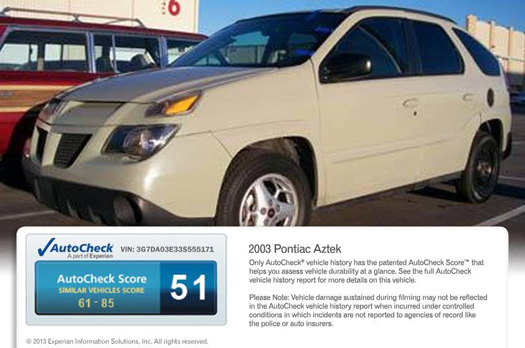
The used car buying process can be as challenging for dealers as it is for consumers. Both parties want to make sure they are getting the best deal on a car that is safe and reliable. But how does anyone really know what they are getting? Across the Internet there are many resources available to help in this process including tips from trusted sites like Edmunds.com, KBB.com and NADAGuides.com. The one common thread among them is that they all tell you to get a vehicle history report as part of the research. And that is good advice. Here at Experian, we offer a vehicle history report called AutoCheck. AutoCheck reports contain information on odometer issues, title brands, frame-damage announcements and other important data points. In addition, where available, the reports contain information on accidents (including airbag deployment, point of impact and whether the vehicle was towed). The reports also include the patented AutoCheck Score, a tool that enables dealers and consumers to quickly and easily understand a vehicle’s past and compare it to other vehicles. The important piece to understand about all vehicle history reports is that no single source of information can be fully comprehensive, since not every accident or other auto-related incident is reported. However, at Experian, we are constantly working to enhance and expand our information sources to provide as much detail as possible. For example, our reports contain exclusive auction announcement information from the two largest U.S. Auction houses that may not appear in other reports. These auction announcements show if the vehicle has any potential issues that dealers and consumers should watch out for including frame damage, major repairs, or if the airbags are missing or defective. Additionally, two of our largest private sources of accident data are exclusive to Experian. These sources provide enhanced accident information that allow AutoCheck users to see additional reported accidents and accident details, even in states where state agencies do not collect or choose to share the information. The truth is, all of this information provides dealers and consumers with a unique view into a vehicle’s past, but it will not eliminate all risk from the used car shopping process. It has long been our philosophy that vehicle history reports should only be one step in the pre-owned vehicle purchasing process. In addition to purchasing an AutoCheck report, we encourage every pre-owned shopper to physically inspect the vehicle whenever possible, and to have a licensed mechanic inspect the vehicle to ensure the best and safest vehicle choice is made. During the shopping process dealers and consumers should also consider: 1. Using online resources such as valuation guides and online sales portals (which can obviously help in showing buyers if there is damage to a vehicle) to get a better idea of the vehicle’s value. 2. Visiting the manufacturer’s website to double check for any safety or recall notices that have been issued on the vehicle. To learn more about AutoCheck vehicle history reports, visit www.AutoCheck.com. Photo: Shutterstock