
At Experian, we have long championed the use of expanded data sources, including buy now, pay later information, to empower consumers while enabling lenders to make more informed decisions. However, concerns about the negative impact on consumer credit scores have historically prevented many buy now, pay later providers from reporting account information to credit reporting agencies.
In an important step towards overcoming these challenges and supporting responsible lending, today, Affirm, one of the largest providers of pay-over-time loans, announced it is expanding its credit reporting with Experian.
Greater transparency in buy now, pay later activity is key to helping consumers build their credit histories and supporting responsible lending.
Scott Brown, Group President, Financial Services, Experian North America
Affirm plans to report all pay-over-time loan products issued from April 1, 2025, and beyond, including Pay-in-4. The move will help drive greater transparency into the buy now, pay later market while helping consumers build their credit histories over time.
“Affirm operates on the principles of transparency and putting consumers first, which is why we have been actively engaged with Experian and across our industry to build upon our credit reporting practices,” said Libor Michalek, President at Affirm. “Having all loans reflected in a consumer’s financial profile will help protect and empower borrowers. The buy now, pay later industry must evolve from simply providing flexible payment options to helping consumers build their credit histories and better manage their finances, and we are pleased to be taking this step with Experian.”
Experian is committed to driving transparency in the BNPL industry without inadvertently negatively impacting consumers. Given this, the new loan reporting will not be factored into consumers’ traditional credit scores in the near term but may in the future as new credit scoring models are developed.
With the new furnishing policy, consumers will be able to see on their Experian credit file information on all Affirm loans issued from April 1, 2025 onward. Consumers can receive an updated version of their Experian credit report at no cost daily by enrolling in a free membership and visiting www.experian.com or via Experian’s mobile app.
“Greater transparency in buy now, pay later activity is key to helping consumers build their credit histories and supporting responsible lending,” said Scott Brown, Group President, Financial Services, Experian North America. “We have a longstanding history working with Affirm and applaud them for expanding the reporting of their pay-over-time products. This is the right thing to do for consumers, the industry and the economy at large. Our role as the first credit reporting agency to establish this partnership with Affirm underscores our shared commitment to improve consumer financial health and foster more informed lending decisions.”
As BNPL information is reported to Experian by additional BNPL providers, a consumer’s BNPL history will be visible to lenders who request to view it as part of an Experian credit report–enabling lenders to make more informed decisions when determining whether to extend credit offers.
We look forward to working with other leading BNPL providers to drive greater transparency in the BNPL space that will benefit lenders and consumers alike.
Related Posts

Healthcare providers are preparing for a new wave of Medicaid eligibility verification requirements that will increase the need for timely, accurate income and employment verification. At the same time, organizations continue to face staffing pressures, reimbursement challenges and growing patient expectations. To help providers address this challenge, Experian Health has integrated Experian Verify into Patient Financial Clearance and its revenue cycle portfolio, bringing instant income and employment verification directly into healthcare workflows. By bringing these capabilities together, we can help providers reduce manual verification work and use verified information to support Medicaid and financial assistance screening earlier in the process. As new One Big Beautiful Bill Act requirements take effect on January 1, 2027, healthcare organizations need efficient ways to verify patient information without creating additional administrative burden. Traditionally, income and employment verification has relied on document collection, follow-up requests and time-consuming manual reviews. That can mean more work for staff, longer eligibility determinations and delays in determining an appropriate financial pathway for patients. By embedding Experian Verify within Patient Financial Clearance, providers can access verified income and employment information in seconds. For revenue cycle teams, that means using verified information to support Medicaid and financial assistance screening within the workflow they already use, rather than relying as heavily on document collection and follow-up. What I particularly like about this launch is how we brought capabilities from across Experian together around a specific client need. Patient Financial Clearance has long helped healthcare providers identify patients who may qualify for Medicaid or financial assistance and guide them to the most appropriate financial pathway. Experian Verify, meanwhile, provides instant income and employment verification through one of the nation’s largest employer payroll networks. Bringing these capabilities together gives providers another way to address growing verification demands within a single workflow. This is One Experian in action in a very impactful way. We’re combining data, technology and expertise from across the business to address a problem our healthcare clients are facing now. More importantly, we’re doing it in a way that fits into the workflows their teams already use. Ultimately, the benefits extend beyond providers. Faster access to verified information can help patients navigate financial assistance processes more easily, reduce paperwork and provide greater clarity around coverage and eligibility. As these requirements move closer, revenue cycle leaders should be looking now at where income and employment verification still depends on document collection and manual follow-up. Bringing verification directly into the financial clearance workflow is one more way we can help clients reduce administrative burden, support earlier decisions and help patients better understand their coverage or financial assistance options.
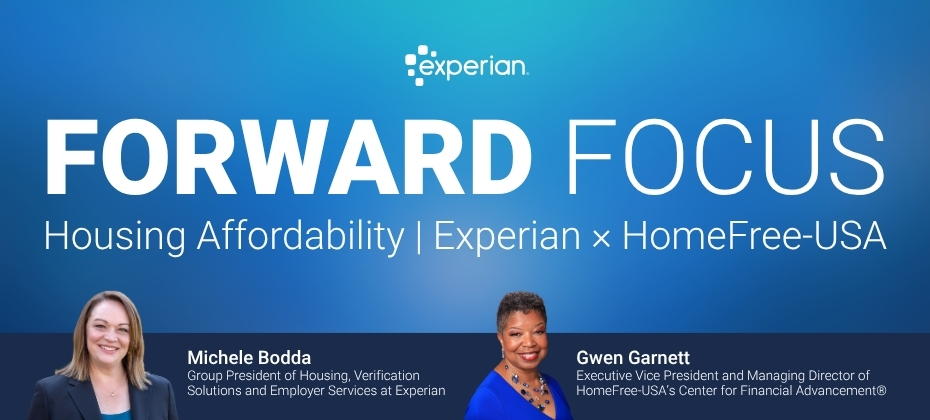
Homeownership has always been about more than buying a house. For many people, it represents stability, independence and a milestone they’ve been working toward for years. That’s part of what makes today’s housing conversation so important. There are real pressures affecting when and how consumers can buy, but the desire to become a homeowner hasn’t gone away. I was reminded of that during a recent conversation with Gwen Garnett, Executive Vice President and Managing Director of HomeFree-USA’s Center for Financial Advancement®. Gwen and her team work directly with aspiring homeowners, and our conversation kept coming back to a simple idea: while we can’t control every factor affecting the housing market, we can do more to help consumers understand where they stand and what’s possible. Our research underscores the opportunity. Nearly half of Gen Z adults we surveyed expect to be in a position to purchase a home within four years. At the same time, 34% of consumers said they have delayed exploring homeownership because they assumed their credit history or score wouldn’t qualify them. For me, those findings tell two sides of the same story. People still want to own homes, but some may be stepping away from that goal before they fully understand their options. Give consumers more clarity Consumers shouldn’t have to wait until they’re ready to fill out a mortgage application to understand their credit, financial position or the steps that could help them prepare. That doesn’t remove the broader affordability pressures they face. But it can give people greater clarity about the factors within their control and more time to act on them. Look beyond the traditional picture We can also continue evolving the way we understand consumers’ financial lives. A prospective homebuyer may have years of consistent rental payments or other positive financial behaviors that provide additional context about how they manage their obligations. Relevant expanded data can help bring more of that picture into view. This isn’t about collecting more information simply because it’s available. It’s about identifying information that can help create a more complete understanding of consumers and risk. Consumers appear to see value in that approach. More than half of those we surveyed said they would be more interested in pursuing homeownership if lenders considered additional positive payment history such as rent and utilities. Bring different strengths together Of course, information only goes so far if consumers don’t know what to do with it. That’s one of the reasons I value conversations with Gwen. Experian and HomeFree-USA bring different perspectives to the same challenge. Companies like ours can help consumers better understand their financial position. Community organizations can help turn that information into a plan grounded in someone’s individual circumstances. And lenders become an important resource when a consumer is ready to explore financing. When those strengths work together, we can make the process easier to understand. There is no single answer to housing affordability. But there are meaningful ways we can help aspiring homeowners today: give them greater clarity, understand more of their financial lives and connect them with information and guidance that helps them make informed decisions. For consumers who still see homeownership in their future, that can make a meaningful difference. You can watch my conversation with Gwen below and learn more about HomeFree at https://homefreeusa.org/.
I joined Experian in 1993. In more than three decades since, I’ve had a front-row seat to a remarkable evolution in how financial institutions use data and analytics to make decisions. The technology has changed. The amount and types of data available have changed. And the speed and sophistication with which we can turn that data into insight would have been difficult to imagine when I started my career. Through all that, one principle remains the same. Better data can lead to better decisions, and better decisions can create more opportunities for consumers and financial institutions. That’s why today’s announcement at Experian Vision 2026 is particularly meaningful to me. We announced Experian Cashflow Data Bureau Inc., an important new foundation for how we believe financial institutions will use data to make decisions and support consumers. Building on the power of credit Credit data has been foundational to the financial system, and it will continue to play that essential role. But today, we have an opportunity to see more. For years, Experian has invested in expanded data because we believe responsibly using additional information can help lenders develop a more complete picture of a consumer and ultimately help expand fair access to credit. That can be especially important when a traditional credit history doesn’t tell the whole story. From earning a steady income, paying bills consistently, maintaining sufficient balances and responsibly managing their day-to-day finances, a consumer may have a limited credit file but still have a rich financial life. Consumer-permissioned cash flow information can help provide insight into those behaviors and give lenders another view into a consumer’s current financial health and capacity. This represents a very useful and meaningful signal. This isn’t about replacing credit data. It’s about building on an incredibly powerful foundation with additional, current information that can help lenders better understand the consumers they serve. From proving the value to putting it to work We’ve been building toward this future for years. Our experience with expanded data and open banking has helped us develop increasingly sophisticated ways to turn bank transaction and balance information into useful insights. We’ve introduced Cashflow Attributes and Cashflow Score for consumer and commercial lenders and, the Experian Credit + Cashflow Score, which brings consumer-permissioned cash flow insights together with Experian’s traditional credit, trended and alternative data in a single model. Along the way, we’ve seen the conversation with our clients and partners evolve. Increasingly, they aren’t asking us whether cash flow information can provide value. They’re asking us how to put it to work. How do I access the information? How do I test it against my portfolio? How do I turn millions of transactions into useful insights? How do I incorporate those insights into my existing strategies? And how do I do all of that responsibly and at scale? Those are important questions, because the next generation of lending requires more than access to another source of data. It requires infrastructure and trust. That’s what Experian Cashflow Data Bureau Inc. is designed to provide. The new consumer reporting agency operates under the Fair Credit Reporting Act and serves as the enabling foundation for Experian’s broader cash flow ecosystem. It brings together capabilities spanning consumer consent and connectivity, standardized cash flow reporting, categorization, attributes and scoring, analytics and decisioning. We’ve spent decades building the data, analytics, technology and consumer reporting expertise financial institutions depend on every day. Now, we’re applying that experience and discipline to cash flow. The goal is to make the combined power of credit and cash flow easier to put to work, giving our clients a more complete view of consumers and the ability to turn those insights into better-informed decisions through a single, trusted provider. This is another step toward a future where our clients can understand a more complete picture of a consumer’s financial life, make better-informed decisions and create more opportunities for people to access the financial products and services they need. I’m excited about where we’re headed and proud that we’re continuing to build the data, technology and infrastructure to help move the industry forward. To learn more about our cash flow capabilities and what we’re building, please visit https://www.experian.com/experian-cashflow-bureau.