Innovation
At Experian, we are continually innovating and using technology to find solutions to global issues, modernize the financial services industry and increase financial access for all. Read about our latest innovation news below:

We sit in a pivotal position in the societies where we work. For us at Experian, using our data and expertise to create a better tomorrow is more than an opportunity. It’s a responsibility. We are pleased to announce we have published our annual Sustainable Business Report 2020, which outlines Experian’s dedication to social and environmental issues and details our corporate responsibility performance. In the report, we also highlight Experian’s target to reach 100 million additional people globally by 2025 with social innovation products and services. Additionally, the Sustainable Business Report focuses on our ambition to become carbon neutral by 2030. By utilizing renewable energy, reducing the carbon impact of business travel, and investing in high-quality carbon offsets, we reduced our carbon footprint by 8% last year and cut the carbon intensity of our business by 14% per $1,000 of revenue compared with the previous year. Additionally, 29% of Experian’s worldwide energy was also renewable. We are excited to share a few key takeaways from this year’s Sustainable Business Report: Experian employees volunteered 54,500 hours in and outside of work time to support their communities. This included over 3,500 hours in March 2020 to support communities as the COVID-19 crisis took hold. In Brazil, we have supported the introduction of new legislation enabling millions of consumers to benefit from the use of ‘positive’ data about the credit and other bills they pay on time. Experian Boost helped over 1.5 million Americans improve their credit scores, collectively boosting their FICO® scores by more than 17 million points. Prove ID-Link helped 7.5 million people in India prove their identity. As a result, more people are able to open a bank account and access credit for the first time. Learn more by viewing or downloading our full Sustainable Business Report here.

We are delighted to have completed the acquisition of a 60% stake in Arvato Financial Solutions Risk Management Division (AFS RM), expanding our presence in Germany, Austria, and Switzerland (DACH) and bringing Germany’s second largest credit bureau into Experian. It is an incredibly exciting moment for us both and marks a significant step forward in Experian EMEA’s growth ambitions. Together, we form a powerful new partnership in Europe’s economic powerhouse. With AFS RM’s local expertise and sector knowledge of industries like e-commerce, telecoms and insurance, and our global experience and innovation in data, analytics, software, and technology platforms, we will redefine what’s possible for our customers. AFS RM brings market presence with high-quality risk, fraud and identity management products and solutions tailored for key industries. We bring scale, expertise, and innovative products like Experian One and Ascend Analytics on Demand. Together, we will offer the best new technologies into these markets, delivering broad coverage and innovation that enables existing and new customers to make better, faster decisions, ultimately delivering greater access to finance for people across the region. Our new partnership will be branded Experian, which is just one of the ways we’re welcoming AFS RM to the Experian family. I’m delighted it will be led by Kai Kalchthaler as CEO, Experian DACH, who will ensure we help businesses find and fulfill their potential, so they can go further with us. Watch how we’re redefining possible, today, tomorrow, together here.

At Experian, we’re dedicated to innovation and the COVID-19 pandemic has been an impetus for further innovation. Our driving force of successful innovation is our employees. We foster a culture of continuous innovation, from the way we work to the solutions we create. Global Hackathon As part of our effort to mitigate the impact of the pandemic, we’re launching Experian’s first-ever Global Hackathon. Taking place between June 1 and 5, we’ve invited all our employees to get involved and connect, share knowledge and find new ways to help our clients and consumers on the road to recovery from the COVID-19 pandemic. Mitigating COVID-19 Crisis Through Our Innovations In addition to the Global Hackathon, we’ve committed vast resources to develop innovative technologies and new sources of data and analytics to drive solutions that help people, businesses and society at large. For example, to aid in the United States re-opening efforts, Experian has made available a free interactive U.S. map showing populations at-risk of being most susceptible to developing severe cases of COVID-19. The Experian COVID-19 Outlook and Response Evaluator (CORE) tool is intended to help guide healthcare organizations and government agencies as they plan for COVID-19 recovery in the months ahead. The map leverages de-identified data such as pre-existing conditions and social determinants of health to form a comprehensive picture that predicts possible pandemic impact on communities. To help essential organizations during the pandemic, Experian also created At-Risk Audiences, which leverage our data assets to identify groups of individuals that are most likely to be impacted. These new privacy-compliant segments, offered free of charge, are designed to help these organizations find and communicate with at-risk populations, enabling them to deliver essential services as quickly as possible. In the UK, we’re working side-by-side with the government. As part of this, we’re building models to help predict how this disease will spread in local populations and predict the effectiveness of various treatment therapies. In Brazil, we’ve organized a coalition of universities, data companies and technology leaders to launch Covid Radar with the purpose of working together to minimize the impacts generated by the COVID-19 pandemic and contribute to the recovery of Brazil’s economy. The Covid Radar integrates companies to the hospitals and communities that need donations of ventilators, personal protection equipment, or other supplies. In addition to providing case monitoring and disease forecasting. The COVID-19 crisis has forced innovation and change on a scale and pace we wouldn’t normally see. We remain relentlessly focused on helping vulnerable communities, strengthening the resilience of businesses, and playing an important role in helping consumers and the world economy get back to strength. As part of our global innovation program, we’re hosting a global hackathon to help our employees create new ways to help our clients and consumers on the road to recovery from the COVID-19 pandemic. As one of the world’s most innovative companies, we’re doing everything at Experian we can to provide our unique insights back to key stakeholders so they can prioritize help those who need it most urgently.
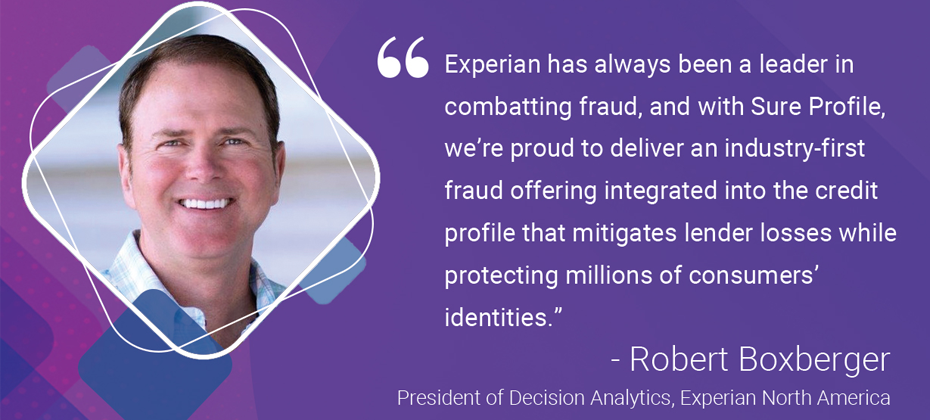
To combat a growing threat that’s expected to drive $48 billion in annual online payment fraud losses by 20231, Experian® has announced the launch of Sure Profile™. Experian is the first company with an offering to combat synthetic identity fraud that is integrated into the credit profile with market-leading assurance. We are proud to be the first in our industry to actually put “skin-in-the-game” by sharing in fraud losses with our clients if the losses occur on assured profiles. Experian’s new offering validates consumer identities, detects profiles that have an increased risk for synthetic identity fraud and helps cover losses resulting from synthetic identity fraud for assured profiles. Leveraging the capabilities of the Experian Ascend Identity Platform™, Sure Profile utilizes Experian’s industry-leading data assets and data quality to drive advanced analytics that set a higher level of protection for lenders. Powered by newly developed machine learning and AI models, Sure Profile offers lenders a streamlined approach to define and detect synthetic identities early in the originations process. Experian’s Sure Profile differentiates between real people and potentially risky applicants, so lenders can confidently increase application approvals with less risk. We expect to authenticate most credit applications through Sure Profile. In the cases where the identity can’t be assured, the company will deliver additional fraud risk indicators, so that lenders can take the right next steps to verify the potential borrower’s identity and prevent fraud. To date, detecting synthetic identities has been a significant challenge for lenders because there’s not an industry standard or a single definition that can be used to establish the legitimacy of an identity. In addition, understanding the financial impact of synthetics has been difficult for lenders as losses tied to synthetic identity fraud are typically categorized as defaults or “bad debt.” With Sure Profile, we are reinforcing our position as a leader by creating a standard set of criteria to define a synthetic identity. Experian has always been a leader in combatting fraud, and with Sure Profile, we’re proud to deliver an industry-first fraud offering integrated into the credit profile that mitigates lender losses while protecting millions of consumers’ identities. Our investments in innovation, AI and machine learning and our data quality are enabling us to lead the way in identity protection and help protect consumers and lenders alike.

As the COVID-19 pandemic continues to disrupt lives across the globe, fraudsters continue to take advantage of the vulnerable situation. The opportunistic nature of fraudsters means that times of crisis and pandemics open up additional breeding grounds for fraud and identity theft. Our latest CrossCore® release has never been more relevant for businesses than right now. Confidently recognizing consumers and safeguarding digital transactions is always a difficult balance – but now more critical than ever. With CrossCore, businesses can limit fraud losses and reduce unnecessary customer friction, at a time when safe and convenient access to financial services is essential. This new version of CrossCore, our integrated digital identity and fraud risk platform, combines risk-based authentication, identity proofing, and fraud detection into a single, cloud-based platform. This means that businesses have the capabilities and technology they need to rapidly respond to an ever-changing environment. With flexible decisioning orchestration, advanced analytics, and pre-integrated identity and fraud services, businesses can make real-time risk decisions throughout the customer lifecycle. And they can do all of this through simple self-service. We know there’s no silver bullet when it comes to fighting fraud, which is why we continue to develop our curated partner ecosystem. This gives companies access to all the technology and capabilities they need, in one place – whether it be Experian’s, our partners’, or their own. We combine this with advanced analytics and our own rich data assets plus a built-in strategy design and enhanced workflow giving fraud and compliance teams more control to adjust strategies based on evolving threats. This helps improve efficiency and reduce operational costs. Updates to the new version include the ability for clients to submit dynamic API request payloads, apply progressive risk assessments, apply parallel logic, enable self-service workflow configurations, and provide an online business intelligence (BI) module to view transactional volume reports. These updates will give CrossCore users a simpler way to manage complex orchestration; faster more scalable performance; and key performance indicators in near real-time, all while enabling a personalized and seamless experience for their true customers. More than 250 clients worldwide use CrossCore today, including capabilities from our third-party partners. To start leveraging best-in-class, pre-integrated identity and fraud services through simple self-service learn more about the Experian CrossCore platform.

The pandemic’s full economic impact is still unfolding, and I can assure you we have not stopped evaluating and evolving our COVID-19 response nor our thinking about economic recovery for consumers and businesses alike. In the last month, we’ve been driven by two major priorities. The first is the health and safety of our employees. On top of that, we have placed a laser focus on putting our resources to work to help people and businesses during these uncertain times. While we have all been adjusting to our ‘new normal’ working environment, our employees in North America have not slowed down. In fact, they have worked hard to create solutions and tools designed specifically to help people successfully navigate the evolving financial landscape. From free credit reports to complementary ‘payer alerts’ for healthcare organizations to consumer credit education, we’ve launched a wide-range of initiatives. Here are a few highlights I’d like to share with you: FOR CONSUMERS: Experian Credit Report and Score: Consumers can sign up and access their FICO® Score, Experian credit report, and ongoing credit monitoring through Experian’s free CreditWorks product. Consumers can also sign up to Experian Boost, a free financial tool that has helped more than 2 million consumers increase their credit score. Consumer Resources Website: As the consumer's credit bureau, Experian’s commitment is to inform, guide and protect its consumers and customers during uncertain times. One way the company is doing this is through this dedicated website, with links to multiple resources and materials to help the community learn about credit and other important personal finance topics. COVID-19 and Your Credit Report: Being fully committed to helping consumers and lenders during this unprecedented period, Experian has created this dedicated blog page with ongoing and updated information pertaining to how COVID-19 may impact consumers’ creditworthiness and – ultimately – what people should do to preserve it. The blog will be updated with relevant news as Experian announces new solutions and tactics. #CreditChat: In response to the urgent and rapid changes associated with COVID-19, Experian is accelerating and enhancing its financial education programming to help consumers protect their financial health. With expected delays in bill payments, unprecedented layoffs, hiring freezes and related hardships, Experian seeks to aid consumers in understanding how the credit reporting system and personal finance overall will move forward in this landscape. Experian has launched an eight-week series of #CreditChat conversations surrounding COVID-19 on Wednesdays at 3 pm ET on Twitter and live video credit chats every Friday at 12:30 pm ET on Facebook Live. FOR BUSINESSES: Free Experian Business Credit Report: Experian is offering all American-owned small businesses free access to their Experian business credit report through May 1, 2020, to help small business owners impacted by the COVID-19 pandemic. By accessing a free business credit report now, small business owners can understand where their credit score stands and look for the best lending options for their business before they obtain funding. COVID-19 U.S. Business Risk Index: To further help small businesses gain access to capital they need, Experian launched its free COVID-19 U.S. Business Risk Index to assist lenders and government organizations in understanding how to make lending options available to the business segments that need it the most. This new risk index can help business risk professionals better understand the impact that the pandemic may have on commercial operations based on several key factors. This methodology combines business risk, anticipated impact on business industries and real-time COVID-19 case data to help businesses better simulate various impact scenarios down to the state level to help develop relevant strategies. Experian® Health Payer Policy Alerts: This is a free comprehensive list of COVID-19 and telehealth payer policy alerts for United States hospitals, medical groups, pharmacies and specialty healthcare service organizations. Payer policy alerts are provided by commercial, Medicare and Medicaid payers and summarize changes to medical coverage policies from those organizations. This public service to the healthcare community will continue to be updated and remain free as long as alerts related to the COVID-19 pandemic continue to be distributed. At-Risk Audiences: In an effort to help essential organizations, such as healthcare and government agencies, provide resources to those most in need during the COVID-19 pandemic, Experian is leveraging its data assets, free of charge, to identify groups of individuals that are most likely to be impacted. Experian developed new audience segments that are built in a privacy-compliant manner and designed to help these organizations find and communicate with at-risk populations, enabling them to deliver essential services as quickly as possible. Business Resources Website: This newly launched website was developed to help businesses prepare to manage increased attacks, continue to push toward digital banking, and understand regulatory changes as businesses find their footing in this evolving financial services landscape. FOR COMMUNITIES IN NEED: First Responders First: Experian North America is supporting first responder workers by donating funds for personal protective equipment (PPE) to COVID-19 for hotspots in New York City and New Orleans through the nonprofit organization, First Responders First. These funds will provide essential supplies, equipment and resources such as masks, gowns, gloves and more to those on the frontline. Heart of Experian Giving Opportunity: Experian is leading this effort in which employees can assist by making a donation to First Responders First through Experian’s Heart of Experian giving opportunity. Experian will match employee donations up to the annual limit of $500 per employee, while funds last. This donation is the latest support the company has provided to help minimize exposure for those most at risk. For example, in California, the company also donated 12,000 masks to the Hoag Medical Group. I’m proud of the work we’re doing at Experian to help those impacted by this crisis. We remain dedicated to our employees, consumers, businesses and communities – and we will continue to innovate and develop new offerings to help those in need. Craig Boundy CEO, Experian North America

Technology revolutionizes the way businesses operate, but implementing change within a company is often challenging and company-wide support is vital to successfully undergoing a transformation. At Experian, we’re using technology and innovation to modernize an industry, and satisfy the real-time data demands of consumers and businesses. The success of this transformation is one of the reasons why we’re proud that our Global CIO, Barry Libenson, has been named the CIO of the Year. The 2019 Dive Awards recognize the industry’s top disruptors and innovators. These executives, companies, trends, and breakthroughs are transforming the industry. Winners were chosen by the editors of CIO Dive based on thorough and independent research, reporting, and analysis. Other award winners include Google Cloud and VMware. In 2015, Experian began the daunting task of moving from a traditional computing architecture to the cloud. Specifically, we put in motion a cloud strategy centered on flexibility and the ability to operate in any cloud. Such transformations often start by centralizing data and implementing new processes that minimize overhead and speed time to market, like cloud and mobile computing. This is a monumental job with our massive digital infrastructure and significant global reach, but it enables us to provide customers with real-time access to data. To do this we pioneered the use of Hadoop to store massive quantities of data for consumer credit scoring. Today, we maintain Ascend, a platform of 250 million redacted consumer records that enables our clients do real time queries on consumer credit data rather than batch processing. This has worked to digitally transform Experian from a traditional credit bureau to a technology and software provider. For us to further evolve we began working on APIs for internal use rather than going straight to customer-facing features. Today, we use APIs to help our clients and consumers access and make use of key data insights. For example, Experian Boost, which has helped millions of people raise their credit scores, is a result of information being accessed through API calls. As a result of our digital transformation, our API hub is processing more than 100 million transactions a month and Ascend is now one of our most successful cloud computing architectures. This all represents business opportunities that wouldn’t have been possible with a traditional digital infrastructure. Success for the technology team at Experian is found in the financial performance of the company. "What I tell my team is the biggest sign of us being successful is praise," said Libenson. "When the businesses at Experian tell us we're helping them or we're doing the right things, that's the best measurement I can think of, in terms of success." As one of the world’s most innovative companies, Experian’s business continues to evolve to deliver faster, better services for our clients and consumers. "The people and organizations that win the Dive Awards are trailblazers and leaders in their markets," said Davide Savenije, editor-in-chief of CIO Dive’s publisher Industry Dive. "Their achievements in 2019 are shaping the future of where the latest strategies and trends are going." While industry accolades like CIO of the Year are important, the truth is that any transformation isn't an endpoint, but a journey. To succeed, we are in it for the long haul to use technology to help deliver results for our clients. Read the full article on CIODive to learn more about Experian’s digital transformation.

To stay ahead of the competition and on the path of sustained growth, you need clear line of sight to both risks and opportunities through the customer lifecycle. Gaining better insights on customers is critical to achieving that, so you can make all the right decisions, big and small, about your customers and business clients. Based on the conversations we have with our clients, we have noticed that most executives are paying a lot of attention to measuring customer experience and reducing friction across digital touch-points through the lifecycle. For customer acquisition, for example, businesses like yours look at time spent on each micro-step (e.g. data field), dropout rates at each of those steps, and do A/B testing at a very granular level. The idea is to understand all points of friction including points of confusion, frustration, etc., so you can learn from those and improve the experience. But this is not an easy task. The various challenges involved are making sense of the vast quantities of data and the immaturity of that data as well as the construct of that data. Given the fast pace at which data analytics change and evolve, our recommendation is that you invest in tools that are data and/or analytics agnostic. Thinking ahead: leveraging data analytics and cloud-based decisioning platforms to design the right customer treatment There is a largely untapped opportunity to leverage data, analytics, optimisation and decision management solutions - such as cloud-based decisioning platforms - to design the right customer treatment and identify the next best action for that customer. Selecting the appropriate timing, medium, and channel for those actions lead to greater consistency and contribute to having more relevant communications with your customers. The more relevant you are, the more precise you are with the offers and the treatments leading to improved response rates, greater connectivity and interaction with the customer. This results in memorable experiences that enhance loyalty and drive profitability.

I recently had the opportunity to discuss the current state of #data collection, analytics, and AI in an interview with @CIODive. As technology advances, businesses can collect and analyse more data than ever before. However, most of that information ends up languishing, seldom being used or even catalogued. Recent research suggests that partly, this happens because businesses are unaware of what data they store or don't know how to get actionable insights out of it. This lack of visibility into data stores affects organisations' readiness to apply artificial intelligence (AI) and machine learning (ML): advanced analytics require data to be properly managed and organised. At Experian, we believe in taking an outcome-focused approach to analytics and AI as we look at activating the power of our data AI outcomes. We work backwards, from high-impact client and consumer outcomes, and bringing to bear the analytics, AI and data to achieve them. This way, we can assess more accurately what effort across data collection and analytics is required to achieve an outcome. Executed effectively this can avoid an enormous amount of investment in people, time, data. If you're interested in this topic, I'd recommend you to read the article in full: http://bit.ly/AImlShri_CIODive