At A Glance
CPG shoppers are splitting spending across price points, retailers, and channels, often within the same purchase journey. Experian Audiences help marketers identify value-driven switching, connect behavior across retailers and channels, and reach shoppers based on how they actually buy.In this article…
Why consumer packaged goods (CPG) marketing needs a broader view of shopper behavior
CPG marketing needs a broader view because shoppers no longer follow a single path to purchase. They move across retailers, channels, and price tiers, often within the same buying cycle. For marketers, that makes behavior harder to track and even harder to act on.
The same household may focus on price in one category, spend on quality or convenience in another, and shift between online and in-store environments along the way. These decisions are not tied to a single moment or channel, which makes them difficult to interpret through any one signal.
At the same time, many CPG brands don’t have direct relationships with shoppers, limiting access to first-party data. Understanding how decisions connect often depends on combining signals from multiple sources across the market.
This fragmentation becomes most visible across the purchase journey. A shopper might discover a product on social, compare prices across retailers, add it to a cart in an app, and complete the purchase later in-store. Retail media networks (RMNs) provide strong, retailer-specific insight and measurement, with a detailed view of what shoppers do within that retailer’s environment. But that view stops there. A retailer can see what a shopper buys in its own stores or app, not how that same shopper compares prices, switches brands, or purchases across other retailers.
The opportunity is to build a more complete view of shopper behavior across the market. Without additional signals, marketers are left with multiple high-quality perspectives of the same shopper, each tied to a specific retailer or platform. That makes it difficult to understand how shoppers compare options, switch retailers, and respond to campaigns beyond a single environment.
How Experian Audiences help CPG marketers adapt to changing shopper behavior
Experian Audiences help CPG marketers adapt to changing shopper behavior by identifying shoppers likely to trade between premium and value, aligning audiences to price sensitivity and purchase behavior, and connecting signals across retailers and channels so your campaigns reflect how decisions are made from first interaction through purchase.
Three shifts are shaping how CPG brands reach and understand shoppers:
- Data is distributed across retailers and channels
- Purchase journeys span more touchpoints
- Shoppers are more selective about where they spend
You can find the full taxonomy paths in the appendix.
1. How can CPG brands connect shopper behavior across retailers without direct consumer access?
CPG brands can connect shopper behavior across retailers without direct consumer access by combining signals from RMNs, retailer partnerships, and data providers to build a broader view of shopper activity, since most brands don’t have direct relationships with their customers or access to extensive first-party data. Instead, they often rely on these partners to understand shopper behavior and campaign performance.
Each RMN provides a strong view of what happens within its own environment, but a shopper may purchase across multiple retailers, compare prices across platforms, and shift behavior depending on promotions or availability. Retailer relationships are critical and strategic, but they capture only part of that activity.
This is becoming more complex as retail media expands. Amazon and Walmart still account for 84% of investment, but the rest is spread across a growing number of networks, each with its own data, definitions, and measurement approach. That fragmentation makes it harder to maintain consistent, deduplicated audiences, connect performance across platforms, and understand true incrementality.
How Experian brings shopper signals together in one place
Experian brings shopper signals together in one place as a way to build more effective CPG campaigns. Through Experian’s data marketplace, brands can unify, deduplicate, and activate shopper data across partners and channels.
In one marketplace, advertisers can access CPG signals, including loyalty card, receipt scan, and point of sale (CPU/SKU) data from tier one partners like Attain, Catalina, and Circana, along with Experian data.
This gives advertisers more flexibility to build audiences from complementary purchase-based signals, rather than relying on a single retailer view or rebuilding audiences separately across platforms.
By joining and deduplicating audiences across partners, advertisers can create more comprehensive CPG segments that better reflect how people shop across retailers, brands, and channels. They can also activate those audiences outside closed media network environments, helping maintain more consistency as campaigns move across destinations.
How to build cross-retailer audiences
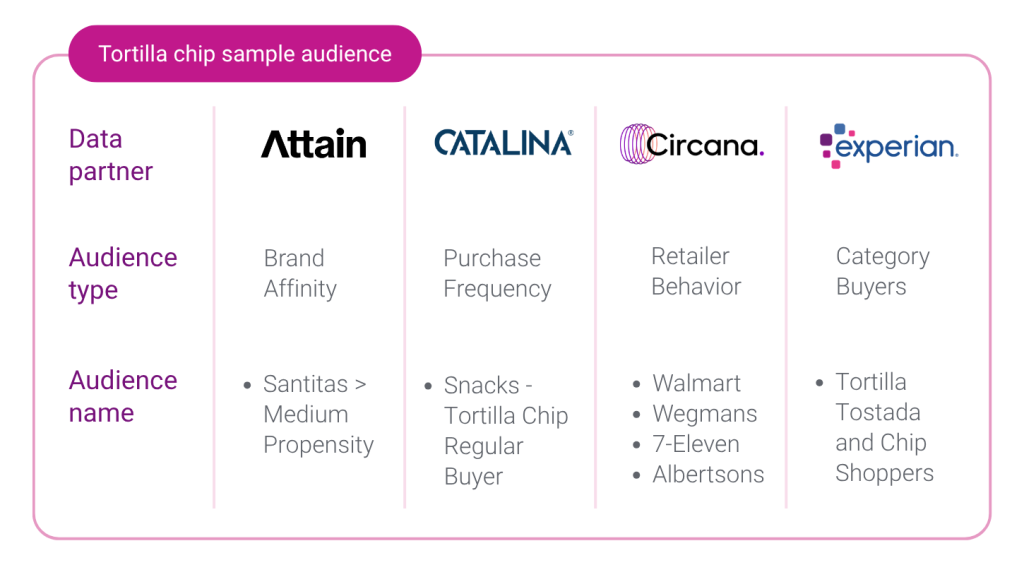
Here’s what that can look like in practice. Instead of relying on a single retailer signal or broad snack category, advertisers can combine shopper behaviors from multiple data partners to create a more detailed audience built around specific purchase patterns and brand affinities.
In the example below, each provider contributes to a different layer of shopper insight, helping advertisers create a more complete tortilla chip audience across retailers, categories, and purchase behaviors.
Additional Experian Audiences you can activate
Advertisers can also start with broader category and retailer audiences to establish a strong base of active CPG shoppers, then use them on their own or layer in additional data to refine more specific behaviors, brands, or purchase patterns.
Core category buyers
- Candy, Snack, and Beverage Buyer Households
- Food, Snack, and Beverage Shoppers
- Grocery Store Frequent Spenders
- Grocery Store High Spenders
Cross-retailer shoppers
- Costco Frequent Spenders
- Discount / Dollar Store Frequent Spenders
- Supercenter Buyers
- Target Frequent Spenders
- Warehouse Club Members
- Walmart Frequent Spenders
2. New paths to conversion: How purchase journeys now span social, e-commerce, and in-store
There are new paths for CPG shoppers to conversion, they are no longer tied to a single channel. Awareness, consideration, and conversion signals now span multiple environments, often within the same buying cycle. A shopper might discover a product on social, compare pricing on Amazon or Walmart, add it through a retailer app, and complete the purchase later in-store, through delivery, or during a stock-up trip.
This shift is becoming more pronounced as online and in-store grocery shopping become increasingly connected. Nearly 94% of grocery shoppers now purchase both online and in-store, with e-commerce driving most recent growth even though stores still account for the majority of purchases. As a result, shoppers move across the purchase funnel fluidly, especially younger audiences, making it harder to map decisions to a single touchpoint.
For marketers, this means your audience strategy needs to follow behavior across the full journey, not just one channel or moment.
Experian Audiences you can activate to align to purchase journeys
Channel engagement
- Digital Display
- Free and Paid Ad Supported Streaming Subscribers
- Highly Active Online Users
- Online Research-Dependent Consumers
- Social Media Heavy Users
Purchase and conversion
- Brick and Mortar High Spenders
- Frequent Online Buyer Households
- Grocery Pick-Up and Delivery Users
- In-Store Buyer Households
- Online Buyer Households
- Online Grocery Delivery High Spenders
- Online-Preferred Shoppers
How to use these audiences
Activate channel engagement audiences like Social Media Heavy Users, Highly Active Online Users, and Online Research-Dependent Consumers alongside purchase audiences such as Online Buyer Households, Grocery Pick-Up and Delivery Users, and In-Store Buyer Households to reach shoppers who discover products through social and digital channels, compare options online, and complete purchases through delivery services, retailer apps, or in-store.
3. How is price pressure splitting shoppers across value tiers?
Price pressure is now splitting shoppers across value tiers. For many households, food prices are now a primary concern, making shoppers more selective about where and how they spend. Some are choosing lower-cost alternatives in everyday categories, while others are still willing to pay more for products tied to health, convenience, or perceived quality. This creates a more fluid market, where the same shopper may cut back in one aisle and spend more in another.
Shopping behavior is also shifting across channels. As more consumers eat at home rather than dining out, CPG brands have more opportunities to capture spend, across grocery and retail environments. Private-label products are gaining traction, often priced 30% lower than branded goods, while smaller independent brands are winning share with shoppers seeking products that better match their preferences and priorities.
For marketers, the focus is understanding these different groups and tailoring messaging to match.
Experian Audiences you can activate to reach shoppers across value tiers
Value-driven shoppers
- Coupon Users
- Deal Seeking Shoppers
- Discount / Dollar Store Frequent Spenders
- Frugal Living and Savings Focused Households
- Value Oriented Discount Deal Shoppers
Premium and benefit-led shoppers
- Healthy Food Meal Kit Service Spenders
- High Spending Specialty Food Shoppers
- High Spending Vitamin and Supplement Buyers
- Organic/Natural Grocery High Spenders
- Premium Spend Index segments
How to use these audiences
Activate value-driven audiences like Coupon Users, Deal Seeking Shoppers, and Discount / Dollar Store Frequent Spenders to run campaigns focused on price, promotions, and bulk purchasing behavior, especially during periods of higher price sensitivity.
Activate premium and benefit-led audiences like Organic/Natural Grocery High Spenders, Healthy Food Meal Kit Service Spenders, and High Spending Specialty Food Shoppers to highlight product attributes such as ingredients, health benefits, or convenience, where shoppers are motivated by perceived value rather than price.
When are CPG audiences most responsive to marketing?
CPG audiences are most receptive to marketing during key consumption and promotional moments that drive stock-up behavior and price comparison, making timing as important as targeting.
Back-to-school and routine-driven consumption
Back-to-school season concentrates demand among households preparing for more structured routines. Grocery, snacks, and household essential purchases often increase as families shift back to packed lunches, after-school meals, and at-home consumption. You can align messaging around convenience, bulk buying, and routine-driven needs to capture this predictable lift in demand.
Prime Day, promotional peaks, and deal-driven behavior
Major promotional events such as Prime Day and Black Friday drive higher engagement among deal seekers, coupon users, and value-focused shoppers. Early results from Prime Day 2025 showed that four of the top five purchased items were household or grocery products, and 57% of shoppers compared Amazon’s prices with other retailers before buying. During these periods, consumers actively compare prices across retailers and plan purchases around promotions, often stocking up on essentials. Aligning campaigns with value-driven audiences helps you focus offers on shoppers most likely to switch brands or retailers based on price.
Holiday periods and stock-up behavior
Holiday periods combine higher consumption with more intentional purchasing. Shoppers prepare for gatherings, travel, and extended time at home, leading to larger basket sizes and more planned trips. Some households prioritize premium or specialty products for specific occasions, while others focus on value and promotions. Seasonal signals help you time campaigns to match these shifts in purchasing behavior and demand.
What sets Experian Audiences apart?
Our syndicated audiences give you an advantage across channels, offering both scale and accuracy:
- Experian’s 3,500+ syndicated audiences are available at over 200 leading activation platforms, including programmatic, social, TV destinations, and can be curated alongside premium inventory through Curated Deals.
- Reach consumers based on who they are, where they live, and their household makeup. Experian ranked #1 in accuracy by Truthset for key demographic attributes.
Explore some of our Partner Audiences that complement Experian Audiences across key CPG use cases, with flexible activation through Experian’s data marketplace or leading activation platforms.
Need a custom audience? Reach out to our audience team, and we can help you build and activate an Experian audience on the platform of your choice.
Want to activate an Experian Audience on Meta, Pinterest, Snap, TikTok, or on a platform not listed above? Contact us today.
For a full list, download our syndicated audiences guide.
Reach the right audiences for your industry
Reach CPG shoppers based on real-world shopping behavior with Experian Audiences
From price pressure and shifting value preferences to fragmented purchase journeys and cross-retailer behavior, CPG demand is shaped by how shoppers make decisions across the market.
Experian Audiences help you respond to these challenges by identifying shoppers likely to switch between value tiers, aligning campaigns to how and where people buy, and connecting high-intent audiences with the right products across retailers and channels.
Connect with our audience experts
FAQs
Experian Audiences are pre-built, privacy-compliant consumer segments that help marketers target based on verified demographic, financial, and behavioral data.
They’re designed for flexibility across channels and can be activated on 200+ platforms, including major social, CTV, and programmatic partners.
Experian ranks #1 in demographic accuracy according to Truthset, and marketers can choose from 3,500+ syndicated audiences that capture signals such as income, spending behavior, household structure, financial attitudes, and ability to pay. These same audiences are also available through partnerships on platforms like DirecTV, Dish, Magnite, OpenAP, and The Trade Desk.
For a deeper look at our audience catalog, explore our syndicated audience guide.
You can activate Experian Audiences across 200+ digital and connected TV (CTV) platforms, including Meta, Pinterest, The Trade Desk, and Audigent private marketplaces (PMPs).
Yes, you can combine your own first-party data with Experian’s 3,500+ syndicated audiences and additional segments from multiple partner data providers, as a custom audience within a Curated Deal, or self-service via Audience Engine.
Appendix
Value-driven shoppers
- Lifestyle and Interests (Affinity) > Purchase Behavior > Coupon Users
- TrueTouch: Communication Preferences > Purchase Behavior > Deal Seeking Shoppers
- Retail Shoppers: Purchase Based > Shopping Behavior > Discount / Dollar Stores: Frequent Spenders
- Publisher Derived > IAB Budgeting > Frugal Living and Savings Focused Households
- Retail Shoppers: Purchase Based > Lifestyle and Interests > Value Oriented Discount Deal Shoppers
Premium and benefit-led shoppers
- Retail Shoppers: Purchase Based > Health and Fitness > Healthy Food Meal Kit Service Spenders
- Retail Shoppers: Purchase Based > Shopping Behavior > High Spending Specialty Food Shoppers
- Retail Shoppers: Purchase Based > Health and Fitness > High Spending Vitamin and Supplement Buyers
- Retail Shoppers: Purchase Based > Grocery > Organic/Natural Grocery Stores: High Spenders
- Financial > Discretionary Spend > Premium Spend Index (Elite / Upper Middle)
Channel engagement
- TrueTouch: Communication Preferences > Engagement Channel Preference > Digital Display
- Television (TV) > Ad Avoiders/Ad Acceptors > Free and Paid Ad Supported Streaming Subscribers
- Lifestyle and Interests (Affinity) > Technology > Highly Active Online Users
- Lifestyle and Interests (Affinity) > Technology > Online Research-Dependent Consumers
- Social Network Behaviors > Social IQ > Social Media Heavy User
Purchase and conversion behavior
- Retail Shoppers: Purchase Based > Shopping Behavior > Brick and Mortar High Spenders
- Purchase Transactions > Shopping > Frequent Online Buyer Households
- Consumer Behaviors > Grocery Pick-Up and Delivery
- Purchase Transactions > Shopping > In Store Buyer Households
- Purchase Transactions > Shopping > Online Buyer Households
- Retail Shoppers: Purchase Based > Grocery > Online Grocery Delivery Services: High Spenders
- Retail Shoppers: Purchase Based > Shopping Behavior > Online-Preferred Shoppers
Tortilla chip sample audience
- Circana > ProScores > Retailer > Mass > Walmart
- Circana > ProScores > Retailer > Food > Wegmans
- Circana > ProScores > Retailer > Convenience > 7-Eleven
- Circana > ProScores > Retailer > Food > Albertsons
- Experian > Retail Shoppers: Purchase Based > CPG Engagement > Tortilla Tostada and Chip Shoppers
- Attain > CPG (Consumer Packaged Goods) > Snacks > Product > Chips > Santitas > Medium Propensity
- Catalina > Category Purchasing > Center Store Snacks > Snacks > Snacks – Tortilla Chip Regular Buyer
Core category buyers
- Purchase Transactions > Food and Beverage > Candy Snack and Beverage Buyer Households
- Purchase Predictors > Shoppers All Channels > Food, Snack, and Beverage Shoppers
- Retail Shoppers: Purchase Based > Grocery > Grocery Stores: Frequent Spenders
- Retail Shoppers: Purchase Based > Grocery > Grocery Stores: High Spenders
Cross-retailer shoppers
- Retail Shoppers: Purchase Based > Shopping Behavior > Big Box and Club Stores: Costco Frequent Spenders
- Retail Shoppers: Purchase Based > Shopping Behavior > Discount / Dollar Stores: Frequent Spenders
- Lifestyle and Interests (Affinity) > Purchase Behavior > Supercenter Buyers
- Retail Shoppers: Purchase Based > Shopping Behavior > Target Frequent Spender
- Lifestyle and Interests (Affinity) > Purchase Behavior > Warehouse Club Members
- Retail Shoppers: Purchase Based > Shopping Behavior > Walmart Frequent Spenders
Seasonal and demand moments
- Retail Shoppers: Purchase Based > Seasonal > Black Friday/Cyber Monday Big Box Shoppers
- Retail Shoppers: Purchase Based > Seasonal > Holiday Shoppers: Coupons/Sale Shoppers: In Store
- Mobile Location Models > Visits > Holiday Deal Shoppers
- Retail Shoppers: Purchase Based > Seasonal > New Year’s Food/Healthy Food Shoppers
Latest posts
Google is replacing User-Agents with Client Hints across their Chromium browsers. Learn what this change means and how it impacts OpenRTB in our Q&A.
Tapad, a part of Experian, is SOC 2 Type 2 and 27001 compliant. Learn why you should add these certifications to your AdTech information security strategy.

Experian kicked off the AdTech year at CES in Las Vegas. Read our CES AdTech recap to learn our key takeaways from the event for the AdTech industry.