
As leaders head into Cannes this year, there will be plenty to talk about: AI, commerce media, identity, data collaboration, consolidation, curation, and measurement. Each one will shape how marketers plan, activate, and prove impact in the years ahead.
But the bigger conversation will be about the foundations underneath them. The market is becoming more connected, operationally complex, and concentrated, which makes independent, interoperable infrastructure more valuable. Brands, agencies, platforms, publishers, commerce media networks (CMNs) and data partners all need systems that can work together with trust, flexibility, and control.
The question I expect to hear at Cannes is: are your foundations strong enough to support connected growth?
Infrastructure now shapes how marketing works
Marketing infrastructure used to be easy to overlook. It sat behind the scenes moving data between teams, platforms, and partners, so campaigns could run and reports could get built. That view is too narrow now.
The choices companies make around data, identity, activation, collaboration, and measurement, now shape what they can do. Those choices affect which partners a brand can work with, how easily teams can connect customer signals, how quickly campaigns can move, and how clearly performance can be measured.

The more connected the ecosystem becomes, the more valuable interoperability becomes. Marketers need infrastructure that can work across agencies, platforms, publishers, commerce media networks, clean rooms, cloud environments, and connected TV (CTV). Not infrastructure tied too tightly to one commercial system or strategies that work well in one environment but break down everywhere else. Marketing needs room to adapt.
Identity connects the customer view
Identity is the connective layer that helps marketers understand who they’re trying to reach across data sources, devices, and partners. It’s the foundation that helps teams connect signals in a governed, privacy-safe way so they can plan, activate, and measure from a more consistent view of the customer.
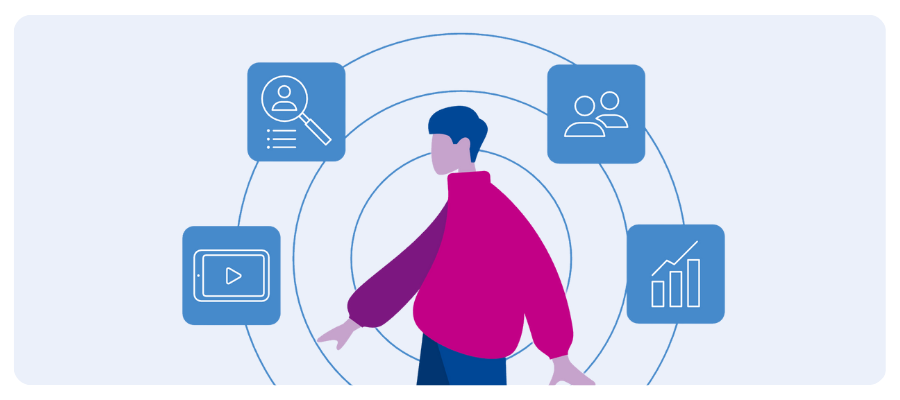
Without that foundation every downstream decision gets weaker. Teams may have more data than ever, but they still struggle to connect it into a clear picture of who they’re trying to reach. That matters more as customers move across devices, channels, platforms, and media environments constantly. No single partner sees the full picture and no single channel carries the full journey. That’s why interoperability matters. Identity has to connect across the market, not sit inside one closed workflow.
AI raises the standard for trusted inputs and independent decisioning
AI will be one of the biggest topics at Cannes. It’s already changing how teams think about planning, decisioning, optimization, and measurement. AI makes trusted data matter more, especially as more decisions depend on the quality of the signals behind them.
AI systems are only as strong as the data feeding them, the identity layer connecting that data, and the governance controlling how that data is used. Marketers also need to understand which signals AI is using, which signals it may be favoring, and how much control the brand retains. Brands need more visibility into the intelligence guiding their investments.
This is where many leaders will need to pressure-test their strategies: are AI decisions based on data you can trust, test, govern, and move across the partners that matter to your business?
The AI conversation should always come back to data quality, identity, governance, transparency, and trust.
Commerce media needs pathways beyond owned environments
Commerce media has created powerful new opportunities for brands and commerce platforms. Commerce environments sit close to intent and can help advertisers understand what people search for, compare, consider, and buy. The next phase is about scale.
CMNs have valuable shopper and transaction signals, but owned inventory can limit reach and create friction for advertisers trying to work across many networks. The next step is helping advertisers use those audiences beyond the network’s own site or app, across channels like CTV, social, and programmatic. That requires an identity foundation that can connect customer records, reduce duplicate profiles, improve audience accuracy, and support activation and measurement across the platforms advertisers already use, without turning every campaign into a separate workflow.

This creates another path for CMNs to grow alongside their media business. It gives them more ways to create value from the signals they already have, and it gives advertisers more consistent ways to activate audiences across the market.
Curation brings data closer to supply
Curation is gaining attention for a reason. It connects audience intelligence and supply at the point of activation. Done well, it helps marketers bring data, context, and inventory together in a more intentional way. But curation only works when the foundation is strong.
It needs trusted identity, high-quality data, clear rules for how signals are used, and supply paths that marketers can understand and measure. It also needs the ability to optimize as campaigns run, so audiences, inventory, and outcomes are not treated as static decisions.
This is where curation can become more than another media tactic. It can become a practical way to connect intelligence with action, giving brands more control over where and how data informs media decisions.
Measurement is where trust is earned
Every growth conversation eventually comes back to proof. Leaders need to know what worked, where it worked, and for whom. They need to understand how activation influenced outcomes across channels and partners. They need confidence that the systems behind those answers are transparent enough to guide future decisions. Measurement confidence depends on the same foundations as everything else: identity, data quality, interoperability, collaboration, and governance. That’s why measurement should be designed into the strategy from the start.

The Cannes conversations that will matter most
The most valuable Cannes conversations this year may not be about chasing the next idea. They may be about asking better questions.
- Can our identity framework adapt as the market changes?
- Can our data strategy work across partners without locking us into one system?
- Do we know which customer signals our AI systems are using, which ones they’re prioritizing, and whether we can test that intelligence outside one system?
- Can our commerce media and curation strategies scale with control?
- Can our measurement framework give us confidence across the full journey?
At Experian, we sit across the ecosystem as an independent identity and data partner built to support flexibility, governance, and interoperability. As the market keeps changing, our role is to help you preserve control. Not by forcing a single path, but by helping identity, data, activation, and measurement work together across the broader market. For leaders heading to Cannes, that’s the conversation worth having.
Watch our Cannes Lions 2026 conversations
At Cannes Lions 2026, we spoke with leaders across the industry on topics ranging from healthcare marketing, to influencer marketing, to agencies, to culture, and more. Read our recaps and watch all of our conversations below
About the author

Kevin Dunn
Chief Revenue Officer, Experian
Kevin Dunn joins Experian Marketing Services with more than 20 years of leadership experience across marketing and advertising technology, most recently serving as Senior Vice President of Brands and Agencies at LiveRamp. In that role, he led growth across retail, CPG, travel, hospitality, financial services, and healthcare, overseeing new business, account expansion, and channel partnerships.
Kevin is known for building cohesive, accountable teams and leading with optimism, clarity, and a strong sense of shared purpose. His leadership philosophy centers on empowering people, driving positive outcomes for clients and fostering a culture where teams can grow, take smart risks, and succeed together.
Latest posts

Partnership combines customer connections and cross-device scale to deliver more strategic customer insights NEW YORK AND CHICAGO — March 16, 2017 — Signal, the global leader in customer identity, today announced a partnership with Tapad, now part of Experian and the leading provider of unified, cross-screen marketing technology solutions. This global integration extends device connectivity for Signal’s clients across North America, APAC and EMEA by leveraging Tapad’s proprietary Device GraphTM. With Signal’s Customer Identity Solution, brands benefit from more visibility of known customers, lower costs to reach those customers and decreased expenses and data loss that often results from using multiple vendors. Integrating with Tapad’s Device Graph, which connects billions of devices, enables Signal clients to build an even broader view of their known customers across multiple devices. This integration combines Signal’s customer identity scale with Tapad’s device scale to expand the reach of addressable media channels and enhance customer journey insights across touchpoints. Tapad and Signal were able to drive incremental device connections for more than 65 percent of customer profiles, linking an average of 6.8 browsers and devices per customer. With this combined data set, Signal clients can expand their authenticated view of a customer to all associated devices and realize more strategic insights into their high-value users. The partnership also allows Signal’s clients to integrate in real-time with Tapad’s media platform, Unify. This proprietary technology enables advertisers to make real-time activation and buying decisions with maximum scale, as well as automated reporting and measurement. “Continuously recognizing customers across devices instantly and in a privacy-safe way is essential for marketers to stay competitive,” said Marc Kiven, founder and CRO of Signal. “We are thrilled to enter this unique, global partnership with Tapad, enabling our clients to access their technology and more effectively reach customers in real-time and at scale.” “Being able to leverage a persistent view of customer connections across devices is a huge challenge for brands,” said Pierre Martensson, SVP and GM of Tapad’s global data division. “With Tapad, Signal is now able to connect with the billions of existing data points in our device graph to help clients better understand customer behavior and realize even stronger customer engagement.” Contact us today

Early successes include revenue increases, global partnerships and fundraising NEW YORK, March 16, 2017 /PRNewswire/ — Tapad’s entrepreneurial mentorship initiative, the Propeller Program, has seen extremely positive results since it began in September 2016. The five early-stage startups selected from Norway have gained momentum in establishing a U.S. presence. Tapad, now a part of Experian, is the leader in unified cross-device marketing technology. The company was acquired by the Telenor Group in 2016. Among the successes within Propeller: Xeneta, the leading ocean freight price comparison platform and contracted rate database, has raised an additional $12M in funding since beginning the Propeller Program. Before the end of 2016, the company had exceeded its revenue expectations by nearly 30 percent, proving the European-focused business could succeed in the American market. “Aside from directly impacting our revenue, the Propeller Program has provided us with incredible access to a countless number of external resources, including subject matter experts from the fields of fundraising, public speaking, corporate structuring and immigration law,” said William Di Ieso, GM of North America for Xeneta. “We remain extremely grateful for the opportunity and exposure the program has provided for Xeneta.” Bubbly, an in-store real-time engagement tool for non-buyers, now has clients on four continents. After only a few months in the U.S. market, Bubbly has signed deals with one major retail brand, one major toy manufacturer and a major global consulting firm. The Propeller Program has also opened doors for greater opportunities in Scandinavia and EMEA. After an introduction to Telenor Group’s President and CEO Sigve Brekke, Bubbly is currently piloting its IoT kiosk with the company. “The mentoring sessions have been very valuable and have given us guidance as to how to best enter the U.S. market,” said Marianne Haugland Hindsgaul, Bubbly CEO and co-founder. “Learning to do business in the U.S. is not something you can necessarily learn from a book. The most impactful lessons are based on real-world experience, and that is what the Propeller Program has given us.” BylineMe, a marketplace for freelancers, publishers and brands to connect for content creation and distribution services, has built an extensive network of potential clients and investors. The company has tested its product in the U.S. market and gained valuable feedback for further development. Eventum, a property-sharing group that digitally assists in securing venues for meetings and corporate events, has closed a seed round of funding for nearly $1M. Eventum has also made key hires in the areas of business development and engineering “It is so rewarding to be able to support these Norwegian startups in a meaningful way,” said Are Traasdahl, CEO and founder at Tapad. “Mentor relationships are critical for strategic growth, and I am proud to be able to pay forward the experiences I have gained as an entrepreneur. To me, the Propeller Program is a shining example of the magic that can happen when Norwegian innovation meets American opportunity.” Contact us today
Tapad’s TV analytics solutions now include premium national cable inventory– Travelocity asserts industry need, praises partnership — NEW YORK, February 28, 2017 — Tapad, a part of Experian, has announced its partnership with clypd, the leading audience-based sales platform for television advertising. By integrating clypd’s national cable network inventory, the partnership will expand Tapad’s extensive supply of TV inventory to include premium national cable inventory. Tapad is the leading provider of privacy-safe, cross-screen marketing technology solutions and was first-to-market with a device graph. Clypd’s robust sell-side advertising platform was one of the first built exclusively for the television industry, empowering media owners with solutions that deliver workflow automation, data-enhanced decisioning and, overall, maximize TV campaign performance. Through this partnership, Tapad’s Device Graph-powered TV tools will work in tandem with clypd’s sales platform to enable more precise audience engagement for TV ad buys. This will enable marketers to integrate their customer data or third-party digital segments into Tapad’s TV platform and use them to precisely engage their audience across clypd’s industry-leading footprint of national TV inventory. Campaigns are then optimized using Tapad’s graph-powered TV attribution, ensuring ads are aligned with the best context for each brand’s message. “Clypd is a pioneer in building TV marketplaces,” says Marshall Wong, SVP of TV market development at Tapad. “They were quick to recognize the benefits a device graph could bring to TV so that advertisers can activate linear inventory curated for any digital audience.” “Tapad’s TV activation platform increases the efficiency in which marketers can reach their intended audience on traditional linear TV,” says Doug Hurd, co-founder and EVP of business development at clypd. “Their customized, data-driven campaigns launch with precision and really increase the value marketers can extract from linear TV inventory.” “At Travelocity, we are always looking for ways to more efficiently reach our target audiences,” says Ashley Parker, head of brand marketing at Travelocity. “The combination of traditional linear TV and solutions like this offering from Tapad and clypd are bringing both the tools and the supply to make this vision a reality.” Contact us today