At A Glance
Identity resolution unifies fragmented IDs into more complete customer profiles, helping you understand your audiences and deliver personalized, privacy-conscious experiences. With Experian’s AI-powered identity resolution solution, you gain the scale, accuracy, and responsible data foundation to compete while making your marketing more human.In this article…
Every marketer has seen it: a customer browses reviews on a laptop, adds items to a cart on mobile, then “disappears.” In reality, they likely switched devices or logged in with a different email. Identity resolution connects these scattered signals into a more complete profile to help you maintain a clear view of the customer journey.
That clearer view can help you deliver more seamless experiences, support increasing privacy expectations, turn first-party data into measurable results, and fuel better customer analytics.
What is identity resolution?
Identity resolution is the process of using privacy-protected methods to connect the different identifiers associated with a customer into a consistent profile. Without it, you’re left with an incomplete picture of the customer — like a cart tied to one email, an app login tied to another device, or a loyalty swipe that never links back to the same person.
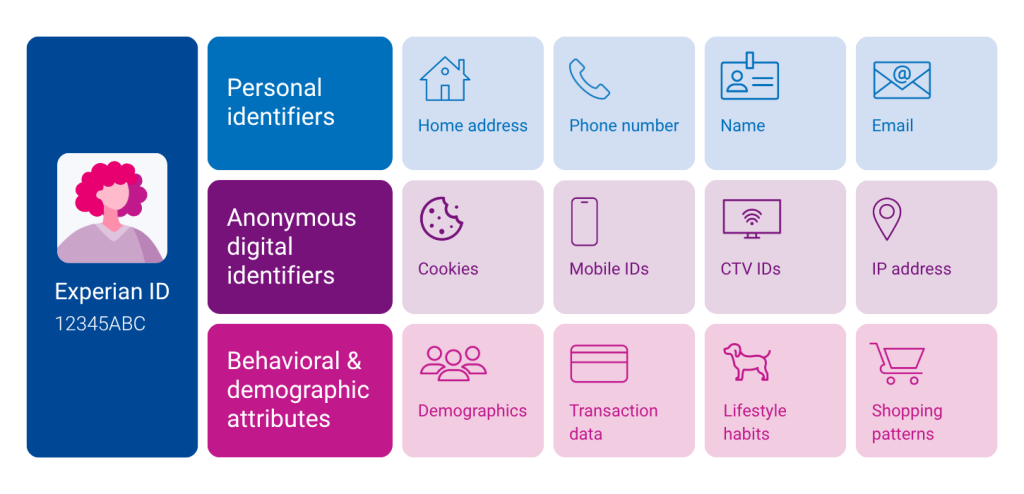
Common identifiers include:
- Cookies: Browser-based identifiers used to recognize activity within a particular browser
- Emails: Plain-text or hashed identifiers that can support identity matching
- Device IDs: Mobile advertising IDs (MAIDs) or app-based identifiers
- Loyalty IDs: Program numbers that tie online and offline activity
- Hashed PII: Personally identifiable information (PII) transformed into privacy-protected strings that can support matching without exposing the original values
Ultimately, identity resolution can help you recognize the same customer wherever they engage while protecting customer data.
Why is identity resolution critical in a privacy-first world?
Even as cookies linger, marketers have already shifted their strategies to rely on first-party data, where choice and transparency are the baseline expectation.
At Experian, our long history as a regulated data steward makes us a uniquely capable and trusted partner for managing modern compliance expectations. Our identity resolution solutions maximize the value of permission-based data while meeting consumer demand for privacy, personalization, and control.
Struggling with scattered customer data? We make identity resolution seamless.
How AI powers modern identity resolution
AI and machine learning strengthen identity resolution by analyzing billions of signals at scale, helping you improve match accuracy and connect recent activity to stable identities. Resolved identity can then provide a stronger foundation for predictive insights and more relevant marketing decisions.
Connect more fragmented identifiers
Deterministic matching connects records using exact identifiers, such as a login, hashed email, or loyalty ID. When those signals are unavailable, machine-learning models can evaluate probabilistic relationships across timestamps, IP addresses, user agents, cookies, and device IDs to determine which identifiers likely belong together.
Our Digital Graph applies advanced machine-learning clustering across more than 4.2 billion digital identifiers. Analyzing patterns at this scale can improve match accuracy and reduce the risk of false positives compared with static rules alone.
Incorporate more recent activity
Activity Feed captures digital events as they occur, resolves them to stable household and individual identities, and delivers event-level records hourly, making fresher resolved activity available for use across your marketing.
Turn resolved data into predictive insight
Identity resolution determines which signals are likely connected. Predictive modeling builds on that resolved identity foundation by analyzing behavioral patterns and other signals to anticipate likely interests or actions.
At Experian, our AI enhanced modeling surfaces combinations of signals associated with outcomes such as purchase, response, retention, or upsell. Our modeling teams review, test, and validate these signals before incorporating them into models. The resulting insights can help you prioritize audiences and inform more relevant messaging, offers, and experiences across personalization, connected TV (CTV), cross-channel targeting, activation, and measurement.
This identity foundation will become even more important as agentic media systems take on a larger role in campaign planning, activation, and optimization. These systems need accurate identity and trustworthy data context to interpret signals, make informed decisions, and act within defined parameters.
What changes for marketers when AI powers identity resolution?
The combination of AI and identity resolution changes how you work with customer data in three practical ways.
1. Respond to recent behavior
Delayed or incomplete customer views can make it harder to recognize changes in intent. With access to recently resolved activity, you can adjust targeting, optimization, and measurement based on newer signals rather than relying solely on periodic data snapshots.
2. Build more useful audiences
Resolved first-party data can be enriched with Experian Marketing Attributes and used alongside our syndicated audiences to help you:
- Understand consumers beyond their direct interactions with your brand
- Build more refined audience segments
- Reduce repetitive data preparation
- Activate audiences more efficiently across channels
3. Prioritize the right opportunities
Broad demographic criteria can show you who belongs to a category, but not necessarily who is more likely to support a particular campaign objective.
Our AI-enhanced modeling can build on resolved and enriched data to identify combinations of signals associated with a particular profile or action. These models can help infer consumer and household attributes when information is limited and identify consumers who may be more likely to act against a given objective.
That gives you a basis for deciding whom to reach, how to engage them, and where to invest while keeping marketing anchored in people.
How does identity resolution help brands?
These operational improvements can translate into broader business benefits, from expanding addressable reach to supporting more relevant customer experiences and more efficient media investment.
Creates a unified customer view
Connecting data from loyalty programs, point-of-sale (POS) systems, customer relationship management (CRM) platforms, digital interactions, and offline sources gives you a clearer picture of each customer across touchpoints.
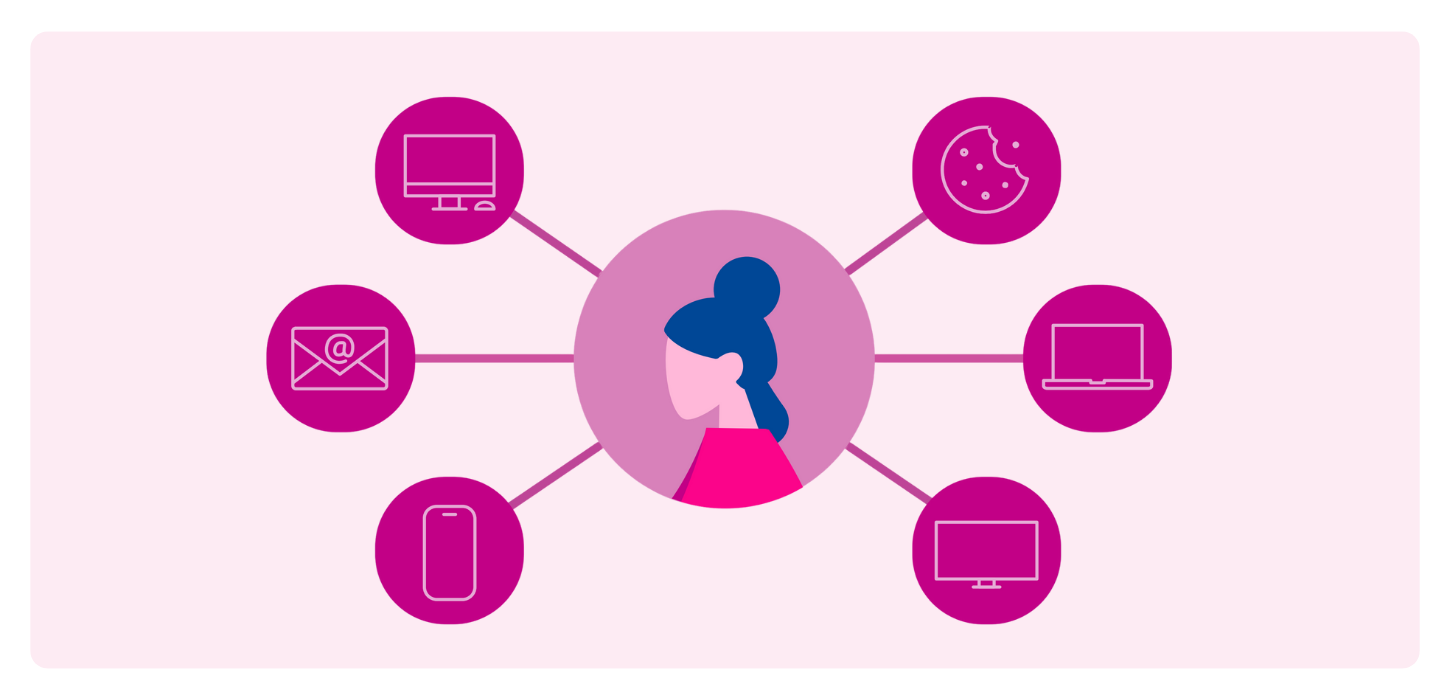
This can improve match rates, expand your addressable audience, and help you reach more of the right consumers across channels.
Enables more relevant AI-powered customer experiences
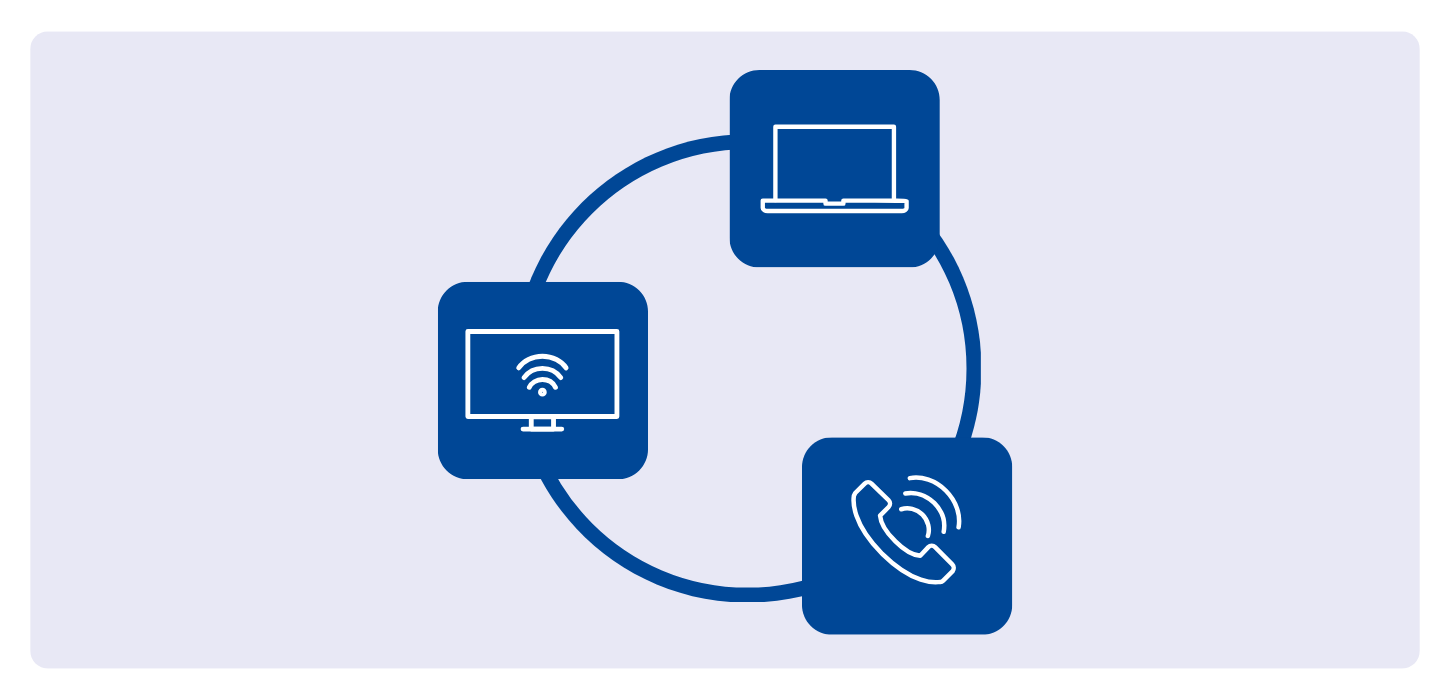
Customers constantly switch devices, update their information, and change preferences. A strong AI customer experience depends on recognizing those changes without treating each new interaction as a different person.

When paired with recent activity, a resolved identity foundation gives AI models more consistent context for interpreting changing signals and informing messaging, offers, and timing.
This can support more consistent cross-channel experiences, stronger engagement, and, over time, conversion and customer lifetime value (LTV) goals.
Drives better marketing ROI
A stronger identity foundation helps you direct your budget toward the audiences, channels, and opportunities most relevant to your campaign objectives. With better targeting and prioritization, you can reduce wasted impressions and make more informed investment decisions.

Over time, that efficiency can contribute to lower acquisition costs, stronger return on ad spend (ROAS), and higher overall marketing ROI.
Supports privacy-conscious data use
We apply rigorous data governance standards and provide consumer choice mechanisms such as opt-outs and data correction. This helps you use identity data responsibly while supporting personalization and protecting consumer trust.

See our identity resolution solution in action
What are some identity resolution use cases and examples?
Every industry faces its own unique identity challenges, but identity resolution is the common thread that turns scattered data into connected experiences. Let’s break down how companies in different verticals are putting it to work (and the kinds of results they’re seeing).
Audio
People use audio while commuting, working out, and even folding laundry. It can be one of the hardest channels to track because of how frequently listeners switch between apps, stations, and devices.

Our identity resolution partnerships with Audacy and DAX change the game:
- Audacy helps tie scattered listening into a single view, so you can follow audiences across devices and keep ads relevant in the moment.
- DAX pairs more than 3,500+ Experian syndicated audiences with its audio network, enabling you to target and launch impactful campaigns at scale.
These partnerships turn audio into an accurate channel where ads feel personal, privacy-safe, and measurable.
Financial services
In financial services, identity resolution creates a more consistent foundation for understanding customers across touchpoints and connecting them with relevant audience insights. This can help banks, insurers, and lenders tailor outreach for mortgages and refinancing, credit cards and deposits, personal loans, insurance, and wealth management, while supporting applicable regulatory requirements.
We offer approximately 400 financial audiences, including segments such as:
- In Market First Mortgage
- Refinancing Homeowners
- Credit Seeking Card Switcher
- Deposits Financial Personality
- Investment Financial Personality
- Investable Assets
Through our partnership with FMCG Direct, Consumer Financial Insights® and Financial Personalities® segments provide additional insight into behaviors such as credit card use, deposit balances, and investment habits without exposing sensitive personal details.
These insights help you engage consumers based on relevant financial behaviors, needs, and moments — from building credit and buying a home to managing investments and preparing for retirement.
Read more about how our financial audiences support privacy-safe personalization.
Gaming
Gamers don’t stick to one platform. Player data gets scattered across mobile, console, and PC, so it’s tough to keep track of individuals. We help stitch those signals together so you can finally see the whole picture, personalize gameplay, and keep players coming back.
With enriched profiles, you can deliver offers that resonate and earn fresh revenue by packaging high-value gaming audiences for advertisers outside the industry.
Unity, a leading gaming platform, is tapping into Experian’s syndicated audiences to gain player insights and help advertisers reach gamers across mobile, web, and CTV. For global publishers, unifying player data with Experian has driven higher engagement and stronger ad ROI.
Healthcare and pharma
You can’t afford slip-ups with HIPAA regulations. Identity resolution makes it possible to engage the right patients (DTC) and healthcare professionals (HCP) with de-identified audiences rather than third-party cookies.
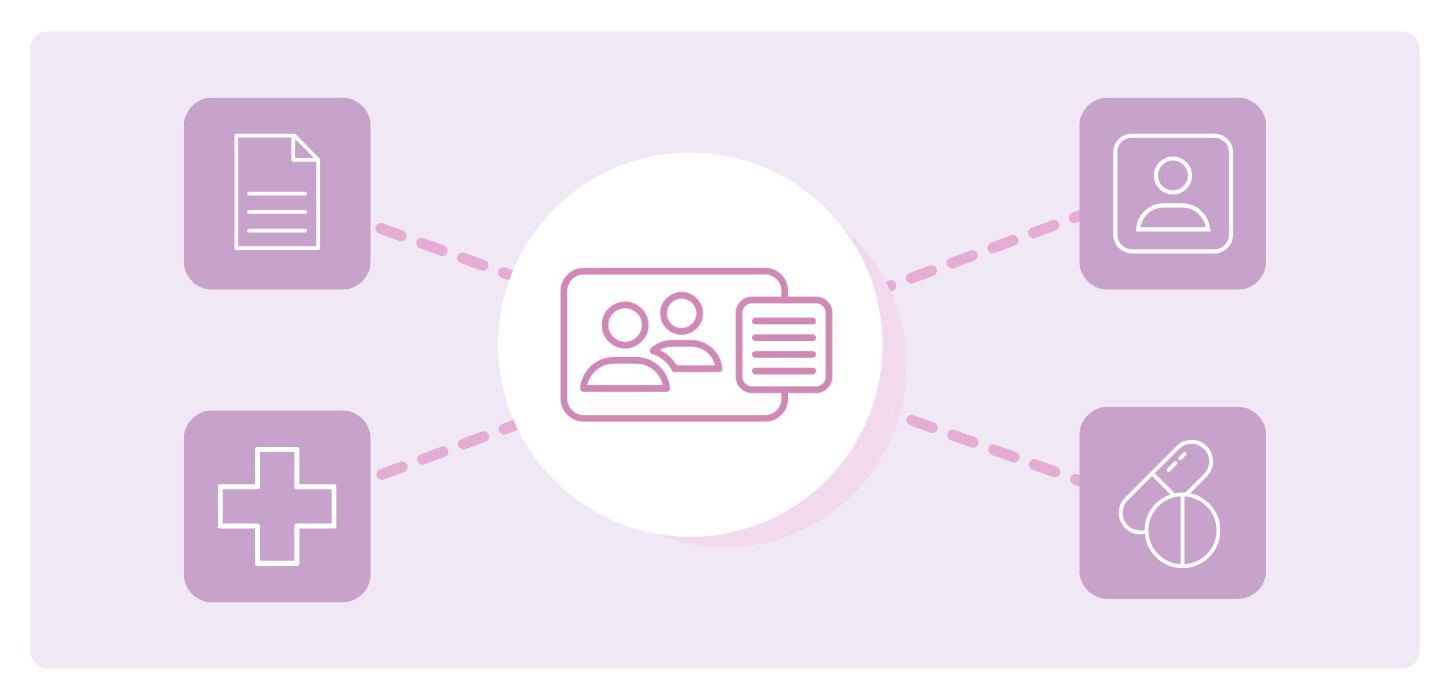
AI and machine learning have always been part of how we power identity resolution. In healthcare, that means using AI-enhanced modeling to connect de-identified clinical and claims data with lifestyle insights. The result is a more comprehensive picture of the patient journey that helps close care gaps, reduce wasted spending, and improve outcomes.
By working with partners like Komodo, PurpleLab, and Health Union, we make it possible to activate campaigns at scale that boost engagement and adherence while keeping patient privacy front and center:
- Komodo Health enriches our identity graph with insights from millions of de-identified patient journeys plus lifestyle data, giving you a fuller view of where care gaps exist and how to close them.
- PurpleLab connects clinical and claims data to our platform, letting you activate HIPAA-compliant audiences across CTV, mobile, and social with the ability to measure outcomes like prescription lift and provider engagement.
- Health Union contributes a data set built from 50 million+ patient IDs and 44 billion+ patient-reported data points. Combined with our identity and modeling capabilities, this improves match rates and delivers up to 76% net-new reach, so campaigns reach patients and caregivers in critical health moments.
These capabilities help you launch privacy-first, highly targeted campaigns and connect media exposure to meaningful outcomes.
Explore our pharma playbook to learn how to:
- Reduce governance risk
- Keep patient and healthcare provider identity workflows appropriately separated
- Sequence activation across channels
- Connect media exposure to outcomes
- Evaluate potential workflow partners
Media and TV
Viewers tend to hop around between linear TV, streaming apps, and social feeds. And without identity resolution, every screen looks like a different person. You can accurately plan, activate, and measure campaigns by unifying viewing behaviors into one ID with our AI-powered identity graph.

Curious how identity resolution can power your customer analytics? We can walk you through it.
Retail and e-commerce
Shoppers move between websites, apps, carts, stores, and checkout lines, leaving fragmented signals along the way. In retail, identity resolution connects online and offline activity — such as digital engagement, loyalty transactions, and in-store purchases — to create a more complete view of the customer journey. This supports more relevant targeting, consistent experiences, and clearer measurement across channels.

Experian retail audiences add context based on how consumers engage, where they shop, and what they buy. You can activate and layer audiences to align channel selection, creative, and timing with demonstrated retail behaviors such as:
- Streaming First Cord-Cutter Households
- eCommerce Diehards
- Frequent In-Store Buyer Households
- Category-Specific High Spenders
Identity resolution is also increasingly important as commerce media evolves beyond traditional retail networks. Our 2026 State of advertising report explains how transactional data can give brands a clearer view of the purchase journey, support on-site and off-site activation, and connect upper-funnel investment to measurable outcomes across payment platforms, marketplaces, and merchant ecosystems.
Our 2026 Digital trends and predictions report examines this broader shift, including how commerce media is expanding beyond retail and why stronger connections among data, identity, activation, and measurement will be essential for turning media investment into business outcomes.
Travel and hospitality
Travelers move between devices and channels as they research destinations, compare options, and complete bookings. Identity resolution helps travel and hospitality brands connect loyalty, booking, and other digital and offline signals to create a more consistent view of guest preferences and intent. You can use that understanding to deliver relevant offers, reach high-intent audiences, and determine which marketing efforts drive bookings and repeat visits.
Windstar Cruises put this approach into action when we worked with MMGY to use our identity graph to connect digital media exposure with confirmed bookings. More than 6,500 bookings valued at over $20 million were attributed to MMGY-managed placements.
How should I evaluate identity resolution tools and providers?
When choosing identity resolution tools and providers, evaluate both their underlying identity data and the way they bring AI and identity resolution together. Look for:
- Data scale, quality, and sourcing: Identity resolution is only as reliable as its underlying data. Ask what online and offline sources the provider uses, whether its models are grounded in proprietary and verified data, and how it evaluates the accuracy, permissioning, and recency of outside sources. A broad data set is most valuable when its origins and quality are clearly understood.
- Match methodology, accuracy, and validation: Look for a provider that combines deterministic matching based on exact identifiers with AI-driven probabilistic (pattern-based) matching when exact signals are unavailable. This balance can preserve the accuracy of confirmed connections while extending reach across fragmented identifiers. Ask how the provider validates match quality, measures false positives, sets confidence thresholds, and refreshes identities as consumer signals change.
- AI governance and responsible use: Providers should be transparent about how their AI models are developed, tested, monitored, and governed. Ask whether qualified experts review and validate model outputs, how performance or bias concerns are addressed, and what safeguards support responsible use.
- Privacy and compliance readiness: Compliance can’t be an afterthought. Your identity partner should maintain strong data governance and provide tools that help support applicable privacy requirements, including consumer opt-outs, corrections, and deletions.
- Integration flexibility: A good provider fits into your world, not the other way around. Look for pre-built integrations with your customer data platform (CDP), demand-side platform (DSP), and broader marketing tech (MarTech) stack so you can get up and running without the heavy IT lift.
- Measurement capabilities: Ask how the provider connects resolved identities, media exposure, and customer outcomes. Strong measurement capabilities should help you evaluate campaign performance across channels and use those insights to improve future planning.
How Experian enables enterprise-grade identity resolution
Experian’s identity resolution solutions give you the scale, accuracy, and compliance support required for complex enterprise environments. Our solutions are:
- Built on trust: Backed by 40+ years as a regulated data steward, so you can act with confidence.
- Powered by our proprietary AI-enhanced identity graph: Combining breadth, accuracy, and recency across more than 4.2 billion identifiers, continuously refined by machine learning for maximum accuracy.
- Seamlessly connected: Pre-built data integration with leading CDPs, DSPs, and MarTech platforms for faster time to value.
- Always up to date: Frequent enrichment and near-real-time identity resolution through Experian Activity Feed for timely personalization and more responsive customer engagement.
- Privacy-first by design: Compliance with GLBA, FCRA, and emerging state regulations baked in at every step, supported by rigorous partner vetting.
Turn connected identities into measurable growth
Identity resolution turns fragmented signals into connected, measurable, and compliant experiences. From retail to gaming, brands using it see stronger personalization, engagement, and ROI.
At Experian, we bring AI and identity resolution together with the data, trust, and innovation needed to make those connections work across every channel. Our approach applies AI to connect fragmented identities at scale, while data enrichment and predictive modeling help you understand audiences, prioritize opportunities, and support more relevant personalization.
If you’re ready to turn fragmented data into growth, now’s the time to start.
See how we can support identity resolution at scale
Identity resolution FAQs
The difference between deterministic and probabilistic matching is how they connect identifiers. Deterministic matching uses exact identifiers to create high-confidence connections, while probabilistic matching uses signals and algorithms to identify likely relationships. Leading providers typically combine both methods.
Yes, AI helps identity resolution by connecting identifiers when exact deterministic matches aren’t available. Machine-learning models evaluate patterns across signals and predict which identifiers likely belong together. We apply machine-learning clustering across more than 4.2 billion digital identifiers to resolve fragmented activity at scale.
Identity resolution can improve ROI by creating more complete customer profiles that support better targeting and personalization. Higher match rates can expand addressable audiences, reduce wasted spend, and boost ROAS.
Yes, identity resolution can work without third-party cookies by using first-party data and privacy-protected identifiers, such as hashed email addresses, to support addressability and personalization.
We differ from a CDP in the scale and depth we can add to your existing data. While a CDP primarily unifies data you already own, we can complement it by connecting customer records to our identity graph and providing identity resolution and data enrichment capabilities.
Yes, Experian is GLBA/FCRA compliant, GDPR/CCPA ready, and supports consumer opt-outs and corrections to ensure responsible personalization.
When comparing identity resolution tools, look for a provider that combines deterministic and AI-driven probabilistic matching, uses high-quality data with clear sourcing, validates match quality, and governs its models responsibly. The right tool should also support applicable privacy requirements and integrate flexibly with your existing marketing technology.
Latest posts

Buyers can now put Experian’s audience and contextual intelligence to work in Google Ad Manager Curation in two ways: through off-the-shelf solutions available directly in Google Ad Manager, or through Custom Curation packages that Experian builds using Google Ad Manager’s inventory supply. Together, these options bring Experian’s consumer data foundation closer to the Google supply agencies already buy, with the flexibility to choose between a ready-to-use solution and an Experian package tailored to specific campaign goals. Why targeting at the source matters Many audience strategies still apply targeting on the buy side, which means signals pass through multiple systems before an impression is evaluated. Each step can shrink the pool of requests where the audience is still recognizable, so a carefully built strategy can reach the auction at a fraction of the scale it started with. Google Ad Manager Curation moves segment evaluation closer to the ad request. When a request matches the selected Experian segment, Ad Manager sends the bid request with the associated Deal ID to the buyer’s DSP. This more direct path can support stronger match and deal-transaction rates, more accurate forecasting, and better access to the audience defined in the strategy. As AI shapes more media decisions, the quality and provenance of the data feeding those systems matter more. Evaluating audience or contextual criteria closer to the source helps preserve the connection between the strategy and the impression being considered. Two ways to get started The right entry point depends on how much customization the campaign requires. Buyers can access Experian solutions off-the-shelf directly in Google Ad Manager or work with Experian to build a Custom Curation package using Google Ad Manager inventory supply. Start off-the-shelf For buyers who want direct, self-service access to Experian audience and contextual solutions. Experian solutions are available off-the-shelf in Google Ad Manager, giving buyers a straightforward way to select the data or contextual strategy that fits their campaign and create packages through Google Ad Manager’s Curation capabilities. Experian Audiences Experian Audiences draw on a deterministic offline identity foundation that represents more than 250 million U.S. consumers and 126 million U.S. households. Buyers can choose from Experian’s Audiences spanning demographics, lifestyle, financial signals, media habits, and household characteristics. That depth adds real-world consumer context beyond digital behavior alone. Contextual Experian contextual solutions give buyers a way to reach relevant environments without relying on identity. Buyers can select contextual audiences aligned to specific interests, categories, and content to inform where media appears. Experian also offers Predictive Indexed, which uses Experian audiences to predict the contextual categories and pages to target based on the likelihood that consumers visiting those environments fall within the selected audience. This gives buyers an audience-informed way to approach contextual activation without requiring identity at the point of activation. Build a Custom Curation package For buyers who need a strategy tailored to specific audience, contextual, and inventory requirements. Experian can build Custom Curation packages using Google Ad Manager’s inventory supply based on the targeting criteria that matter for a campaign. Where off-the-shelf solutions draw on Experian data, custom packages can also incorporate partner audiences and a brand’s own first-party audiences. Packages can combine Experian audiences, partner audiences, a brand’s own first-party audiences, contextual signals, and inventory or site criteria. Experian applies those criteria against Google Ad Manager inventory supply and brings the data, targeting, and inventory together into a single curated deal. This gives buyers a way to combine audience and supply decisions rather than managing each component separately. The approach can be tailored to the campaign. A buyer might start with a defined audience and add contextual or inventory criteria, bring a brand’s established first-party audience into the strategy, or build around specific supply and audience-quality requirements. Choose the path that fits the campaign Both paths do the same underlying thing: they move the audience or contextual decision closer to the ad request, before signal loss builds across the path. Whether a campaign calls for something ready to use or a package built to spec, the result is a more direct line from strategy to impression. Ready to get started? Explore Experian solutions available off-the-shelf in Google Ad Manager or contact your Experian representative to request a Custom Curation package. Latest posts

See how Experian helped FanThreeSixty clean, match, and enrich 7.6 million fan records through data enrichment and identity resolution.

Activate Experian Audiences through Index Marketplaces to connect audience data and media supply with simpler workflows and greater visibility.