
How to Make Quicker Decisions on Used Vehicle Acquisition

by Kelly Lawson 3 min read July 11, 2022

As competition for used vehicles remains fierce, dealers must make quick decisions on whether to acquire a potential vehicle—or someone else will. Whether you need to evaluate a trade-in or want to make a flat-out offer on a vehicle, quickly accessing the vehicle’s history is only the first step. What if you could determine the likelihood that a vehicle will be on the road in five years and compare it to other similar vehicles? Would this help in your decision-making?

Use the AutoCheck Score to evaluate vehicles for your lot

The patented AutoCheck ScoreSM was developed to help dealers determine the likelihood that a vehicle will be on the road in five years. The AutoCheck Score summarizes vehicle history data into an easy-to-understand “score” and provides an equivalent score range. Understanding the likelihood that a unit will still be on the road in five years gives dealers more perspective on a vehicle’s desirability and can help you accurately price it.

Use the AutoCheck Score to more accurately merchandise vehicles

The AutoCheck Score range will give you similarly aged and classed vehicles for comparison that you can use to help merchandise the vehicle for market and help manage consumer conversations regarding the vehicle’s price.

How does the AutoCheck Score work?

The AutoCheck Score analyzes various characteristics, including age, segment, mileage, number of owners, vehicle use, vehicle events, accidents, theft, and title brands. Essentially, this score summarizes the AutoCheck Vehicle History Report fields and delivers a “score range” that allows you to compare the actual vehicle (score) to other similarly aged and classed vehicles.

The score is based on a scale of 1 to 100, but reading the score in conjunction with the score range is essential since looking at the score without knowing the range will reveal only half the story. Check out the example below.
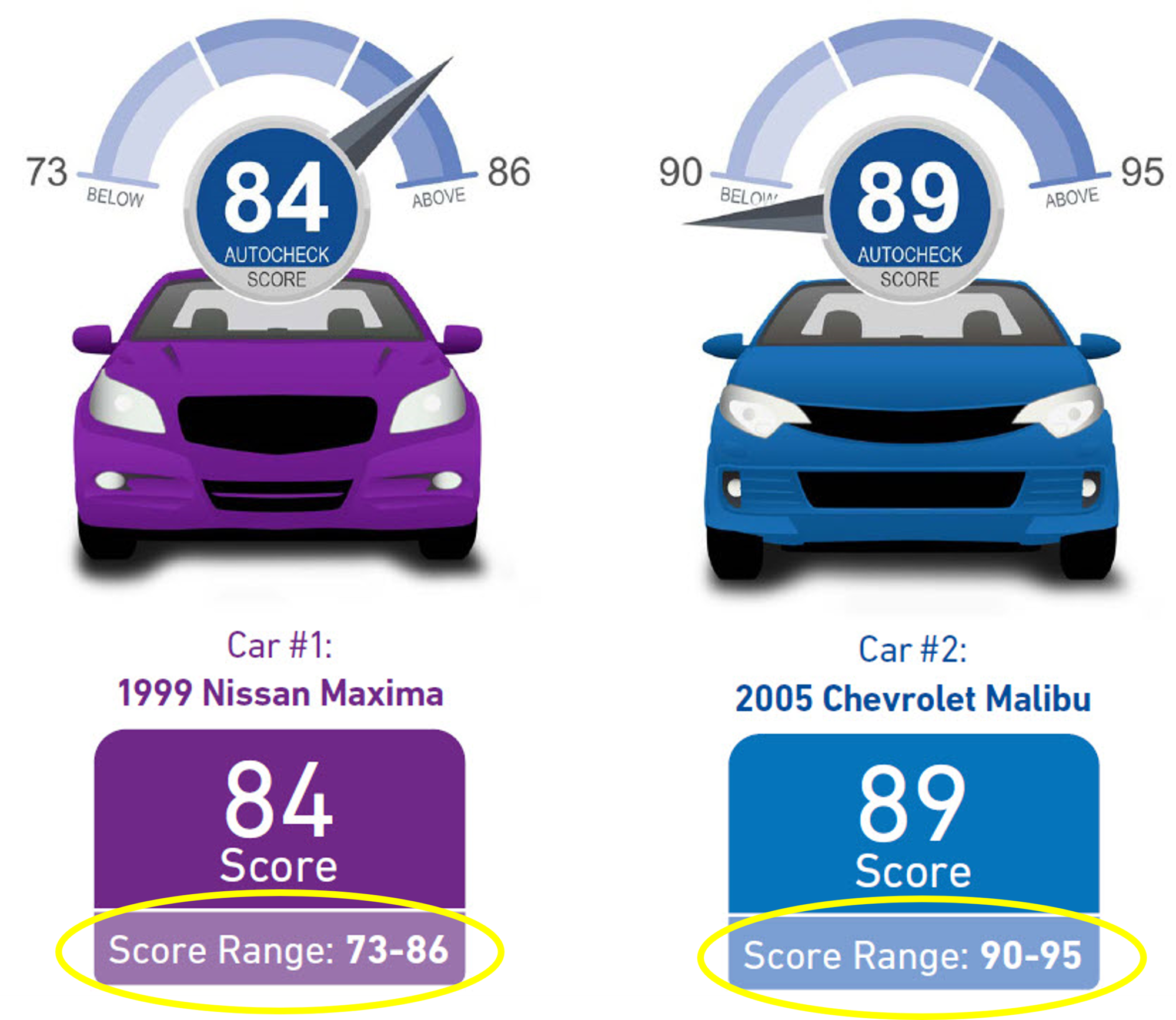
Car #1 has a lower score than Car #2. However, look at the score ranges (73-86). For Car #1, other comparable vehicles should fall into a range from 73 to 86, and this car scored an 84. That means the vehicle is within the AutoCheck Score range compared to other similar cars of the same age and class.

Car #2 has a score of 89. Because this is higher than Car #1’s score, you might assume this car has a more favorable vehicle history, but that’s not entirely accurate. Comparable vehicles should score in a range from 90 to 95, and this car falls short. That means the car’s history is slightly less favorable compared to similar vehicles of the same age and class. In today’s competitive environment though, dealers may decide to take in both trades, and the AutoCheck Score can also help make decisions on how to price the vehicles for market.

Become an AutoCheck member today

As an AutoCheck subscriber, you’ll have access to the AutoCheck Score. Between the large graphic display and the simple number comparison, the AutoCheck Score can help you make decisions on vehicle acquisition much quicker and easier!


Related Posts

Why Distribution Matters in Income and Employment Verification 

Verification has become an increasingly important area of focus in mortgage lending, but success is about more than just coverage. In the latest episode of the Chrisman Commentary Podcast, Experian's Jamie Norris, Senior Manager of Strategic Alliances, shares why distribution and integration are increasingly the keys to driving adoption, automation, and better borrower experiences.  Why Distribution Matters in Verification  As lenders continue to pursue faster, more efficient mortgage processes, verification solutions must fit seamlessly into the systems they already use. Norris explains how Experian's strategy is focused on helping lenders access trusted income and employment data while minimizing workflow disruption by making Experian Verify accessible across loan origination systems (LOS), point-of-sale platforms, underwriting technologies, and reseller networks.  Building a Smarter Verification Strategy  The conversation explores why lenders benefit from having access to multiple verification providers, how they can optimize verification strategies to maximize automation while minimizing costs and borrower friction, and why an "instant-first" approach is gaining momentum across the industry.  Looking Ahead: AI, Automation, and the Future of Mortgage Lending  Norris also discusses how AI-driven underwriting and decisioning are reshaping mortgage technology. As lending platforms become increasingly automated, real-time verification data is expected to support faster decisioning and more streamlined borrower experiences.  She shares Experian's vision for expanding its verification ecosystem and delivering a broader suite of solutions that meet lenders wherever they work.  Listen to the full episode above to hear Jamie's insights on verification strategy, partner integrations, AI-enabled lending, and what's next for mortgage automation. 

August 18, 2026 by Ted Wentzel
The Email Address as Your Most Powerful Identity Signal

The why behind Experian's acquisition of AtData What happens when a comprehensive email intelligence database joins a global leader in data, analytics and fraud prevention? The acquisition of AtData adds 25+ years of building a complete view of email as an identity signal. Financial institutions can recognize, engage and protect customers unlocking a new standard for the way their teams work and the customer experience. That's what Experian's acquisition of AtData delivers. How we got here Not all email addresses tell the same story. Some are newly created. Some exhibit bot-like patterns. Some are inconsistent with every other signal you have about that person. Imagine a real customer. You have a job. You shop online. You have a primary email from your employer, a personal Gmail you've used for 15 years, and an old Yahoo address you still use for shopping because you've been using it since college. You're an engaged customer who interacts with brands, makes purchases and pays bills on time. But each system sees a different version of you. When you apply for credit, the lender sees one email. When you shop, the retailer sees another. When you sign up for a service, you might use the third. For financial institutions: You slow down the approval process to manually verify identity or approve applicants without the full picture. For retailers: You can't tell which version of "customer" is the most engaged, so you either over-mail or under-serve. For fraud systems: Sees a new account created under one email and flags it as suspicious because it doesn't have the history. This was the original problem AtData was built to solve in 1999. Twenty-five years later, that problem didn’t go away, it became more complex. Email fragmentation and device sharing are more common, and identity theft is more sophisticated. Capabilities that now work together Experian has built sophisticated identity and fraud solutions backed by consumer data resources and decades of expertise in credit and risk. AtData brought the ability to assess whether an email address is trustworthy, reachable and consistent—at scale, in real time. Experian is now making email intelligence foundational, not optional. This matters for: Fraud prevention and risk management: Distinguishing a returning customer from a new threat. Knowing whether an email is newly created, exhibiting bot-like patterns or inconsistent with other identities is crucial. Compliance: Building audit trails that can explain identity decisions. Email data history and behavioral signals create the documentation needed to defend your decisions. Credit: Verifying identity in a world where traditional signals are shifting. Email signals provide a persistent, durable identifier that confirms who someone actually is. Marketing: Reaching the right person across email, mail and digital channels. Email intelligence reveals which addresses are actively engaged and reachable. Research shows email remains one of the highest-ROI marketing channels outperforming paid search and social advertising1. The problem every marketer faces: You end up burning budget on addresses that bounce, are unmonitored or are associated with users who never open mail. For credit marketing specifically, email enables faster, more targeted delivery of firm offers across channels, something that's increasingly important in a post-cookie world. "Email is a persistent identifier in a fragmented world. It's what connects a person's postal address, phones, devices, behaviors—the full picture of who they are. By embedding that into our infrastructure, we're not just adding another data point. We're fundamentally improving how businesses understand who their customers are."- Ashley Knight, Senior Vice President, Financial Services and Data Why now? AI is reshaping how decisions are made in every industry. Models are getting faster, more automated and more embedded in core workflows. But AI is only as effective as the data behind it. Fragmented data + fast models = faster, larger-scale misclassifications. In an era of synthetic identities, AI agents, deepfakes and AI-generated activity, the value of durable, persistent, real-world data signals has increased dramatically. Deloitte’s Center for Financial Services projects that generative AI could drive fraud losses in the U.S. up to $40 billion by 2027, a 32% growth rate since 2023. And email sits at the center of it with business email compromise already being one of the most common and costly fraud types. People change phones, move homes and swap devices, but they often hold onto their email for years. That's the signal that protects your business, and the one we've built into the core of how we help you make decisions with confidence. View the press release here

August 6, 2026 by Zohreen Ismail
Building Financial Opportunity Through Purpose-Driven Partnership

Discover how the National Urban League and Experian partner to expand financial literacy and create economic opportunity.

August 6, 2026 by Scarlet Nickel

Subscribe to our Newsletter

Enter your name and email for the latest updates.

This site is protected by reCAPTCHA and the Google Privacy Policy and Terms of Service apply.

Subscribe to our Newsletter

Don't miss out on the latest industry trends and insights!
Subscribe