Loading...

Three essential ingredients for your marketing mix in a recession

Published: March 7, 2023 by Experian Marketing Services

The AdTech industry is undergoing rapid changes as it adjusts to the impacts of data deprecation and ever-changing privacy regulations. At the same time, there are fears of a potential economic downturn. How should you handle marketing in a recession? What should your marketing mix look like? In this blog post, we’ll cover how to navigate this uncertainty and three essential ingredients for your marketing mix.

First, we’ll look at the complexity and uncertainty facing marketers.

Turbulence with Twitter

After Elon Musk’s Twitter takeover in October 2022, half of Twitter’s top 100 advertisers left the platform and started to seek out alternatives.

The retail media boom

In the next four years, Forrester Research projects that U.S. retail media ad sales will double to reach 85 billion by 2026.1

Most of this growth is catalyzed by CPG and consumer electronic brands that have a scarcity of zero- and first-party data; they need more media closer to the point of purchase, especially as CFOs are scrutinizing budgets.
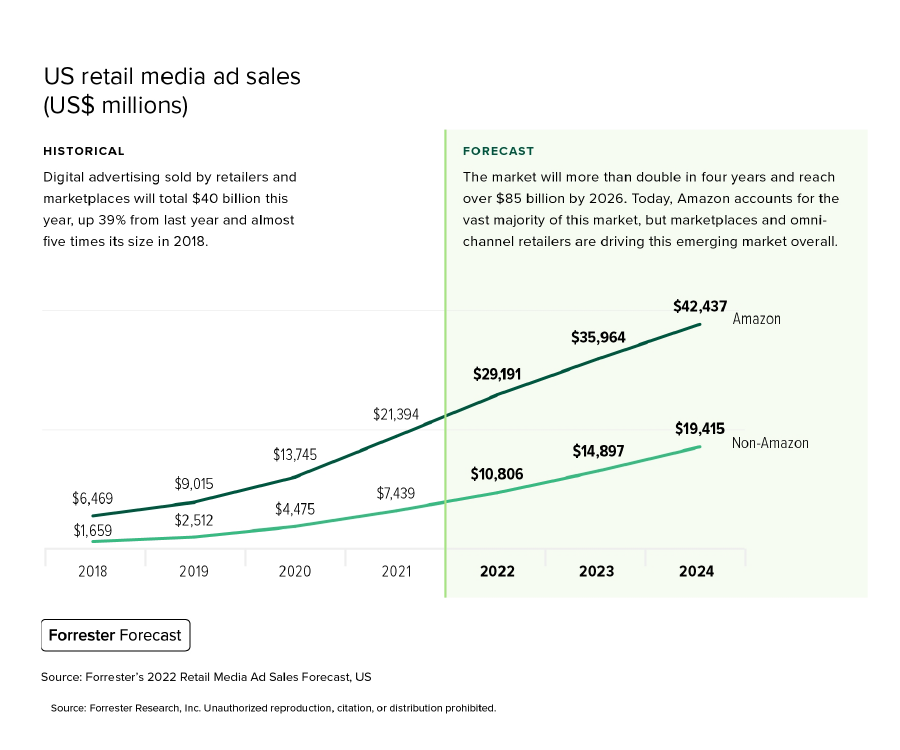
Chart that forecasts U.S. retail media ad sales will more than double in four years

Consumption continues to fragment

It’s becoming harder than ever to reach the right person, at the right time, predict their intent, and get a 360-degree view of your customer.2
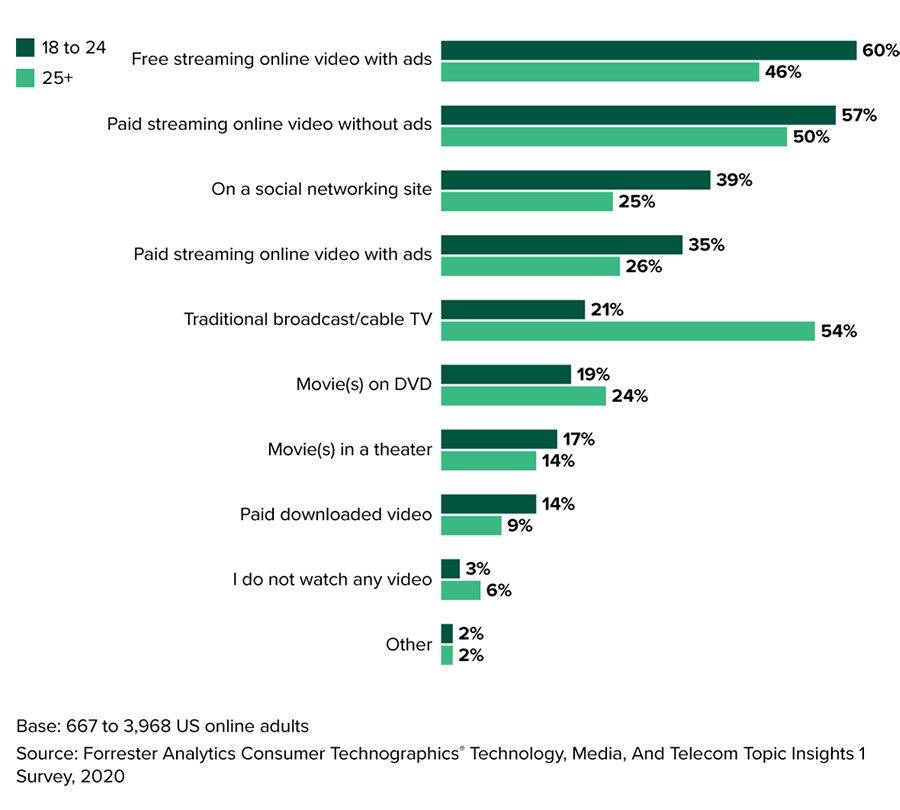
Chart that shows fragmented consumer media consumption

Data deprecation is top of mind

According to Forrester Research, updating their data strategy to address data deprecation is the number one priority for marketers. Addressing data deprecation is also a priority for consumers, who increasingly feel that audience targeting is more intrusive than beneficial.3

Data deprecation affects identity solutions

Third-party data and mobile ad IDs (MAIDs) are the connective tissue for identity solutions. As we see those signals go away, there are fewer linkages to resolve identity and it’s leading to a rise in fragmented, duplicated, and shallow identity.

Recession fears

In addition to everything happening in AdTech, there are also fears of a possible recession. According to Forrester, 40% of Gen Z and 41% of Millennials believe fears of an upcoming recession are greatly exaggerated. On the other hand, only 24% of Gen X and 12% of Baby Boomers agree.4

Navigate uncertainty and marketing in a recession

With the current macroeconomic conditions, data deprecation, and fragmented consumption in mind, what should your strategy look like for marketing in a recession? Forrester recommends three strategies:

  • People-led planning
  • Test creative
  • Optimize for marginal costs

People-led planning

Planning doesn’t have to be fragmented. Map offline and online media exposures to consumer decision journeys. Strategies like lifetime value (LTV) driven audience segmentation to correlate awareness at top of the funnel layered with demand generation exposures harvested later in the funnel. To do this, it’s crucial to work with providers that give you visibility into the audience buyer’s journey to awareness, intent, consideration, and purchase, all the way through to loyalty.5

Test creative

Make your creative work harder for you. Apply the same rigor with your creative that you applied to segmentation. Utilize multivariate testing to identify creative that is winning or losing. When you understand how each variable performs, you can scale the variables with creative optimization to have a material impact on performance.

Optimize for marginal costs

Optimize for marginal costs of acquisition, not just the average. Adjust for incrementality – what is the cost to acquire one more customer, rather than the average cost of acquisition.

Find the right marketing mix in a recession

With these changes in mind, how can you find the right marketing mix in a recession? We can show you the way.

You can create the right marketing mix with three key ingredients:

  • Audiences
  • Identity
  • Activation

Let’s explore each ingredient to start you down the path toward marketing campaign success.

Audiences: Know your customer

The first ingredient to add to your marketing mix in a recession is your audience. Knowing your customer is key to targeting the right audiences successfully. Data-driven targeting can help you find your best audiences based on demographics, modeled lifestyles, and behaviors to improve marketing campaign performance.

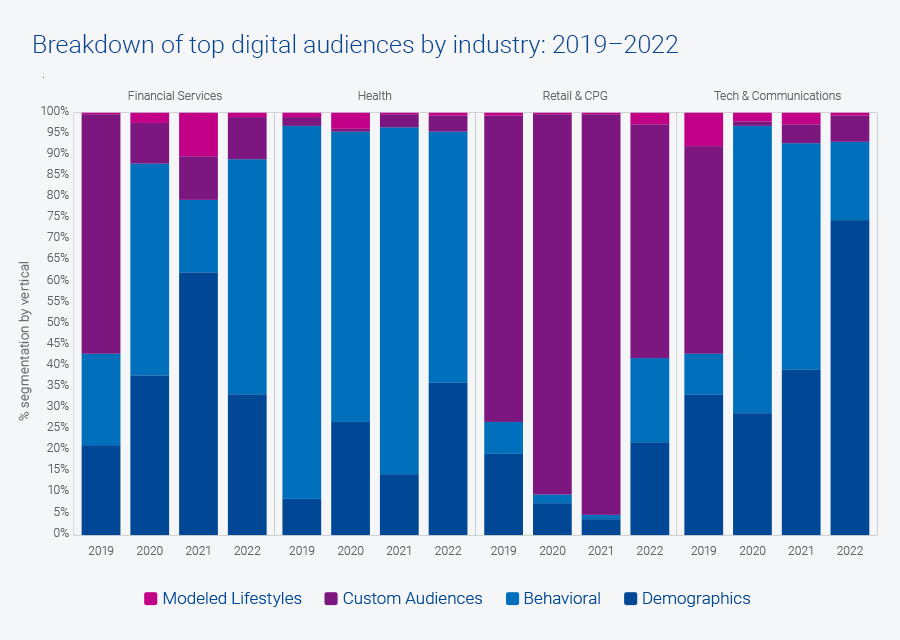
Not sure where to start when it comes to developing your target audience strategy? We can help. We track digital usage of our data used by advertisers and identified the top four digital audiences that advertisers purchased over the last four years.

Four digital audiences to consider

Marketing strategies are only as strong as the data foundation they’re built on. The top four digital audiences that advertisers are purchasing from Experian include:

  • Demographics
  • Behavioral
  • Modeled Lifestyles
  • Custom Audiences
Chart that shows the top digital audiences by industry from 2019-2022

Demographics

Examples include age, gender, relationship status, living situation, life experience, and employment.

Behavioral

This audience allows marketers to identify households that are more likely to engage in certain activities or belong to certain groups.

Modeled Lifestyles

Experian’s Mosaic® USA segmentation. This is a household-based consumer lifestyle segmentation system that classifies all U.S. households and neighborhoods into 71 unique types and 19 overarching groups, providing a 360-degree view of consumers’ choices, preferences, and habits.

Custom Audiences

This is an audience blended from multiple sources or derived from first-party look-alike modeling.

Changes in digital audience strategies

Over the last four years, Modeled Lifestyles and Custom Audience purchases represented the smallest share of digital activation, while Behavioral and Demographic segments were more popular with advertisers.

When the U.S. rolled out the COVID-19 vaccine, consumers became more active. People were shopping in stores, returning to the gym, and taking trips that they had postponed during the height of the pandemic. Marketers turned to higher compositions of Demographic and Modeled Lifestyles to reach these audiences between April and December of 2021.

Sustained growth in Demographic audience activation could suggest a move back to tried and true audience strategies as signals continue to decline and amid evolving regulation. With economic uncertainty, marketers return to what they know. Traditional targeting methods like Demographics and Modeled Lifestyles are the baseline of many marketing strategies and we predict that we will continue to see marketers activating against these data sets.

Download our 2023 digital audience trends and predictions report to discover our full insights on how digital activation has changed and where we’re headed.

Identity: Understand the customer journey

Identity resolution is the next ingredient that you should add to your marketing mix in a recession. It should be a foundational element of every marketer’s strategy.

What is identity resolution? In the simplest terms, identity resolution is the process of matching different devices, IDs, and touchpoints back to a single person. Identity resolution expands marketers’ addressability and reach of their target audience and helps inform and measure accurate customer journeys.

Identity resolution challenges

Identity resolution faces two main challenges:

  1. Making the data actionable. Humans are complex. We have behaviors that change based on our current social groups and life events, we use dozens of internet-connected devices in a single day, and we exhibit distinct behaviors that happen online and in the physical world. This means marketers have mounds of data being collected from different channels based on that dynamic behavior of people, making it feel impossible to organize the data in a way that makes it feel actionable, know how it ties back to real humans, and ensure they’re doing it in a responsible and compliant way.
  2. Signal loss. Marketers continue to lose important signals that they’ve previously been able to rely on to inform their next move. Signals are being lost as our industry places more privacy regulations and restrictions on what can be tracked and as consumers themselves change behaviors to protect their privacy.

As consumer behaviors continue to change and signals disappear, identity resolution gets exponentially harder.

Expand addressability and reach with identity resolution

Data deprecation adversely affects identity solutions, but identity resolution should be a key ingredient in your marketing mix. Identity resolution ensures that consumers experience more relevant products, offers, and messaging – allowing you to reap the ROI benefits of hitting consumers at the perfect point in their journey.
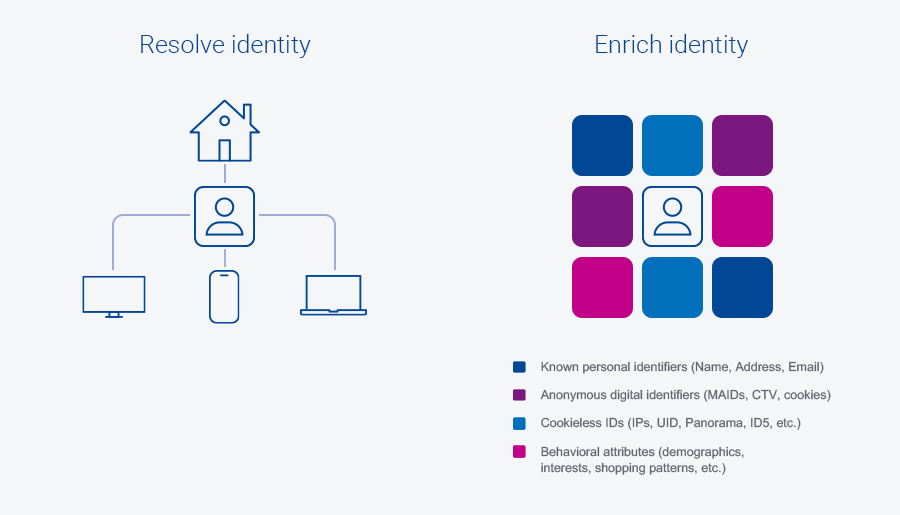
Resolve and enrich identity with identifiers and attributes

Finding an identity resolution partner

When selecting an identity resolution partner, you should understand the data and processes that are implemented behind the scenes. It’s important to know:

  • What makes up their consumer database?
  • How fresh is their data?
  • What identifiers can they match?
  • How do they protect consumer privacy?

At Experian, we’re rooted in deterministic offline data which creates a stable foundation. We then layer in digital and behavioral touchpoints. We have decades of experience managing consumer data safely. We have insights on 250 million individuals, three billion devices, and one trillion device signals. Our databases evolve as quickly as the human behavior powering them does.

Our approach to identity resolution is open and agnostic. This means we can collect and ingest nearly all available offline and online identifiers. We can do this in all types of environments, including connected TV (CTV), mobile, and cookieless. We have two types of identity resolution:

  • Offline
  • Digital

This ensures we control how known and anonymous data points are connected for consumer privacy purposes.

Identity resolution in action

Our depth of data gives our clients access to see the whole human and gain the context around singular data points.

Let’s walk through an example of our identity resolution capabilities.

Challenge

Our TV media platform client needed to measure the effectiveness of an ad campaign they were running on behalf of a leading consumer electronics brand. The TV platform wanted to be able to accurately report on which consumers made a purchase after seeing the brand’s TV commercial on their platforms.

Solution

Using our digital identity resolution services, our client could capture online purchases made on the brand’s website and link them back to a consumer profile. In addition to online transactions, our client used our offline resolution services to resolve email addresses of consumers that purchased offline, using warranty registration details.

With online and offline purchase data now resolved back to an individual ID, we also performed identity resolution on viewers in their TV subscriber files that had also been exposed to the TV commercial. This allowed us to identify subscribers that had both seen the ad and purchased a product.

We provided our client with a packaged report that they could white-label and pass along to the brand.

Results

By providing this attribution reporting to the brand, the TV platform could validate the ROI spent on their platform. The brand was extremely satisfied with the results, and they transitioned the one-off TV commercial into an ongoing campaign and purchased quarterly measurement. This led to solid recurring revenue for the TV platform.

Activation: Experiment and measure the impact

The third and final ingredient to finding the right marketing mix in a recession is activation. Experimentation is the best way to determine which channels work best for your business and provide the most ROI.

Demand-side platforms (DSP), video platforms, and sell-side targeting are three important activation channels that you should consider experimenting with.
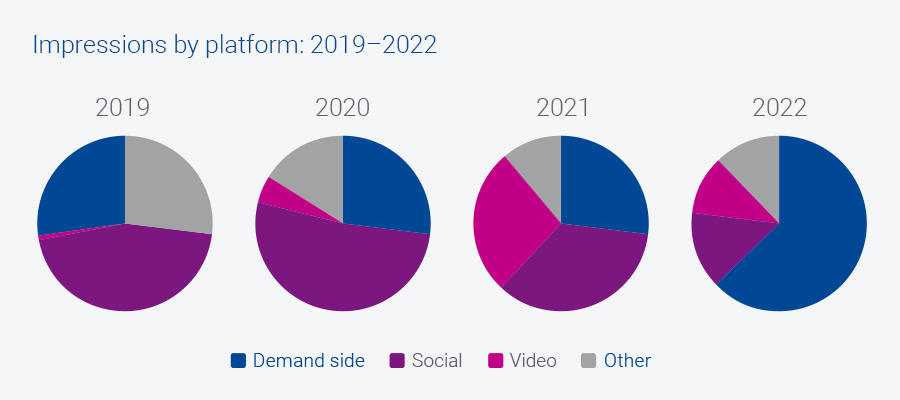
Chart that shows changes in impressions by platform from 2019-2022

Demand-side platforms

We continue to see increased demand for environments where alternative identifiers are being transacted (like DSPs and video). Social channels are decreasing; this can be attributed to changes in privacy, security, and concerns around brand safety.

Amazon’s DSP is catching up with Google and Meta to become a top ad platform.

Video platforms

Digital video and other video channels like over-the-top (OTT) and CTV will continue to grow. Digital video will capture the most ad spend in 2023 (22.4% in 2023 vs 19.3% in 2022). Because of this, advertisers are placing bigger bets on the combination of addressable and CTV.

Sell-side targeting

Data sharing relationships will become strongest on the sell-side as we move toward consented first-party data. Ad dollars are shifting to channels that use the sell-side approach, like retail media and CTV.

Sell-side targeting enables brands to access large amounts of inventory across publishers and retailers. By getting closer to the ad inventory, advertisers can future-proof their strategies by having more access to better data signals. Direct relationships like these will be necessary as privacy regulations increase and signal loss continues.

We can help you find the right marketing mix in a recession

Now is the time to be opportunistic. Gaining share of voice during a downturn is cost-effective. Proactive marketing builds pent-up demand.

Delivering the right message in the right place at the right time means truly knowing your prospects and customers as individuals. At Experian, we bring you the highest-resolution picture of people, so you and your customers can connect with confidence.

You can turn prospects into customers with the right audience. By understanding your customers better, you can find more like them. Together we can power better results.

Find the right marketing mix

Check out our webinar, “Find the right marketing mix with rising consumer expectations.” Guest speaker, Nikhil Lai, Senior Analyst from Forrester Research, joined Experian experts Erin Haselkorn and Eden Wilbur. Watch the recording to learn:

  • New data on the complexity and uncertainty facing marketers
  • Consumer trends for 2023
  • Recommendations on finding the right channel mix and the right consumers
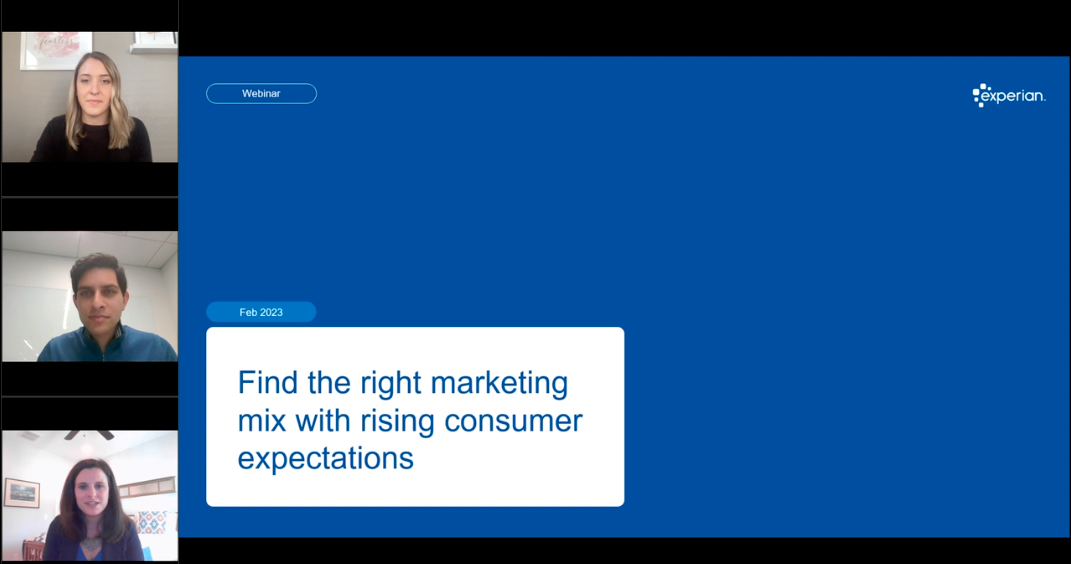
Three webinar speakers

Get in touch

This site is protected by reCAPTCHA and the Google Privacy Policy and Terms of Service apply.

Sources

  1. 2022 Retail Media Ad Sales Forecast, US. Forrester Research, Inc. 2022.
  2. Forrester Analytics Consumer Technographics® Technology, Media, and Telecom Topic Insights 1 Survey. Forrester Research, Inc. 2020.
  3. CMO Pulse Survey. Forrester Research, Inc. July 2021.
  4. Forrester’s Consumer Energy And Retail Online Survey. Forrester Research, Inc.
  5. People-Led Planning Solves Customer Problems to Drive Growth. Forrester Research, Inc. August 2, 2021.

Latest posts
Loading…
How Cuebiq improved campaign measurement with Experian’s Activity Feed

Cuebiq’s mission, as an offline intelligence and measurement company, is to quantify how digital marketing impacts offline consumer behavior. This case study shows how Cuebiq partnered with Experian to continue delivering in-store lift analyses despite signal loss. To achieve this, Cuebiq used Experian’s Activity Feed to resolve digital ad exposures to mobile ad IDs, so that marketers could know the effectiveness of their media campaigns on in-store visits and purchases.  Even as Google backs away from third-party cookie deprecation, the need for flexible, future-proof identity solutions remains. By working with Experian, Cuebiq could help their clients more accurately measure their campaigns and optimize their media.    Challenge: Increasing match rates across digital platforms Cuebiq wanted to enhance how well they connect digital ad exposures, across web, mobile, and connected TV (CTV), to mobile ad IDs (MAIDs), of consumers who visited their clients’ stores. They needed a single technology partner who could collect data across these environments and improve these connections.  With the ability to resolve exposures to households, individuals, and MAIDs to then facilitate attribution of digital exposures to offline store visitation, Cuebiq could continue to provide accurate reports on how digital ads impact offline consumer behavior. This clarity in data enables their clients to fine-tune their marketing strategies.   Cuebiq’s key objectives included:   Resolving digital exposures to MAIDs Increase overlap of offline and online data Improving the effectiveness of offline measurement offerings  Activity Feed: The solution to increase match rates Experian’s Activity Feed pulls together fragmented digital event data from all digital channels, including browsers like Safari and Firefox that restrict traditional tracking methods. Activity Feed ingests and ties digital ad exposure and website activity data to household or individual profiles hourly, helping client's associate ad exposures to impact by a household or individual. Activity Feed plays a crucial role in overcoming fragmented data and helping marketers accurately measure their cross-channel marketing efforts.   Cuebiq used Activity Feed to resolve exposure data from all environments, even cookieless ones, to a single household or individual and saw significantly higher match rates. Cuebiq received their clients’ ad exposure data resolved to mobile ad IDs (MAIDs) and correlated it to their clients’ in-store visitation and sales. To do so, Cuebiq implemented the Experian pixel, which they placed to track all their marketers’ impressions (mobile, CTV, web traffic, etc.). The Experian pixel collects information in real-time, such as:   Timestamp Cookies Device ID (MAID/CTV) when available IP address User-Agent Impression ID “Before we started working with Experian, we couldn’t fully maximize ad views across the complex digital landscape. In just a few weeks, they were able to maximize the match rate across the fragmented digital inventory, solving a huge problem when it comes to cross-channel attribution.” Luca Bocchiardi, Director of Product, Cuebiq Results Activity Feed combines separate data streams and matches them back to a household. This enables Cuebiq to expand household IDs and accurately identify MAIDs that are seen in-store for cross-channel measurement. Over a 21-day period, Cuebiq passed ~1 billion events to Experian. Activity Feed resolved 85% of total events to a household, 91% of which were tied to MAIDs.   By implementing Activity Feed, Cuebiq was successfully able to: Gain clearer insights into the success of their client‘s campaigns  Match consumer engagements in a privacy-compliant manner Tell the story of the key performance indicators (KPIs) related to their marketing efforts  A solution for measurement across cookied and cookieless environments Activity Feed is prepared for whatever the future of signal loss holds in store, capable of using third-party cookies and alternative IDs, like UID2.0s, ID5 IDs, hashed emails, and IPs for identity resolution. Experian remains fully committed to exploring a suite of next-generation solutions and prioritizing continued testing of different industry solutions to help customers maintain consumer visibility amidst signal loss. We’ve identified six viable alternatives to third-party cookies, how these alternatives fall short, and how Experian can help you navigate these alternatives.   “Experian’s customer service is extremely efficient and collaborative. We trust them to keep putting our business first long-term.”Luca Bocchiardi, Director of Product, Cuebiq Download the full case study to discover how Cuebiq used Activity Feed to overcome their challenges. Your path to maximizing match rates and resolving data from cookieless environments starts here.  Download the full case study Contact us About Cuebiq Cuebiq is transforming the way businesses interact with mobility data to providing a high-quality and transparent currency to map and measure offline behavior. They are at the forefront of all industry privacy standards, establishing an industry-leading data collection framework, and making it safe and easy for businesses to use location data for innovation and growth. To learn more, visit their website at www.cuebiq.com Latest posts

Jun 26,2024 by Lucy Simmonds, Content Marketing Specialist

Experian’s Graph unlocks a suite of next-generation data-driven advertising solutions

Today, Experian announced a suite of next-generation solutions that will help marketers navigate the challenges of cookie deprecation. Powered by the Experian Graph, these solutions will enable marketers to maintain behavioral targeting at scale. In partnership with Audigent, Experian announced the early-stage limited availability of Experian Audiences inside the Privacy Sandbox through the Protected Audiences API. Experian has also co-developed, with Audigent, an AI-driven contextual targeting solution layered with Experian’s rich Experian Marketing Data to continue delivering marketers scale and performance from their campaigns. Finally, Experian continues to evolve its signal-agnostic Graph, including coverage for industry-leading universal IDs, and plans to support IPv6 and phone-based UID2s. With these solutions, marketers can confidently deliver behavioral targeting after cookie deprecation and benefit from the power of Experian Marketing Data in their contextually targeted campaigns. As the industry prepares for ongoing signal loss and tightened privacy regulations, these solutions and further investments in Experian's identity Graph ensure Experian continues to power data-driven advertising and achieves the needs of modern marketers: addressable advertising, cross-device targeting, and measurement. Experian’s Graph allows marketers to target audiences in Privacy Sandbox via Audigent Building off Audigent’s work with Privacy Sandbox, Experian and Audigent tested the scale of Experian audience data in Privacy Sandbox and found that over 15 days, they were able to match audiences to over 150M Chrome browsers in the US. This solution – now in alpha – is powered by Experian’s Graph, leveraging an array of identifiers, including hashed emails and Hadron IDs. While the scale of targetable users and ad opportunities is still growing with the adoption of Privacy Sandbox by publishers and SSPs, the results are strong and provide a real-life illustration of how advertisers will be able to reach audiences in this new environment. “As the industry’s leader in building Interest Group segments in PAAPI, Audigent is thrilled to see world-class data partners like Experian work with us to build innovative solutions that deliver value now and will be absolutely critical as third-party cookies are deprecated in 2025.”DREW STEIN, FOUNDER AND CEO, AUDIGENT Data-driven contextual targeting is available through partnerships with Audigent and Peer39 As marketers prepare for cookie deprecation, they are turning to tried and true methods of targeting, like contextual, as they offer targeting strategies based on content and behavior instead of user identity. Experian is co-developing ID-less solutions that upgrade contextual targeting by intelligently indexing and infusing Experian’s rich Experian Marketing Data against contextual signals. By using these products, advertisers gain the ability to reach their audiences with a new and improved solution that delivers scale, performance, and value. We have beta launched a unique solution with Audigent that indexes Experian syndicated audiences against contextual signals through the power of the Experian Graph and Audigent’s Hadron ID to create PMPs that can be activated on any DSP. As part of the beta, a leading national advertiser ran a test via Audigent to see if this fully cookieless solution could deliver results at parity or better than today's ID-based options. The scaled 15-day flight not only met existing campaign delivery targets but also exceeded CTR goals by 25%. Experian has also partnered with Peer39 to make our geo-indexed syndicated audiences (e.g., Purchase Affinity and Demographic data) available through Peer39's contextual integrations. This allows marketers to confidently reach the right audiences in their digital marketing campaigns without third-party cookies. Experian's Graph now includes leading Universal IDs With the ever-changing nature of signal and identity, we’re continuing steps to be interoperable, and Experian's signal-agnostic Graph now supports the leading universal IDs: UID2s, ID5 IDs, and Hadron IDs. This is in addition to hashed e-mails, mobile ad IDs, and Connected TV IDs. Our strong coverage against cookieless identifiers means marketers will maintain addressable advertising as the Graph continues resolving data back to consumers and households in a privacy-centric way. In addition to providing greater breadth and depth of signals to reach US consumers, Experian's Graph is rebuilt weekly, which means our connections are highly accurate, refreshed, and addressable. “Experian is a valued partner in Nexxen's unified identity graph powering the Nexxen data platforms, which bring us the ability to seamlessly onboard client data, activate campaigns, and measure performance while maximizing biddable opportunities for our advertisers. They help ensure our clients can continue reaching audiences at scale and successfully execute campaigns.”Chance Johnson, Chief Commercial Officer, Nexxen Investments planned over the next year continue to ensure a Graph resilient to signal loss As connected TV (CTV) viewing continues to dominate, the importance of being able to match to IPv6 increases. Later this year, we’ll add support for IPv6 in our Graph as well as phone-based UID2s. This is in addition to our current coverage of IPv4 and email-based UID2s. As a result, all IP signals and UID2s will be resolved back to Experian’s household and individual profiles and their associated devices, which means marketers and platforms can better understand the full customer journey and reach people across their devices. Experian’s toolkit of cookieless solutions maintains addressability and ensures marketers can continue to do privacy-safe behavioral targeting at scale As the industry braces for the challenges posed by signal loss and evolving regulation, the unparalleled breadth, depth, and stability of Experian’s Graph empowers our partners across the ad tech ecosystem to confidently achieve their objectives and navigate uncertainty. What are you waiting for? Fill out the form to begin testing one of these cookieless solutions. Get started About the author Budi Tanzi, VP of Product and Solution Engineering, Experian Marketing Services Budi Tanzi is the Vice President of Product at Experian Marketing Services, overseeing all Identity Products. Prior to joining Experian, Budi worked at various stakeholders of the ad-tech ecosystem, such as Tapad, Sizmek and StrikeAd. During his career, he held leadership roles in both Product Management and Solution Engineering. Budi has been living in New York for almost 11 years and enjoys being outdoors as well as sailing around NYC whenever possible. Latest posts

Jun 13,2024 by Budi Tanzi, VP, Product

Introducing Experian Third-Party Onboarding

At Experian, we power data-driven advertising through connectivity. Today, we're excited to introduce our newest offering, which drives that connectivity: Experian Third-Party Onboarding. This new capability empowers third-party data providers by streamlining the monetization of their audiences through Experian’s expansive network of over 20 programmatic, social, and TV platforms. Data onboarding typically presents challenges, including complicated integration processes, limited ID matching capabilities, and opaque pricing structures, all compounded by less-than-ideal customer service. Experian Third-Party Onboarding eliminates the common barriers in the onboarding process and leaves users with a simple yet powerful solution for data providers to increase the adoption of their audiences and maximize their revenue. A leap forward in data connectivity Experian Third-Party Onboarding builds upon the investment and infrastructure used to distribute Experian's own audience segments. Notably, in 2020, we began the transformation of moving away from third-party partners to using our own direct connections for audience distribution. Compared to the competition, Experian’s Third-Party Onboarding capabilities offers data providers: Enhanced programmatic addressability: 50% increase in programmatic addressability compared to the competition. Superior CTV addressability: As a top identity partner in TV, we provide a 73% increase in CTV addressability as compared to the competition. Vast digital reach: Approximately 3.8B digital IDs that are active and addressable on a weekly basis. The first data providers to use Experian’s third-party onboarding capabilities are Adentro, Kontext, L2, and Webbula.  "Moving beyond cookie-only third-party onboarding solutions is critical for our users in the age of cookie deprecation, and Experian's identity capabilities do that. Experian's match rates and speed to turn around audiences to a large number of platforms is critical for our political buyers during this very busy campaign season."Paul Westcott, EVP, L2 Benefits to Experian Third-Party Onboarding Experian’s unique onboarding process enhances current capabilities and sets new benchmarks in the industry. The comprehensive benefits of Experian’s Third-Party Onboarding include: Future-proof your addressability: With Experian's advanced digital and offline identity capabilities embedded within this new onboarding solution, user audiences will automatically be expanded to a deep set of identifiers (e.g., CTV IDs, MAIDs, IPs, UID2s, ID5s, and more) to ensure scale and maximum addressability. Seize the CTV opportunity: Tap into the explosive growth of connected TV (CTV), the fastest-growing major ad channel in the U.S., with connectivity to more than ten TV destinations.  Simple pricing structure: Straightforward revenue-share pricing structure free of hidden costs, ensuring clarity and trust in all financial dealings. Streamlined reporting: Gain valuable insights with self-service reporting available within days of receiving data from the platform. Drive growth and adoption with faster reporting, allowing you to track usage by segment, advertiser, or destination effortlessly. Efficiency and support: A self-service, user-friendly interface gives you control over taxonomy field names, CPMs, and destinations. It is complemented by a dedicated account team, which reduces the burden on user resources and guarantees a seamless experience from onboarding to activation to reporting. Support for syndicated and custom audiences: Seamlessly onboard bulk syndicated audience taxonomies and custom audiences to programmatic, social, and TV platforms through our existing integrations. “Both activation platforms and data providers familiar with our world-class identity capabilities and top-notch service have proactively asked Experian to provide third-party onboarding services. After listening carefully to how we can improve upon their current setup, we are excited to bring a solution to the market that directly addresses their needs.”Scott Kozub, VP, Product Management, Experian Stay ahead of the curve Maintaining a competitive edge with your data is no longer optional; it's imperative. Experian Third-Party Onboarding arms users with advanced connectivity, unparalleled data expertise, and thorough support, positioning them at the forefront of industry innovations.  Reach out to our team today to learn more about Experian Third-Party Onboarding and how it can make your data go further. Go further now   Read the AdExchanger press release about Third-Party Onboarding Learn more Latest posts

Jun 11,2024 by Scott Kozub, VP, Product Management

Subscribe to our newsletter

Enter your name and email for the latest updates

This site is protected by reCAPTCHA and the Google Privacy Policy and Terms of Service apply.

About Experian Marketing Services

At Experian Marketing Services, we use data and insights to help brands have more meaningful interactions with people. As leaders in the evolution of the advertising landscape, Experian Marketing Services can help you identify your customers and the right potential customers, uncover the most appropriate communication channels, develop messages that resonate, and measure the effectiveness of marketing activities and campaigns.

Visit our website

Subscribe to our newsletter

Stay up to date on the latest industry news and receive expert tips from our marketing experts.
Subscribe now!