Vision 2026 Day One Recap: Designing What’s Next 

by Sharis Rostamian 5 min read October 6, 2026

At A Glance

Day one of Vision 2026 brought big ideas to the stage and practical conversations to life across the conference. Leaders from across the industry came together to explore the technologies, strategies and opportunities shaping what’s next.
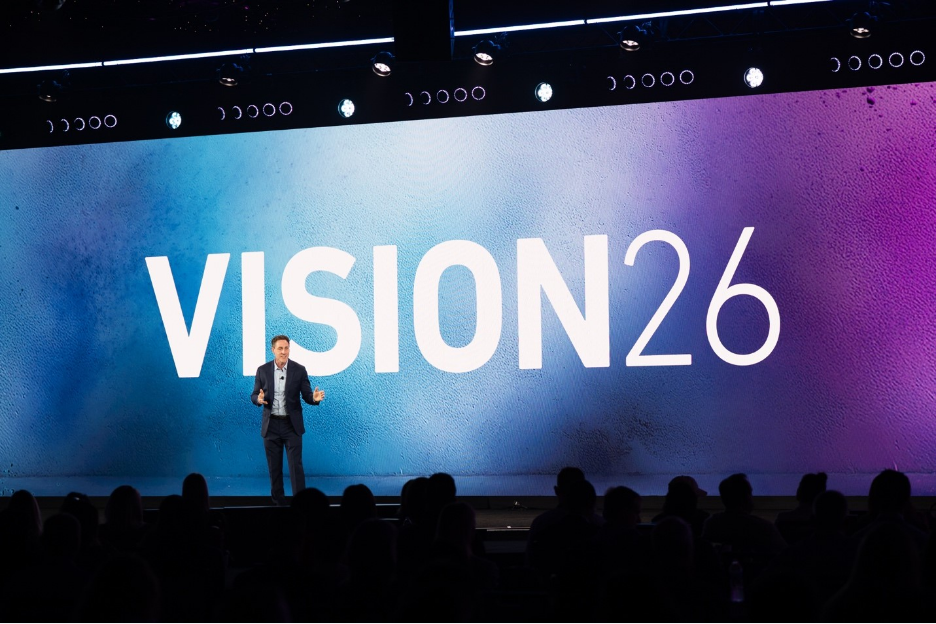
Jeff Softley, CEO of Experian North America, welcomes participants to Vision 2026.

Jeff Softley, CEO of Experian North America, welcomed attendees with a look at the growing importance of trust as AI becomes a more active participant in business and decision-making.

He announced Experian Cashflow Data Bureau, Inc, a new consumer reporting agency (CRA) that operates under the Fair Credit Reporting Act (FCRA), enabling financial institutions to leverage consumer-permissioned cash flow insights at scale to help support more informed underwriting decisions and responsibly expand access to credit.

Softley emphasized how trusted data, technology and connections can come together to create greater opportunity and meaningful outcomes for consumers and businesses. Reflecting on the growing role of AI agents, Softley explored how organizations can lead as intelligence becomes a more active participant in decision-making, emphasizing the importance of trust, scalability and accountability.

Softley also explored how connecting trusted data in new ways can help businesses make smarter decisions and create greater opportunities for consumers. His opening remarks set the stage for a day focused on embracing greater intelligence while maintaining the trust needed to turn possibility into meaningful outcomes.

Data isn’t scarce anymore. Trust is.

Jeff Softley, CEO of Experian North America

Designing Tomorrow: Molly Poppie and Kathleen Peters

Next, Molly Poppie, Chief Product & Analytics Officer, Experian North America, and Kathleen Peters, Chief Innovation Officer, Experian North America, took the stage for Designing Tomorrow.

They explored how trusted data, advanced analytics and seamless workflows can help organizations navigate an increasingly agentic world, make smarter decisions and drive resilient growth.
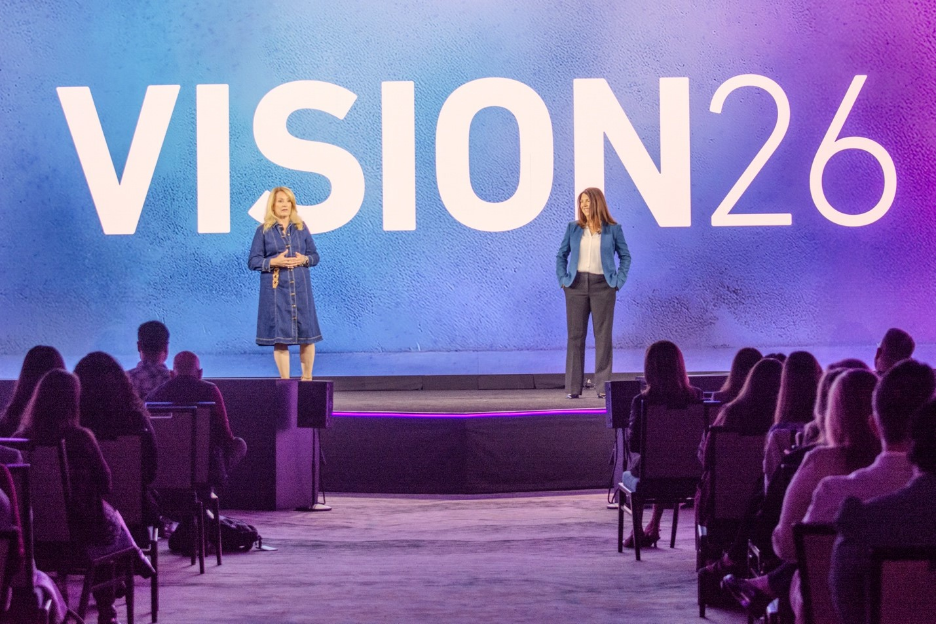
Vision 2026 speakers

Trust remained central to the conversation, particularly as AI agents become more prevalent. Poppie and Peters explored digital identity and human-to-agent connections, including how organizations can establish trust between an agent and the person behind it.

They also looked at how bringing together the right data, logic and technology can reduce guesswork, make interactions smarter and accelerate new capabilities. As disruption creates both risk and opportunity, organizations have an opportunity to design what comes next with trust built in from the start.

Day 1 keynote: A conversation with Ethan Mollick

Day one keynote speaker Ethan Mollick, Innovation Expert and Artificial Intelligence Thought Leader; Professor of Entrepreneurship at The Wharton School, explored the evolving relationship between people and AI.

Through live demonstrations, he examined how working effectively with AI calls for many of the same skills that make strong managers — providing direction, context and judgment while keeping people at the center.

As AI becomes increasingly capable, Mollick explored what it means to keep people involved in the process. The conversation reinforced the continued importance of human expertise and judgment even as AI takes on increasingly complex tasks.

From big ideas to practical action

Beyond the main stage, day one breakout sessions gave attendees the opportunity to dig deeper into some of the biggest questions facing businesses today.

Conversations explored practical AI roadmaps and trust frameworks for agentic ecosystems, new approaches to fraud prevention, and how better data and analytics can support smarter lending decisions.

Other sessions examined the growing role of nontraditional data in expanding credit access, fairness by design in AI underwriting, real-time prescreen, AI-powered connected intelligence and smarter approaches to pre-delinquency management.

Across topics, a common theme emerged: turning rapidly evolving technology, data and intelligence into practical strategies that can help organizations make smarter decisions and create better outcomes.

Innovation in action

Innovation was on full display in the Innovation Arena, with 27 demos bringing Experian’s latest capabilities to life and creating opportunities to connect directly with the experts behind them.

From AI-driven decisioning and fraud prevention to growth and operational resilience, the Arena offered a hands-on look at how emerging capabilities can help address real business challenges.

Connections beyond the conference floor

Hundreds of participants fill the conference halls serving as a backdrop to 27 demo stations.

After a full day of ideas and innovation, attendees stepped away from the conference floor for networking activities across San Antonio.

From exploring the city’s food scene and taking in the Alamo and River Walk to a pickleball showdown, Texas BBQ tour, golf at TPC San Antonio and more, attendees had the opportunity to continue conversations, meet new people and build connections with peers, industry leaders and Experian experts.

The afternoon offered a chance to turn conversations started inside the conference into connections that extend well beyond it — a defining part of the Vision experience

Celebrating innovation at Vision after dark

The connections continue tonight at Vision after dark, beginning with recognition of the 2026 Vision Award winners.

The Vision Awards celebrate organizations accelerating action and driving meaningful change, spotlighting the people and organizations putting innovation into practice. Then, renowned mentalist and magician Asi Wind takes the stage for an unforgettable performance filled with mystery, audience participation and unexpected moments.

It’s a fitting way to close a day centered on new ideas, unexpected perspectives and meaningful connections.

Up next: Day two

Day one may be over, but there’s plenty more ahead. Get ready for another day of big ideas, practical insights and memorable connections at Vision 2026.


Related Posts

2026 Retail Banking Identity and Fraud Report 

Learn how banks can convert rising fraud investment into protection customers recognize, value and feel in our recent report. Read more!

October 28, 2026 by Laura Burrows
One Platform, Fewer Handoffs, Faster Decisions

The average credit union manages between 100-300 vendor relationships, and nearly a third have no dedicated staff managing them. What was supposed to drive efficiency is stunting growth and compromising the member experience. Application volume is continuing to rise, and consumers expect a loan decision at digital speed. But for credit unions, meeting that expectation isn't the only goal. They must also continue to make the right lending decisions while also prioritizing risk management. The institutions pulling ahead aren't the ones with the most tools. They're the ones that have turned credit, fraud and decisioning into a single, coordinated system. A single loan decision touches: Credit data Identity verification Fraud signals Decisioning logic Reporting Rarely does all of that live in one place. More often, it’s stitched together across separate platforms, each with its own contract and its own support line. When a credit view and a fraud view are generated separately, they must be reconciled instead of read together in the same instant. Every handoff is a place where a decision slows down and a signal gets missed. It's why a fraud pattern that would be obvious next to the credit file often surfaces only after the funds are already gone. Fragmentation also makes it harder to optimize lending strategies over time. When data, analytics and decisioning are disconnected, credit unions have less visibility into what's working, what's changing and where strategies need to be adjusted. An integrated decisioning ecosystem closes those seams by design, with credit, fraud and lending strategy running on one platform and accessed through a single Application Programming Interface (API). Identity and compliance capabilities can be an integrated decisioning flow. The data doesn't need to be reconciled after the fact because it was never separated in the first place. Stop overengineering, start removing friction When decisioning underperforms, the instinct is to build something more custom: a proprietary model, tighter segmentation, more configuration.  Custom modeling has its place for institutions with the scale and data to justify it. But often, for small or mid-sized credit unions, the bigger opportunity is a flexible decisioning strategy that uses a strong, continuously refreshed model. This shouldn't be either/or. The right approach gives credit unions a strong decisioning strategy today, with the ability to introduce more customized analytics and modeling as their needs evolve.  The same principle applies to strategy management: credit unions can gain greater control through self-service capabilities as they build a more sophisticated data science team.   That kind of flexibility is important as credit unions modernize their decisioning infrastructure. Research surveying more than 2,000 senior credit risk and fraud decision-makers across 11 countries found that organizations investing in unified platforms and modern infrastructure are moving faster and realizing the greatest Return on Investment (ROI).   As their needs evolve, credit unions can adjust decisioning strategies without introducing another layer of technology or relying on third parties to make every change. Until self-service is the right fit, choose a partner that understands what makes your credit union’s membership and risk appetite different from others.  Same member, same afternoon, faster answer Consider a credit union growing its auto and personal loan originations.  A member applies for an auto loan on Saturday afternoon. Credit data, identity and fraud signals are read together in a single real-time pass instead of separate reviews:  Most applications resolve immediately, approved or declined based on a more comprehensive view of the applicant. A smaller number are flagged for quick step-up verification and cleared within minutes. Only genuinely ambiguous cases reach an underwriter, who is working from one complete picture instead of reconciling multiple signals. The member has an answer before the weekend is over. The credit union books the loan before competitors even open on Monday. Built to scale This kind of process holds up today. However, the better test is whether it holds up eighteen months from now when application volume has grown, new products are live and the data flowing through the system looks nothing like it does right now. Future-proofing isn't only about handling more volume. It's about having room to be nimbler and make adjustments as quickly as the market changes. A credit union that relies on standard models within a decisioning strategy may want more customized analytics and greater control over its strategies tomorrow. Connect with us With more than three decades of credit expertise and one of the industry's largest data footprints, Experian helps credit unions do more than solve this year's friction. We're helping to build a decisioning foundation that scales, so growth becomes something the system absorbs, rather than something it must be rebuilt around. Explore More

October 21, 2026 by Zohreen Ismail
Cash Flow Insights: Powering the Next Evolution in Lending

For decades, credit data has given lenders a trusted foundation for assessing risk. Now, consumer-permissioned cash flow data is adding another layer of insight into consumers’ financial lives, including income, spending, liquidity and changing financial obligations. The opportunity is significant. Nearly one in five consumers lacks access to or has damaged credit. New Experian research also shows that 60% of consumers who have previously been denied credit or received less favorable terms than expected believe the outcome would have been different if lenders had considered their recent income and banking activity alongside their credit history. 1,2 For lenders, cash flow insights can provide additional context about a consumer’s financial capacity and support more informed underwriting decisions. The next challenge is making those insights easier to use consistently and responsibly at scale. What are cash flow insights? Cash flow insights are derived from consumer-permissioned banking data and provide visibility into how money moves into and out of a consumer’s accounts. Depending on the information available, cash flow data can provide insight into financial behaviors such as: Income and income stability: Regular and irregular income streams and changes over time Spending and recurring expenses: Everyday spending patterns and ongoing financial obligations Account balances and liquidity: Available funds and changes in account balances Debt obligations: Loan payments and other recurring debt commitments Cash flow patterns: How money moves into and out of accounts over time Traditional credit information provides a rich history of how consumers have managed credit. Cash flow insights add context about their current financial activity and capacity, providing lenders with a more complete view of financial health. Cash flow insights can also add predictive value to risk assessment. Experian analysis shows Cashflow Score can deliver up to a 25% lift in predictive performance over conventional credit scores when tailored to targeted risk tiers.3 Cash flow data is having its moment In this Forbes article, Sandy Anderson, Experian's Executive Vice President of the Data Office and Operations, explains why more data alone isn’t enough — and what it takes to turn cash flow insights into trusted, actionable intelligence. Read the article How lenders can put cash flow insights to work at scale As interest in cash flow insights grows, the conversation is moving beyond what the data can reveal to how financial institutions can use it consistently and responsibly. That requires standardized consumer reporting, clear governance and decision-ready insights that can work within established lending processes. The launch of Experian Cashflow Data Bureau at Vision 2026 reflects this shift from access to adoption. The new consumer reporting agency operates under the Fair Credit Reporting Act (FCRA) and is designed to help financial institutions adopt consumer-permissioned cash flow insights at scale. A key part of that foundation is the cash flow consumer report, which organizes consumer-permissioned banking information into a standardized consumer report regulated under the FCRA. This gives lenders a consistent foundation for incorporating cash flow information into lending decisions while providing consumers with access to the information in their report. Watch this video to see how Experian Cashflow Solutions turns consumer-permissioned cash flow data into decision-ready attributes, scores and custom analytics, backed by bureau-grade governance. Turning greater visibility into better decisions The next evolution in credit isn’t about choosing between traditional credit and cash flow data. Each provides a different perspective. Traditional credit information offers deep insight into how consumers have managed credit over time. Cash flow insights can add context about financial activity and capacity. Bringing those perspectives together can give lenders greater visibility into consumers’ financial health and help them better distinguish between risk and resilience, support more informed decisions and identify opportunities to responsibly expand access to credit. As cash flow adoption continues to grow, its value will come from how effectively it complements the information lenders already use. The opportunity isn't simply to see more data. It's to turn that additional visibility into smarter, more informed decisions. Explore how Experian Cashflow Data Bureau is helping financial institutions put consumer-permissioned cash flow insights into practice at scale. Learn more [1] Federal Reserve Bank of New York, The Market for Credit Building: Demand, Product Characteristics and Consumer Uses, 2026. [2] Experian commissioned Atomik Research to conduct an online survey of 2,000 U.S. adults age 18+. Fieldwork took place July 16–21, 2026. Margin of error: +/- 2.2 percentage points at a 95% confidence level. [3] Based on Experian analysis when Cashflow Score is compared with conventional credit scores, tailored to targeted risk tiers. Predictability based on KS.

October 14, 2026 by Julie Lee

Subscribe to our Newsletter

Enter your name and email for the latest updates.

This site is protected by reCAPTCHA and the Google Privacy Policy and Terms of Service apply.

Subscribe to our Newsletter

Don't miss out on the latest industry trends and insights!
Subscribe