
Housing

Experian's annual thought leadership conference will be held May 5-8 in San Antonio Texas, and will feature 50+ sessions on the industry's latest trends.

An Experian study revealed 86% of millennials believe that buying a house is a good financial investment - they just don't have the credit scores they need.

Recent research shows Hispanics—especially Millennials who are entering their home-buying years—are particularly eager for homeownership.

Underwriting a sizeable loan can take weeks with the task of collecting income and asset documents to analyze and verify. Understand how verification solutions are easing the pains in the complex mortgage process.

The economic expansion just passed the eight-year mark, and consumer credit defaults across mortgages, bankcards and auto loans are at pre–financial crisis levels

Study noted that travelers relied heavily on credit for vacation purchases last yr—with many planning to charge much of their vacation expenses this summer

Experian took a deep dive into the data and performance surrounding the credit union universe in their first-ever “State of Credit Unions” report, featuring insights utilizing data from both 2015 and 2017.
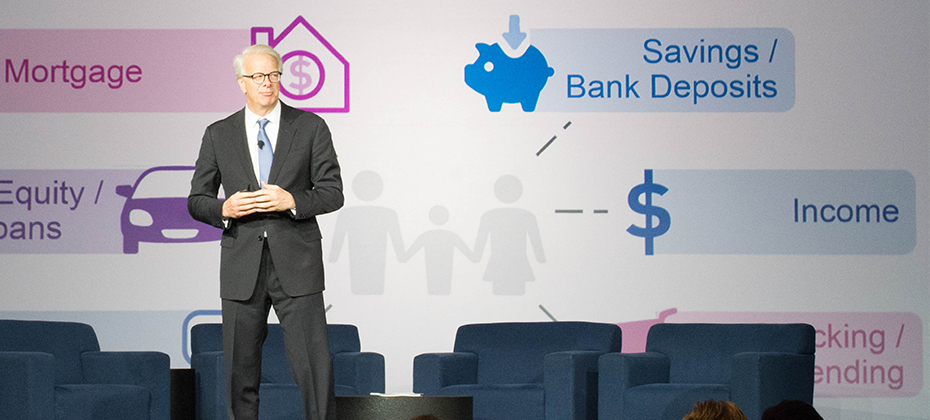
So many insights and learnings to report after the first full day of 2017 Vision sessions. From the musings shared by tech engineer and pioneer Steve Wozniak, to a panel of technology thought leaders, to countless breakout sessions on a wide array of business topics … here’s a look at our top 10 from the day. A mortgage process for the digital age. At last. In his opening remarks, Experian President of Credit Services Alex Lintner asked the audience to imagine a world when applying for a mortgage simply required a few clicks or swipes. Instead of being sent home to collect a hundred pieces of paper to verify employment, income and assets, a consumer could click on a link and provide a few credentials to verify everything digitally. Finally, lenders can make this a reality, and soon it will be the only way consumers expect to go through the mortgage process. The global and U.S. economies are stable. In fact, they are strong. As Experian Vice President of Analytics Michele Raneri notes, “the fundamentals and technicals look really solid across the countries.” While many were worried a year ago that Brexit would turn the economy upside down, it appears everything is good. Consumer confidence is high. The Dow Jones Index is high. The U.S. unemployment rate is at 4.7%. Home prices are up year-over-year. While there has been a great deal of change in the world – politically and beyond – the economy is holding strong. The rise of the micropreneur. This term is not officially in the dictionary … but it will be. What is it? A micropreneur is a business with 0 to 4 employees bringing in no more than $200k in annual revenue. But the real story is that numbers show microbusiness are improving on many fronts when it comes to contribution to the economy and overall performance compared to other small businesses. Keep an eye on these budding business people. Fraud is running fierce. Synthetic identity losses are estimated in the hundreds of millions annually, with 50% year-over year growth. Criminals are now trying to use credit cleaners to get tradelines removed from used Synthetic IDs. Oh, and it is essential for businesses to ready themselves for “Dark Web” threats. Experts advise to harden your defenses (and play offense) to keep pace with the criminal underground. As soon as you think you’ve protected everything, the criminals will find a gap. The cloud is cool and so are APIs. A panel of thought leaders took to the main stage to discuss the latest trends in tech. Experian Global CIO Barry Libenson said, “The cloud has changed the way we deliver services to our customers and clients, making it seamless and elastic.” Combine that with API, and the goal is to ultimately make all Experian data available to its customers. Experian President of Decision Analytics Steve Platt added, “We are enabling you to tap into what you need, when you need it.” No need to “rip and replace” all your tech. Expect more regulation – and less. A panel of regulatory experts addressed the fast-changing regulatory environment. With the new Trump administration settling in, and calls for change to Dodd-Frank and the Consumer Financial Protection Bureau (CFPB), it’s too soon to tell what will unfold in 2017. CFPB Director Richard Cordray may be making a run for governor of Ohio, so he could be transitioning out sooner than the scheduled close of his July 2018 term. The auto market continues to cruise. Experian’s auto expert, Malinda Zabritski, revealed the latest and greatest stats pertaining to the auto market. A few numbers to blow your mind … U.S. passenger cars and light trucks surpassed 17 million units for the second consecutive year Most new vehicle buyers in the U.S. are 45 years of age or older Crossover and sport utility vehicles remain popular, accounting for 40% of the market in 2016 – this is also driving up finance payments since these vehicles are more expensive. There are signs the auto market is beginning to soften, but interest rates are still low, and leasing is hot. Defining alternative data. As more in the industry discuss the need for alternative data to decision, it often gets labeled as something radical. But in reality, alternative data should be simple. Experian Sr. Director of Government Affairs Liz Oesterle defined it as “getting more financial data in the system that is predicted, validated and can be disputed.” #DeathtoPasswords – could it be a reality? It’s no secret we live in a digital world where we are increasingly relying on apps and websites to manage our lives, but let’s throw out some numbers to quantify the shift. In 2013, the average U.S. consumer had 26 online accounts. By 2015, that number increased to 118 online accounts. By 2020, the average person will have 207 online accounts. When you think about this number, and the passwords associated with these accounts, it is clear a change needs to be made to managing our lives online. Experian Vice President David Britton addressed his session, introducing the concept of creating an “ultimate consumer identity profile,” where multi-source data will be brought together to identify someone. It’s coming, and all of us managing dozens of passwords can’t wait. “The Woz.” I guess you needed to be there, but let’s just say he was honest, opinionated and notes that while he loves tech, he loves it even more when it enables us to live in the “human world.” Too much wonderful content to share, but more to come tomorrow …

Average mortgage rate was >4% at the end of Q1 with mortgage originations nearly $450 billion—a 5% increase over the $427 billion a year earlier.

It was two years ago when I found myself sitting cross-legged on my home office floor, papers strewn about as I organized piles of tax returns, W-2s, pay stubs, 401k and bank statements, and previous escrow docs. My task? Sort through it all, scan them (if I couldn’t access them digitally) and then upload/email them to a site for my mortgage broker to print and package for my refinance application. For a girl accustomed to Amazon Prime, mobile banking, social media and smart TVs, this monumental financial task seemed utterly archaic – even in 2015. Fast forward two years later, and the mortgage space has failed to make much progress. Clearly, the financial meltdown and Great Recession placed more regulation and compliance stresses on financial institutions. Verification steps and requirements needed to be strengthened – and that made sense. We want to make sure people are capable of paying for those sizable mortgage payments, right? Even now, I get flashbacks to scenes from The Big Short. Still, the hunt for paper, the endless scanning, the emailing, the document uploads required? In an era where the smartphone rules, how has the mortgage industry failed to evolve in the digital age? It’s no secret the financial services industry is typically slow to adopt the latest in technology advancements, but consumers are pushing. A 2016 Accenture survey reveals online banking is now the top choice of consumers at 28%, followed by branch banking at 24%. In the mobile banking space, there has additionally been a significant increase. From 2011 to 2015, mobile banking doubled (22% to 43%) and rose from 43% to 53% for smartphone users in particular. But what about mortgage? Finally, it seems, shifts are underway. In a recent Oliver Wyman paper titled Digital Mortgage Nirvana, the authors state, “Gone are the days when the only way to properly underwrite a mortgage was with long application forms and tall stacks of documents.” Once easy to carry in one hand, the average mortgage application file has ballooned to 500 pages, according to David Stevens, CEO of the Mortgage Bankers Association. And while the application may not shrink, portions of the application process can be digitized and automated. Today, lenders have the ability to partner with data aggregators to verify a consumer’s assets and income with online solutions. In fact, lenders can take this a step further, feeding the data into their automated decision engines, providing the consumer with an approval, decline or conditions that must be met in order to clear the loan process. Nonbanks have been picking off business and disrupting the onerous mortgage process for the past several years. Think Quicken, LoanDepot and GuaranteedRate. But all mortgage lenders have the ability to speed up consumer verification and decisioning by partnering with data aggregators and leveraging solutions like Experian’s digital verification suite. Are we talking a one-click shopping experience? No. This is a mortgage after all, not your average online purchase. But banks now have the opportunity to dramatically enhance the mortgage experience for consumers. The question is whether they are ready to finally embrace a digital journey in the mortgage space in 2017, or will they let another year pass them by?

Divorce often affects financial health negatively. It’s expensive – often causing nearly $20,000 in losses.

the amount of time it’s taking for automotive loans opened in Q4 2015 to become delinquent is actually similar to the pace in 2008.

2017 is expected to bring some big changes. But what do those changes mean for the financial services space? Here are 3 trends and twists Experian expects to occur over the next 12 months:

For members of the U.S. military, relocating often, returning home following a lengthy deployment and living with uncertainty isn’t easy. It can take an emotional and financial toll, and many are unprepared for their economic reality after they separate from the military. As we honor those who have served our country this Veterans Day, we are highlighting some of the special financial benefits and safeguards available to help veterans. Housing Help One of the best benefits offered to service members is the Veteran’s Administration (VA) home-loan program. Loan rates are competitive, and the VA guarantees up to 25 percent of the payment on the loan, making it one of the only ways available to buy a home with no down payment and no private mortgage insurance. Debt Relief Having a VA loan qualifies military members for a Military Debt Consolidation Loan (MDCL) that can help with overcoming financial difficulties. The MDCL is similar to a debt consolidation loan: take out one loan to pay off all unsecured debts, such as credit cards, medical bills and payday loans, and make a single payment to one lender. The advantage of a MDCL? Paying a lower interest rate and closing costs than civilians and far less interest than paying the same bills with credit cards. These refinancing loans can be spread out over 10, 15 and sometimes 30 years. Education Benefits The GI Bill is arguably the best benefit for veterans and members of the armed forces. It helps service members pay for higher education for themselves and their dependents, and is one of the top reasons people enlist. Eligible service members receive up to 36 months of education benefits, based on the type of training, length of service, college fund availability and whether he or she contributed to a buy-up program while on active duty. Benefits last up to 10 years, but the time limit may be extended. Saving & Investing Money According to the Department of Defense’s annual Demographics Report, 87 percent of military families contribute to a retirement account. Service members who participated in the Thrift Savings Plan, however, are often unaware of their options after they separate from service, and many don’t realize the advantages of rolling their plans into an IRA or retirement plan of a new employer. Safeguarding Identity Everyone is a potential identity theft target, but military personnel and veterans are particularly vulnerable. Routinely reviewing a credit report is one way to detect a breach. The Attorney General's Office provides general information about what steps to take to recover from identify theft or fraud. Today is a great time to consider ways to support your veteran and active military consumers. They are deserving of our support and recognition not just today but continuously. Learn more about services for veterans and active military to understand the varying protections, and how financial institutions can best support military credit consumers and their families.

Will they still aspire to achieve the “American Dream” of education, homeownership and raising a family? Are Millennials ready for a mortgage?